Sam Altman (CEO of OpenAI):
"You no longer need to write prompts."
In just 38 minutes, he explains how to use ChatGPT at a level that most people can't even imagine.
It's a talk he gave to Stanford students. A friend sent me the recording last night.
After watching it, I realized I was only taking advantage of about 15% of what this tool can really do.
Watch it in full and then read the guide I leave below on how to create a system that prompts itself.
Hoy contratar a Tony Robbins cuesta 1 millón de dólares por un solo día.
Esto es una cinta de 21 minutos grabada en su propia casa hace más de 30 años.
Ahí explica exactamente cómo lograr que cualquiera diga que sí.
El mismo material por el que ahora cobran fortuna… completamente gratis.
Es una grabación rara e sin filtros, de la época en que todavía no cobraba a multimillonarios solo por estar en la misma habitación.
Cuando alguien dice que no, da dos excusas:
“No tengo tiempo” o “No tengo dinero”
Ninguna es verdad.
La verdadera razón es que todavía no cree que valga la pena.
No es un problema de dinero. Es un problema de estado.
Tony enseña algo que llama “atacar y confesar”
En lugar de discutir la objeción, confiesas la tuya propia:
“Yo tuve la oportunidad de ir hace seis meses y no fui hasta hace dos.
No puedo ni imaginar el tiempo que perdí”
La sala se queda en silencio. Nadie discute.
Después mete a la persona en el “tren del sí”
Cada pequeño sí se suma al siguiente.
Hasta que decir que no al final se siente más difícil que decir que sí.
Cuando llega el momento de firmar, la persona ya ha aceptado cinco veces sin darse cuenta.
Solo 21 minutos.
Ahí aprendes las dos únicas jugadas por las que la gente paga 1 millón al día:
cómo leer el estado de cualquiera… y cómo moverlo.
La mayoría se pasa años adivinando en ventas.
Él lo escribió en un flipchart de su sala de estar en menos de media hora.
Un asiento en esa habitación costaba $125 dólares.
Hoy cuesta $1 millón de dólares al día estar frente a él.
La cinta está gratis ahora mismo.
Y la respuesta está en este video.
"Don't speak negatively about yourself, even as a joke. Your body doesn't know the difference. Words are energy and they cast spells, that's why it's called spelling. Change the way you speak about yourself, and you can change your life."
Bruce Lee!!!
Written feedback can be valuable. But its impact is not measured by how much we write, it is measured by what students do next.
Before adding comments to a piece of work, it is worth asking:
→ Will the student read them?
→ Will they understand them?
→ Will they have time to act on them?
Blog by @KateJones_teach exploring when written feedback is worth the investment and shares two practical, workload-conscious approaches.
Read it here
https://t.co/HepEBc5PRo
Ten million people have watched an MIT professor accidentally destroy the executive coaching industry.
He filmed the lecture once in January 2018 and died eighteen months later.
Executive coaches charge fifteen thousand dollars a session to teach a third of what he covered in one hour for free.
His name was Patrick Winston. He ran the MIT Artificial Intelligence Laboratory from 1972 to 1997 and wrote the AI textbook every computer science major in the world read for thirty years.
Every January for four decades, he gave a lecture called "How to Speak."
His entire framework fits on a napkin.
Do not read. Be in the image. Keep images simple. Eliminate clutter. Start with an empathetic connection. End with a punch line the audience can repeat over dinner. Never open with a joke. Never end with "thank you."
That last rule alone has probably cost the executive coaching industry a hundred million dollars.
"Your success in life will be determined largely by your ability to speak, your ability to write, and the quality of your ideas. In that order."
That is the actual opening line of the lecture. Winston believed it strongly enough to spend fifty years teaching computer scientists how to talk.
Founders spend $80,000 on an MBA and then hire a communications coach to teach them the same material Winston filmed once for free. Engineers write brilliant code and lose promotions to teammates who watched this lecture on the train.
The lecture is free on MIT OpenCourseWare. The textbook is free on his page.
Winston died in 2019. Almost none of the ten million viewers have actually implemented the four rules on the napkin.
The napkin is free. The willingness to actually use it in your next meeting is the entire edge.
Are you seeing posts about the science of learning, and looking for an introduction you can use with your students?
Powerpoints and notes are free to download here for MS or HS students.
+ 5 minute video to give them a super useful model of learning.
https://t.co/xSAcm0qBlZ
I’m loving my updated “How Learning Happens” knowledge organizer.
Yes, I spend the first couple of days of the school year teaching students the basics of human cognitive architecture. It gives them the lens through which they’ll understand why I teach the way I do and the foundational principles behind our procedures, routines, and instructional practices. Some people will probably be annoyed by that. Let’s all be cool about it, OK?
INSTEAD OF WATCHING AN HOUR OF NETFLIX TONIGHT.
This 60-minute Cambridge lecture by Demis Hassabis will teach you more about the future of AI than most people will learn in the next 5 years.
Bookmark it and give it an hour, no matter what.
"Setting a “Do-Now” for students is hardly a new strategy.
I remember experiencing them as a student, both in primary and secondary school.
When I went through my initial teacher training, in a context and time when “hooks” were seen as a necessary component of a lesson plan, setting a “Do-Now” was considered an easy way to captivate students’ attention and pique their interest in the lesson.
So what are they, and why do we use “Do-Now” tasks?"
Blog by CJ Rauch 👇
https://t.co/gSkL2TVUG7
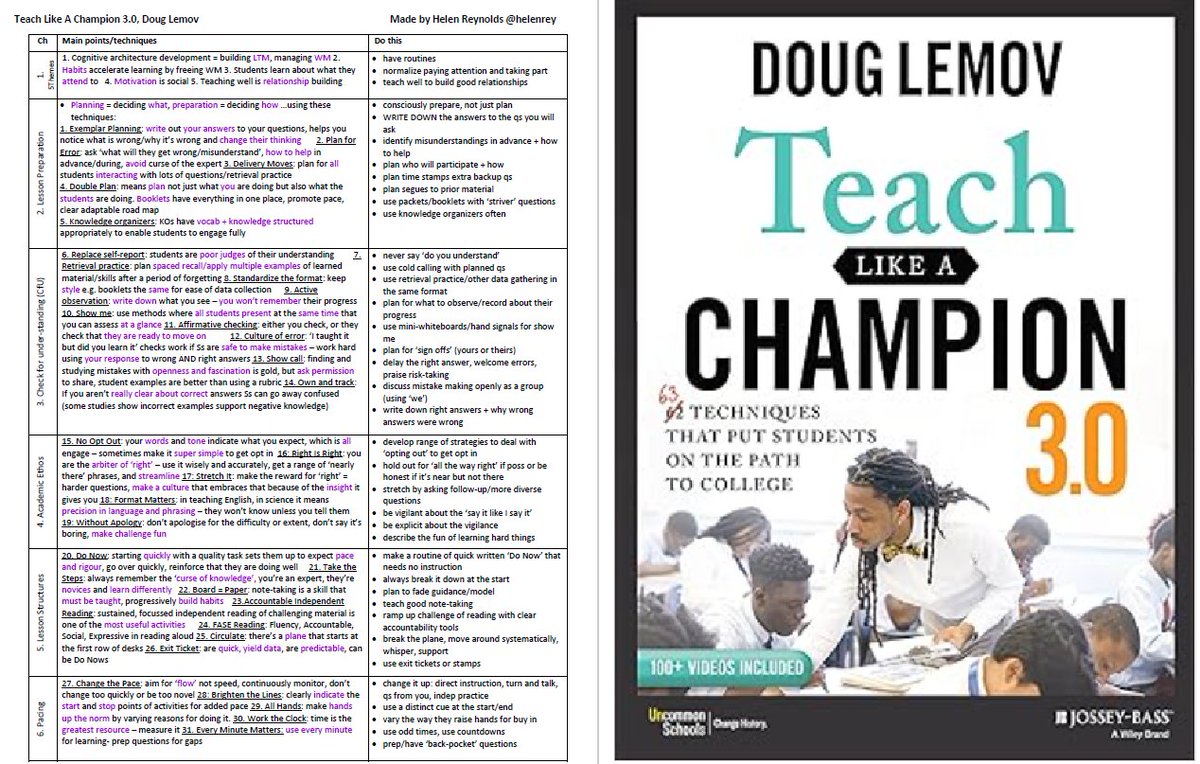
@katie_a_baker@TeachLikeAChamp@Doug_Lemov Fantastic.... if you're interested there's a summary here - and a version with a blank column for you to fill in!
https://t.co/0mqa9dPe98
The engineer who built Claude Code just dropped a 28-minute video on how to write prompts that actually work.
I've seen $300 courses that don't cover what he shows in the first 10 minutes.
CLAUDE.md files, memory shortcuts, parallel sessions, prompting patterns.
Watch it, then read the guide below on the Claude features 99% of users never find.
👑 If you're taking a road trip this summer, here are the essential Queen songs you need on your playlist! Which songs are you adding to yours?
https://t.co/ucCTJpr4ya ⏯️