陶哲轩前几天去哈佛做了一场讲座,名义上是宣传他刚出的科普新书《Six Math Essentials》,结果开场没两分钟,他就把新书晾在一边,直接聊起了当下数学界最让人焦虑的话题:数学正在从延续了几千年的“1.0 时代”,强行升级到“2.0 时代”。
他自己写这本新书的初衷其实挺逗的,纯粹是受够了在派对上跟人寒暄——每次别人问他是干嘛的,他一说“我是数学家”,空气要么瞬间凝固,要么对方立刻接一句“哎呀我上学时数学最差了”。为了以后聊天不冷场,他才跟编辑对着录音棚聊出这么一本没啥公式的书。
可真坐到台前,大家最关心的还是 AI 把数学圈搅成什么样了。陶哲轩点破了一个特别反直觉的事实:数学对人类来说是最烧脑的学科,但对现代机器学习而言,几乎是量身定制的游乐场——没有现实世界乱七八糟的隐私和法律包袱,数据干净,对错还能由电脑一秒钟客观验证。这就造就了当下 AI 极其“参差不齐”的怪象:它能轻松搞定研究生级别的数学证明,在某些方向上强得像外星人,可你真让它打电话去跟真人前台订间酒店,它能当场卡壳。
外面社交媒体天天刷屏说“AI 攻克了所有数学难题”,陶哲轩顺手戳破了这层滤镜。社交网络有极强的幸存者偏差,比如大家都在传 OpenAI 一口气解出了 300 道重要数学题,却没人提它背后一共试了 4000 道,成功率其实只有 9%——剩下那三千多次翻车,根本没人发推。
但在他看来,真正让数学界感到危机四伏的,还不是 AI 偶尔算错,而是人类社会正在从延续了数千年的“证明稀缺时代”,一夜间跌进了“证明泛滥时代”。
以前证明一道题太难了,所以“能解出题”天然等价于“真正懂了数学”,能写教材、能带学生、能建立直觉。可现在证明变得廉价了,AI 动辄甩出几十页人类根本看不懂的冗长推导,甚至连在电脑前敲提示词的人自己都不知道题目在说什么。如果只是纯数学游戏,看不懂顶多算没乐趣;但陶哲轩警告,一旦把这套逻辑搬进气象预测、金融系统、空中交通管制这些应用数学领域,麻烦就大了——过去防止数学模型在现实世界里跑偏的最后一道刹车,正是人类科学家对模型边界的深刻理解。如果以后全靠 AI 算、人却越来越不懂,这道刹车迟早会失灵。
那“数学 2.0”到底该怎么走?陶哲轩给出的方向特别有意思。一方面,是把一向靠纸笔单打独斗的纯理论数学,变成一门实验科学——既然有了 AI 这个超级苦力,就别再像过去看病那样一次只死磕一个病例,而是直接把几百万个问题扫一遍,画出整片领域的难度地形图。他自己前阵子就带着人和机器联手,把泛代数里的 2200 万个命题全过了一遍,最近还在用类似“寻宝游戏”的方式众包攻克 24 次以上的逆伽罗瓦问题。
另一方面,则是硬把 AI 拉回“增强人类理解”的轨道上。他举了加州理工学院刚办完的一场“数学马拉松”:一百支队伍不比谁能用 AI 瞎猫碰死耗子解出新题,而是专门挑那些已经被 AI 证出来、但写得像天书一样晦涩的结果,比赛谁能把它改写得最简洁、最直观,甚至做成动画演示,让人类大脑真正看懂。至于学术圈的评价体系也得跟着变,以后招人面试,光看简历上挂着几篇漂亮论文已经没用了,必须拉到黑板前,不准放 PPT,实打实地一问一答,看你脑子里到底有没有真货。
整场对话最让人会心一笑的,还是他和主持人聊起“人类到底是怎么思考数学的”。陶哲轩说,人类进化压根没在大脑里留出专门的“数学中枢”,每个能把数学学下去的人,都是在强行征用大脑的其他功能区——有人靠视觉,有人靠语言符号,而他自己极度依赖肢体和物理直觉,连讲数学都忍不住手舞足蹈。他自曝三十岁左右有一次去姑妈家做客,被一个高维向量场的几何变换彻底卡住了,脑子里怎么都想象不出来,最后急得直接躺在地板上闭上眼睛,一边满地打滚一边把自己想象成那个向量场。正滚得起劲,姑妈推门进来了,盯着地上的他看了两秒,一句话没说又默默退了出去,俩人这辈子再也没提过这事。
临结束有学生问他,面对来势汹汹的 AI 工具,年轻一代到底该怎么用、怎么防?陶哲轩用了一个“两个桶”的比喻:你得把人生中要做的事分成两类,一类是“为了把活干完、丢了也不可惜的技能”,另一类是“你死活要留给自己的核心能力”。你可以随时把第一个桶里的东西扔进第二个桶交给 AI,但记住,一旦交出去,这辈子基本就再也捡不回来了。他自己现在已经彻底把写 Python、JavaScript 代码和查文献扔进了 AI 的桶里,唯独写 Lean 形式化验证和最核心的数学推演,他依然坚持亲手一点点去算——那是他无论如何都不肯让渡给机器的自留地。
I have used AI to translate Iranian Martyr Ali Larijani's book "The Mathematical Method in Kant's Philosophy" from Farsi to English.
The original and translated PDFs are on my GitHub:
https://t.co/mNckqEePXw
I haven't watched TV in years, and I rarely watch Netflix anymore. I've found a certain kind of peace in studying mathematics. In the evening, when everyone is asleep and I can finally set the day's thoughts aside, I like to open a book and study.
It's stimulating and, in its own way, relaxing. I know far more mathematics today than I did back when I actually needed it for my studies. Maybe none of this will ever be particularly useful. But it makes me feel good, and that's something.
And as long as it does, I'll keep studying.
🇮🇷 Iranian Discombobulator!
Anthony Aguilar noticed something unusual about the way US Central Command described its latest strikes on Iran.
Normally, when CENTCOM reports striking a target on Qeshm Island, Bandar Abbas, Jask, or Sarik, its statements are quite specific. They refer to a missile launcher or a missile.
This time, however, CENTCOM used a different word: "device."
That caught Aguilar's attention. In military reporting, words matter, particularly when describing battle damage. If the target was a missile launcher, why not call it one? If it was a missile, why not say so? What exactly had the US military struck?
Aguilar believes the answer may lie in a capability Iran has been developing.
Iran operates small submarines, including the Ghadir and Fatah classes, under a shared area of responsibility between the Islamic Revolutionary Guard Corps (IRGC) and the Iranian Navy. These submarines are much smaller than those operated by the United States, Israel, or NATO countries. But their size does not make them insignificant. They can carry ballistic missiles.
Operating these submarines throughout the Strait of Hormuz presents challenges. The narrow waterway is crowded with ships, mines, and US surveillance drones, leaving limited room to maneuver or remain concealed.
But the submarines offer Iran something else: a ballistic missile capability.
According to Aguilar, Iran has adapted that capability for use on land. Rather than relying on the submarines themselves to launch the missiles, Iran has modified the launch systems so they can operate from mobile land-based platforms.
He points to Russian equipment, including older K10 systems associated with the S-400 family, as part of the technology involved in these modifications. The idea is to adapt existing components so missiles can be launched through tube-based systems rather than conventional launch rails.
The result is a different way of deploying a capability Iran already possesses.
Aguilar says the missiles involved are JK-2 ballistic missiles, associated with the coastal port city of Jask. Iran originally configured these missiles for its Ghadir and Fatah mini-submarines.
Now, he believes Iran has adapted the same technology for mobile land-based use.
That may explain why the recent US strikes have attracted his attention.
When American forces struck targets on Qeshm Island, the objects visible in the available imagery appeared to resemble missile systems. But they did not look like conventional missile launchers.
And that brings us back to CENTCOM's choice of words.
Rather than identifying the targets as missiles or launchers, the US military described them as devices.
Aguilar's interpretation is that the United States may be encountering a configuration it has not previously seen in this form.
The technology itself is not necessarily new. Iran has combined existing systems and modified their configuration to create a different operational capability.
As Aguilar explains, it is like taking parts from an old Toyota and an old Nissan and combining them to build something that has never existed in quite that form before.
The underlying capability remains the same. The way it is deployed has changed.
And that could be what makes Iran's latest missile configuration particularly significant.
The Navier–Stokes equations wouldn’t exist for a galaxy-scale intelligence. Our model of reality and our laws of physics come from our limitations as the observer. Take water, for example. When we look at it, we see the properties of a continuous fluid: density, momentum, energy, temperature, and pressure. These properties come with the fact that we can’t see individual molecules. But a galaxy-scale intelligence with the capacity to track the trajectory of every molecule wouldn’t understand the properties of water that we are talking about. That is why it wouldn’t come up with the Navier–Stokes equations.
Even though a Superintelligence would understand humans very well (since it was initially trained on human data), it would have a very different construct of reality. The question is: what would that construct be? More importantly, would we be able to understand each other?
Watch the full interview with Jonathan Gorard here 👇
https://t.co/uhOdoiaK1S
🧵 Video Thread
A rare collection of videos of Imam Musa Sadr, his speeches (In Arabic and Farsi), his family, and related matters 👇
(most of them are very original)
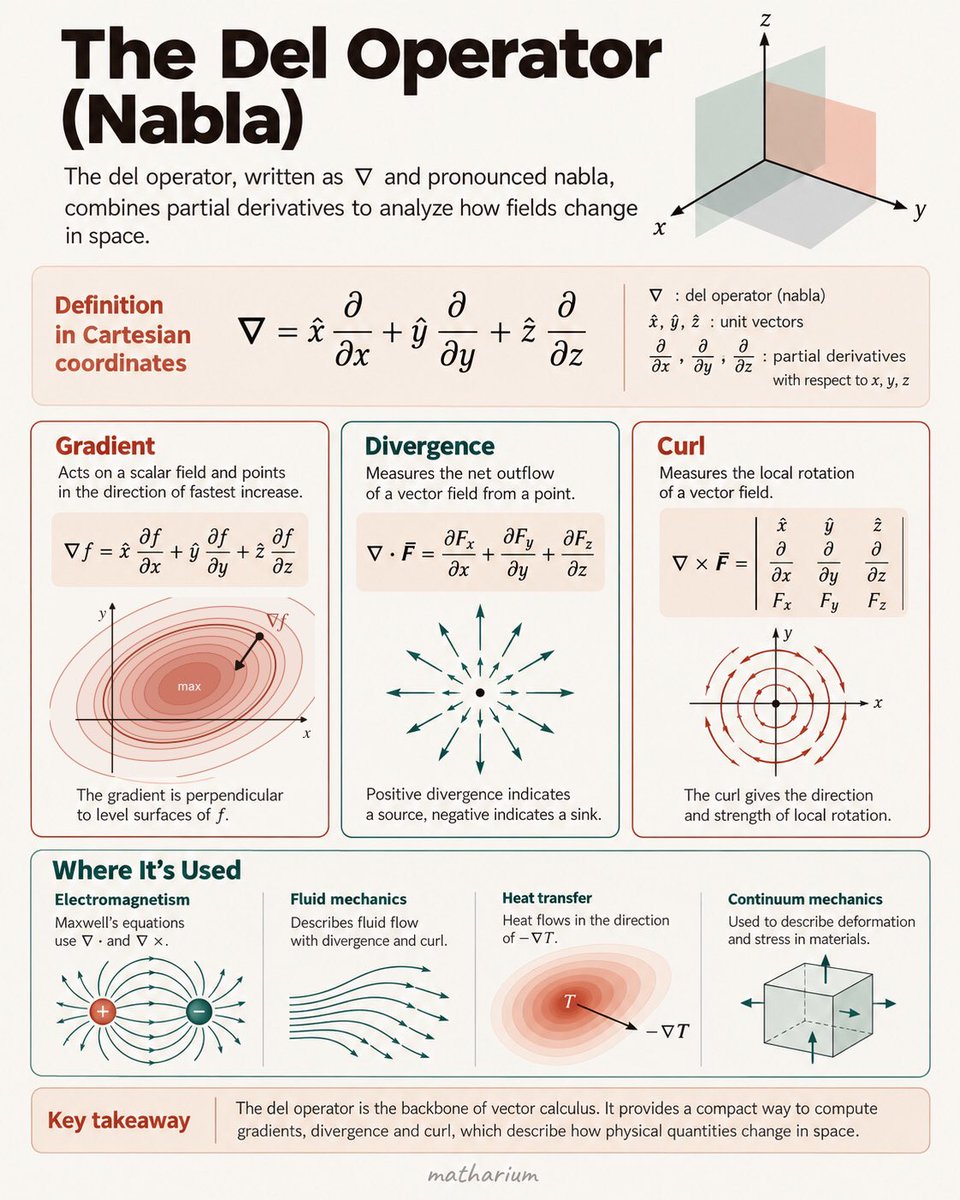
One symbol, ∇, generates the main operations of vector calculus. In Cartesian coordinates it is the vector of partial derivatives î ∂/∂x + ĵ ∂/∂y + k̂ ∂/∂z.
Applied to a scalar f, ∇f is the gradient, pointing in the direction of fastest increase and perpendicular to level surfaces. The dot product ∇ · v is the divergence, the net outflow per unit volume: positive at a source, negative at a sink. The cross product ∇ × v is the curl, which measures local rotation, and ∇²f = ∇ · ∇f is the Laplacian.
William Rowan Hamilton introduced the symbol in the 1840s. Maxwell's equations, fluid dynamics and heat flow are all written with these four operators.
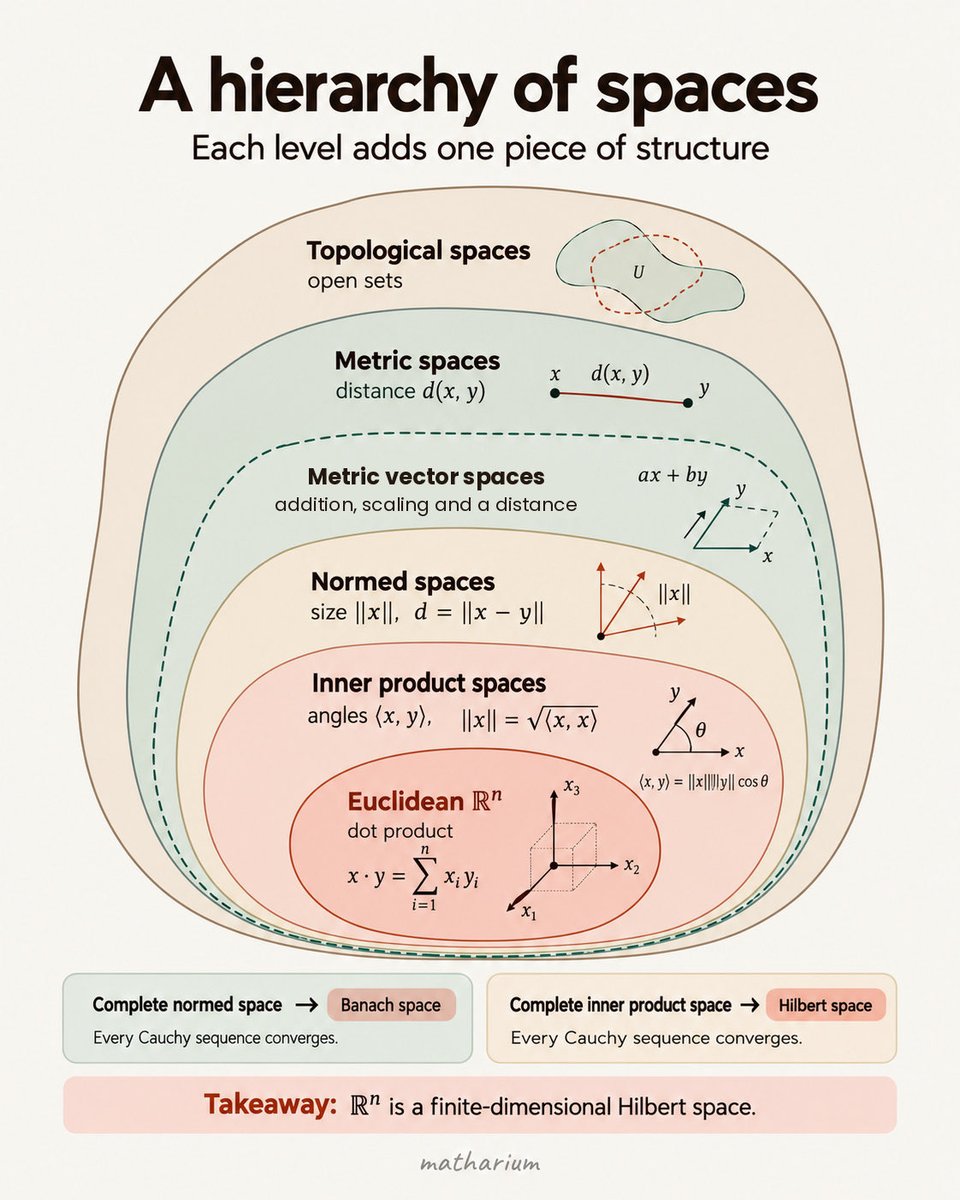
Every inner product space is normed, every normed space is metric, and every metric space is topological. Each level adds one piece of structure.
A topology says which sets are open. A metric adds a distance, a norm adds size with d = ‖x − y‖, and an inner product adds angles with ‖x‖ = √⟨x, x⟩.
Completeness gives the named classes: a complete normed space is a Banach space, a complete inner product space is a Hilbert space, and ℝⁿ with the dot product is a finite-dimensional Hilbert space.