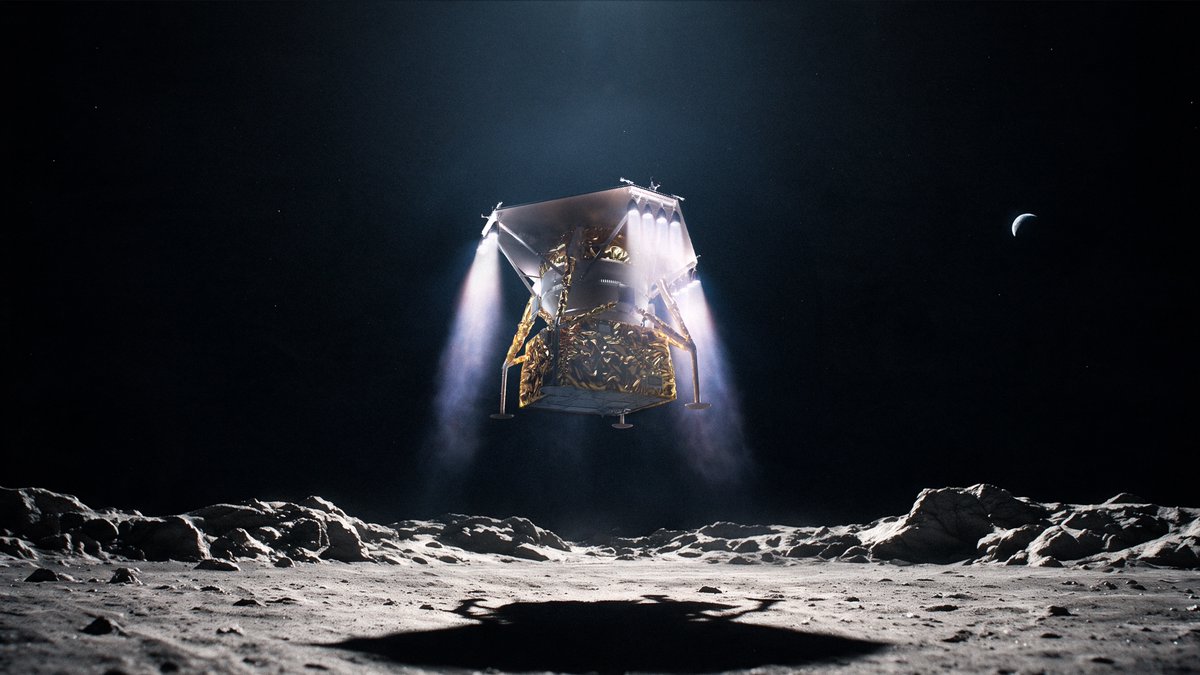
Ad lunam Impulse! 🚀
We are proud to announce that @NASA has awarded Impulse two missions as part of its Moon Base program, an ambitious effort to establish humanity’s first permanent lunar outpost.
For decades, the Moon has been a place we’ve visited. Now, Impulse is delivering the transportation to make it a place we can call home.
Read more: https://t.co/N6FfEDuN07
@TurbulentSphere@ThePrimalDino I don't go that far. It isn't that nothing is new. We are not at the end of technology.
But aerospace in particular has had generations for people to think of and propose what to do without humanity delivering on almost any of it. There's a massive execution backlog.
@BellikOzan@puppy_kirk@KenKirtland17 It's definitely happening right now.
I don't have a ton of confidence in the near term that any of the launch providers can scale up to match the demand, let alone doing so cost comparable to Falcon. Lots of business cases fall apart if you're paying significantly more.
@T33K3SS3LCH3N@brickett24 If large steerable mirrors work they're extremely easy to abuse for offensive purposes both against ground and space targets.
That's really the only reason to invest in this company. If it works even if it's not economical the DoD is an obvious customer pivot.
@T33K3SS3LCH3N@brickett24 They could be a piece of the puzzle, but I don't buy the economics or the technical readiness. Steerable space mirrors are a huge challenge. So far the flown missions have been largely failures even at small scale.
My bigger take is that this has to be treated as a weapon system
@T33K3SS3LCH3N@brickett24 I'm not a space based solar guy overall, but that's why the thesis there is to use microwave band to beam power. You take some fixed losses, but it's invariant to weather.
Mirror based has to be so much cheaper to deploy the scale that even with bad weather it wins.
@T33K3SS3LCH3N@brickett24 Duck curve problem is already solved more cost effectively with building more terrestrial solar and/or batteries. Solar prices and scale have improved so fast that is an outdated debate.
It could help with higher latitudes. It's still prone to weather losses.
@BellikOzan The thesis is right. 2x in 8 years for GM isn't bad and Tesla has always been willing to gamble it's achievements for the next big leap.
As long as investors correctly assessed their own risk tolerance nobody lost here.
I've done this style of hot stone cook the steak yourself and love it. It's not for everyone, but it's fun if you are into it and if you're particular lets you cook it exactly how you like.
This person was taught wrong. The cutting the steak off the stone is crazy.
i feel so bad for people who work in restaurants that have some gimmick like this because you know shes fully aware that its flawed but she needs to continue the script anyway
@Gedmark Someone needs to spearhead an open source self hosted home automation framework.
I can tackle doing one of these reverse engineer->debloat->self host cycles but what I really need is a supported long term low maintenance ecosystem. It needs to be usable by my family, not just me
@BellikOzan The optimal mix is probably reusable second stage, cheap expendable third stage if you need to go past LEO.
I am of course heavily biased, but the rocket equation math makes sense. You really do need two stages to orbit practically. When the role changes use a different stage.
@Robotbeat In similar bureaucratic stupidity someone convinced regulators that a controlled disposal reentry that fails is more likely to hurt someone than leaving a dead satellite in orbit to reenter uncontrolled.
@Robotbeat It's an open secret of the industry that demisability analysis is all fake and based on modeling that isn't grounded in reality. Almost every satellite has stuff that makes it to the ground.
@satofishi@Dillonshrop06@DJSnM@SpaceX It would probably be reasonable to switch at staging/treat booster and ship differently. Booster is returning to the launch site after stage sep. Ship is heading to orbit.
They would still have this problem on entry for ship catches.