My favorite @elonmusk quote that I often send friends:
Do not fear losing. “You will lose,” Musk says. “It will hurt the first fifty times. When you get used to losing, you will play each game with less emotion.” You will be more fearless, take more risks.
market is waking up
next rotation is funny money
and when funny money starts flying again,
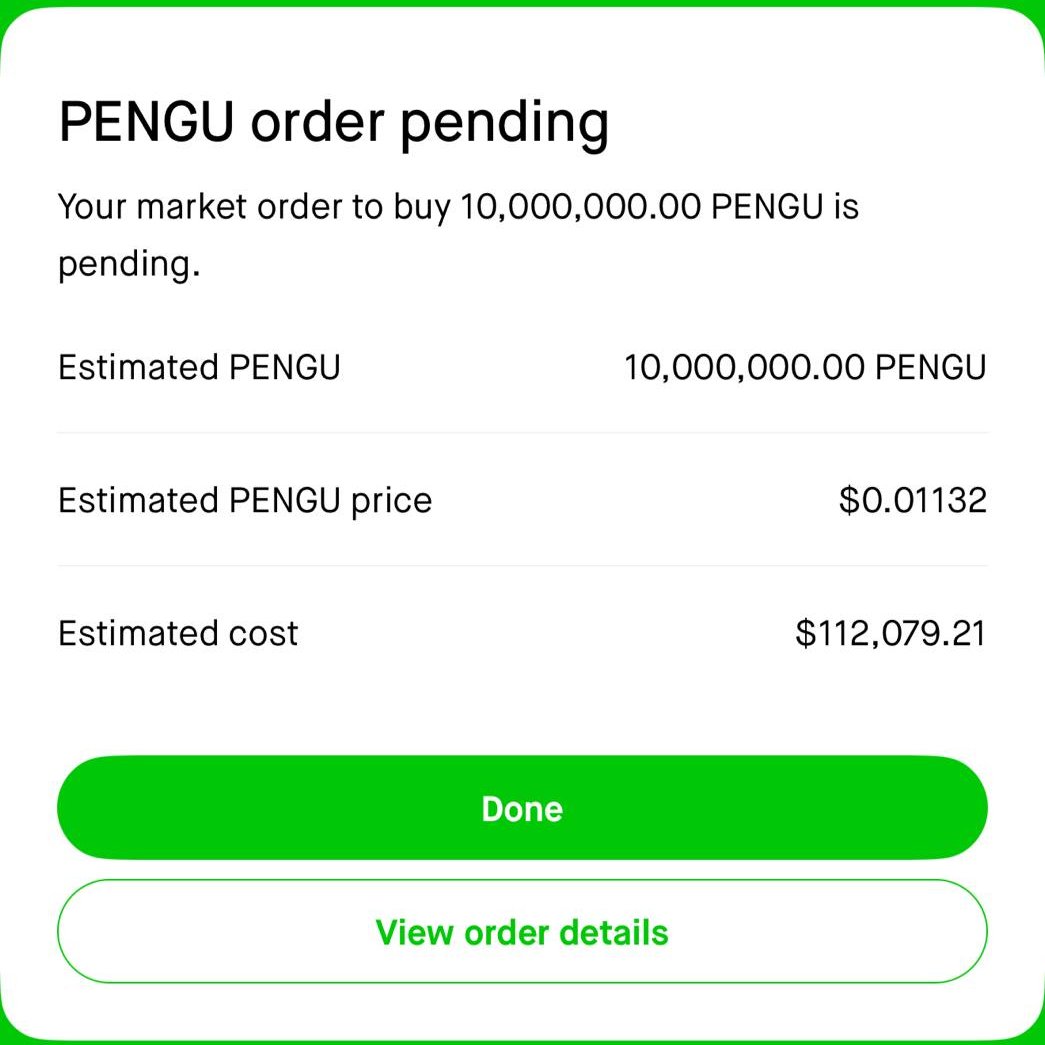
$PENGU is one of the cleanest bets on the board
not bullish enough
In my teens and 20's I would spend way too much time playing Starcraft and Civilization. Harvesting resources, building things, and expanding was super addictive to my brain - to an almost unhealthy degree.
Later I realized that entrepreneurship and business is the ultimate game. It scratches the same itch for me (resources, building, expanding), but you're actually contributing to humanity at the end of the day, which can be much more fulfilling.
Business is also much more positive sum than video games. In Starcraft, the other player has to lose for you to win. In business, there is competition, but in a growing market there can be multiple winners. And gains compound long term (it's a infinite game) instead of starting over each time.
Now days I prefer to watch pros play video games to unwind, instead of playing video games myself. But a quick game can still be fun here and there to unwind. By contrast, the game of business is played over many decades.
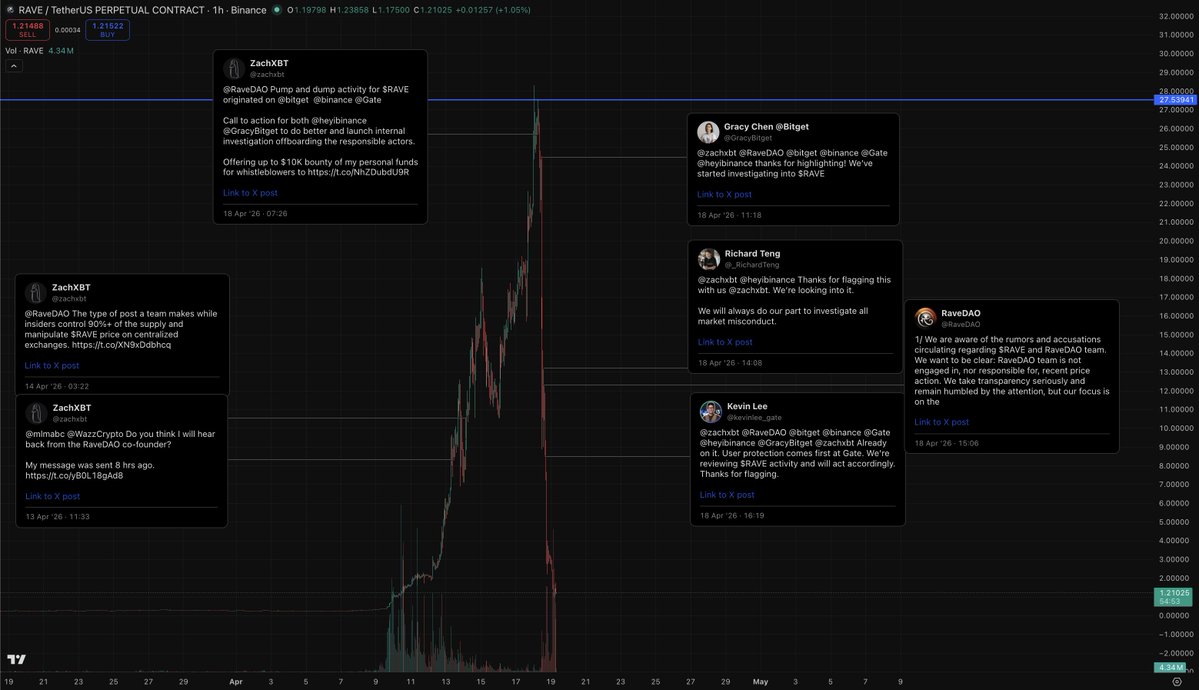
A summary of the RAVE -95% price fluctuation from $26 to $1 over the past 24 hours.
RAVE Timeline: April 18, 2026
7:26 am UTC: I posted a call to action for Binance, Bitget, & Gate to investigate RAVE market manipulation and offered a $10K bounty.
10:56 am UTC: I posted an update increasing the bounty to $25K.
11:18 am UTC: Bitget publicly acknowledged the call to action.
2:08 pm UTC: Binance publicly acknowledged the call to action.
3:06 pm UTC: RaveDAO posted claiming they have no involvement.
4:19 pm UTC: Gate publicly acknowledged the call to action.
In the days leading up, on April 13 & 14, I confronted RaveDAO co-founder Yemu Xu (wildwoomoo) but have yet to receive an answer.
RAVE launched in Dec 2025 on Binance Alpha with a 1B total supply. The addresses below, linked to the initial distribution, control ~95% of the RAVE supply (h/t Mlm):
0x9831156F1a6E506Fca41503590b42F07c2e80f54
0x8Ed6245C3276307E1A9D9Dc872E98A0E770070fd
0x6020656d1EF182173E45D4Fc375BDD5a48c674B0
0x2664cB80a5ee7D8EC05fe7C752dD62E078056E6d
0x2D81F8AeBf3e58A5e638006c9fd8F38C5220ecab
0x31694d761A8e851cFFbCd286aC54D01e5Ce5aFe6
0x0A1F07993a51CcEb4f52CA67765AECeADDA790d7
0xEB74Df8588cFC1C179Df4bd96C0bB8B227B9bE92
0x53d7d52301366DC14E1916b14eFeC1aDD8F3487b
I found suspicious CEX activity in April 2026 tied to RaveDAO team addresses onchain, which potentially contradicts their recent statement:
Bitget
0x2dc20f2180582172f5450c5d71e23fa438a7031b
0xa3a02aeb97fc1737c66f50d07d024799c137891d
0x2d95eb42525e6087e0cb7869f98da6838ed2e743
Gate
0x31711246b05d71e9eda5e38a3abb654020ee3353
Given the supply concentration, the team at minimum knows who is responsible for this price action.
A simple litmus test: $6B in market cap was wiped out on just $52M of 24hr liquidations (h/t CoinGlass). That ratio points to a manipulated and unsustainable valuation.
RAVE is not the only token with manipulation we have seen on major centralized exchanges. It's just the most blatant, reaching a top 15 market cap within 10 days before dropping 95% in hours.
Other projects with highly questionable price action recently include: SIREN, MYX, COAI, M, PIPPIN, RIVER.
Exchanges need faster intervention on manipulation. Detection at scale isn't easy, but each day of delay means retail traders absorb losses while platforms collect fees on the volume. The outcome is the same regardless of intent.
While it's good the exchanges responded, I find it unlikely this activity wasn't spotted internally before I raised it publicly.
I recognize how much this behavior takes from retail traders, and I plan to investigate similar movements in hopes of identifying the responsible parties.
I want to reiterate that I did not take a position. If I had, I would have been liquidated myself. I also could not anticipate if or when the exchanges would comment publicly.
My $25K bounty will remain active since the only DMs received were unverified claims rather than non-public information with supporting evidence as requested.
One of my favorite lessons I’ve learnt from working with smart people:
Action produces information. If you’re unsure of what to do, just do anything, even if it’s the wrong thing. This will give you information about what you should actually be doing.
Sounds simple on the surface - the hard part is making it part of your every day working process.
The layoff wave tells two stories, not one.
Tech giants like Amazon, Meta, and Microsoft are cutting to fund GPU purchases. Their revenues are growing. Their stock prices are climbing. They're firing people to free up cash for compute. This isn't cost-cutting during a downturn. It's a forced reallocation from payroll to datacenter capacity. The math is brutal: every percentage point of headcount reduction funds another batch of H100s.
Meanwhile, UPS, Nestle, Ford, and Target are cutting for the opposite reason. They've already deployed AI tools that work. Customer service automation, supply chain optimization, generative design systems. The productivity gains are real and compounding. These companies don't need to buy massive GPU clusters. They're renting inference from hyperscalers and cutting headcount because the math finally works.
Both sides are feeding the same beast. Tech companies are buying the shovels. Everyone else is buying the gold those shovels dig up. Semiconductor companies sit in the middle, collecting rent from the entire value chain. TSMC, NVIDIA, and ASML are printing money while employment craters on both ends.
The timing matters. We're at 10% enterprise AI adoption, heading toward 50%. History says this phase moves fastest and generates the most wealth. But that wealth is concentrating in compute, not labor. The gap between market cap growth and wage growth has never been wider. This isn't a recession. It's a rebalancing. And most workers are on the wrong side of it.