In a world where there are strong open source alternatives that are only just behind the frontier models, you make yourself less secure and competitive by gatekeeping access to frontier model capabilities.
If you play this out, even if America could fully ban access to open source models, other ecosystems wouldn't have that ban and they'd have a leg up on access to those models. They could use them against us -or just use them to better defend themselves- and our own companies wouldn't be able to keep up.
The calculus of what you do about AI regulation simply must change to account for the fact that open weights models are far stronger than many expected.
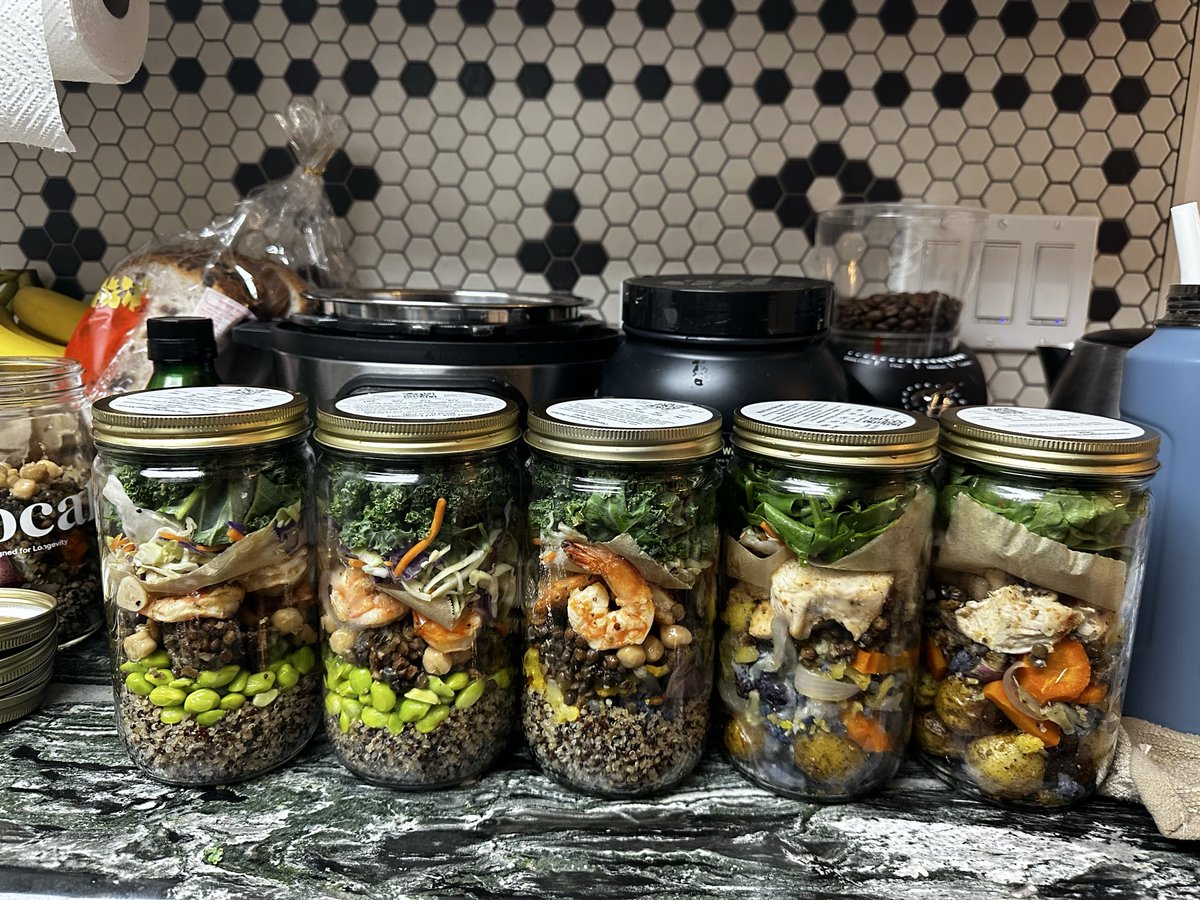
We just pivoted to ready-to-eat meal delivery from AI GTM.
3 hr of cooking. 0.64 hr of grocery shopping. 2 people. -> 10 meals. Does this feel like PMF??
This shows the best leaders are not just managers. They understand the tasks enough to delegate efficiently.
Besides who doesn’t like to save some token cost now?
Everyone's talking about agentic MapReduce as a compute story. It's actually a trust story.
Levie points out that swarms of agents mean 100X more inference. True, but that's the obvious part. The hidden problem: when you decompose a task across 100 agents, who verifies the output?
MapReduce works in software because the mapper and reducer are deterministic. Feed them the same input, you get the same output. LLMs are the opposite. Run the same prompt twice, you get two different answers. Now multiply that non-determinism across a swarm of agents and you have a correctness problem that scale makes worse, not better.
1/ The naive solution is a verifier agent. But the verifier is also an LLM, with the same hallucination rate. You've just pushed the error one level up.
2/ The brute force solution is majority voting: run 5 agents per task, take the consensus. Now your inference cost is 500X instead of 100X. And you still don't have a guarantee, just a probability.
3/ The actual solution is constraint. Don't give agents open-ended reasoning tasks. Give them narrow, verifiable sub-tasks with structured outputs. The Map step is agentic, the Reduce step is deterministic code. But that limits what the swarm can do.
IIRC, the most successful "agentic" systems today (Cursor, Devin, Copilot) work because the verification is built in: code compiles or it doesn't, tests pass or they don't. That feedback loop is what makes the swarm useful. Remove it and you're just generating plausible-sounding garbage at scale.
The inference demand curve will go vertical. The companies that survive it won't be the ones with the cheapest tokens. They'll be the ones that figured out how to make agent output falsifiable.
If you’ve ever wondered why we will need 100X more AI inference in the future, and what it’s going to be driven by, this is another good example.
Devin pushes forward an idea of agentic mapreduce, which means we’ll now have swarms of agents that are processing large amounts of data (code) to handle tasks that humans never could have done before.
“Devin maps relevant signals across the repo, fans out focused agents over bounded shards, reduces their findings into one report, then verifies serious vulnerabilities in isolated sandboxes before marking them confirmed.”
In this case it’s code security, but there are tons of other use-cases in code and knowledge work. We see this at Box with customers that want to process and understand millions of documents for risk, insights, relationships, and more. This will play out in pharma, banking, and many other industries across all forms of unstructured data.
As an aside, these types of capabilities are generally only possible when you can deploy a variety of models (both the frontier and lower cost) because of the sheer amount of tokens that go into these use-cases. This is going to be a major value proposition for the applied AI layer.
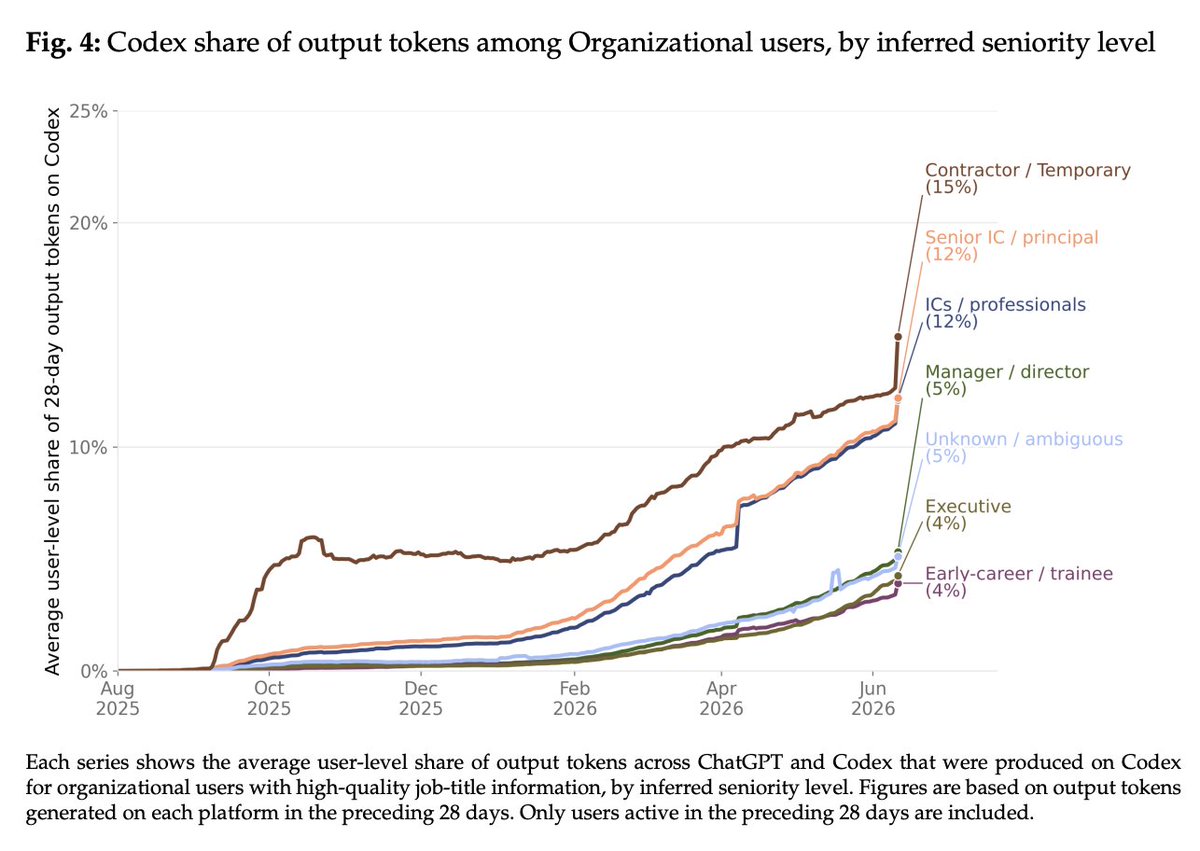
But at OpenAI, even folks in legal and recruiting are at this point primarily using Codex, not ChatGPT.
The transition to agentic AI is also happening across all seniority levels, although it is slightly less far along for those at both the lowest and highest seniority levels.
Fugu stands shoulder-to-shoulder with leading models like Fable and Mythos across the industry's most rigorous engineering, scientific, and reasoning benchmarks.
Read the full blog: https://t.co/2ZJbdWqCUj
Beyond Bigger Models: Why are Orchestration Models the Next Frontier
Progress in AI has been driven largely by giant, monolithic models. But the most powerful systems of the future will be collaborative ecosystems.
Today, this orchestration is no longer just a technical optimization. It has become a geopolitical and operational imperative.
For an organization or a nation, relying on a single company's model for critical infrastructure, finance, or governance is a material vulnerability. This risk is no longer a hypothetical possibility, but a reality.
As we have seen with recent export controls imposed on models like Fable and Mythos, access can disappear overnight.
Collective intelligence is the practical hedge against this concentration of power. Because Fugu orchestrates an underlying pool of swappable agents, it simply routes around vendor restrictions.
By orchestrating the world’s models, we are delivering the resilient blueprint required for true AI sovereignty.
Funny thing is that AI makes CLI cool again. Web 2.0 is supposed to bring rich UI/UX so we no longer need to look at text walls again, yet here we are.
@helloitsolly@helloitsolly love how you’re doing this openly! I’m curious how you handle design tasks…? Do you contract someone, or use AI, or just have engineer do the first pass and you edit afterwards?
AI Model Release Timeline 🤖
11 companies. 85+ models. Nov 2022 → Feb 2026.
Every major AI model on a single chart.
🇺🇸 OpenAI, Google, Anthropic, xAI, Meta
🇫🇷 Mistral
🇨🇳 DeepSeek, Qwen, Kimi, MiniMax, https://t.co/Gl7AMpZ2Qq
#AI#LLM#GPT5#Gemini#Claude#AITimeline
Plan mode is now launched in Gemini CLI🚀
A read-only mode that allows you to safely explore and work with Gemini CLI to come up with a plan prior to implementation.
Plan mode can leverage read-only MCP tools, Agent Skills and is built to be fully extensible 🔌🧩
Read more👇
85 major models in three years is exhausting just to look at. I keep getting stuck on the geography. 2022 was an entirely US game. Then Mistral and DeepSeek proved you don't need an endless wall of GPUs if your math is better. The SV oligopoly lasted 18 months.
AI Model Release Timeline 🤖
11 companies. 85+ models. Nov 2022 → Feb 2026.
Every major AI model on a single chart.
🇺🇸 OpenAI, Google, Anthropic, xAI, Meta
🇫🇷 Mistral
🇨🇳 DeepSeek, Qwen, Kimi, MiniMax, https://t.co/Gl7AMpZ2Qq
#AI#LLM#GPT5#Gemini#Claude#AITimeline
Anthropic has overtaken OpenAI in enterprise LLM API market share.
OpenAI fell from 50% in late 2023 to 25% by mid-2025, which shows that brand alone does not hold share once real workloads start.
Anthropic now leads enterprise LLM API usage with 32%, while OpenAI has 25%, pointing to a real shift in how companies pick vendors.
Enterprise LLM API spend hit $8.4B in the first half of 2025.
Anthropic’s push on data controls, compliance, and clean integration with existing systems won trust, and that trust tends to decide renewals and expansions.
Claude’s recent lines, including stronger reasoning and coding, helped too, with developer code-gen share around 42% for Anthropic vs 21% for OpenAI.
Usage is shifting to inference at scale, so uptime, latency, and incident response matter more than raw benchmark wins.
Vendor switching stayed low at 11%, and 66% of teams just upgraded within the same vendor, so any share gain here is hard won.
Google sits near 20% and Meta near 9%, so this is not a 2-player market, and strengths differ by use case like agents, code, or retrieval.
Buyers now weigh cost per token, data residency, auditability, SOC reports, and fine-grained controls as much as model quality.
Multi-vendor setups are rising because they reduce lock-in and let teams route tasks to the best model for that job.
Perplexity Computer replaced $225K in tools in one weekend.
Their agent scans hourly, tweaks budgets, caught 224 micro-optimizations nobody asked for.
Is it SaaS doom? No it’s a DIY project with amazing craft:
Perplexity Computer replaced $225K/yr in marketing tools in a single weekend.
We built an AI marketing agent that scans hourly, manages budgets, detects fatigue, and coordinates several campaigns end to end.
In one test run, it made 224 micro-optimizations to our ad stack.
OpenAI tested if GPT-5.4 could hide its reasoning from safety monitors.
Result: it can't.
This is huge for AI safety, means we can actually audit what reasoning models are "thinking" before they act.
Chain-of-thought monitoring just became a legit safety tool.
We're publishing a new evaluation suite and research paper on Chain-of-Thought (CoT) Controllability.
We find that GPT-5.4 Thinking shows low ability to obscure its reasoning—suggesting CoT monitoring remains a useful safety tool. https://t.co/isZkNkPXZm
Claude Cowork just got a $50B endorsement.
Microsoft licensed Anthropic's Claude Cowork instead of building their own. That’s an admission ticket.
Why it matters:
- Copilot was a “joke”
- Office franchise = $50B/year
https://t.co/iSCIbxdXKR
Microsoft has worked with Anthropic to integrate the technology behind Claude Cowork into Microsoft 365 Copilot. The new Copilot Cowork feature is now in Research Preview, and will be available more broadly later this month https://t.co/ewjyNZFrAD