Thanks for answering your own question why India is not allowing Starlink internet. Because we don’t want the Internet in India to be controlled by some Potus or Elon.
Yes, when ballot paper was used (until the mid 2000s), we only had booth capturing, ballot-box stuffing, pre marked ballots, invalidation of votes due to smudging/marking, widespread double voting in many states, and open intimidation or violence outside polling stations.
Modi has basically humiliated himself and the country.
He did not push domestic military manufacturing enough, did not fund the jet or marine engine programme, did not order naval ships, artillery, in due time, and therefore oversaw the largest relative reduction in military capability wrt to China. This relative reduction is what led to 2020 border skirmish, which then lead to concessionary behaviour towards the US, and then complete humiliation by Trump 2.0.
It is why grassroots politicians suck. They just can't see things beyond their bubble.
Nothing sums up modern India better than this.
You follow every rule and wait your turn, while someone cuts the line, skips the system, and wins without a single consequence.
India’s economic story has two very different chapters.
India’s GDP per capita fell from 35.2% of the EMDE average in 2003 to 27.8% in 2013.
Since 2014, that trajectory has reversed.
India reached 37.2% of the EMDE average in 2026 and is projected to reach 46.2% by 2031.
The EMDE group itself comprises 150+ emerging markets and developing economies, representing roughly 85% of the world’s population.
So this is not simply India growing in isolation. It is India steadily closing the gap with the broader developing world.
The lost decade was followed by a decade of catch-up.
We lost crazy amounts of foreign investment in manufacturing from 2004-2014, all because we didn't even have tier 1 infrastructure.
1> POSCO's $12 Billion steel plant in 2005 in odisha biggest FDI in indian history But due to lack of deep sea port and NGO's, vent to China +
In 2014 at his first addressed at red fort he talked about making toilets.
In 2026 he is talking about making semiconductor plants, computer chips, nuclear reactor.
History will be much kinder to him 🇮🇳
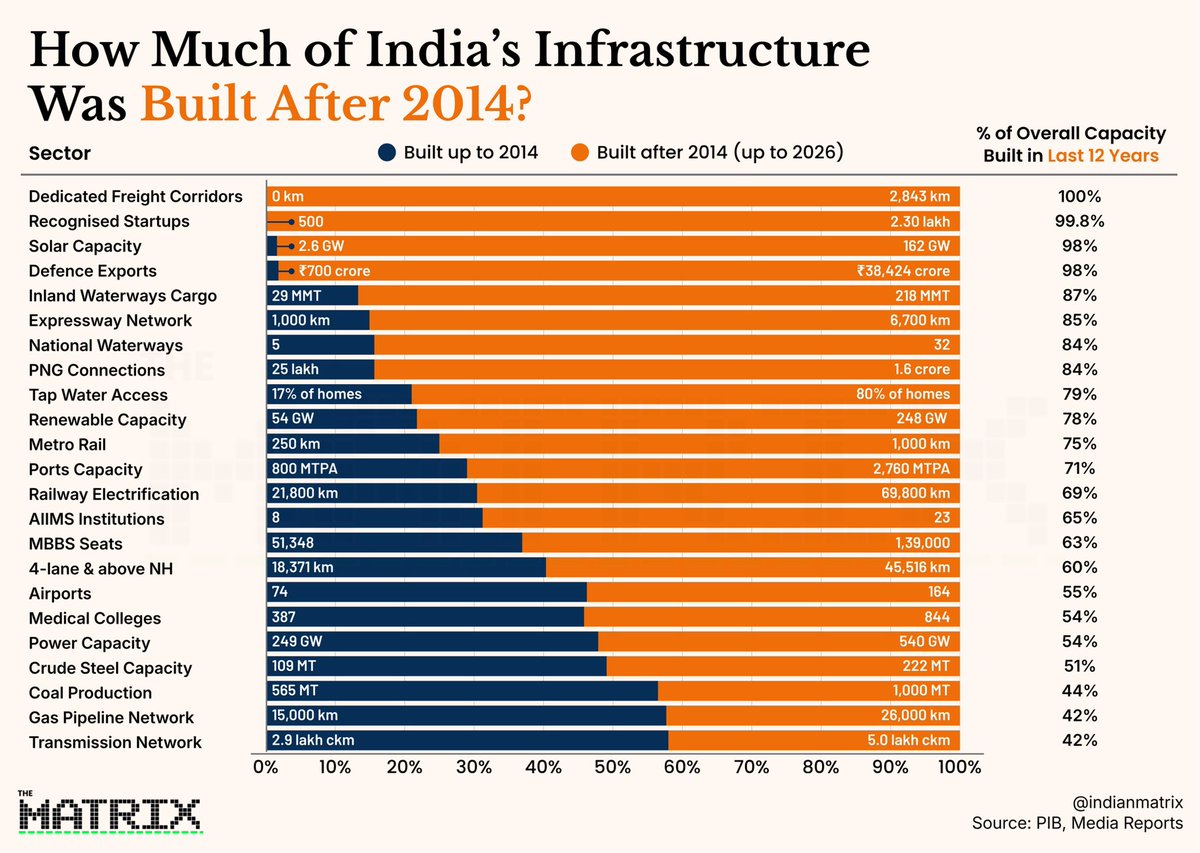
How much of India's infrastructure was built after 2014?
• 100% of Dedicated Freight Corridors
• 98% of Solar Capacity
• 85% of the Expressway Network
• 79% of Tap Water Access
• 75% of Metro Rail
• 71% of Port Capacity
• 69% of Railway Electrification
• 60% of 4-Lane National Highways
Infrastructure is built over decades.
But some decades build more than others.
Imagine comparing yourself to somone who's engineering success led to direct economic impact of Rs 1,000+ core and served as the primary technology proof-of-concept that convinced the Government of India to launch the Digital India RISC-V (DIR-V) program under the ₹76,000 Crore ($10 Billion) India Semiconductor Mission (ISM).
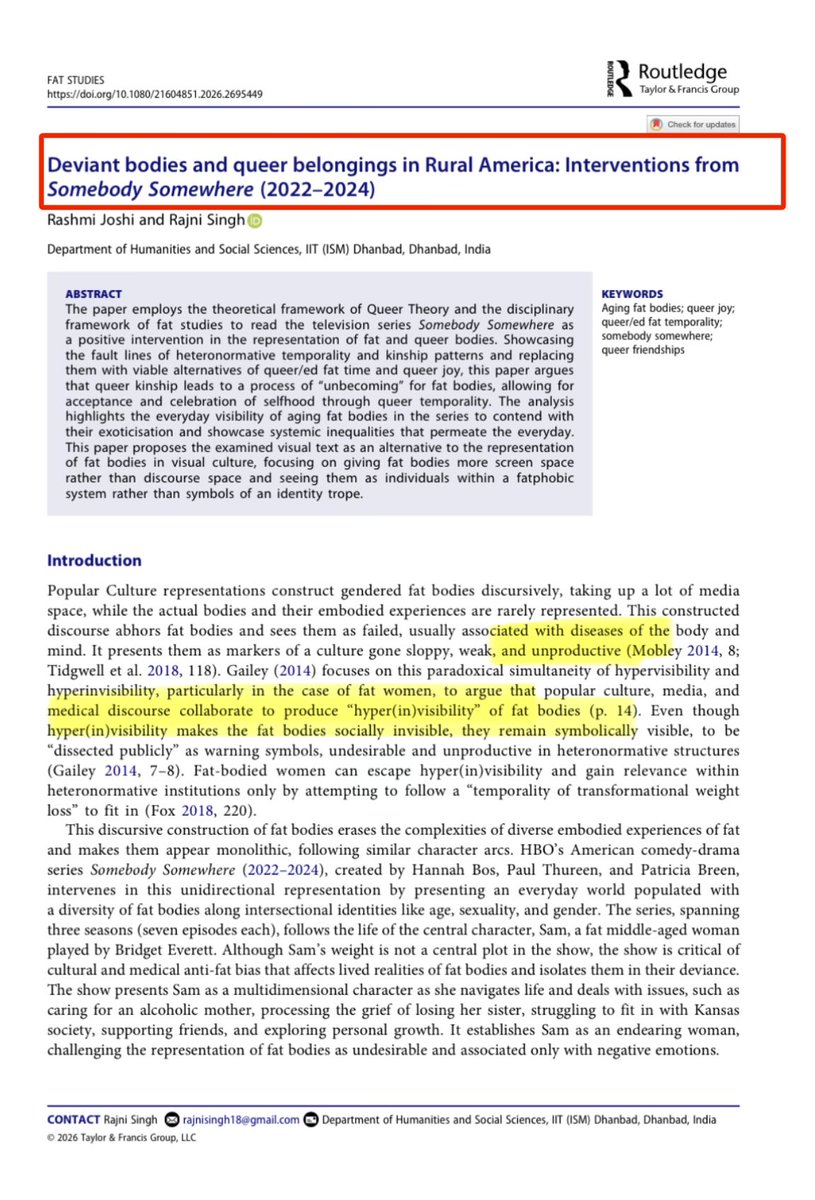
British opened IIT-ISM in Dhanbad to research on mining.
@EduMinOfIndia is now using it to research on fat and queer bodies in rural America. What is India gaining from such research?
This is what a fall of education system looks like! @JoshiPralhad
Namaste, Ma'am...Aapko 1 story sunata hoon....
In the summer of 1980, a distraught 7th grade boy stood in the courtyard of a modest house in Mylapore, watching his father toss his cricket bat down a deep well. A fast bouncer had shattered the boy's spectacles during a local match & his father, a renowned Sanskrit logician, was terrified for his son's sight.
"Your cricket days are done," his father declared, handing him a violin. "If you want to master precision, master this."
The boy did not throw a tantrum. He directed his focus toward the strings, training until he was performing alongside musical legends, even taking direct corrections from Bharat Ratna M.S. Subbulakshmi.
5 yrs later, he suffered another blow: he failed to clear the IIT-JEE examination.
He did not give up. He enrolled in a regional engineering college, quietly mastering computer science logic gates. He eventually worked his way into IIT Madras as a postgrad researcher, earned a PhD, joined as a prof & eventually became the Director of the very institute that had once turned him away.
By 2011, while the world was building consumer mobile apps, this prof was looking at a hidden national vulnerability: every radar, fighter jet, banking server & defense system in India was running on foreign-designed microprocessors.
He had a single question in his mind: "We can test that a foreign chip does what we WANT it to do. But can we guarantee it does not do something we DO NOT want it to do when a war starts?"
He proposed building a completely indigenous, industrial-grade microprocessor from scratch. Global tech giants insisted it could not be done w/o billions of dollars in infrastructure & massive foreign patents.
He did not care. Working out of cramped labs on long shifts, he & his team adopted the open source RISC-V instruction set. They hand-coded logic gates, mapped silicon layouts & verified billions of instruction cycles.
In July 2018, a tiny 16mm² piece of silicon codenamed Risecreek arrived back at the lab. The team wired it up, flipped the switch & watched a flickering monitor as the Linux operating system booted on 100% Indian-designed silicon for the 1st time in history.
Today, his SHAKTI processor architecture powers everything from defense communications to space grade controllers built in collaboration with ISRO.
That young boy whose father threw his cricket bat down a well...
The student who missed the JEE list in 1985...
The violinist who turned down the official IIT Director's mansion to stay in his family home & protect his late father's Sanskrit library...
His name is Prof. Veezhinathan Kamakoti.