Stars, thunderstorms, city lights, aurora, and sunrise, captured in a single time-lapse sequence from the International Space Station (view fullscreen).
Full 4K widescreen version on Youtube: https://t.co/QFwXBPKIA2
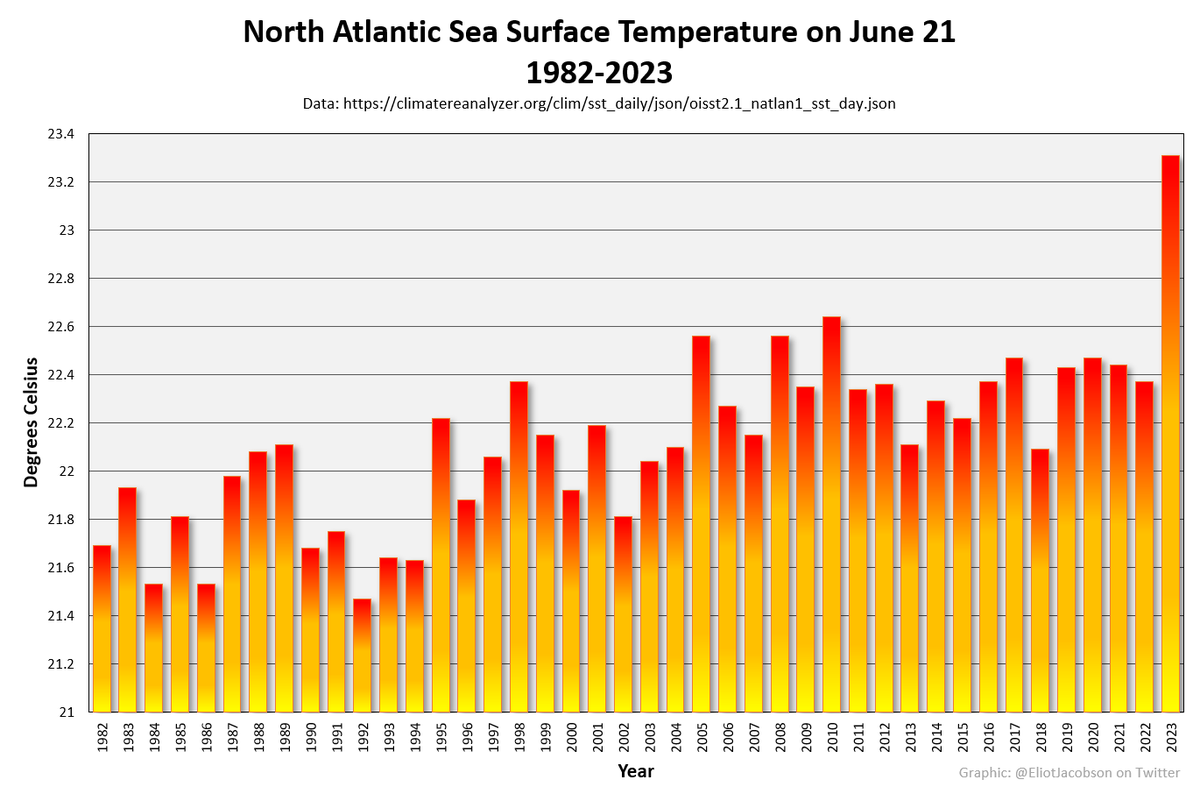
For another way of looking at the ongoing North Atlantic sea surface temperature spike, here are the temperatures of the North Atlantic on the Summer solstice, June 21, for every year 1982-2023.
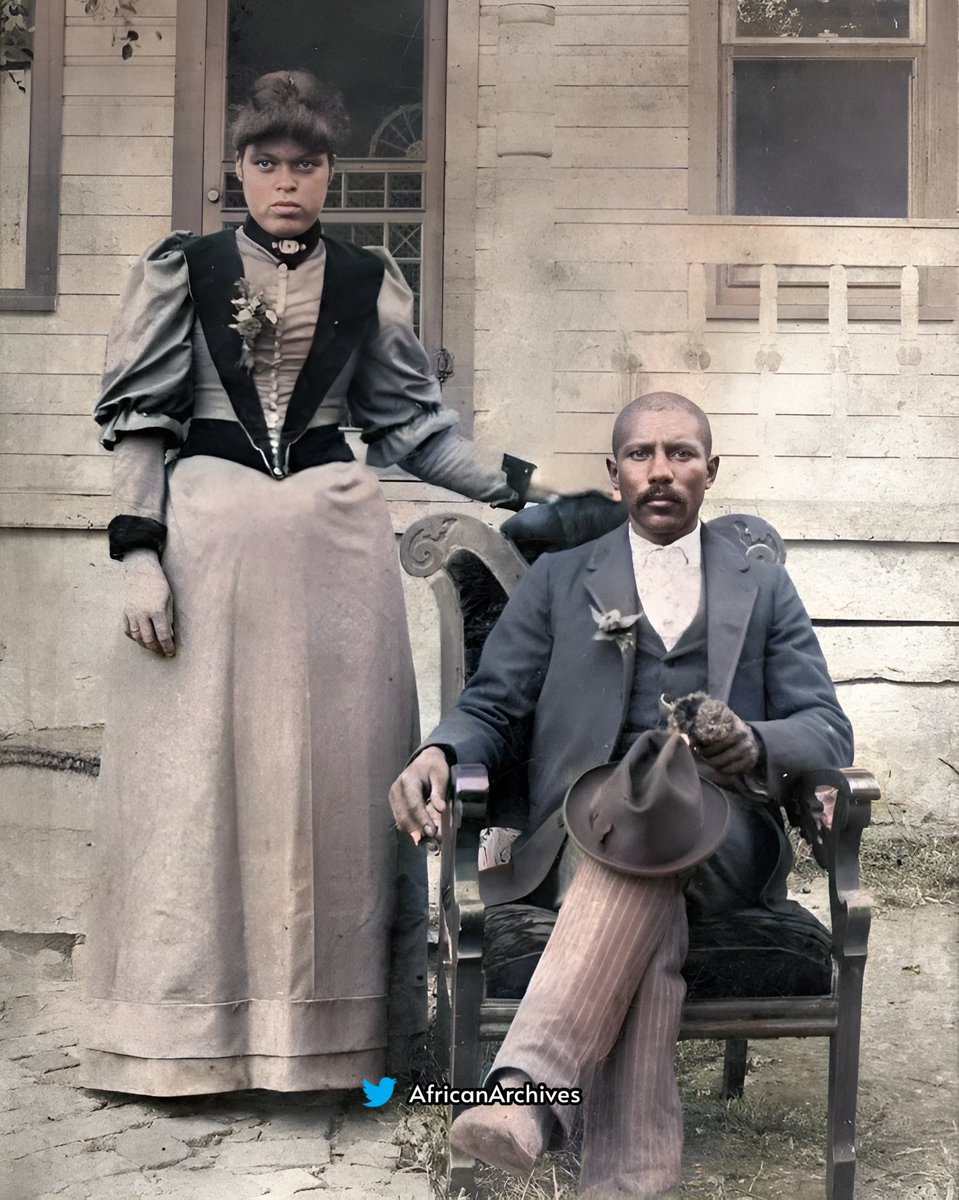
‘Potato King of The World’, Farmer, landowner and businessman, Junius G. Groves (1859-1925), was one of the wealthiest African Americans of the early 20th century.
Born enslaved in Green County, Kentucky, Groves was later liberated and joined other freedmen in the “Great Exodus” to Kansas in 1879, eventually finding work as a farmhand.
Impressed with his strong work ethic and production, Groves’ employer offered him nine acres of land to farm on shares. By 1884, he and his wife Matilda had saved enough to purchase 80 acres of land near Edwardsville, Kansas. So successful was their venture that, just four years later, they had acquired a total of 2,000 acres and replaced their one-room shanty with a 22-room mansion. Groves made a name for himself as a potato grower, producing as many as 721,500 bushels in one year – far and away more than any other farmer – and earning the title of “Potato King of the World.” He also operated a general store, maintained several orchards, and had investments in various mining and banking interests. Groves worked the farm until his death in 1925. He attributed his success to the endless hard work and devotion of his wife and 12 children.
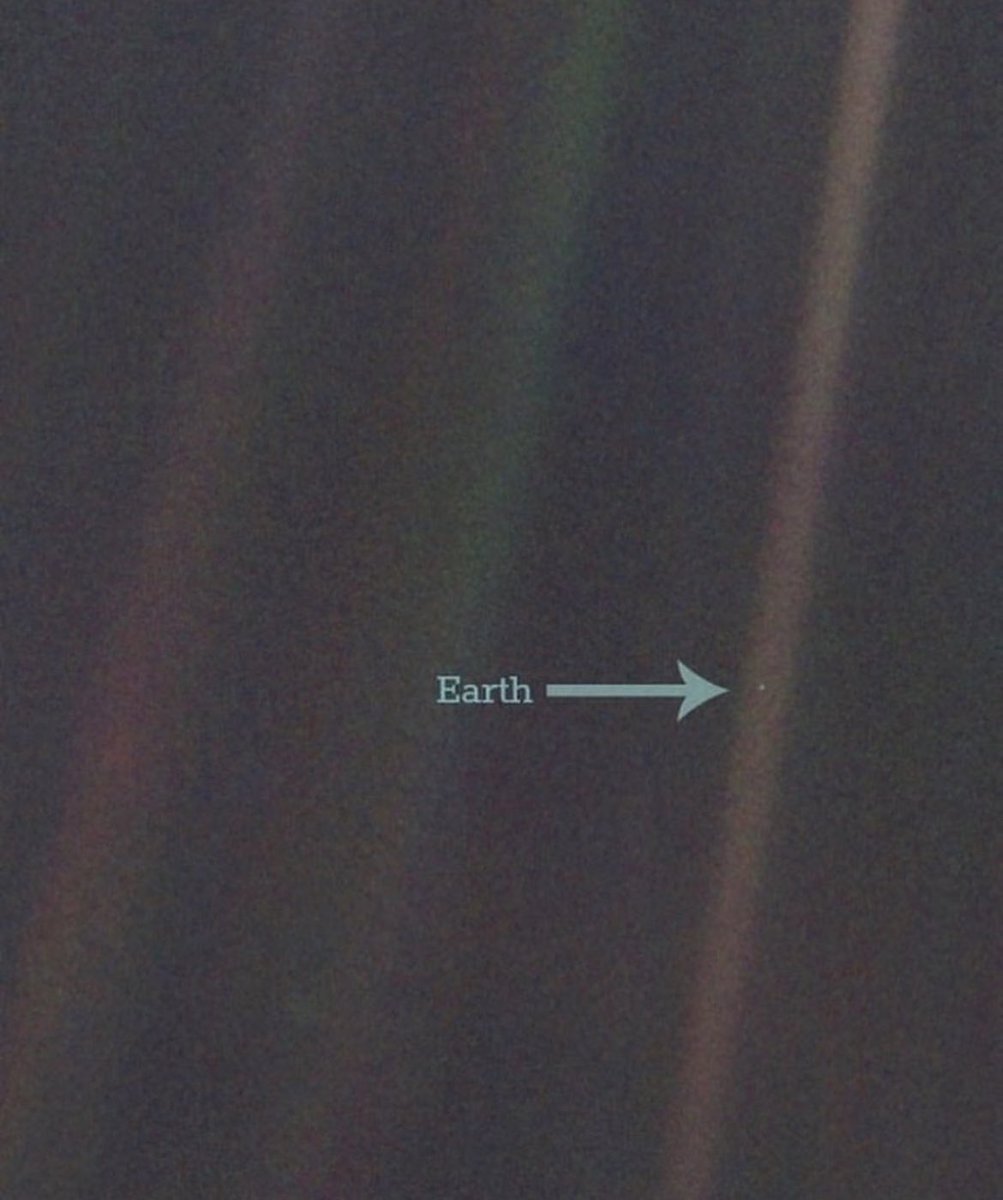
Pale Blue Dot is a photo of Earth that was taken by the Voyager 1 space probe in 1990 from a distance of about 6 billion kilometers (3.7 billion miles) as it was leaving our solar system. This is what Carl Sagan said about the photo:
"Look again at that dot. That's here. That's home. That's us. On it, everyone you love, everyone you know, everyone you ever heard of, every human being who ever was, lived out their lives. The aggregate of our joy and suffering, thousands of confident religions, ideologies, and economic doctrines, every hunter and forager, every hero and coward, every creator and destroyer of civilization, every king and peasant, every young couple in love, every mother and father, hopeful child, inventor, and explorer, every teacher of morals, every corrupt politician, every 'superstar,' every 'supreme leader,' every saint and sinner in the history of our species lived there — on a mote of dust suspended in a sunbeam.
The Earth is the only world known so far to harbor life. There is nowhere else, at least in the near future, to which our species could migrate. Visit, yes. Settle, not yet. Like it or not, for the moment the Earth is where we make our stand. It has been said that astronomy is a humbling and character-building experience. There is perhaps no better demonstration of the folly of human conceits than this distant image of our tiny world. To me, it underscores our responsibility to deal more kindly with one another, and to preserve and cherish the pale blue dot, the only home we've ever known.”
A crocodile in a Costa Rican zoo began guarding a spot in her enclosure. When employees later examined the area, they found 14 eggs. It was the first known case of facultative parthenogenesis, a form of asexual reproduction, involving a crocodile. https://t.co/c09RJpBaBw
Yes we have an eruption within Halemaʻumaʻu, at the summit of Kīlauea 🌋 Go to the park website for safety and eruption viewing tips: https://t.co/ctEdfij9gA
📸Jean Campbell
From a Canadian firefighter who knows what’s going on:
#canada#wildfire#smoke
(Worth the read)
“I know you may know, but people need to know and understand that most Canadian wildfire management agencies have fire “zonation” policies similar to Alaska.
This means in large areas of their jurisdictions, especially in the northern part of the country, wildfires are left to run there natural course w little or no direct action or suppression. We’ll protect values at risk, ie. infrastructure, communities, critical habitat or culturally significant features on the landscape, we’ll map them and maybe try to burn them to natural barrier, fight one flank and let the rest roll (limited action) but we are not putting them out.
On many of the fires we don’t even try. A number of these fires are huge boreal gobblers (I am currently assigned to a 250,000 ha fire, well over 600,000 acres and you could fit the org. chart on one side of a beer can).
The only thing that is going to put out this fire out and many across the country is winter, 5 months from now. It’s going to be a long, smoky summer for everyone. You have a wide reach, it would be great if you can help people understand these dynamics in the Canadian wildfire scene when they’re bitching about the smoke.
Cheers 🍻 and thanks.”
Pretty decent picture of what’s going on. Thanks for the insight.
In the industry we call this letting a fire “Do its thing”. It’s especially common in these vast boreal forests. Siberia does the same thing. Identify hazards and values at risk, mitigate, let it go.
Cheers.
Phalera assimilis is a moth featuring an impressive natural camouflage which allows it to perfectly mimic small twigs in order to avoid predators
[video: https://t.co/eTqIm4oZkJ]
[read more: https://t.co/xeVoZSQprX]
Inspired by solar furnaces, this parabolic mirror concentrates light onto a focal point, and can be consequently used for more mundane tasks in place of industrial purposes
[how it works: https://t.co/QAqdPMUgkU]
[📹 https://t.co/HF2LfdCd7j]
I periodically post this visualization reminder as summer approaches in the Northern Hemisphere - think heatwaves 🫠
The changing distribution of land temperature anomalies since 1950...
Animation is by @NASAViz using GISTEMPv4 data. More information at https://t.co/ui4Ws506Su.