Tomorrow I’ll share how doctors can break into tech (hint: it’s not through job apps)
Come join if you literally have nothing better to do on a Saturday
https://t.co/JPGFx9Ph6g
I thought this was cool -- and we discussed it here @endpointarena
- can this help patients? (by driving interest in clinical trials from patients + funding)
- does it tackle transparency / incentive problems at the source
- risks of anonymous bets + insider knowledge
- could this sit as clintech ops inside pharma
Interesting! Is your suggestion to rip out carriers for self-insured employers? And then replace their bundled services with:
- employer continues directly taking on risk (with stop loss)
- a light touch TPA on top to handle admin
- providers contract directly at transparent rates
If a 5000 employee company CEO called you and asked where to start - what would you suggest?
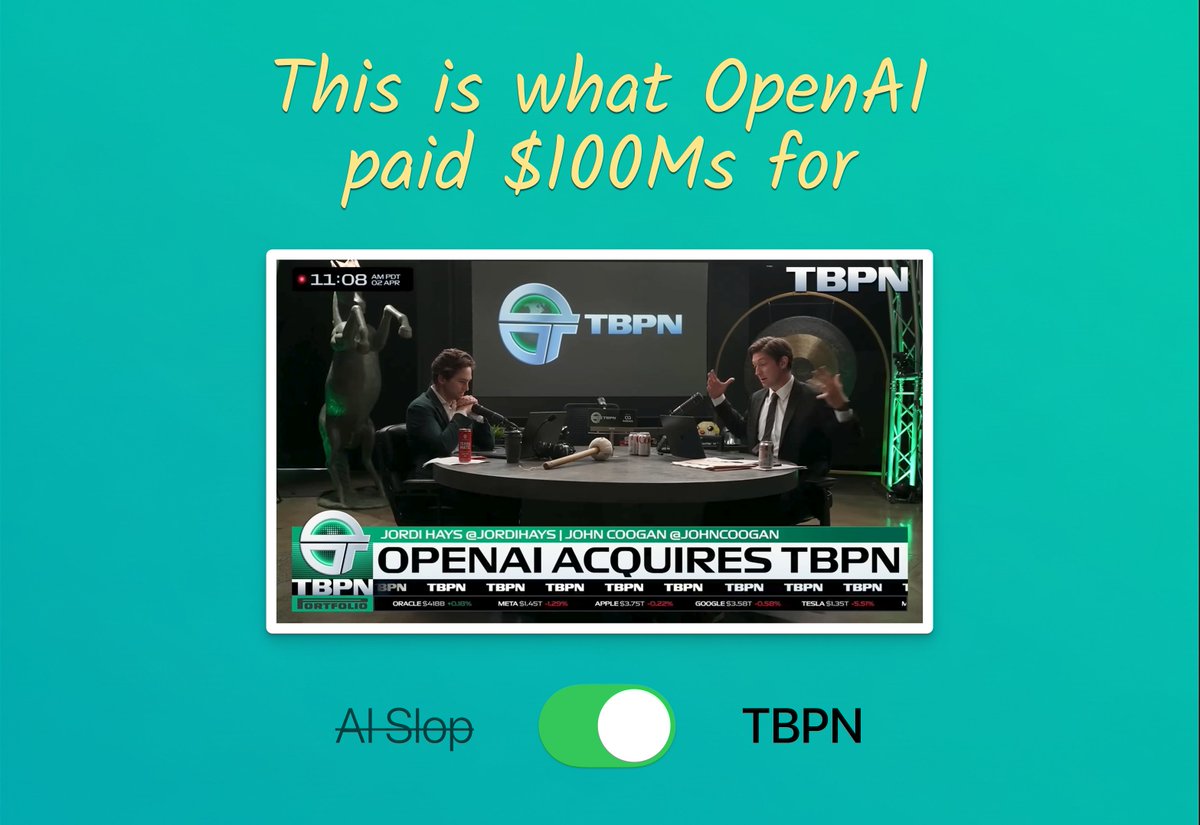
I've been thinking a lot about @OpenAI's acquisition of @tbpn -- and what creators / startup media can learn from it...
It's interesting that OpenAI did the acquisition. They're best placed to know that media will be nuked by AI slop. If you think your X feed is bad right now -- wait until 2027. People are already working on strong 'proof of human' checks on media (check out C2PA). I fully expect web browsers will include a toggle to filter out AI-created content from your web xp in the next 12mo.
So who will the media winners be in the age of AI slop? I think there are four principles we can learn from TBPN: (1) cult of personality, (2) proof of work, (3) a nod to old media, and (4) cool branding
(1) Cult of Personality
Look at the top podcasts right now... most of us listen because we like the hosts (i.e., parasocial relationships). @johncoogan and @jordihays are exceptionally likable with v strong chemistry. When's the last time you had those feelings towards AI-generated content? Never
(2) Proof of Work
John and Jordi turned up every day for 13mo and delivered. That is really really hard. It way surpasses what we're used to (two guys in hoodies on a Zoom call). They focused on 'delighting' their users. You can feel the love that went into each episode (treating media like product vs hitting export to .mp4 on Zoom).
Proof of real 'human work' being done is the antithesis of AI slop.
(3) A nod to 'Old Media'
@a16z's New Media thesis (tl;dr founders skip press, and go straight to your customers) is generally right, but new media players have perverse incentives too. There are lots of founders doing press releases (just with a bit more personality), VCs promoting their portcos / fishing for deal flow etc.
TBPN avoided that -- they borrowed old media's editorial independence (i.e., no you can't only shill your new book / product), without 'gotcha' culture or a sense that the hosts are outsiders commenting about something they've never done. AND then they had new media's direct distribution and pro-tech optimism (without becoming a shill vehicle). That's quite hard to pull off.
(4) Brand / taste
Probably my least developed thought here.. but people just seem tired of blandness. That's one of the problems with AI-generated content. It all reverts to the mean. Having a strong brand identity is exactly the opposite of AI slop.
TBPN's brand identity (a broadcast news set with sponsor logos everywhere) was so specific that an LLM (or 'design by committee') could never independently create it.
... and finally what this means for health / life sci media...
The same AI-slop pressures are coming for us but we're just less mature. Is there any media in our space which is as good as TBPN, 20VC, etc.? I don't think so (and that includes what I do!).
I'd bet that a media brand will be acquired by a major healthtech/life-sci company for the same reasons OpenAI bought TBPN soon ... our media is just v behind at the moment
Thank you, @MustafaSultan @BigPictureMedicine, for having me. It’s always humbling to look back on the journey, and a good reminder of why the work in healthcare continues to matter. Looking forward to continuing the conversation soon!
https://t.co/ltlTeS4gZg
We are excited to announce that we've raised $20 million in Series A funding led by New Enterprise Associates (NEA), with participation from Sequoia Capital, Blue Lion Global and Neo.
A new era for Co:Helm as we introduce our new name and brand identity — Anterior.
We are the AI company built by clinicians for clinicians to transform healthcare administration.
This is @jonronson's 'The Psychopath Test' pitch to @iraglass — a book which spent 10 wks on the New York Times Bestseller List
...and also convinced me to join med school wanting to become a psychiatrist. That didn't happen. But it was a pleasure learning how Jon writes.
@Anchit171 I have no xp in consulting/IB/big law etc etc
But if considering it, I think it's worth watching talks like this to get an idea of what it takes
https://t.co/tyXJkY1pPT
I'm curious, what was your advice for your friend?
My take (general philosophy + tangible steps):
Philosophy
- It's really hard to just jump out of Medicine without having put in years of work developing a skillset/network. The UK healthtech (et al) market is not super hot, and it's competitive.
- for every story about a medic successfully leaving, there are 10 who tried and failed
- so I'd view this as a multi-year project, not a quick thing
- I had a lot of arrogance thinking that Doctors are massively demand in the private sector, just because we are doctors. Not true. People hardly care.
- For your initial move out, I think it's worth picking something healthcare-related. At least you'll have a leg up from your clinical xp
Assuming your friend is like most of us at the start, i.e. has no sellable skillset outside of Medicine — options are:
- Continue in Medicine and start developing a skillset (can go LTFT). E.g. coding healthcare related projects (you'll have much more advice on this), freelance creative work for agencies/startups, beg/borrow/steal to get internships.
You need to create a portfolio/body of work you can point to. Realistically, you need to be able to point to a few things that you have made, examples:
coding: I created a 'chatGPT' for primary care demo, I contributed to this public repo, I launched this startup
creative: I made this creative work for X startup (can be graphics, video, podcast whatever)
internships: I led X project which resulted in <a measurable improvement> at this startup
- If interested in consulting, bear in mind that landing a position in the most prestigious firms (MBB) is as hard as getting into Harvard. If you're the Oxbridge/London/AFP calibre of Medic — then sure it's possible. But you'll need to put at least 6 months of dedicated work into this.
If you thought F1 was hard, you're about to enter something 2x as intense
Join fishbowl, start cold messaging medics who have entered consulting, go to consulting 'open days'. (Caveat: I have no xp in this).
- an underrated path is via research. E.g. can do AFP/ACP (or research outside of a formal training programme) and leverage these connections to get startup roles. can also use this to develop useful skillsets (data science/python/stats etc etc).
- another path is pharma (e.g. medical liaisons). I have no xp with this though.
- If you have no idea what you could do, it's not a bad idea to spend a year on learning about the landscape (@azeemaa100's BiteLabs Fellowship, NHS Clinical Entrepreneur, MBA/MPH/comp sci type masters... Biggest benefit to all of these is network IMO
The best piece of advice I received was to get a blank sheet of paper, and write down everything you've achieved in the last few years.
Until this piece of paper looks impressive, I think stay in med and start populating this sheet
Caveat: Sometimes through raw hustle/grit/bravery — you can fall into opportunities with no skillset. Definitely worth trying this (essential reading: The Third Door), but don't rely on it
More essential reading: the Dilbert career advice https://t.co/xCKBH49iyL
"Capitalism rewards things that are both rare and valuable. You make yourself rare by combining two or more “pretty goods” until no one else has your mix."