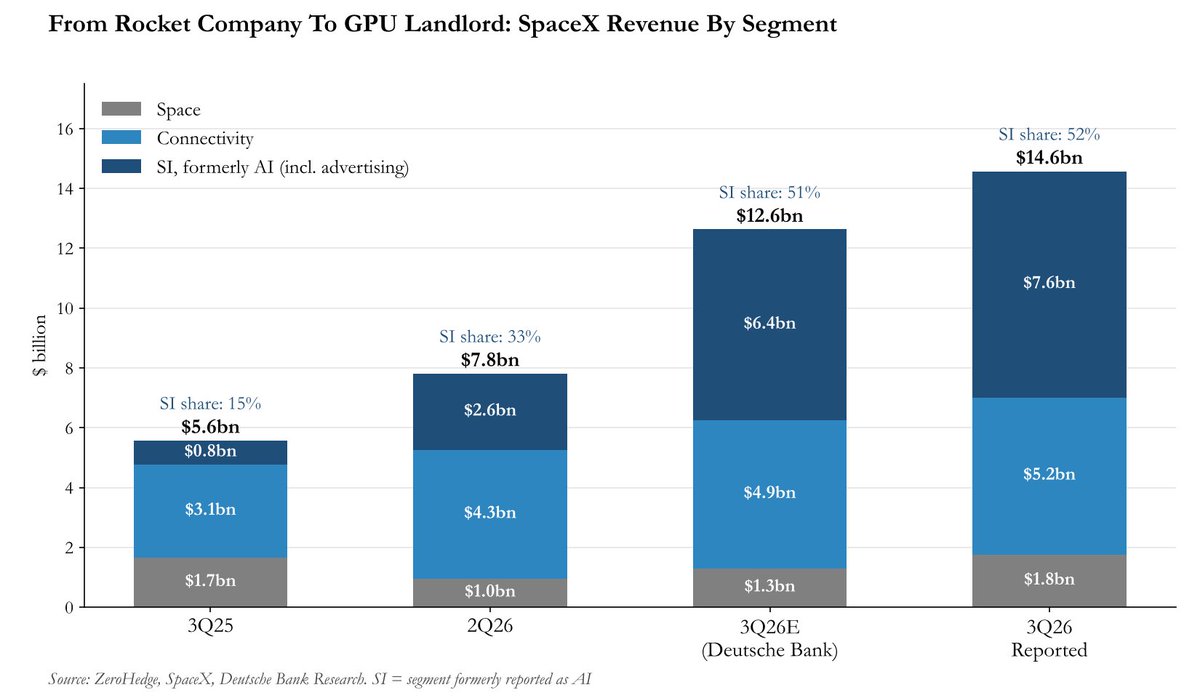
Elon Musk on Grok Bot: "We're seeing the fastest growth of a product that I've ever seen in my life. I've never seen anything growth this fast. The usage of Grok Bot per user actually has been growing over time. They are using it more per week, not less. Enterprise Grok Bot will be in wide deployment in a few weeks. I think Grok Bot will use most of SI compute."
🇫🇷 France's government SPENDING now equals roughly 57% of its entire economy...
That's higher than the levels shown here for the Soviet Union, communist Romania, Poland, and China.
• USSR at 50%
• Communist Romania at 42%
• Venezuela under Chávez at 38%
• Communist Poland at 36%
• China at 33%
Will France fall?
Source: @randgroup / Writer: Samuel
The first Starship to return to its launch site, Ship 40's journey took it across air, space, and sea. Now that it is vertical alongside three other Starships in a Megabay at Starbase, it will provide first-of-its-kind data on a flown Starship heatshield, Raptor engines, avionics, and more.
This is why Texas will do better than your state.
There is a center of gravity forming around all the stuff @elonmusk is building between Austin and San Antonio and beyond. It's going to be the closest thing the US has to Shenzhen.
Our hourlong exploration of the tech scene in Texas in full here on X.
Nvidia's market cap of $5.8 trillion is over $2 trillion higher than all of the companies in the Russell 2000 combined.
Seems absolutely crazy until you learn that Nvidia made a profit of $193 billion over the last year while the Russell 2000 members collectively lost $14 billion.
Video: https://t.co/R4VFHPjNiF
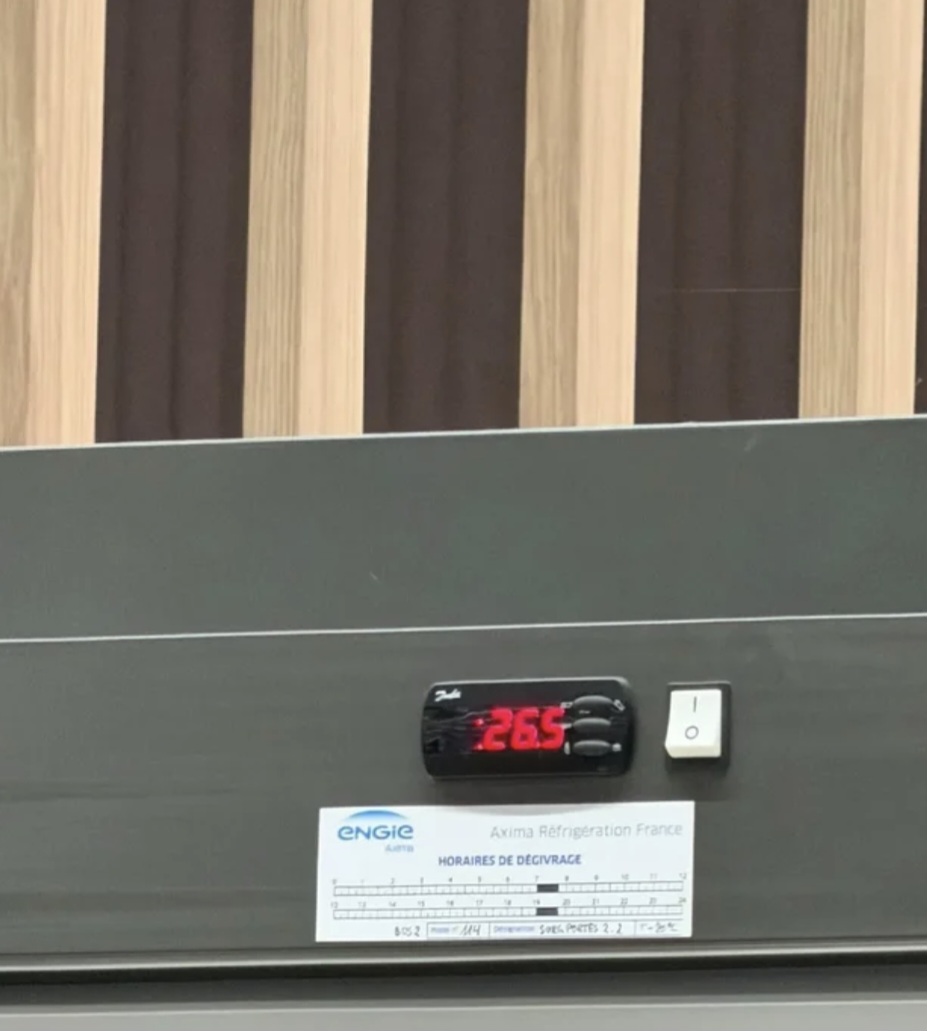
BREAKING: 🇫🇷 A major cyberattack has hit supermarket refrigeration systems across France, reportedly causing fresh and frozen food to spoil after hackers remotely manipulated temperature controls.
According to BFMTV, the attack began overnight from Sunday into Monday, targeting older versions of refrigeration-control software supplied by Danish company Danfoss.
The attackers allegedly exploited the systems’ defrosting function, forcing refrigeration equipment to heat continuously instead of keeping products cold. Temperatures were reportedly set as high as 50°C, destroying entire stocks of food within hours.
Several major supermarket chains have been affected, including Intermarché, Super U and https://t.co/7bHBi61WPZ. Metro stores and independent businesses, including butcher shops also have been impacted.
Around 150 Intermarché stores are reportedly affected, according to industry sources cited by BFMTV. The full number of affected locations remains unclear.
The financial damage is already significant. In Haguenau, Alsace, an Intermarché store reportedly lost its entire frozen-food stock, worth approximately €50,000. A nearby Super U allegedly had to discard both fresh and frozen products, with losses estimated at €220,000. An https://t.co/7bHBi61WPZ store in the same town was also affected, although its losses had not yet been calculated.
The combined losses reported at the Intermarché and Super U stores in Haguenau alone amount to around €270,000. Nationwide damage could reach several million euros.
Intermarché reportedly confirmed the incident in an internal communication, warning that several stores had suffered losses of frozen products. Coopérative U also acknowledged the attack and established crisis teams to assist affected stores and coordinate with refrigeration specialists.
Technical investigations are ongoing, and the full extent of the damage has yet to be established.
Authorities and companies are still working to determine the full circumstances of the attack. The identity of the perpetrators has not been confirmed.
Mark Zuckerberg says Alexandr Wang is the sharpest entrepreneur of his generation: "Alex is the guy. He's the fucking guy."
"Alex and I had spent a bunch of time talking over the years, and maybe once every few months or something we'd talk. And I was always just very impressed by how he thought about things strategically."
"I kind of had this view of like, all right, currently he's doing this very operational data business, but it always felt to me like he was the sharpest entrepreneur of his generation of the ones who I had a chance to meet."
"I think maybe when we got started, a lot of people were like, okay, like how is this going to work? It's like the social media guy is working with the data guy. Like, are we going to build a frontier lab here or what?"
"My really strong conviction is because I talked to all the leaders of all the labs, all the heads of research, all this stuff, and I was like, no, Alex is the guy. Like he's the fucking guy."
"We need this kind of strategic clarity that he has around the different ways that we want to approach this, the kind of extreme focus on talent density, on the clarity of communicating the different vision which we kind of fashioned together over this period."
"And a bunch of things that I think were kind of extreme but have basically worked, like having this very flat culture was something that you were kind of really obsessed with."
Arnold Schwarzenegger was a millionaire before Conan and before The Terminator. Not from movies. From bricks. He came to America in 1968 with almost nothing, and his first business was an ad in the Los Angeles Times with his friend Franco Columbu. It read “European bricklayers and
masonry experts.” Only one of them actually knew how to lay bricks. Franco had learned the trade back in Europe. Arnold was the one who wrote the ad.
At first they tried to be the cheapest crew in town. Nobody called. So they raised the price to European prices and sold it as European craftsmanship.
A week after the ad ran, an earthquake shook Los Angeles and knocked chimneys off buildings all over the city. Suddenly two European masonry experts were exactly what Los Angeles needed, and they were busy for two years.
Arnold saved every dollar. When he had about $26,000 in the bank, he put all of it into a six unit apartment building that cost around $240,000. Not one dollar left over. The front unit was twice the size of the others, so he lived there and the tenants paid the mortgage.
Two or three years later he sold it for roughly double. He tells the rest himself in the video below.
By the time Hollywood called, he owned more than a hundred apartments and offices on Main Street in Santa Monica.
On the Street we had a name for men like that. They didn’t wait to be rich before they started acting like owners.
Everyone remembers Arnold for the fortune. Almost nobody remembers who laid the first bricks of it.
Franco Columbu died in 2019 while swimming off the coast of Sardinia, the island where he was born. Arnold wrote the ad. Franco built the chimneys.
Gerard Butler Reveals What It Was REALLY Like Filming 300
THIS! IS! SPARTAAAAAA!!!
I generally speaking DGAF about Hollywood. That being said, thank you for making one of my all time top 5! 💪
In 1975, Steve Jobs told Steve Wozniak that Atari had paid them $700 for a game they built together. He handed Woz a check for $350.
Atari had actually paid Jobs about $5,000.
In the video below, Woz says: "Who cares about money? Well, you do care about friendship and honesty."
Jobs was working the night shift at Atari. The company wanted a new arcade game called Breakout, built with as few chips as possible.
Jobs couldn't build it. Woz could. He already had a full-time job at Hewlett-Packard, and Jobs said they had four days. Woz went four days with no sleep. Both of them came down with mono.
Woz did it in 45 chips. Atari's own engineers were using 150 or more.
He took his $350 and was happy with it. Jobs took the rest and went up to Oregon to buy into a farm.
About ten years later, Woz read the real number in a book about Atari. By then the two of them had built Apple, and Woz was a multimillionaire.
If Jobs had just told him he needed the money, Woz says, "I would say take it all."
It wasn't the last time. Before Apple went public in 1980, Jobs refused to give stock options to Daniel Kottke, his friend since college, who had helped build the first Apple computers.
Woz did the opposite. He sold his own shares cheaply to Kottke and other early employees who had been left out.
One friend kept almost all of a $5,000 bonus. The other gave away millions.
Was Jobs a genius who knew what business takes, or just a bad friend?
A copper dealer screwed over so many customers 3,700 years ago that when archaeologists dug up his house, they found a whole pile of angry letters inside. He kept every one.
His name was Ea-nasir. He sold copper out of the city of Ur, in what's now southern Iraq, around 1750 BC. This tablet is from a customer named Nanni, who paid up front for good copper ingots, got garbage metal instead, and then had his messenger insulted and sent home empty-handed. Twice.
Think about what it took to complain back then. Nanni couldn't write. So he hired a professional scribe to press his rant into wet clay with a reed stylus, waited for it to dry, then paid a courier to carry it across hostile territory to Ea-nasir's door. The tablet literally says his messengers passed through enemy land to collect. He was mad enough to fund a small delivery operation about it.
There's a reason he went to all that trouble.
Ea-nasir belonged to a guild of Gulf traders who hauled copper up from Dilmun, modern-day Bahrain. No court on earth could force a refund across that distance. Reputation was the only enforcement that existed, so a written complaint, witnessed and delivered, was Nanni's version of a one-star review the whole merchant community could see.
It seems to have worked. Later records suggest Ea-nasir's copper business dried up and he pivoted into real estate and used clothing.
Woolley's team excavated his house in the 1920s and found complaint after complaint, from Nanni and at least three other furious customers, stacked together in one room. Guinness lists Nanni's as the oldest written customer complaint in history.
The man got the worst reviews of the ancient world. And he filed them.
@Revelation1217 If the price of energy such as oil and gas goes up and people spend more on those resources…
Then wouldn’t they have less money to spend on everything else, bringing prices down on other items due to the decreased demand?