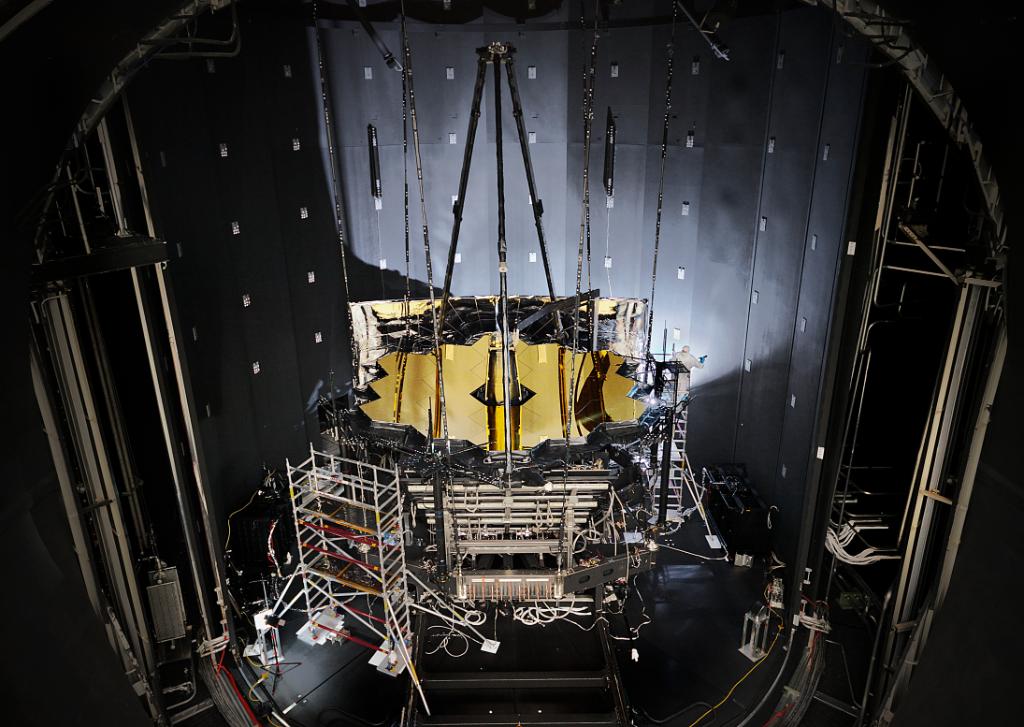
We know that water makes life as we know it possible. But where did Earth’s abundant water come from? Learn how @NASAWebb will investigate this open scientific question: https://t.co/S98iNlKnwU #astrobiology#NASAWebb
After the @NASAHubble Space Telescope launched in 1990, blurry images revealed a problem with the primary mirror.
After several years of careful planning STS-61 was launched on a 5 spacewalk repair mission. The first spacewalk began at 10:44pm (ET) on Dec. 4th, 1993.
#HubbleFriday Seeing the profile of galaxy NGC 3717 can provide a vivid sense of its three-dimensional shape. Spiral galaxies are mostly thin disks, but they have bright, spherical, star-filled centers that extend above and below: https://t.co/udIHfCXo9z
.@NotreDame tomorrow night - I’ll be giving the public lecture on “#Hubble’s Recent Hits and a Look Forward to the James Webb Space Telescope”. Join us at 7:30 pm in Jordan Hall for a tour of the Universe. https://t.co/5T58X5quSS @NDscience#JWST
Tomorrow's Our Universe Revealed: Hubble's Recent Hits and a Look Forward to the James Webb Space Telescope, a talk for everyone by Dr. Jason Kalirai. Jordan Hall of Science, Rm 101, Jan 23 @ 7:30 pm.
Mind-bending, color-enhanced swirls of Jupiter’s turbulent atmosphere can be seen in this @NASAJuno image of the planet. The spacecraft took this image of colorful, textured clouds in Jupiter’s northern hemisphere on Dec. 16, 2017. Discover more: https://t.co/mHoMlSS5xo
#OTD 20 yrs ago, Saul Perlmutter (right) and colleagues announced the startling discovery that the universe’s expansion is speeding up https://t.co/TScGCvlkC7
A great view of the storm hammering the East Coast. Of course, our eye was drawn to the angle of the day-night terminator so close to the northern winter solstice! Note the arctic is in the Earth’s shadow all day right now. [Check out animated images here: https://t.co/mGo6cLqpeQ
UGC6093 is a barred spiral galaxy — it has beautiful arms that swirl outwards from a bar slicing through the galaxy’s center. It is classified as an active galaxy, which means that it hosts an active galactic nucleus. Read on to find out what that means: https://t.co/pexeLd329k
A cosmic search for a missing arm…This dwarf galaxy, located ~30 million light-years away, reveals a single major spiral galaxy arm, giving it an asymmetric appearance. Why is there only one, when it would normally have at least two? Find out: https://t.co/5vsFLC10W9