The AI hype boys and superintelligence cultists forgot the only thing that matters: profits.
After years of breathless claims, trillions in spending, and endless demos, AI has delivered zero broad-based profit growth to most companies outside the pure tech players. Productivity theater? Sure. Measurable bottom-line impact that moves margins for the S&P 493? Flat. Dead. Nonexistent. The same economists pointing this out are now watching agent programs collapse under their own weight.
Here’s why the whole agent dream is stillborn as long as it’s built on LLMs:
An LLM doesn’t reason. It doesn’t understand. It doesn’t know. It statistically guesses the next token based on patterns in training data. That’s it. Calling that “intelligence” is the most expensive category error in modern business. You cannot control what you cannot verify, and you cannot verify a probabilistic next-word machine when it is given tools, memory, and autonomy.
Every multi-step agent multiplies the failure surface. One hallucination, one bad tool call, one context drift, and the cascade is already in motion. Real deployments are failing at 70-95% rates in production for a reason. Uncontrolled technology is not a feature. It is an uninsurable liability waiting for the first material incident.
Humans don’t work that way. When you ask me a question, I don’t sample the most probable next words. I use knowledge, experience, judgment, context, creativity, and an actual model of what you meant. That combination is what makes decisions reliable enough to trust with real money, customers, and operations.
SecureAgentzAI was built for this exact failure mode. Agents that stay reliable because humans stay in the loop by design—not as a temporary patch, but as the control surface. Strict permissions. No excess capability. Impossible to prompt-inject. Zero tolerance for uncontrolled autonomy. The technology does the heavy lifting; the human owns the outcome.
The industry is still selling the fantasy that next-token predictors can be left alone to run businesses. The numbers already show they can’t. The companies that figure out controllable, human-in-the-loop systems first will be the ones that actually capture the productivity. Everyone else is just burning capital on demos.
Human in the loop isn’t a limitation. It’s the only architecture that works. #GovernedAutonomy #AIhype
Nvidia is reportedly cutting gaming GPU supply by another 20–30% this quarter, per Chinese distributor forum Board Channels.
RTX 50-series stock is already low, and distributors could face more price hikes. In China, GPU makers are steering distributors toward older RTX 3060 and 3050 cards.
Here are 5 of the most common questions I've been getting about JFK -- with answers:
- Was Oswald an intelligence asset?
Oswald was surrounded by US Intel operatives regularly over a 5-year period. You have to accept an enormous number of coincidences (from Atsugi - Dallas - Moscow - New Orleans - Mexico City) to conclude he wasn't an intel asset of some kind.
- Was the Warren Commission Legit?
The Warren Commission was not a good-faith investigation. The evidence is overwhelming -- their goal was to make sure Oswald was found "guilty". Attorney General Katzenbach wrote that “the public must be satisfied that Oswald was the assassin.” Perhaps this was to avoid WWIII, but at a minimum, it forever contaminated the evidence and the investigation.
- What did the doctors at Parkland See?:
Medical experts at Parkland were consistent in what they saw -- a gaping wound in the back of President Kennedy's head.
- If Oswald Was Innocent, Why Did He Leave the TSBD?: It is fair to say that Oswald did things that raise questions on the day of the assassination (or the night before): he left his wedding ring, he left the TSBD, he got a gun, he went to the Texas Theater. However -- Oswald was neither a gunman (much less a lone gunman) nor an innocent bystander. He was very likely an Intel asset who thought he was on the inside of an operation/conspiracy -- only to realize after the gunshots that things hadn't gone as he expected. At some point, as he left the TSBD, he realized he was being set up. A Patsy.
- What did Jack Ruby tell the Warren Commission?:
It took them 6 months to meet with Ruby. Jack begged the WC to get him out of Dallas. He said he was in danger and could tell the full truth in Washington, D.C. In Ruby's words: “I want to tell the truth, and I can’t tell it here.” The WC never moved him. He died in Dallas, never having shared what he knew.
All of this and so much more in the new book I co-wrote with Rob Reiner and @DickRussell1 : WHO KILLED JFK?
I got hacked and the hacker dumped my coins on you and then the hacker transferred the funds to my wallet then the hacker transferred the funds to Coinbase and the hacker began off ramping funds to my bank account and the hacker started paying my bills
BREAKING: Jensen Huang returned to Nvidia’s Santa Clara headquarters Monday to cheers and chants from employees, hours after the board reinstated him as CEO.
“I’m going to be a better CEO the second time around,” Huang told staff, per Business Insider. “Thank you all for the second chance,” he said
BREAKING: Senator Ruben Gallego is calling for an investigation into stock positions taken ahead of Nvidia’s announcement that it would reinstate Jensen Huang as CEO.
Nvidia announced the board’s unanimous vote before the market opened Monday, and the stock surged at the open. Semafor reported that President Trump joined a board meeting by phone to push for Huang’s return, and the White House confirmed Trump was “totally involved.”
The call comes days after a CNBC analysis found Trump’s accounts traded Nvidia stock at least 103 times between January 2025 and August 2026, worth up to $97.5 million in total.
🚨 Almost NOBODY is fighting for a seat at Trump's memecoin dinner tonight, with one buyer getting in for just $518.
The first $TRUMP gala required at least $55,000 in coins, per The Washington Post.
Over 5,000 holders who could have qualified didn't even sign up, even after a 4-day extension.
The coin trades near its all-time low under $1, down about 99% from its $75 peak.
Trump has said he earned $635 MILLION from it.
8 Democratic senators, led by Adam Schiff, called the event a possible "pay-to-play scheme," and Democrats have pledged to investigate once they control Congress next year.
The White House says it's a private event that promises no official government action.
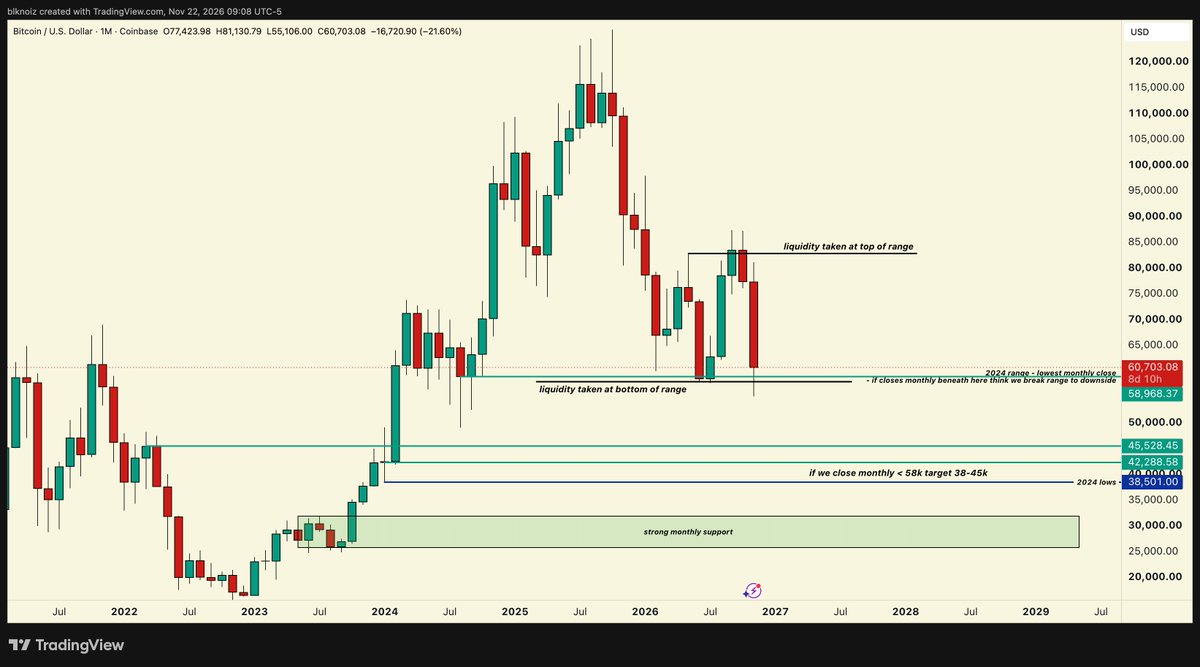
bitcoin:native
- need mid 50ks to hold, bearish bias until 82.5k+ reclaimed, expecting chop until end of year and decisive move in H1 of 2027
- if i had to guess on squiggly id say 56k->70k->56k next few months with muted volatility
- HTF closes sub 56k & think we retest low-mid 40ks
it's a bit higher for me
i only started using and talking about fomo a few months ago (genuinely wish i'd done so much earlier)
but even then, it's still nowhere near the $24.5 MILLION+ my fomo portfolio is currently down from its ATH
and no, i'm not 'selling on side wallets' as many continue to insinuate on this app without providing a single shred of evidence (if they have any, they should share it)
so while the numbers may seem impressive to many, they're still just 1/16th of what my portfolio is currently down from peak
PS: i've also had an active six-figure giveaway running for my fomo referrals for months now 👀
Honestly this cycle has been pretty easy.
All you had to do was catch memes early in 2024, rotate from dogs, to cats, to AI, farm $HYPE, full port $TRUMP at launch and sell the next day, avoid $MELANIA, $LIBRA, and every other celebrity rug, catch the $PUMP breakout, sell the exact top, rotate into $ASTER, then catch the BNB meta that lasted 2 days, be early to the Believe coins, sell before pasternak exit scammed, buy $USELESS when it was down -90% and ride it to $400m, long $ZEC before privacy coins started flying, move to Robinhood, full port $PONS at $1m and sell at $600m before Robinhood abandoned crypto, predict the stock meta, full port $ZCAT and sell the top, then ride off into the sunset.
Really wasn't that complicated.
$ANT - ANTHROPIC MATHEMATICIAN CLAIMS CLAUDE SOLVED 167-YEAR-OLD RIEMANN HYPOTHESIS
Anthropic mathematician Levent Alpöge claims to have proved the Riemann Hypothesis and its more ambitious generalization using Claude AI.
The proposed proof was formalized in Lean, a mathematical verification system.
Independent validation remains pending.
If confirmed, it would mark a historic breakthrough in mathematics and AI-driven scientific discovery.
the greatest technology mankind has ever invented is going to get exponentially better during a cyclical downtrend in risk assets
if this continues you are being gifted a generational opportunity over the next 9-18 months
This is an open invitation for all crypto bros.
I’m single, 28, 172 cm and 58 kg, measurements 102-63-95. Long blonde hair, very pale skin. I speak 3 languages, graduated with high honors from the top university in my country, and have visited 45 countries across 6 continents.
I cook and clean well, do all my beauty treatments myself (so I’m not expensive) and am kinda rich.
I have 8 houses worldwide and 3 cars. I’ve only had 2 boyfriends. I trade memecoins and know all the gossip in the space so you’ll never get bored.
Also I am funny sometimes.
Serious men only. Not a shitpost.
Thank you 🫶🏻
BREAKING: A cybersecurity firm used AI to uncover a critical security flaw in Java, one of the world’s most widely used programming languages.
The bug, dubbed “Java4Shell,” was found by start-up Calif in OpenJDK, the core software that runs Java programs. Researcher Quang Luong used OpenAI’s Codex coding agent to find the flaw in about an hour, then build a working attack in about two more, for less than $200 in computing costs. Calif rated it 9.2 out of 10 for severity.
The flaw sits in Java’s Base64 decoder and can be triggered by sending just 64 “A” characters followed by a single “=.” That can corrupt the computer’s memory, potentially letting an attacker take over a server or expose sensitive data, similar to the Heartbleed bug. Calif demonstrated a working break-in on Keycloak, a widely used login system, and says tools like Jira, Confluence and Jenkins are also at risk.
Java runs at 90% of Fortune 500 companies, Calif estimates, and is used by banks, hospitals and governments worldwide. “This is such an unlikely and serious flaw,” computer scientist Toby Walsh told the BBC, because Java is designed to handle memory safely.
Oracle and OpenJDK have released fixes.
🚨 Another major scandal is coming out of NVIDIA.
And this one has nothing to do with Jensen Huang's affairs.
According to a Wall Street Journal report, Nvidia was offering billions in financial guarantees to AI companies that could not afford its chips, so they could keep buying them.
Some of these deals were being pushed by Jensen's own son-in-law, Nico Caprez, who became a vice president in January. His team was telling small cloud companies and data center builders that Nvidia could arrange credit support for them within a couple of weeks.
The goal was simple: turn them into long term buyers of Nvidia GPUs.
And the size of Nvidia's commitments has exploded. Its own filing shows $530 BILLION in commitments and guarantees, up from $184 billion just one quarter earlier.
Inside the company, CFO Colette Kress was raising concerns. She kept asking how these guarantees were priced and what Nvidia was really getting back.
In an August meeting, Jensen cut her off and called her "a deer in the headlights."
She was also the one who cut Nvidia's guarantee on OpenAI's Ohio data center from $250 billion to $105 billion.
Now Jensen is gone, and the CFO who questioned these deals is running Nvidia.
To understand why this is a big deal, you need to understand the AI funding loop.
Here is how it works:
1. Nvidia puts money into an AI company, or guarantees its loans and leases.
2. That company uses the money and credit to build a data center.
3. The data center is filled with Nvidia GPUs.
4. Nvidia reports those GPU sales as revenue.
5. If the company cannot rent out all its computing power, Nvidia agrees to buy the unused part.
SO NVIDIA IS THE INVESTOR, THE LENDER, THE SUPPLIER AND THE BACKUP CUSTOMER, ALL IN THE SAME DEAL.
The money goes out of Nvidia and comes back to Nvidia as sales.
CoreWeave is the clearest example. Nvidia owns a stake in it, sells it chips, and agreed to buy up to $6.3 billion of its unused computing capacity through 2032.
OpenAI is the biggest. Nvidia is guaranteeing up to $105 billion for its Ohio data center, supplying all the chips inside it, and invested $1.5 billion in the company building it.
Nvidia's own filing for the quarter ending July 26 shows where the money is tied up:
• Supply commitments for memory and chip wafers: $279 BILLION, up from $119 billion.
• Guarantee on the OpenAI Ohio data center: up to $105 BILLION.
• Deals to buy unused cloud capacity from neoclouds: $36 BILLION.
Nvidia's actual liabilities on its balance sheet: $91 BILLION.
That means the commitments outside the balance sheet are almost 6 times bigger than the debts on it.
Nvidia does not lose this money unless something breaks. A guarantee only costs Nvidia if a customer cannot pay.
But this is where it gets uncomfortable.
The WSJ says Jensen himself had started to panic. He warned executives that the biggest cloud companies were moving to their own chips to depend less on Nvidia.
At the same time, the wafers and memory Nvidia had committed to buy were coming at him like an "avalanche."
So the biggest customers were trying to leave, Nvidia was locked into buying huge amounts of supply, and smaller customers were being kept alive with Nvidia's credit.
And things were already starting to crack:
• Nvidia paused some of its financing deals in August.
• Nearly half of the $80 billion in data center bonds issued this year were rated junk.
• Neocloud stocks crashed this week, with Nebius down over 20% and CoreWeave down 17% at the lows.
• OpenAI raised less than it wanted, at a lower valuation.
And now Kress is the one deciding whether this continues.
If she pulls back on the financing, the companies that depended on Nvidia's money will have to borrow elsewhere, in a debt market that is already nervous.
If they cannot, they stop buying chips.
And if they stop buying chips, Nvidia's revenue drops.
That is the risk of a loop. It works perfectly when money keeps flowing, and it hurts on the way down.
BREAKING: Hackers spread malware to websites run by at least 178 major organizations, including Zoom, CNN, BBC, Fox News, HSBC, Equifax, Salesforce, IKEA and Air France-KLM, per security firm Report URI.
Attackers exploited a flaw in Optimizely, a website-testing platform, to plant code designed to steal payment data, hijack crypto payments and target older iPhones. Banking and finance was hit hardest, with 32 organizations affected, including HSBC across multiple markets.
Optimizely says the flaw is fixed. Report URI has traced about $7,000 in stolen crypto so far.
Anthropic CEO Dario Amodei says compute is “the deepest business dilemma that the company faces,” days before the company’s IPO.
Amodei said Anthropic has to buy computing capacity one to two years before it knows whether revenue will cover the cost.
Buy too little, and it can’t serve customers or build new models. Buy too much, and “you can financially overextend yourself.” “There’s a huge uncertainty in what’s going to happen next year,” he said.
People will likely look back at the Quantum period for Bitcoin as one of the most incredible asset buying opportunities in financial history.
Without quantum overhang Bitcoin likely trades at $250k+ right now.