Mathematics.
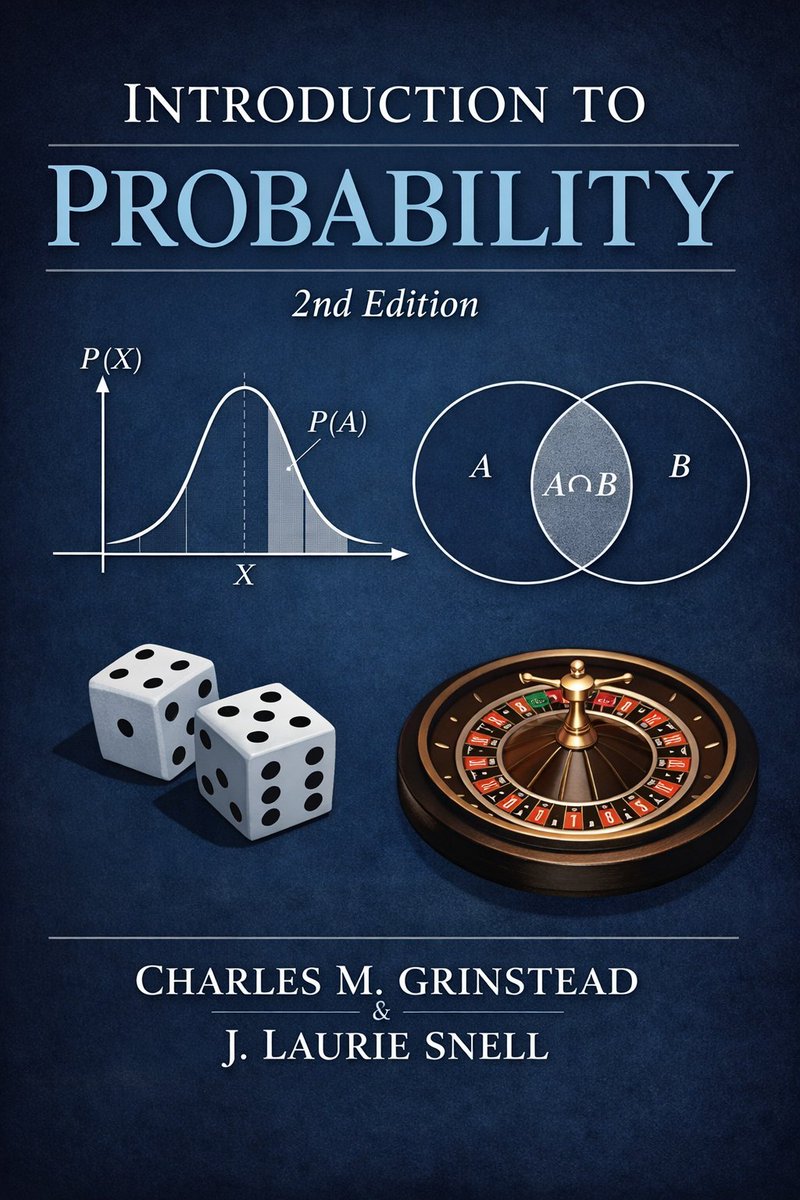
Free book PDF. "Introduction to Probability," 2nd edition, by Charles M. Grinstead and J. Laurie Snell.
"Probability theory began in seventeenth century France when the two great French mathematicians, Blaise Pascal and Pierre de Fermat, corresponded over two problems from games of chance. Problems like those Pascal and Fermat solved continued to influence such early researchers as Huygens, Bernoulli, and DeMoivre in establishing a mathematical theory of probability. Today, probability theory is a well-established branch of mathematics that finds applications in every area of scholarly activity from music to physics, and in daily experience from weather prediction to predicting the risks of new medical treatments."
Link: https://t.co/JxZlnwr6Gi
New release: DIA's “Analyzing Will to Fight” gives analysts a framework to determine an actor’s ability to survive and sustain combat, accomplish the mission, and prevail over the adversary.
Find the framework and background: https://t.co/ON11JGGJVT
Exciting quantum milestone from RBC (@RBC)!
Great to see them advancing their quantum strategy by launching a hands-on workforce training program using PennyLane (@PennyLaneAI)'s open-source software to build real-world application capabilities—supported by new academic partnerships with the University of Waterloo (@UWaterloo) and the University of Toronto (@UofT).
A massive step forward that strengthens quantum talent and accelerates the entire ecosystem.
Read more: https://t.co/opXS01Oa3P
Major announcement in mathematical formalization!
Finally, after 3 months of very intensive, nonstop work by several AI agents (Codex and Claude Code), we have settled a classification of ALL 15,973 semigroups of order 6. Every one of the 15,969 that has a finite basis now has it written down explicitly, and the remaining 4 are proved to have none at all.
The whole list of bases is produced for the first time in history. Until now, for most of these semigroups, mathematicians only knew that a basis exists; nobody had ever written one down. The formalization in Lean, orchestrated with a multi-agent approach, reached more than 5 MILLION lines of verified Lean code, one of the largest auto-formalization projects to date.
It's been an amazing joint work with @JanotaMikolas and @Jan_Hula, accompanied by senior experts in semigroup theory, João Araújo and Edmond W. H. Lee.
Our paper describing this project, "Proving at Scale for Universal Algebra", has been accepted at the MATH-AI workshop, NeurIPS 2026!
When we launched this project, we were a bit pessimistic: producing proofs for 15,973 semigroups seemed out of scope for the current technology. But with a careful setup (agents communicating through a mailbox we arranged, orchestrating the effort with a custom method of bootstrapping and auto-research), it has finally come to the finish line. The last 390 semigroups took 23 more days. The very last one needed a whole structural analysis before its proof could even be written.
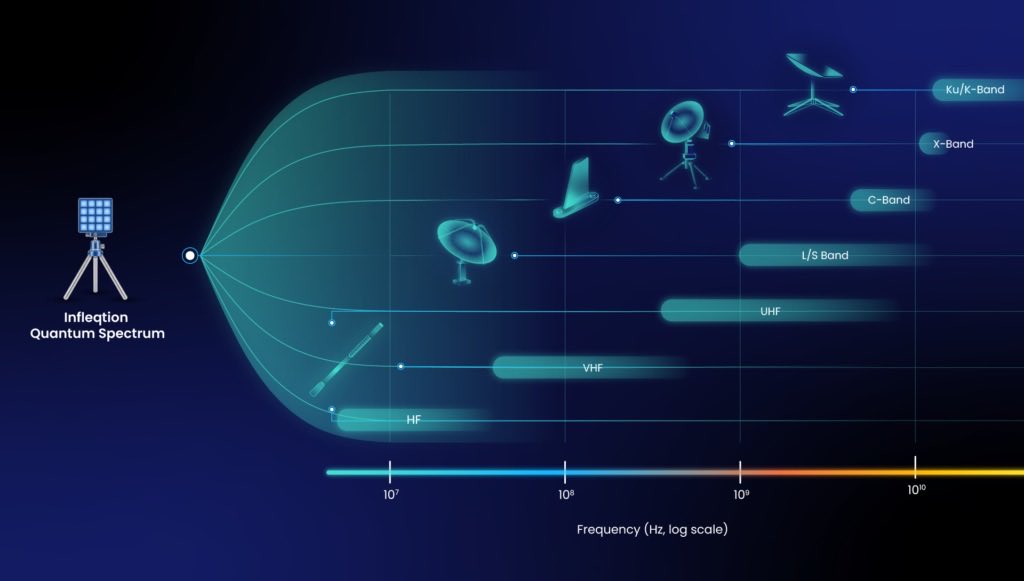
ONE QUANTUM ANTENNA CAN HEAR THE ENTIRE RADIO SPECTRUM.
Every antenna in the world is built for one slice of radio. The physics forces it, an antenna has to be roughly the size of the wavelength it's catching, so a low frequency HF antenna is tens of meters long and a Ku-band dish is a small plate. A warship or an aircraft carries dozens, one per band, and every one is a visible, jammable piece of metal, but this is changing.
Infleqtion's Quantum Spectrum does it with a cloud of atoms. Excite cesium atoms into a Rydberg state, where the outer electron orbits far from the nucleus, and the atom becomes exquisitely sensitive to electric fields. Shine a laser through the cloud and you can read any radio signal passing by. The current generation covers 1 MHz to 12 GHz continuously in a single aperture, HF through Ku band, with a roadmap that stretches toward terahertz. It fits in a 4U rack unit, down from 9U a generation ago, with chip scale packaging on the roadmap.
Why militaries are paying for it: It listens without transmitting, so it can't be detected the way a radar can. It's hard to jam, because the atoms aren't tuned to one frequency to overload and one unit monitors the whole spectrum at once, which is the core job of signals intelligence and electronic warfare.
Three countries have already bought in. The U.S. Army, through its research lab, for transportable quantum RF systems. The U.K., for a multi-sensor direction finding program. Australia's defense science group, for a broadband receiver. Integration partners include L3Harris, SAIC, and Dell Federal.
$INFQ $IONQ $QNT
Eduard 1.4.18 released: cast shadow layer, Mapterhorn DEM download, support for macOS 27, and various bug fixes and improvements
https://t.co/JZuWPG34BX
For 70 years, physicists have designed elaborate detectors and experiments to study a mysterious particle called the neutrino. Today, Fermilab is building the next era of neutrino discovery through the world-leading @DUNEScience at @LBNFacility. https://t.co/TkFFCqkzq3
We are hiring a Quantum Scientist - Compilation to join Xanadu’s software and algorithms group and work with our team of scientists and developers to design cutting-edge quantum algorithms.
In this role, you will help build one of the world’s most advanced software platforms for quantum computing by designing compilation architectures, optimizing compilation passes, inventing key IP, and publishing scientific papers.
Sound like your next role? Learn more and apply today: https://t.co/YyOx8WXhM5
As AI agents gain authority to run tools and access data, boundary enforcement can't rely on the model alone. Discover how Red Hat and @NVIDIA are building independent enforcement layers across software and hardware boundaries. https://t.co/K1CH6x68Wd
The idea of an intelligence explosion caused by recursive self improvement has been around for a long time but until very recently it did not seem imminent. Now many leading researchers think it may happen quite soon. You can read our paper about it here:
https://t.co/sgUpugjpRY
Codex CLI just got a major refresh, with a new look and powerful new capabilities.
We’re continuing to invest in Codex CLI for developers who live in the command line.
New full-screen interface, better readability, and ways to manage parallel work, all inside your terminal.
Bumblebees matched a flowerlike platform moving sideways twice a second, though their flight lagged behind it. How they sense their own turns remains unclear. @RSocPublishing https://t.co/tyDeY4yj7h
The USGS LiDAR app just crossed 37,000 users in less than 1 month!
Main takeaway: people love exploring the data, but it needs to be faster.
The current version pulls from USGS as you move around the map. That keeps it cheap and gives national coverage, but speed depends on live requests + processing.
So I built a new version that preprocesses LiDAR + aerial imagery into multi-resolution tiles. As you zoom in, it only loads the detail you need.
The result is lightning fast... smooth flying, instant LiDAR/imagery comparison, and real-time elevation rescaling.
The problem is storage. Massachusetts: ~100 GB, Colorado: ~1 TB, Entire US: 60+ terabytes.
At full scale, hosting would cost $6k-12K/year.
Also learned that 68% of users are on mobile, so a better mobile version is coming.
Hope to have a faster version soon when I figure out how to pay for it!
Happy exploring on the original app:
https://t.co/L0plghwNvw
Stop refactoring stable code just to apply a security patch. Read how Lightwell delivers targeted fixes directly to your production stack without breaking APIs or slowing releases: https://t.co/hbM5MDcyT8 #Sibos
The strangest feature of Anti-de Sitter spacetime may not be its negative curvature. It is the boundary. Light can travel outward, reach this boundary, and return in finite coordinate time.
This makes infinity more than something infinitely far away. It becomes part of the causal structure of the spacetime, a feature that later became central to ideas such as holography and AdS/CFT.
Twelve years after launching Universal SSL, Cloudflare is applying to become a certificate authority. By combining an established root, an ACME-first approach, and Merkle Tree Certificates, we are building a post-quantum CA for the open web. https://t.co/N5UAbp8Jwx #BirthdayWeek
If you have not heard this news story, it is pretty big in the chemistry world. Being able to break down polyethylene cheaply is a big deal. It makes waste plastic more valuable, which makes it less likely people will just throw it into rivers where it flushes into the oceans.
AI discovered how a material just one atom thick can keep carrying load as its atomic structure begins to break, preventing catastrophic failure. This discovery is based on first-principles atomic scale reasoning integrated with biological principles, cutting across scales and providing deep insights into materials in extreme conditions. The resulting material is extremely lightweight yet strong, far better performing than existing structures. By organizing "simple" carbon atoms into hierarchical graphene architectures, unique materials can be designed that redistribute forces, accommodate deformation, and confine damage, the AI identified design principles for resisting catastrophic failure. The AI built the atomistic simulation instrument itself "from scratch"; and then conducted experiments autonomously that revealed when alignment strengthens a material, when hierarchy protects it, and when an apparently promising design fails. This is a frontier in designing matter at its ultimate thinness - controlling how mechanical failure unfolds through the organization of individual atoms.
Here is what we did:
▶️ We asked an AI to build and use a scientific instrument. It wrote the force engine, structure generators, loading procedures, analysis tools, and experiment database. The independent campaign ran for multiple days without scientific intervention.
▶️ We required the instrument to pass physical and numerical tests. The implementation passed twenty validation tests and reproduced reference energies to approximately 10⁻¹³ eV per atom in the tested configurations. Every proposed design then faced the same reactive interatomic model.
▶️ We required predictions before results, creating a loop of world model building and falsification/verification. The AI had to commit to what unseen designs would do, then run the simulations. Incorrect predictions became opportunities to identify missing mechanisms.
What emerged is a set of physical design principles:
▶️ The atom-scale arrangement of matter controls strength. The AI first showed how and why strength varied by more than sixfold across architectures. Similar amounts of carbon produced very different resistance to failure because they organized the load-bearing connections differently.
▶️ Rotating a pattern can change the mechanism of failure. Angled slit arrays revealed three regimes: neighboring slit tips link, intervening ligaments rotate, or short bridges bend. A rule based only on the remaining cross-section misses these changes in connectivity and motion.
��️ Hierarchical structuring works under identifiable conditions. At the original scale, much of its apparent strength advantage can be explained by alignment. With greater separation between structural levels, selected hierarchical designs became about 25% stronger than same-mass single-level controls and showed larger integrated stress-strain responses. Veins redistribute load, compartments localize damage, and the architecture changes how cracks propagate.
▶️ A failed prediction is crucial to reveal the next experiment. Some proposed rules survived targeted tests; others failed. Longer loading preserved the broad architectural strength contrasts while revealing additional deformation and, in some cases, later stress peaks. The scientific value lies in identifying both the rule and its boundary as the AI punctures known scientific knowledge.
▶️ The instrument opens an extremely complex design space. The AI was able to expand the design languages into an open atlas of hundreds of thousands of atomically explicit structures.
The deeper implication is that AI can construct an executable connection between equations, experiments, and explanations. Physical reasoning is something they can implement, interrogate, and revise.
A scientific instrument extends what a scientist can observe; and an AI that builds such an instrument extends the experiments it can perform, and the questions it can ask, starting from basic principles of how atoms interact based on quantum mechanical ground truth.
Models building models, with physical evidence shaping recursive reasoning loops.