Visualizing moiré and atomic lattice patterns in 2D heterostructures is key to advancing quantum devices. Torsional Force Microscopy (TFM) enables fast, non-destructive imaging under ambient conditions—no electrical bias, no contacts, just pure nanoscale insightVisualizing moiré and atomic lattice patterns in 2D heterostructures is key to advancing quantum devices. Torsional Force Microscopy (TFM) enables fast, non-destructive imaging under ambient conditions—no electrical bias, no contacts, just pure nanoscale insight.
My first flight to USA was @airindia. I still remember the the non stop flight from Delhi to New York. Their staffs are well trained. I would always fly them again. My prayers are with the airline and families today!
It's been a busy week for us. SO busy that we forgot to mention that @NotebookLM is officially powered by Gemini 2.5 Flash ⚡️⚡️⚡️
The 2.5 models are thinking models, so you should start to see more comprehensive answers, particularly to complex, multi-step reasoning questions.
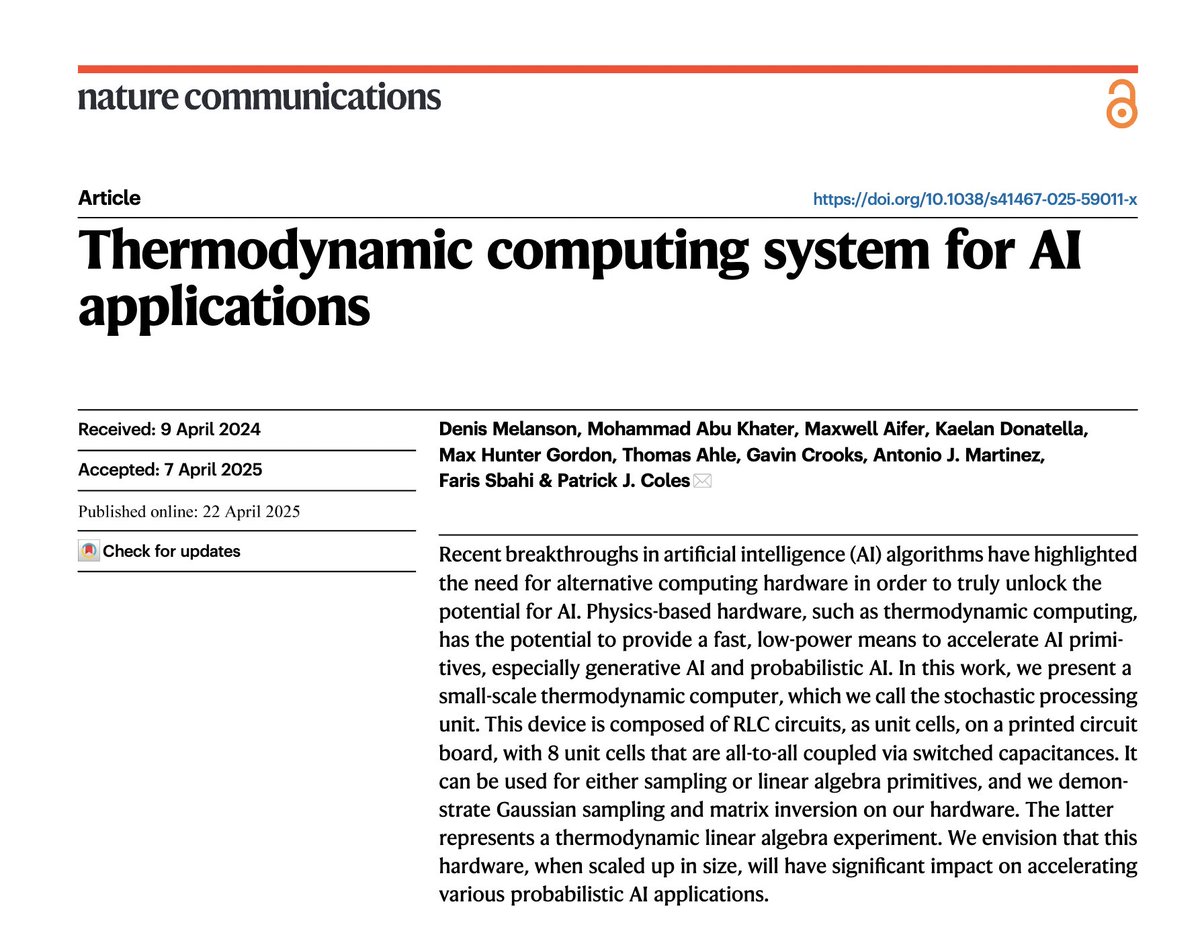
We're excited to share that our research "Thermodynamic computing system for AI applications" has been published in @NatureComms, detailing our early work on a prototype thermodynamic computer. Our stochastic processing unit used coupled RLC circuits with injected noise to demo various thermodynamic algorithms, like matrix inversion, Gaussian sampling, and ML uncertainty quantification. A scaled-up version of this architecture would significantly impact probabilistic AI applications.
Fortunately, we are already making progress in this direction! As shared at NYC Deep Tech Week, we're now building the Carnot architecture - silicon that enables unprecedented scaling for thermodynamic computing. Our approach simulates Langevin dynamics to accelerate algorithms that reason about the physical world, with transformational applications in generative design, scientific computing, and probabilistic reasoning.
Congratulations to Denis Melanson, Mohammad Abu Khater, Maxwell Aifer (@MaxAifer), Kaelan Donatella, Max Hunter Gordon, Thomas Ahle (@thomasahle) , Gavin Crooks (@gavincrooks), Antonio J. Martinez (@zaqqwerty_ai), Faris Sbahi (@FarisSbahi), and Patrick Coles (@ColesThermoAI)!
Read the full article here: https://t.co/REUCUSCGJJ
Quadrupolar exciton states are shown experimentally to be present in the reflectance contrast spectrum of 2𝐻-stacked bilayer MoSe₂ https://t.co/fKaNUnLnXD
MIT engineers have done it again! They've developed groundbreaking "high-rise" 3D chips that can exponentially increase the number of transistors on a chip. This means faster, more powerful computers and AI hardware. https://t.co/f9ByfW6aAv
@TwistoCaen I want raise a strong complaint against 6a bus which suppose to stop at Nashville even after the passengers have pressed the 🛑 button. It stopped between memorial and Nashville to drop the passengers and was not able to catch the bus even after running behind it.
Check out the latest from MIT EQuS and Lincoln Lab in @NaturePhysics! We generate remote entanglement by emitting and absorbing a chiral (directional) microwave photon.
https://t.co/9zoo9vZtm8. See also the MIT News feature: https://t.co/fE4iXT9Nrv