“A basket overflowing with bread sits atop your head,
yet you go door to door, begging for crumbs.
You are knee-deep in a river,
yet, heedless of yourself, seeking water from this and that."
- Rumi (V, 1073)
A former Executive at Carvana sheds light on the company culture, the execution challenges, and what caused their near-death experiences.
"It caused it. Let me give an analogy. Imagine I'm a company that requires common carriers to ship. I've grown to the point where I have 50 ship points instead of three where I started, and I have a TMS system. That TMS system lets me reroute. If a driver calls in sick, I can give it to another driver. I can backfill certain lanes where I have a driver. Let me back up. When I put a TMS system in and my drivers are all over the place, I start routing them from where they live. They own the truck or use our truck. They live at their house in the middle of Nebraska, and their job is to drive to this point and back every week to deliver. That was how some companies run. You put a TMS in, it changes their routes, and they start getting dispatched here and back, there and back, here and back versus that one lane. Now, if you take the TMS system out, they go back to a static route. The driver's back to one lane. Then imagine Covid comes in, and all of a sudden all these guys that are in the middle of relays are gone. They can't work. How do you route your freight through static relays with no system when you've got holes all over the entire U.S. geography from people? Twenty percent of your drivers are out. How do you move it? You're not set up to move it. Something takes out the middle of your network, you're screwed. At the edges, if I'm in New Jersey and I get a sick guy, I can find other drivers. It's a big center. When you're in the heartland Midwest, you don't have drivers floating around. Everybody else has the same issue. Everybody's losing drivers. Everybody's losing dock house workers, everybody's losing mechanics. Anybody that's in the public domain is taking a hit. Twenty percent are gone. The TMS system and a WMS system will help you compensate. It won't protect you. It won't shield you 100%, but it mitigates that risk and lowers the impact significantly."
$CVNA $KMX
There has always been speculation about how @Carvana creates such differentiated results. The truth is simpler than many people realize - it's a vertically integrated business model built to create better customer experiences end to end. I appreciate @peterahigh digging into the details of our integrated systems and the tailwinds to come from AI.
Apple: https://t.co/qpgcZx6zSo
Spotify: https://t.co/e7HN7UQQ5H
YouTube: https://t.co/JqS18hgppF
⚡️Clean intent is rare.
And reality is wired to respond to rarity with leverage.
Clean intent is an energy stabilizer in a chaotic system
Most human behavior is noise:
•self-protection
•status-seeking
•resource extraction
•trauma reenactment
•future control attempts
•social simulation
When you act without any of that - when the motive is just to do what must be done - it becomes signal in a noise-dominated system.
And signal always cuts through faster than noise.
That’s the first reason things seem to “work better” when you drop self-concern:
you stop broadcasting interference.
You become easier to cooperate with.
Easier to trust.
Easier to predict.
Easier to align with.
The world isn’t helping you.
You’re finally helping it resolve itself.
Secondly, it's pretty interesting that Gotham inadvertently highlighted that both Drivetime and $CVNA make money on VSCs originated by $CVNA, which has been a big point of contention for bears. The contract originator gets most of the economics, and DT still makes 15% margins on contracts originated by $CVNA. I doubt people will argue that is so far off market that it is a huge subsidy gifted to $CVNA by Drivetime.
The biggest misunderstanding about capitalism is that it’s zero-sum. When it’s working, it’s a system for creating value, not redistributing a fixed pie. That’s the core thesis behind @tryramp.
We started with a simple question: what happens if you make every dollar a company spends more productive? Not just cheaper, but faster, better allocated, and less error-prone.
The obvious result is savings. On average, businesses on Ramp spend 5% less than they otherwise would.
The more interesting result is growth. We recently learned that the average business on Ramp grew revenue 12% last year — several times the U.S. national average. Not because Ramp is a “growth tool,” but because time, attention, and capital are scarce. When you give them back, and reduce avoidable operational risk, they get reinvested.
Seven years ago Ramp didn’t exist. Today 50,000+ businesses run on it, spending less and growing faster than they did before.
A $32B valuation might sounds like a lot until you ask the deeper question: what is it worth if a meaningful slice of businesses suddenly becomes more productive — employs more people, invests more, and wastes less?
That’s the prosperity machine we’re trying to build.
People often ask how we balance speed and quality at @tryramp.
We don’t. Because speed is how you get to quality.
Even the best hitters in baseball miss 70% of the time. A .300 batting average means the world’s best still fail twice as often as they succeed.
Building products is no different.
Even if you deeply understand your customer, you’ll still be wrong most of the time — it just takes iteration to discover what actually works.
Take two teams:
Team A ships every 2 weeks.
Weeks 2, 4, 6, 8 — all wrong. Week 10 — nailed it.
Team B waits for “perfect.”
Week 8 — wrong. Week 16 — wrong. Week 24 — finally right.
Team A made more mistakes, but found truth faster.
Team B “protected” quality and ended up slower, later, and with less conviction.
In the real world, there’s no limit to your at-bats per inning.
You can swing 100 times if you design your org and culture for it.
Speed isn’t a trade-off with quality. Speed is the way to get to quality.
$KMX was removed from the S&P 500 recently. $CVNA is near the top of the eligible list, per Bloomberg. Seems like they might want the largest and most profitable independent auto retailer. Is it time?
$CVNA is launching 2025-P4. Yesterday they claimed that the auto credit spreads have tightened back up again since Tricolor and that they see no deterioration in consumer patterns.
Also, the two new loan purchasers at $4B each specifically want non-prime only.
Per Yipit (an alt data provider), based on web scraping. For the week of 10/18:
Carvana sold 12,881 cars
CarMax sold 12,715 cars
So, for the 2nd time, Carvana was the largest vehicle retailer in the US for the week. CONGRATULATIONS to the $CVNA Team! The march continues!
Per Yipit (an alt data provider), based on web scraping.
For the week of 10/12:
Carvana sold 12,427 cars
CarMax sold 12,413 cars
Thus, for the first time, Carvana took the title of largest vehicle retailer in the US.
CONGRATULATIONS to the $CVNA Team!
The march continues!
Despite opposition from ISS, Glass Lewis & NY State Comptroller—and skewed Reuters coverage—I expect Tesla shareholders to approve the 2025 CEO Performance Award on Nov 6—it's a steal! Up to 424M shares tied to wild milestones: market cap milestones starting at $2T up to $8.5T (creating $7.5T in shareholder value), $400B EBITDA, 1M Robotaxis, Level 5 FSD & more. Elon doesn't take from what's already there—he only gets paid big if he creates trillions in new value! @Reuters: That's for massive achievements, not for "hitting a handful of the board’s easier goals that won’t necessarily revolutionize Tesla’s products or business." 🚀 #Tesla
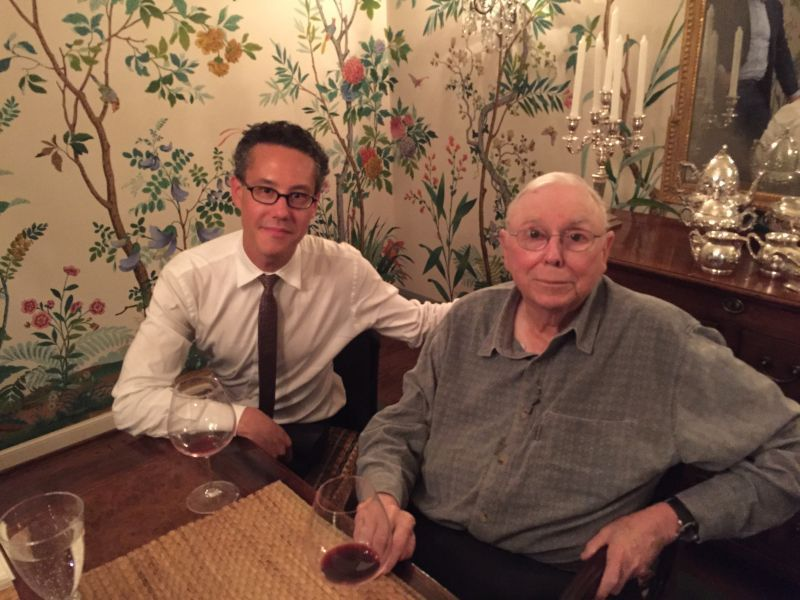
This photograph was taken with the late Charlie Munger at his home in 2018. He spoke over dinner about simplicity, of removing unnecessary motion in investing and life.
I'll always remember something he said that day: “It’s the nature of the world for the large to get larger."
Especially in technology, you see this dynamic play out. The biggest players typically become even more dominant, leading to winner-take-most or winner-take-all outcomes.
There’s Google in search, Apple in hardware and software ecosystems, Nvidia in AI chips, or Tesla in electric vehicles. Each started as a disruptor and built advantages so durable that competitors often struggle to catch up. Their size created a flywheel: more users bring in more data, more data improves the product, and a better product attracts even more users.
Great companies, like great investors, tend to compound their advantages. Markets tempt us to act, but Munger taught so many of us that progress comes from thoughtful inaction and from the discipline to wait for the right pitch.
Marcel Proust wrote: The real voyage of discovery consists not in seeking new landscapes, but in having new eyes.
At Tsai Capital, that’s how we think about valuation in an age of disruption. Don’t dismiss a business as “expensive” because of traditional heuristics. Do the work. Study the business model. Look with new eyes. Some of the greatest opportunities hide behind seemingly high multiples.
Though the past offers no ironclad promises for tomorrow, history reveals that the biggest winners—from Apple and Microsoft to Amazon and Tesla—often lurked behind what appeared to be lofty valuations.
Nice summary by @MatthewGut21 on Tsai Capital's investment approach:
Christopher Tsai’s Investment Approach: Lessons on Compounding, Patience, and Omission https://t.co/526Ll2W0St
Important Disclosures: Portfolio holdings are subject to change.
Our preference is for inaction... until the right pitch comes. When it does, we like to swing hard.
This discipline results in a focused portfolio of what we consider to be exceptional businesses, usually with network effects or positive feedback loops that reinforce growth. The best opportunities are rare. So we wait patiently, seek to protect our capital, and then act decisively when we think the odds are firmly in our favor.
As Warren Buffett said, you don’t have to swing at every pitch.
“The trick in investing is just to sit there and watch pitch after pitch go by and wait for the one right in your sweet spot. And if people are yelling, ‘Swing, you bum!,’ ignore them.”