Joining @CelestiaOrg as a Research Engineer 5 months ago has been a game-changer.
The team is amazing, every single person is a wealth of knowledge.
I'm grateful for the support and encouragement I receive, my questions are always entertained.
@checkmatexxxxxx@nickwh8te@dankrad@_Enoch@christine_dkim@l2beat The funds that are issued on the L2 are safe, because of the Celestia model and sampling. But the funds that are issued on Ethereum and bridged up have a different trust assumption because of Blobstream. A smart contract cannot do DAS, so you have an honest majority assumption.
@nickwh8te Your logic:
We abuse "decentralized" to mean X
But centralized still has X
Therefore we should not call it centralized.
Imo we could just be specific if rollups have X or not and call out abuse of "decentralized".
It's only a semantics/optics discussion, so great bait.
@bertcmiller@DistributedMarz 4. Yeah, I read the paper you linked, but it did not categorize what spam is like you did. I wondered if they have a different category of spam. Excited to see more data on this !
Some thoughts after reading "MEV and the Limits of Scaling". Cool results and well explained, so its a nice read.
1) Is spam good for metrics and revenue for Base so they want to keep it? Higher base fee means more rev. "A full Base block is great no matter whats inside."
@bertcmiller@DistributedMarz 3. By sophisticated spam, I meant trying to outmaneuver the auction with other spam. My point was that solving this would not induce other non-spam demand on Base. For that, you would need apps that abuse these low fees. ( and yes we are both excited for them ;))
@0xBreadguy @yangl1996 That means 1 transaction is 1400 bytes ! That's quite large. Do you know what information is encoded in that transaction, that would offload work on nodes syncing? Is it maybe a list of state accessed by the transaction, so you can execute them in parallel?
2) Base could run this query bot and internalize this arb at the bottom of the block.More revenue less spam
They could even ingest more targeted arb on the fly as they know the state. It could even be part of the STF. Arb is good for the user and Base, so why not internalize it?
This looks like a huge mispricing of gas. The first line of defense would be to adjust that.
What is the reason for it being so mispriced? I get Solana because there they only do CU and DA is free but I am confused why that's also the case for OP-Stack Rollups.
To investigate, we did a deep-dive on OP-Stack rollups. Our findings serve as a window into an industry-wide problem.
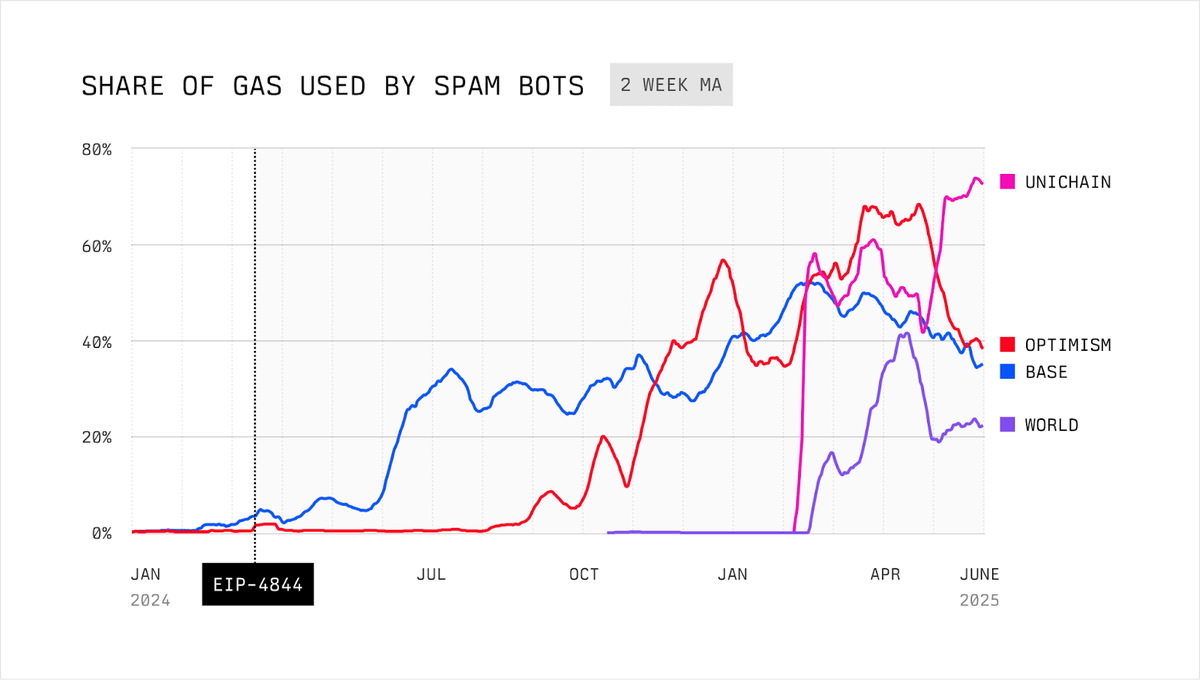
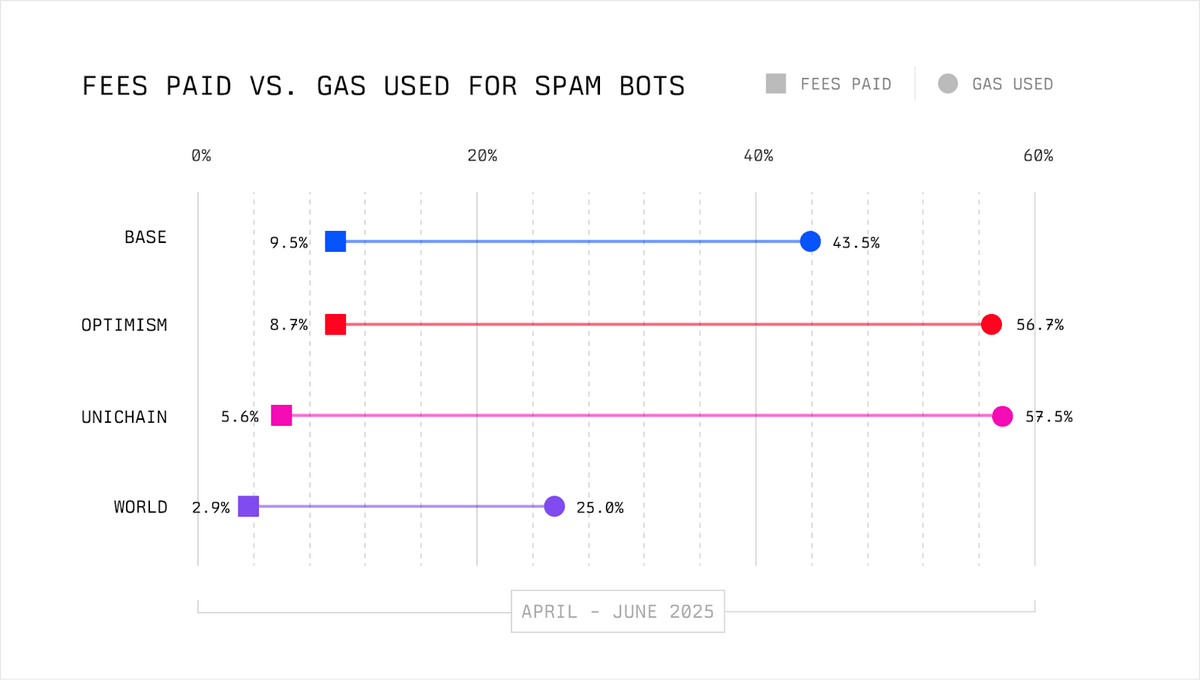
Spam bots consume huge portions of gas across top rollups, while paying disproportionately low fees
Highly recommend reading the article yourself. Very excited to see what kind of solution they will cook up.
cc @DistributedMarz@bertcmiller
https://t.co/iGfhLxyemJ
4) Could the reason be latency?
OP chains are slower in comparison to Orbit chains meaning they are more mispriced and a target for arbitrage later in the block. For Arbitrum its mostly top-of-block. A latency race rather than blind signing? What if you just go very very fast?
@0xkydo The logical conclusion would be to price congested state differently. Straw man: have a fixed size queue of all touched state during a block. Touching a state increments it by 1. Decay over some blocks. Expensive state sits at the top of the queue and is priced accordingly.
@0xkydo Maybe. The one thing that the these arb transactions have in common is that they touch the same state. Is mostly just swaps touching the same pools for arbitrage. Meaning that you don't have congestion on the global level because blobs are free but on the local level.