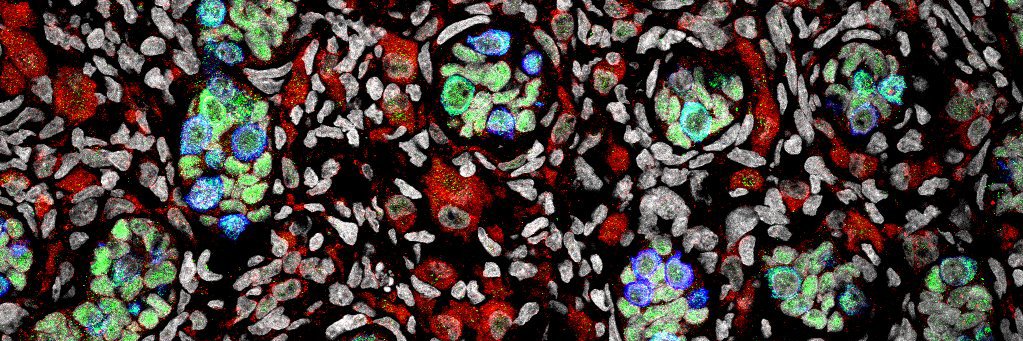
Excited to share our Review on human PGC development covering the latest in vivo observations & in vitro developments, particularly in the last 5 years. If you’re interested – have a read! https://t.co/UI7QEG6TI3
From: @astar_gis@karolinskainst@uniofwarwick@GurdonInstitute
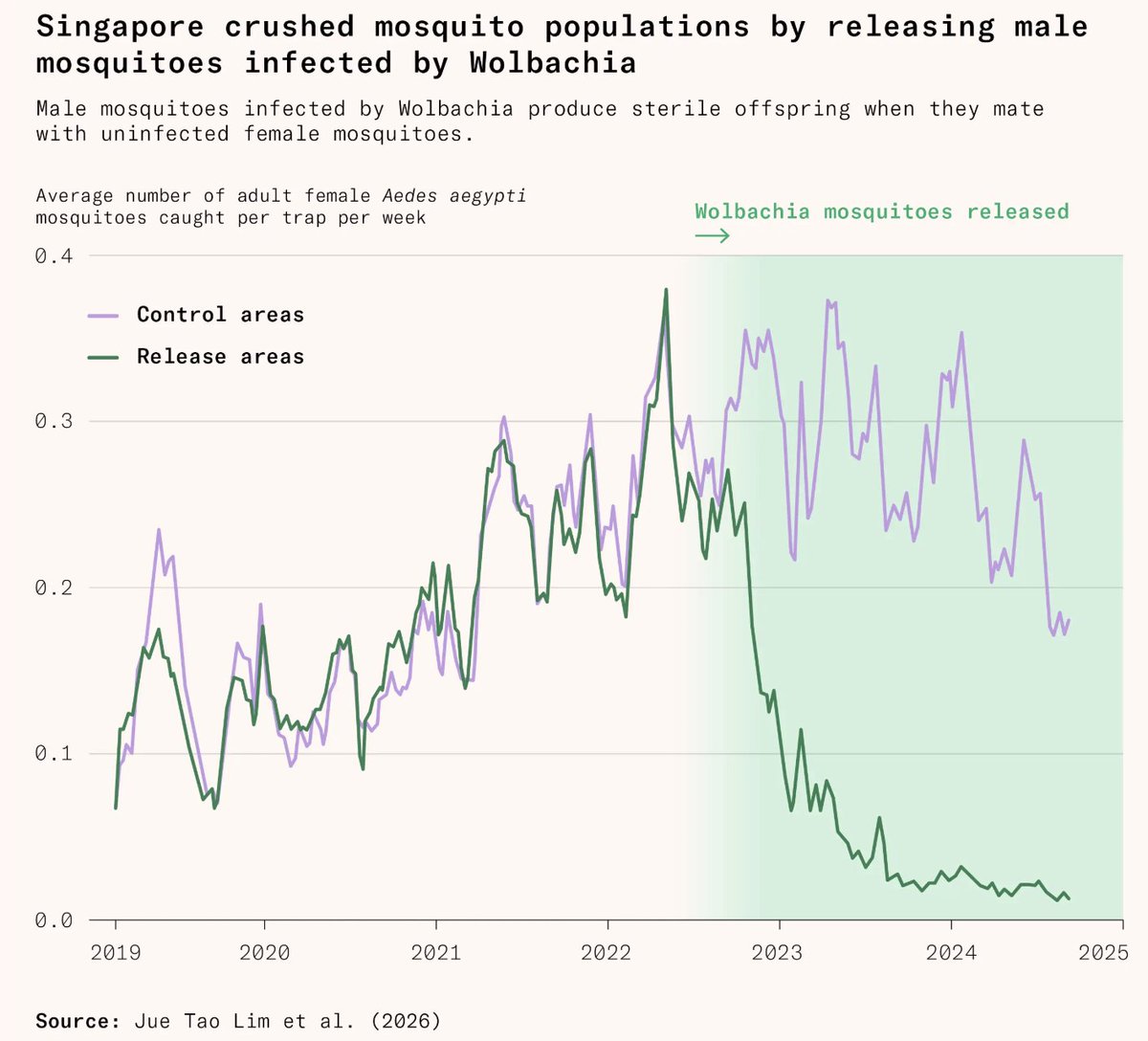
When I stilled worked on biosecurity, I first learned about Debug, a Google project to reduce mosquito populations.
Results from their Singapore pilot are now out.
They crushed mosquito populations, reducing dengue infections by 70% in the process:
There should be massive rewards in any new structure for honest reporting of findings over sales pitches. This is the single most important thing we can fix in a rethinking new systems. 6/
🧬🧪🔬Why are enhancers transcribed? How does it impact gene regulation? I’m excited to share our new paper in @ScienceMagazine showing that ncRNAs control the timing of gene activation in embryos. w/Mike Levine #ScienceResearch#RNA
A few highlights 🧵👇
https://t.co/ZHPXKBDLhh
Could the folding of synthetic gene circuits in 3D shape how genes are expressed? Today @ScienceMagazine we report on the role of gene syntax in shaping feedback between transcriptional activity and genome folding for advanced circuit design🧵 (1/n)
This is a "detective story" paper that shows how setting up the right negative controls can lead to real discoveries.
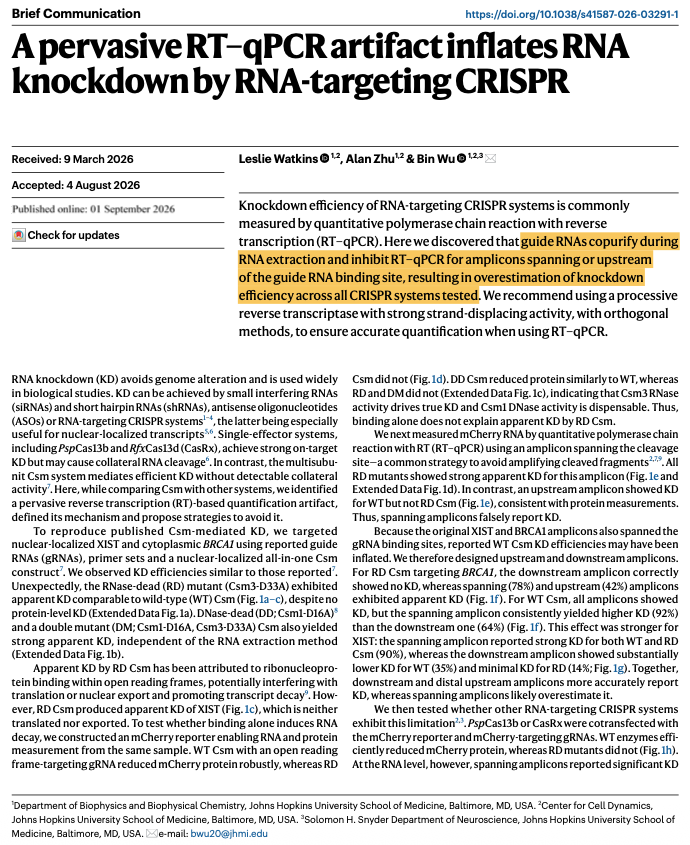
Basically, the authors wanted to reproduce a published result showing that a specific CRISPR tool, called Csm, could chop up RNA molecules and lower their levels in a cell. They measured this with RT-qPCR, a common experiment that quantifies how much of a given RNA is present before and after the CRISPR knockdown.
When they went to reproduce this result, they found that Csm did reduce RNA levels. But a negative control, a mutated version of Csm that shouldn't be able to cut anything, also knocked down RNA by roughly the same amount. Weird!
So the authors started varying the experimental parameters to solve this dilemma. First, they tried different RNA extraction methods and tested several more CRISPR tools. They confirmed, too, that the mutant Csm couldn't cut RNA. The RT-qPCR results persisted anyway.
Second, they built an mCherry reporter to measure protein levels directly. Normal Csm reduced protein levels, which makes sense since it's cutting the RNA. Mutant Csm did not change protein levels at all. This was another good sign that the mutant Csm was producing some kind of artifact.
To figure out why, we need to talk about RT-qPCR. This is a method that, first, converts RNA into DNA using reverse transcriptase, an enzyme that builds a matching DNA copy. qPCR then counts how many DNA copies got made from a short stretch of that RNA, called an amplicon. More copies of DNA = more RNA was present at the start.
Normally, scientists place this amplicon so that it overlaps with the guide RNA's binding site, since that's the region expected to get cut. But with mutant Csm, an amplicon located at the guide RNA site showed false knockdowns. When the amplicon was moved to *before* the binding site, the artifact disappeared and RNA levels appeared unchanged.
Why was this happening?
The reason, oddly, was that the guide RNAs (without any protein!) were blocking reverse transcription, making it look like mutant Csm was reducing RNA levels. The researchers tested this by spiking synthetic guide RNA, made with no CRISPR protein at all, directly into the reverse transcription reaction. This reproduced the false knockdown.
If a guide RNA can bind a target without a CRISPR protein at all, then we should also see similar gene silencing in cells. Right? Well, no; it turns out guide RNAs break down quickly in cells unless a CRISPR protein binds and stabilizes them. The proteins protect the guide RNA.
So TL;DR: guide RNAs can bind a target and block reverse transcription in test tubes. This causes weird experimental artifacts and likely means dozens of CRISPR papers that used RT-qPCR are wrong, in either a minor or possibly major way.
We are on the cusp of a wave of new therapies for some of the worst diseases. But the world won’t benefit unless the US fixes its drug regulatory system. My new essay for @nytimes, on how slow clinical trials are now the biggest obstacle to curing cancer.
https://t.co/a5qf9bAKXL
- I interviewed dozens of researchers, especially oncologists at leading U.S. centers. A striking consensus emerged: science is no longer the main bottleneck to new cancer drugs. It is our ability to test discoveries in patients through clinical trials.
- The cost of starting a Phase 1 trial in America has roughly doubled over the past decade. As a result, companies increasingly take early trials abroad: Australia’s Phase 1 trial volume has nearly doubled in a decade, driven mainly by U.S. companies.
- Unfortunately, the underlying incentives are badly asymmetric: Institutions can be blamed for harms caused by moving too fast, but almost no one is blamed when patients deteriorate during avoidable delays. One doctor called the emerging system “ritualized safety over actual risk assessment.” Or as, @DavidHongMD put it: "We often forget that the biggest risk is the cancer itself."
- This problem is becoming more urgent because medicine itself is changing. Sequencing, biological engineering and A.I. make increasingly personalized therapies possible. But our regulatory system was mostly built for standardized drugs tested in large populations.
- @sytse, the co-founder of GitLab, shows what personalized medicine can achieve: after relapsed osteosarcoma and being told there were no options left, he pursued a highly individualized approach and has now been cancer-free for a year. But doing so required extraordinary resources and regulatory expertise.
- Pierce Ogden’s father was less lucky. After molecular analysis identified a drug that might target his glioblastoma, the manufacturer agreed to provide it. But administrative barriers delayed access until it was too late. “My dad was ready to try anything,” Pierce told me. “But the system is paternalistic.”
- The A.I. revolution is making this bottleneck more important, not less. A.I. relies on relevant data. Information from early-stage trials could compound with A.I. tools to achieve truly revolutionary medicines. Without the data, this is far less likely to happen.
- Another important shift is that innovation increasingly comes from academic labs and small biotech companies rather than Big Pharma. These small companies find it far harder to unable to absorb delays and regulatory barriers.
- Apart from cancer, China is the biggest winner from America's outdated medical regulations. China has a much faster trial system, with testing often starting a full year earlier. This allows Chinese pharmaceutical companies to experiment and improve medicines while American companies play with mice. Today, half of all drugs licensed by major pharmaceutical companies originate there, up from less than 5 percent only a decade ago.
- But we don't need to copy China. The best model is Australia: lots of on-site scientific and ethics reviews, and requirements that are proportionate to small, early-stage trials. Phase 1 studies there begin roughly 6–12 months faster, without any notable increases in adverse safety events.
- Operation TrialBlazer, a 2026 HHS initiative is a good start in this direction, but we need legislative action by Congress to truly make Phase I trials faster and more efficient!
I want to thank everyone who helped me with this article: everyone I interviewed and the amazing editors at the Times. This is the result of a months long journey of extensive interviews and research.
Special thanks go to those who came on the record. One of the features of the system is an atmosphere of fear, where practitioners are afraid to publicly come out and explain these issues. So anyone who does is a hero in my book!
Published now in @Nature - "Long-read sequencing reveals pre-meiotic gene conversion in sperm".
We show an unexpected source of new genetic variation in human sperm, occuring earlier in development than previously thought. Check it out here: https://t.co/Oz30R2myhi
Thread: 1/
BIG NEW piece by me.
A few years ago, if you asked me to summarize my entire worldview in one article, I would’ve said it was too broad and too difficult. But this year, I decided to do it.
https://t.co/HupJtlwyDx
The central drama of the modern world is innovation against suffering, and we have made incredible progress so far.
But we are doing far worse than we could. Millions still suffer from untreatable diseases, because of bottlenecks that we could fix. You can help fix them.
Remarkable new paper describing the first-ever complete sequencing of both copies of every chromosome of the same person, led by @aphillippy and Nancy Hansen, with contributions from Hayden Ji in my lab and many others in the #T2TConsortium: https://t.co/svRPkwpfzM
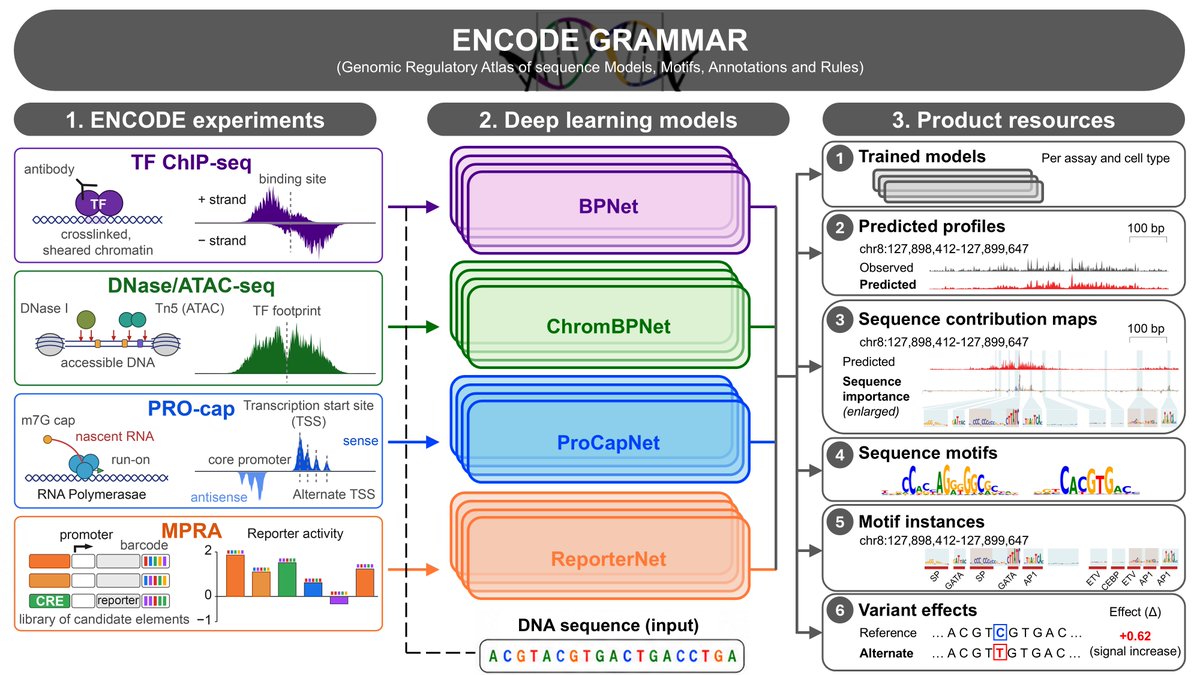
Very excited to announce ENCODE GRAMMAR (Genomic Regulatory Atlas of sequence Models, Motifs, Annotations & Rules): 3,865 experiment-specific deep learning model sets and sequence annotations for decoding human regulatory DNA. 1/
Check out our published work:
We show that L1 insertion intermediates can recombine with one another or with DNA breaks to form genome rearrangements, highlighting the risk of L1 retrotransposition causing genomic instability.
@KathleenHBurns
https://t.co/cII0giks86
Masahiro and I were fortunate to contribute some RCMC analyses to this beautiful paper from Koska and Wysocka that comprehensively dissects the determinants of promoter competition:
https://t.co/ZpS9REoQTZ
New post! @NikoMcCarty & I break down the latest news in biology:
- a synthetic cell made with chemistry
- laser phase plate electron microscopy
- the first base-edited human embryo
- lab-grown sperm and immature eggs
- and more
All from the past month!
https://t.co/Aarl6qdd2g
NEW JOB ALERT! (Yes another one! 🚌 🚌)
We are looking for a postdoc to develop our recently published human pluripotent stem cell model of paediatric germ cell tumours
Press release from our funders: https://t.co/SJzvRDIVpU
Job advert: https://t.co/WMjWt3nWyn