1/ New preprint from the lab, led by Maria Bergamasco!
We've developed a way to deliver BDNF directly to the brain using nose drops. Weekly dosing rejuvenates an old mouse's brain and blocks memory loss in a mouse model of Alzheimer's disease.
https://t.co/bY8cg2QMi1
An unexpected and potentially big finding:
A single mitochondrial protein has an outsized role, acting as a central node, coordinating our circadian clock, temperature, dietary cues, sleep/wake cycle to control brown fat metabolism @ScienceMagazine
https://t.co/jBbmaSjkaQ
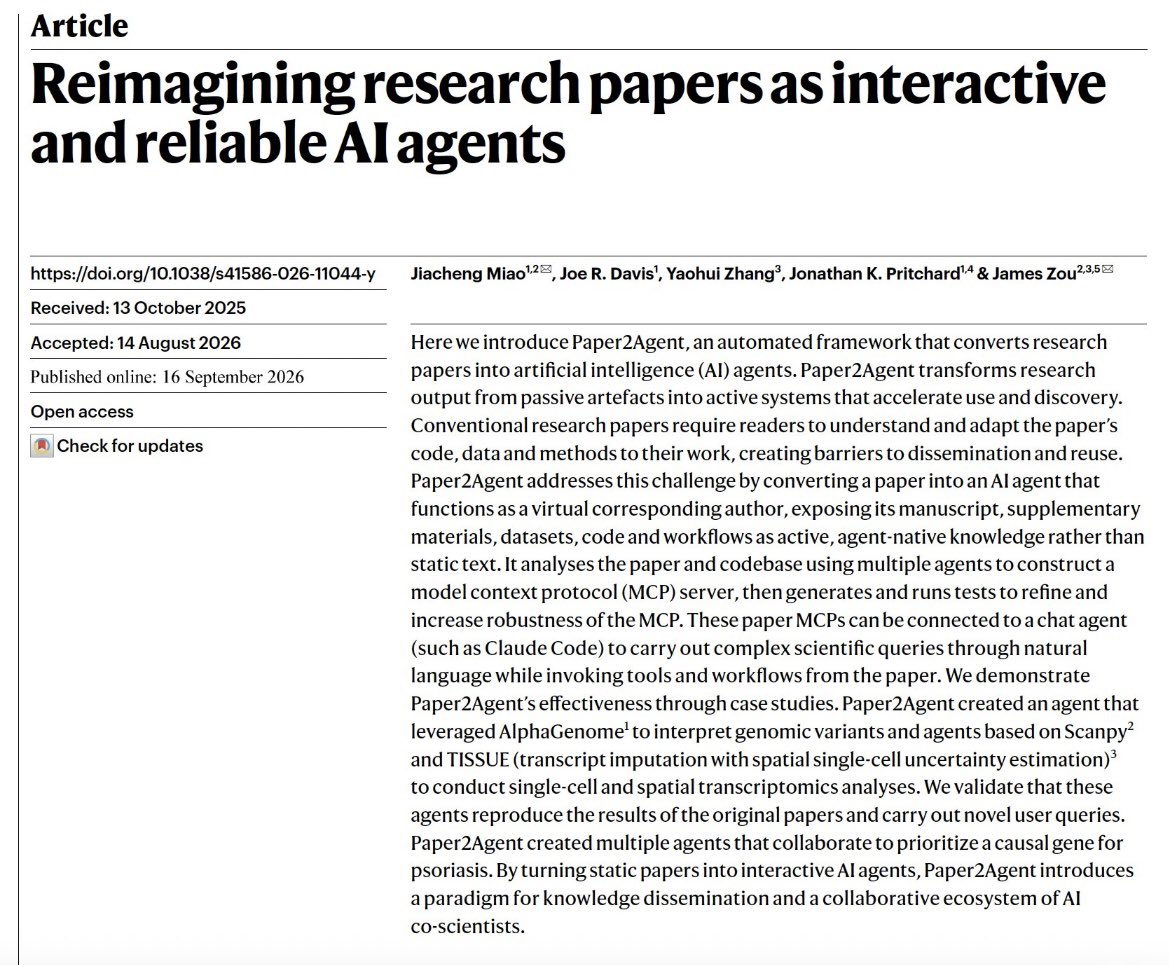
Nature has just published a pretty incredible paper.
The authors introduce a framework that turns research papers into interactive AI agents.
Rather than engaging with a paper only as static text, researchers can question its agent, ask it to reproduce an analysis, or apply the paper’s methods to new data.
This could make research methods much easier to understand, reproduce, and use.
It also opens up a strange possibility: research papers that can, in a sense, talk to one another. The authors demonstrate this by connecting agents derived from different papers so that they can combine their methods and data.
Used carefully (and with human scientific judgment still firmly in the loop) this could become a powerful new form of scientific communication.
*
Full paper in the first reply
Sweet, our new paper out in Science Advances(Cover). Sea nettles sting millions of people every year and the best treatment we have is baking soda and seawater. We ran a whole-genome CRISPR screen to find how the venom targets us. https://t.co/RptYzMGBXk 1/9
New findings mark a potential use for heparin as a safe, accessible treatment to relieve people suffering from painful sea nettle stings.
Learn more in this week’s issue of Science Advances: https://t.co/iPydtt0T13
In mice, venom in the footpad caused immediate spontaneous pain, heat hypersensitivity at 1 hour and mechanical pain out to 7 hours. Heparin given with the venom reduced all three. 8/9
@EricTopol Will require extensive investment for decades. AI can help us drive progress and increase chance of survival for sure, but not “cure” in the sense they mean. People said the same would arise from deep sequencing a decade ago.
@LynAldenContact I wouldn’t stress too much about this Lyn, bonafide advanced computing using cerebral organoids is decades away. Ironically we prob need today’s AI advances to help us figure out how to do this anyway. It’s not impossible just currently far from a technical reality.
1. Thrilled to announce our new preprint! A collaborative effort to sequence the bluebottle (Physalia utriculus) genome and decipher how this colonial organism's division of labour is driven by re-wired developmental programs rather than gene innovation 🧬🪼
Thread 🧵👇
3. Together, we also characterize bluebottle venom and identify potential heparin-derived therapies to counteract stings 🩹
Thanks to all our collaborators! Read the full @bioRxivpreprint:
https://t.co/NTNK2Pwhbf
Yet another study shows a 24% reduced risk of dementia after the Shingles vaccine. This one in over 500,000 participants with a recent skilled nursing facility stay, adding to 4 huge natural experiments in 4 countries (US, Canada, Wales, and Australia)
https://t.co/TmYqwTB7IT @AnnalsofIM
There hasn't previously been a treatment vs pancreatic cancer this successful. Striking improved (a > doubling) survival results @NEJM and @ASCO today with daraxonrasib, which also became available via an FDA approved early access program and began shipping to physicians this week @RevMedicines
https://t.co/e04jqJMPw0
10/ This is a platform. BDNF (and Oxytocin previously) is our proof of concept, but the same approach should work for other secreted proteins relevant to brain disease.
This is a preprint not yet peer reviewed, feedback welcome.
1/ New preprint from the lab, led by Maria Bergamasco!
We've developed a way to deliver BDNF directly to the brain using nose drops. Weekly dosing rejuvenates an old mouse's brain and blocks memory loss in a mouse model of Alzheimer's disease.
https://t.co/bY8cg2QMi1
9/ A paper out in ACS Nano from Yu, Deng and colleagues (Cheng, Teng, Wei labs) shows the same general approach works in a different disease setting. Two independent groups, different disease models, same conclusion: intranasal mRNA-LNP of neurotrophic factors works.