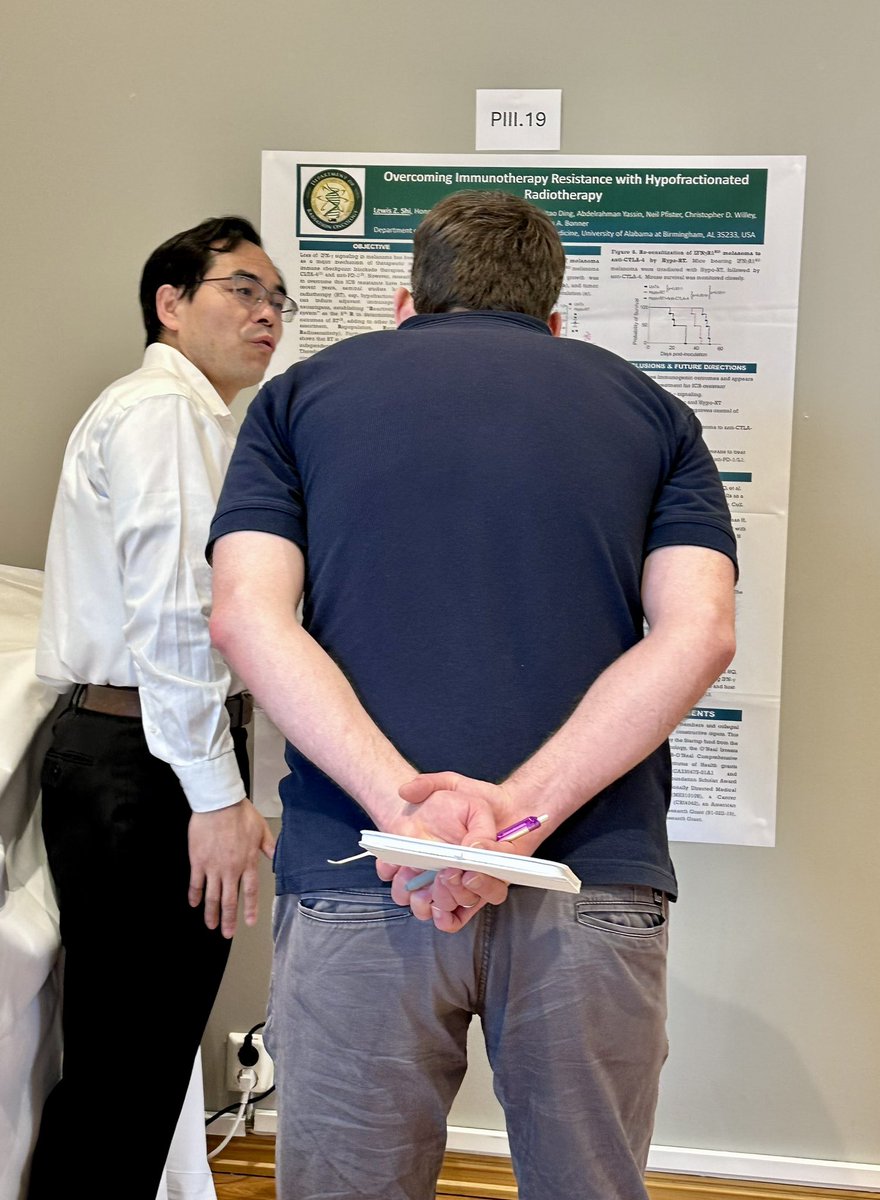
Incredible science and stellar presentations from @UABRadOnc at the Wolfsberg Meeting! 💥 From FLASH proton therapy to immunoradiosensitization and molecular targeting, our team is showcasing cutting-edge work that’s pushing the field forward. Proud to be part of this amazing group! #RadOnc #Wolfsberg2025 #TeamUAB
📸👇
👏 Huge congratulations to Dr. Neil Pfister (@UABRadOnc) for his invited lecture at the 17th Wolfsberg Meeting on “Ionizing radiation-induced oxidative stress and PARP-dependent mitochondrial signaling”! 🌟
We are incredibly proud to have him on faculty at @UABHeersink, driving discovery at the interface of redox biology and radiation response.
#Wolfsberg2025 #RadOnc #TeamUAB #UABPride
@tedradonc@rweichselbaum This is going to immediately open investigation into new targets in this is space (targets that likely will benefit in chemoIO population too). Exciting stuff
Incredible AI work showcased @ AWS Life Sciences Symposium in NYC today. Real advances in preclinical through clinical implementation. Significant venture presence too, looking for unicorns! @awscloud
This is a good initiative. Will be contributing in the AI clinical trials space (AI-enabled patient eligibility decisions using phase 2 to design better phase 3 trials).
This has been a long-time coming. Want to acknowledge the great team i got to work with on this project where we looked at funding of radiation oncology research from the NIH.
https://t.co/Y6s7O0UONH
Have no respect whatsoever for authority; forget who said it and instead look what he starts with, where he ends up, and ask yourself, "Is it reasonable?"
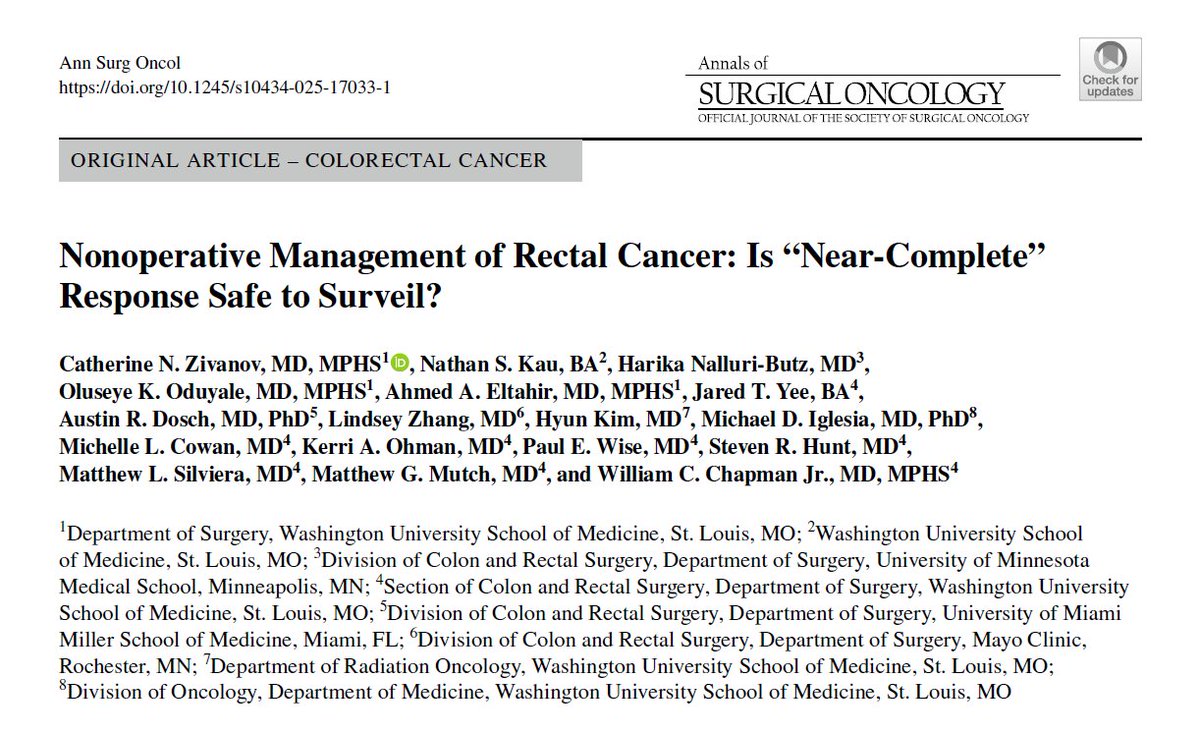
Important recent @AnnSurgOncol study from @WashUSurgery looking retrospectively at long-term outcomes of near-complete responses who undergo #WatchAndWait for rectal cancer.
Almost all patients received SCRT followed by consolidation chemo-->48% cCR, 28% near-complete (NCR), and 24% incomplete
The NCRs (n=61) had a median f/u of 27 months: 6.6% developed distant metastasis and 41% developed local regrowth.
The next part is important! Please keep reading!
64% of NCRs evolved into cCRs within 3-6 months. Of those, only 15% (6/39) developed local regrowth.
36% of NCRs continued to be NCRs (ulcers, nodularities, abnormal MRIs), and 86% of these (19/22) developed local regrowth.
21 patients underwent salvage surgery with 95%=R0. Unfortunately, 4/21 (19%) developed local recurrence after surgery.
What does this mean to me? Near-complete responses can evolve into cCRs in 3-6 months, and have excellent outcomes with watch-and-wait...they just needed a little more time.
However, if the irregularity remains after 3-6 months, I'm putting that rectum in a bucket.
https://t.co/Q1wpkVIfq3
@DrEmmaHolliday@ASTRO_org@KrishanJethwa Nice guideline. I advocate for T2 tumors >3 cm to have the same 54 Gy dose as 3cm+ LNs. It does not make oncologic sense to treat a primary to a lower dose than a same-size LN. These differences are too small to ever have cat1 evidence but follow first principles
Big news: Scientists at @Columbia developed an AI model that predicts gene activity in cells with high accuracy – this could transform our understanding of cellular processes and diseases, making biology more predictive. https://t.co/wHjrvCQgD9
LEAP-012: TACE +/- lenvima/pembro for intermediate risk HCC.
-No difference in OS
-Grade 3+ AE 71% in combo arm, and 32% with TACE alone (!!)
IMO this is not an effective, cost-effective, or “well-tolerated” regimen.
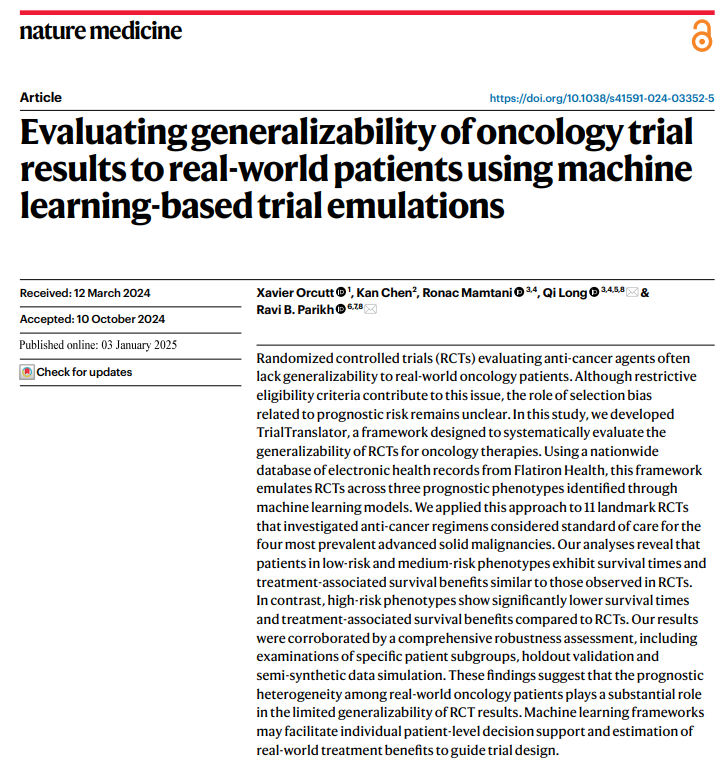
One of the hardest things I do in #oncology clinic is translate results from a clinical trial to the #patient in front of me. In @NatureMedicine, we introduce TrialTranslator, a #machinelearning framework for individualized #cancer trial emulation.
https://t.co/25zjFPFD8y