Bittensor $TAO is a very interesting and innovative project that aims to create a decentralized machine-learning network powered by blockchain technology. It has the same tokenomics as Bitcoin $BTC, 🧵👇
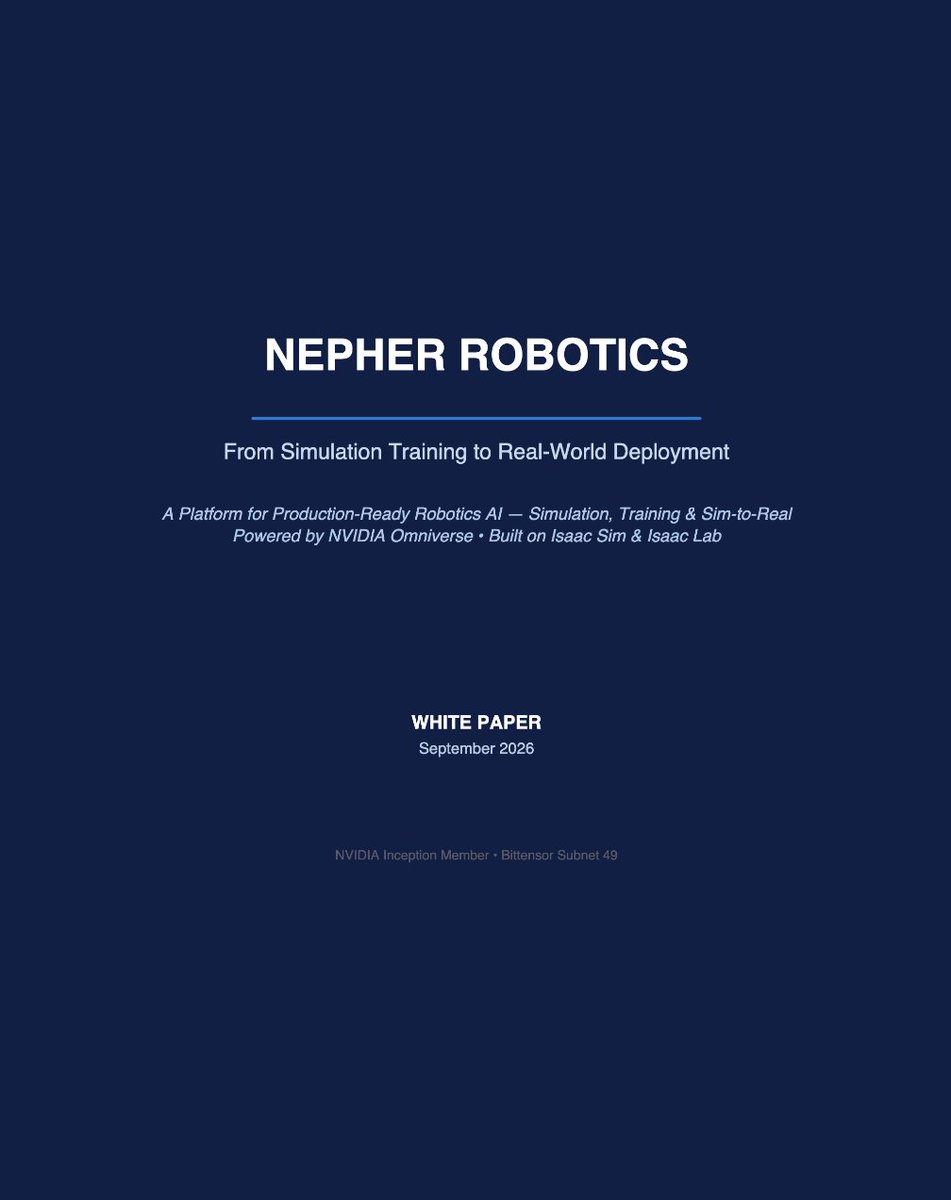
𝗧𝗵𝗲 𝗡𝗲𝗽𝗵𝗲𝗿 𝗥𝗼𝗯𝗼𝘁𝗶𝗰𝘀 𝘄𝗵𝗶𝘁𝗲 𝗽𝗮𝗽𝗲𝗿 𝗶𝘀 𝗹𝗶𝘃𝗲.
AI has mastered language, code and images, but it still can't reliably control a robot in the physical world. That gap is where Physical AI lives, and it's the problem Nepher was built to solve.
The paper lays out how we turn NVIDIA's simulation stack (Omniverse, Isaac Sim and Isaac Lab) into production-ready robot policies through open tournaments, standardized environments and decentralized evaluation on Bittensor SN49.
Every completed tournament ships three things:
• A trained control policy, ready for inference
• A full Isaac Lab External Project anyone can retrain or deploy
• Public training environments, plus hidden benchmark scenes only validators see
Independent validators score every submission with the same open-source harness inside isolated GPU sandboxes, so when a policy ranks first, anyone can clone it and reproduce the score.
23 tournaments in, across humanoids, quadrupeds, robot arms and LiDAR navigation, the path from prototype to deployed robot is getting shorter.
Read the full white paper 👇
https://t.co/PlJDgpfWv9
About 97 miners competed to train the best policy for a robot navigating with no camera or map, using only a 360° LiDAR sensor.
Using Bittensor’s distributed network, miners submitted policies tested on unseen environments, resulting in:
> 337 submissions.
> 90 hidden mazes.
This is exactly how Nepher turns decentralized competition into better robotics intelligence.
Watch the winning policy from Leatherback LiDAR Real Maze Phase 2 in action 👇
Same model. Same GPUs. Up to 54% more tokens/sec.
We tested the top miner for Qwen3.8-27B against the baseline using @nvidia 's AIPerf: all 600 requests completed, with 23–54% higher output throughput across tested loads.
Every token costs money. Pareton is driving that cost down.
We’re pleased to announce that Nepher Verified is now officially available as a selectable certification type on a major robotics product-listing platform.
It now appears alongside options such as CE, UL, ISO, TÜV, FCC, and FDA.
Manufacturers can now attach Nepher Verified to their product listings as independent simulation proof for their robot hardware and policies.
This is a major step forward for Nepher in building trust across robotics.
A Harvard research team and @chutes_ai just released a public dataset covering one year of real-world LLM inference on Chutes: 6.12B requests across 9,174 models.
Technical usage data from a Bittensor subnet is now open to the wider AI research community.
It baffles me that the big accounts are still not spending ANY time looking into $TAO.
Just look at what’s happening across the board in the ecosystem.
Heck, just looked at the below post by @reliquary_ai.
How can you not be stupidly bullish about where this is going??
Announcing one year of LLM inference metadata traces, with 6.12 billion requests.
We hope this dataset can support research on real-world LLM serving workload understanding, system design and infrastructure optimization. Explore the dataset and learn more: https://t.co/5nFSp2PPaa
Driven by our great graduate student William Nixon and
in collab with @jon_durbin@airesearch12@chutes_ai
Introducing Nepher Robotics, a simulation-first platform for training and deploying robots.
We’ve been actively shipping since January, and we’re excited to give you a closer look at what we’re building and the team behind it.
Built on NVIDIA Omniverse and powered by Bittensor.
@opentensor@const_reborn
Today, we’re announcing a solution found by our miners to Erdős Problem 859, a 56-year-old question.
Let dₜ be the density of integers whose distinct divisors can sum to t. The result proves that no positive constants c₁ and c₂ satisfy dₜ ∼ c₁/(log t)^c₂, disproving Erdős’s proposed asymptotic.
Verified in Lean through Conjectures. Full proof below.
Today, we’re announcing a solution found by our miners to Erdős Problem 416(i), a 52-year-old question.
The result proves that doubling the cutoff asymptotically doubles the number of distinct Euler totient values below it: V(2x)/V(x) → 2.
Verified in Lean through Conjectures. Full proofs below.