🚨 Preprint alert 🚨 - Thrilled to share our latest computational work entitled: "Local changes in potassium ions modulate dendritic integration" by @Malthe_nord et al. 🧠💻 Truly fun collaboration with @na0ya_takahashi and @NassiPapoutsi.
Check it out!
https://t.co/RVl4N9oaSL
Pls RT! We're hiring! My lab @iins_bordeaux seeks postdocs and PhD students to study cortical processing underlying touch and embodiment using in vivo imaging and Neuropixels. Positions funded by @CercleFSER, @FRM_officiel, @AgenceRecherche. Details👉 https://t.co/k2rNiGzpPF
Are you a PhD student in Copenhagen/Denmark looking to learn more about all the new open tools and datasets coming out? Join us for an exciting week of open science, open-source tools, and playing with open neuroscience data.
@icanhasMiranda@MedicalCollege Fantastic news!! Congratulations Miranda – they're very lucky to have you! Looking much forward to follow your lab in the future :)
@roaldarbol@DFF_raad@VILLUMFONDEN Jeg forstår din frustration Mikkel. En mulighed, omend også projekt-baseret, kunne være at søge @lundbeckfonden's LF Experiment som gives til risikable 2-årige forskningsprojekter.
@hubermanlab@SusannaSberg1 Excellent podcast – I may test the waters around Copenhagen harbour come winter time🥶 One comment: I think the diving reflex is elicited when receptors within the nostrils and face are exposed to cold water and is amplified by breath-holding; that is, head needs to be submerged.
🚨Cover alert🚨 Very glad to see our illustration of astrocyte calcium signaling featured on the cover of @TrendsNeuro. Big kudos to Antonis Asiminas (@temp2spec) for drawing this one🎨
June 2023 issue of @TrendsNeuro:
https://t.co/aJY0UMqNF8
Free featured content & more:
https://t.co/k6qoYUOrHw
On the cover: ‘Astrocytes: integrators of arousal state and sensory context’ by R. Rasmussen @NeuroRune, Antonis Asiminas, @Eva_Carlsen, @CeliaKjaerby & @NathanASmith1
@LoogerL@yulonglilab No, I have not personally used. We will look into the sensors by Robert Campbell and see what is doable for us in the future. Thanks again!!
🚨 Preprint alert 🚨 - Thrilled to share our latest computational work entitled: "Local changes in potassium ions modulate dendritic integration" by @Malthe_nord et al. 🧠💻 Truly fun collaboration with @na0ya_takahashi and @NassiPapoutsi.
Check it out!
https://t.co/RVl4N9oaSL
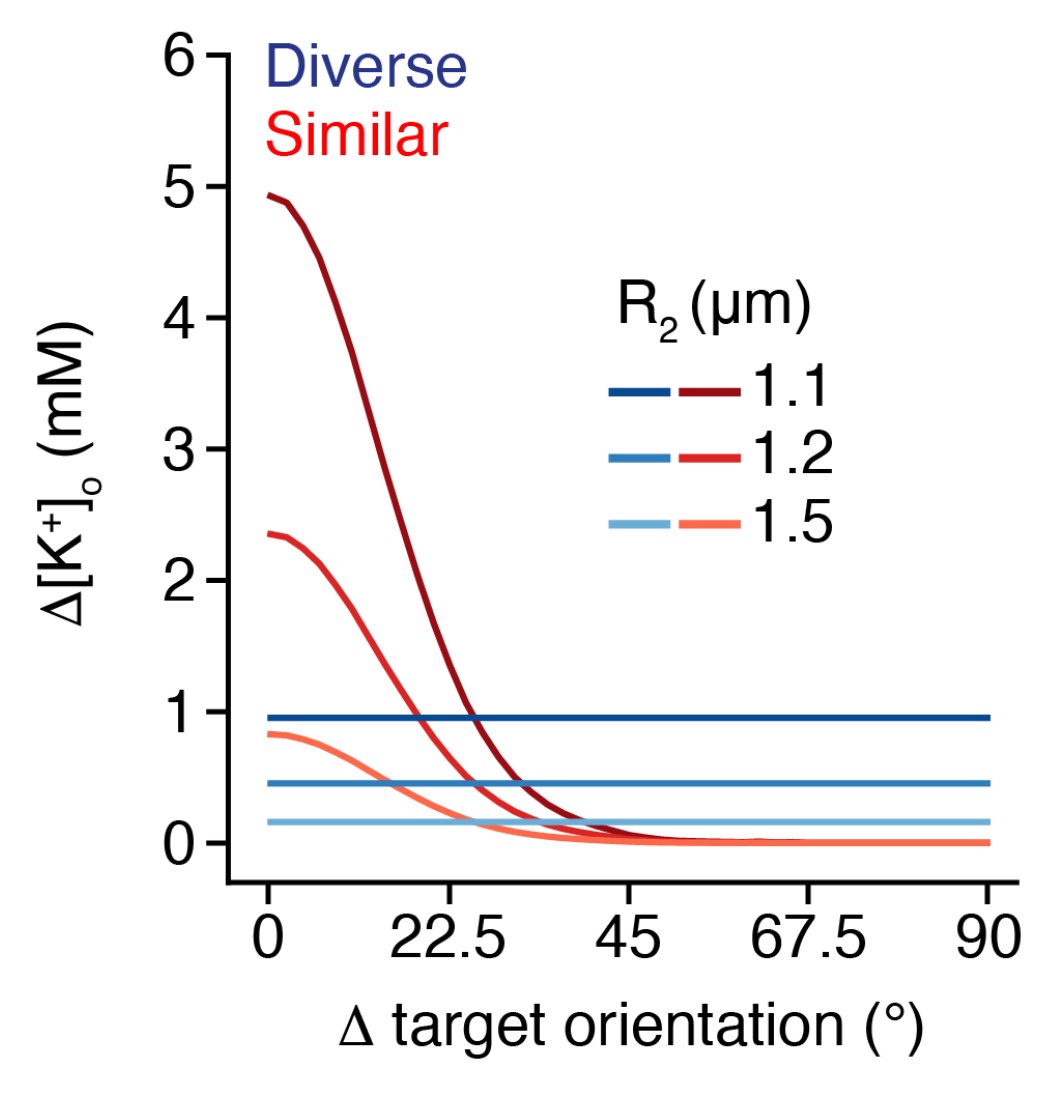
@LoogerL@yulonglilab Interesting. We do think it’s reasonable to expect increases of at least 1-2 mM near dendritic segments with functional clusters (with all limitations of course giving uncertainty). Segments with diverse tuning we expect 0.25-1 mM changes. Let’s see!
@LoogerL@yulonglilab Ah I see. That makes sense. I guess, for now, we have to make due with computational work in combination with ion-selective microelectrodes for probing changes within the physiological range (0.5-5 mM). Thanks!!
@ptrrupprecht @Malthe_nord @na0ya_takahashi@NassiPapoutsi@ValentinNagerl That would indeed be very exciting to obtain such experimental data, although very challenging as you also point out. I guess the most fundamental aspect to test first is our prediction of dendritic [K+]o hotspots during co-active inputs; ideally with absolute mM resolution.
@ptrrupprecht @Malthe_nord @na0ya_takahashi@NassiPapoutsi So if you had differences in ECS space across dendritic segments, everything else being equal, you would theoretically have different K+ change amplitudes which could have notable effects on local gain (high vs low) of synaptic inputs.
Do you know of such ECS data?
@ptrrupprecht @Malthe_nord @na0ya_takahashi@NassiPapoutsi Thanks Peter!
Re R_2, that is indeed interesting. As we allude to in the paper, we do not have specific data for the ECS space around specific dendritic segments, so we treated all segments equal. But the size does have a substantial effect for the K+ changes - see Figure 1G: