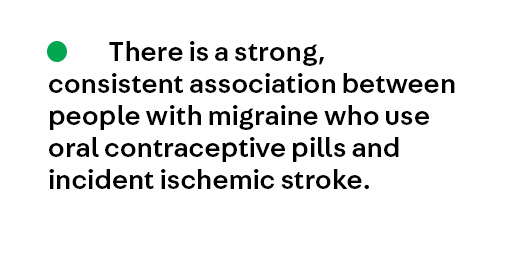
Key Point 3 from the article Sex Differences in Stroke Diagnosis, Treatment, and Outcome by Dr. Cheryl E. Carcel from the June #CerebrovascularDisease issue, which is available to subscribers at https://t.co/PQEiVjFkdK. #NeuroTwitter#MedEd
A scene from F.W. Murnau’s masterpiece Faust (1926), where the demon Mephisto takes Faust on a flying tour of the world.
To fake this in the 1920s, the crew built a hidden iron platform in the studio to hold the actors, using massive fans to blow their capes and billowing glass wool to create the surrounding clouds. They then used double exposure to layer the actors over a moving, miniature model city, making it look like they were actually soaring over the mountains and rooftops.
🇲🇽Por un minuto olvidémonos un poco del Mundial y pongámosle la debida atención al asesinato de Roxana Guzmán.
Dimensionen la barbarie: una periodista fue privada de la libertad en su propio domicilio, presuntamente por policías municipales de Ixhuatlán del Sureste, Veracruz, para después ser entregada a un grupo criminal y finalmente ejecutada.
Que la prensa internacional lo sepa. Que los aficionados extranjeros se enteren. México no está bien. Lo que hoy ven durante la Copa del Mundo es apenas una fachada de un mes, mientras millones de mexicanos siguen viviendo bajo el miedo, la violencia y la impunidad.
Disfrutemos el Mundial, sí. Pero no dejemos que estos actos de terror queden sepultados entre los festejos y las transmisiones deportivas.
Updated guidelines for managing migraine in the emergency department: Intravenous prochlorperazine and greater occipital nerve blocks emerged as first-line interventions. Read key points: https://t.co/5rur3nCyCO
El sarampión es horrible, borra la memoria inmunológica y puede dar todo tipo de complicaciones.
Además, cuando parece que curó, no siempre es así. Años después puede desarrollarse una encefalitis esclerosante subaguda que progresa a la muerte.
¡Defendamos la vacunación!
Charlie Munger:
“El mundo no se mueve por la codicia. Se mueve por la envidia.”
“El hecho de que todo el mundo viva cinco veces mejor que antes se da por hecho. Solo piensan en que otro tiene más, y en que no es justo que él lo tenga y ellos no.”
“Hay mucha gente que sigue sintiéndose infeliz y maltratada, aunque la calidad de vida haya mejorado muchísimo con el tiempo, simplemente porque siempre ven a alguien que tiene más.”
𝗦𝘂𝗴𝗴𝗲𝘀𝘁𝗲𝗱 𝗥𝗲𝘃𝗲𝗿𝘀𝗮𝗹 𝗦𝘁𝗿𝗮𝘁𝗲𝗴𝗶𝗲𝘀 𝗼𝗳 𝗢𝗿𝗮𝗹 𝗔𝗻𝘁𝗶𝗰𝗼𝗮𝗴𝘂𝗹𝗮𝗻𝘁 𝗨𝘀𝗲 𝗳𝗼𝗿 𝗠𝗮𝗷𝗼𝗿 𝗕𝗹𝗲𝗲𝗱𝗶𝗻𝗴 𝗮𝗻𝗱 𝗯𝗲𝗳𝗼𝗿𝗲 𝗘𝗺𝗲𝗿𝗴𝗲𝗻𝗰𝘆 𝗦𝘂𝗿𝗴𝗲𝗿𝘆.
As shown in Panel A, reversal management depends on the urgency of surgery or the invasive procedure. Reversal management includes administration of oral or intravenous (IV) vitamin K with or without 4F-PCC, depending on the timing of the procedure (emergency or urgent), baseline international normalized ratio (INR) value, and presence (or absence) of active bleeding. For patients receiving direct oral anticoagulants (DOACs), the decision also depends on time to surgery. Decision making is informed by DOAC type, time since last dose, half-life, presence (or absence) of active bleeding, and renal function tests to estimate residual drug activity.
Panel B shows reversal strategies for patients presenting with major bleeding while receiving an oral anticoagulant. The reversal strategy of vitamin K antagonists includes vitamin K given intravenously or orally, combined with 4F-PCC and INR testing. Management of anticoagulant reversal of direct oral FXaIs is based on four key factors (shown as the 4Ts): type of bleeding, timing of the last dose, thrombotic risk, and need for invasive procedures in the next 48 hours that would result in the administration of UFH. These factors may facilitate the use of specific (e.g., andexanet alfa) or nonspecific (e.g., 4F-PCC) antidotes. The reversal of dabigatran is informed by three clinical variables (shown as the 3Rs) — the type of bleeding, time of the last dose of dabigatran, and preserved renal function.
Learn more in the Review Article “Antidotes for Anticoagulation Reversal” by Bianca Rocca, MD, PhD, and Hugo ten Cate, MD, PhD: https://t.co/XobqwMebfy
NEJM subscribers: Explore this article deeper with AI Companion.
Warren Buffett: "The bottom 2% in terms of income in the United States, the bottom 5%, and for sure the top 1% all live better than John D. Rockefeller was living when I was six years old."
"John D. Rockefeller was the richest man in the world and, today, you can get better medicine, better education, better entertainment, better transportation. You can do everything better than he could."
"When I was born, the dentist didn't use novocaine!"
In a retrospective observational, hypothesis-generating study using the TriNetX platform, prescription of a GLP-1 RA was associated with a lower risk of intracranial aneurysm rupture. #stroke https://t.co/EfwqwA5bZj
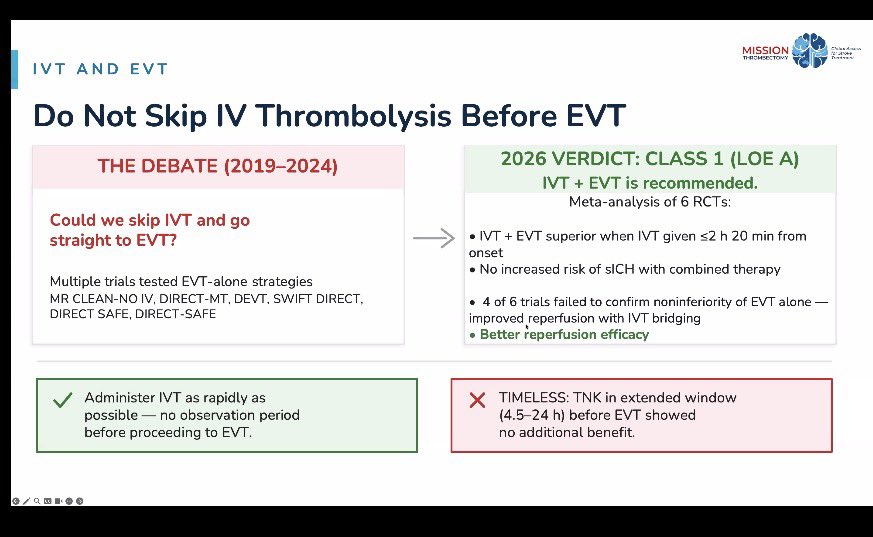
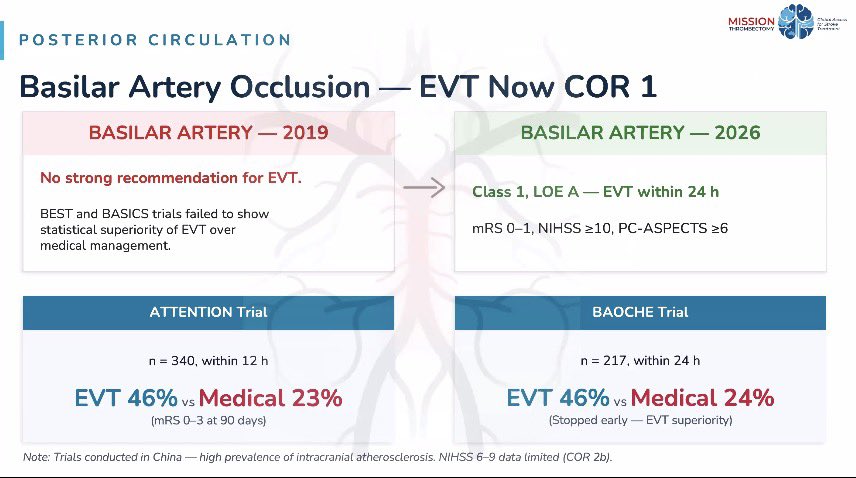
🧠🌍 Mechanical Thrombectomy Update by Dr. Daniel Vela Duarte
EVT continues to evolve with growing evidence and refined patient selection.
⏱️ Time still matters, but selection is increasingly “time + tissue” based.
🧠 Extended window EVT (up to 24h) remains for carefully selected patients using imaging-based criteria.
🧭 Vessel coverage: • ICA/M1 = standard • Basilar occlusion = increasing evidence/support • M2 occlusions = selected cases only
🧪 Imaging (CTA ± perfusion) remains central in identifying salvageable brain tissue.
💊 System efficiency and faster workflows continue to drive better outcomes.
#Stroke #MissionThrombectomy #AHA2026 #SVIN
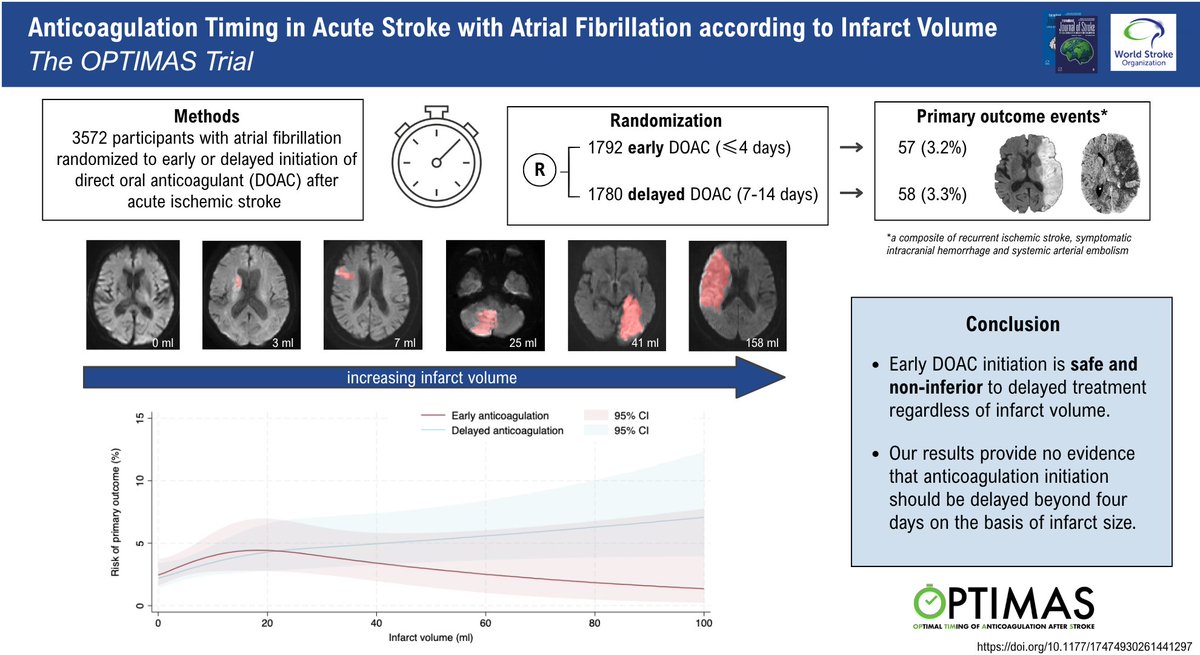
💊Early DOAC initiation is safe and non-inferior to delayed treatment regardless of infarct volume
❌⏱️No evidence that anticoagulation initiation should be delayed beyond 4 days on the basis of infarct size
Read the paper here!👇
https://t.co/3P82y5VF72 @UCLStrokeRes