Congrats to my friend and colleague Guosong Hong for his stunning and original discovery, published today in Science, on clearing tissues *in living animals* with a common food dye!
The dye is tartrazine, used in Doritos!
https://t.co/fqVivyH0kI
Excited to share my PhD work in @pgolshani 's lab designing and building low-cost miniature 2P microscopes with everyone! They cost < $10k USD (even at low production runs), are fitted with 2 on-board SiPM detectors, and are completely open-source! 1/5 https://t.co/LRof7MMKf7
Excited to share our work with @mlphillips17 about 9-color calcium imaging under a GRIN miniscope!
Functional imaging of nine distinct neuronal populations under a miniscope in freely behaving animals.
https://t.co/NnNsI808XD
@hcratigan We've tried 3D printing headbars for our 2p imaging setup, but have never had much luck. The materials (various plastics) have always had too much flex. In the end, metal has been so much more reliable for us. Aluminum works well, and is cheaper than stainless steel.
Very proud to have played a part in this great paper from Tad Blair @DanielBAharoni Jason Cong and many others on a hardware system for real-time decoding of miniscope recordings. This will change the game.
https://t.co/NkJWXa4eM6
So while a reward engram goes dormant after extinction learning, it's both necessary and sufficient for reinstatement later on.
Shoutouts to the twitterless Albert Park and Liz Hsiang for spearheading this project! And to @sjo09 and @JohnGHowland for making it all happen. [3/3]
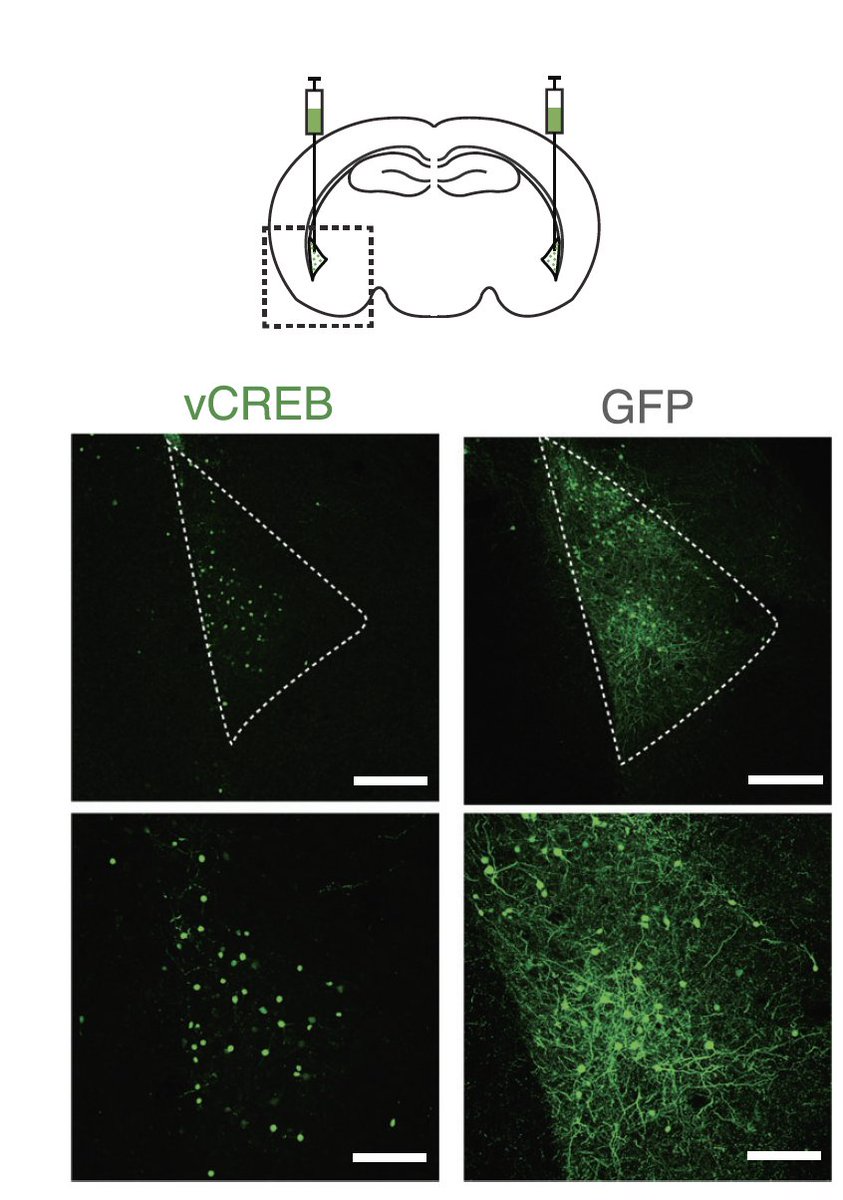
New paper out from our group! We looked at the formation, extinction and reinstatement of a drug reward engram in the lateral amygdala. Turns out fear and reward engrams aren't so different - both require high neuronal excitability to form
[1/3]
New in @npp_journal: Formation and fate of an engram in the lateral amygdala supporting a rewarding memory in mice led by Albert Park and Alexander Jacob @Neurochatter, labs of @JohnGHowland and Sheena Josselyn @sjo09
https://t.co/HS4fdD2jFa
We also found that even after extinction, this reward engram persisted. Artificially reactivating it caused mice to remember the extinguished association. And silencing the engram prevented drug-induced reinstatement. [2/3]
📣 📣 📣 Excited to highlight our latest publication led by the super talented @Shikun_Hou out today in #eNeuro. Introducing Pi USB Cam – an affordable, simple, powerful, & versatile DIY video recording solution for behavioral neuroscientists 🧵
https://t.co/pNAueZN5p2
There is no central repository for 3D printed objects used in neuroscience research. So we created one. Please read about the repository and consider sending in your designs at the link below. #openscience#neurotwitter#3Dprinting
https://t.co/2YAW2CwNCw
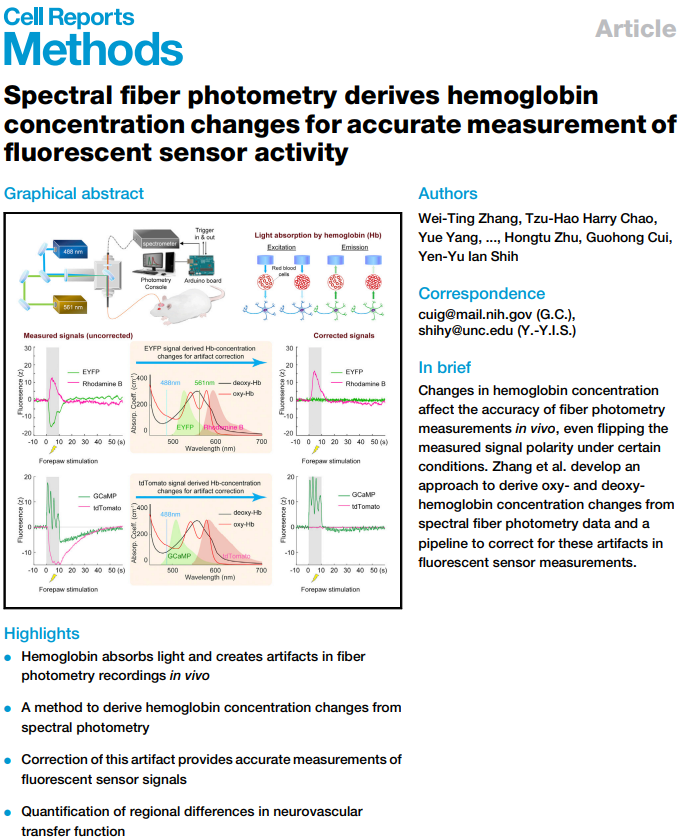
Hemoglobin (Hb) absorbs light and affects optical measures in vivo. In our new @CellRepMethods paper, @WeitingZhangUNC, @TzuhaoHarryChao et al. from @ShihYYI lab @BRIC_UNC and Cui Lab @NIEHS describe a method to correct Hb absorption in fiber photometry: https://t.co/gcUgnoWIlM
Computational Miniature Mesoscope V2: >7mm FOV, < 10um lateral and < 25um axial resolution; a fast & efficient 3D Shift-Variant model + a fully simulation-trained DNN generalizes to real experiments. Another impressive effort led by @xue_yujia.
https://t.co/J3vcY6Nr2Y