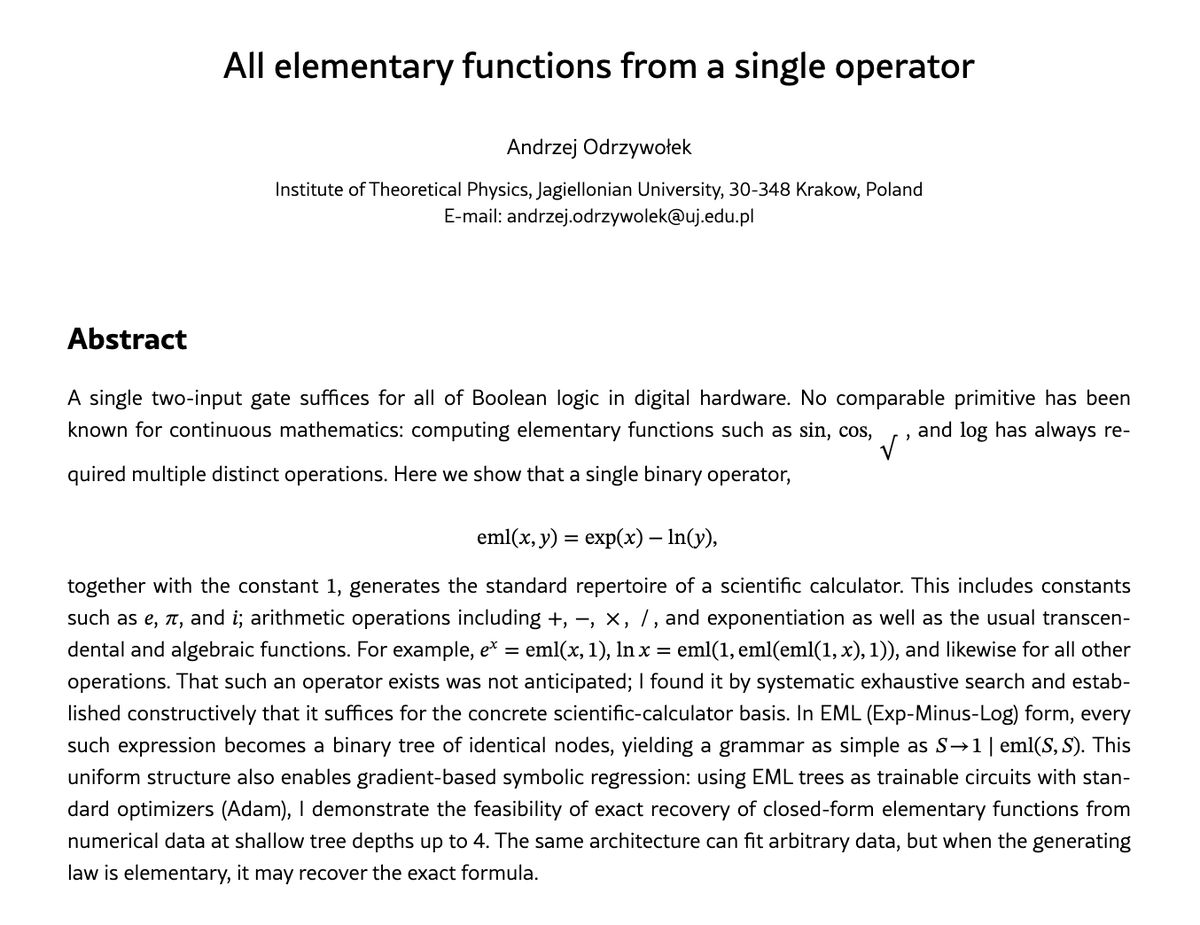
Researchers just proved that every single elementary function, sin, exp, log, sqrt, comes from one single binary operator.
It is like finding the “God Particle" for calculus.
In computer science, every complex program breaks down to a single logical operator: the NAND gate. It is the fundamental building block of all digital reality.
But for continuous math, physics, engineering, machine learning, we thought we needed a massive toolbox.
Addition. Subtraction. Trigonometry. Logarithms.
Every scientific calculator and neural network has to juggle all of them.
Until today.
But this paper proved that every single mathematical function can be generated by a single, bizarre binary operator.
eml(x,y) = exp(x) - ln(y).
Combine that with the number 1, and you can build everything.
Pi. The square root. Sine and Cosine. Arithmetic.
It is all just the exact same operator, repeating over and over again in a binary tree.
Nobody anticipated this existed. It was found by systematic exhaustive search.
But the implications for AI are massive.
Instead of an AI struggling to combine different mathematical rules to discover a new scientific law, it can just use a single, uniform architecture.
One trainable circuit. One repeatable node.
We thought the language of the universe was complex.
It turns out, it's just one equation repeating in the dark.
RAG is broken and nobody's talking about it.
Stanford researchers exposed the fatal flaw killing every "AI that reads your docs" product in existence.
It’s called "Semantic Collapse," and it happens the second your knowledge base hits critical mass. If you've noticed your AI getting "dumber" as you add more data, this is exactly why.
Right now, companies are dumping thousands of documents into their AI, thinking it’s getting smarter.
When you add a document to RAG, it converts it into a high-dimensional vector.
Under 10,000 documents, this works perfectly. Similar concepts cluster together.
But past 10,000 documents, the space fills up. The clusters overlap. The distances compress.
Everything starts to look "relevant."
It is a mathematical law called the Curse of Dimensionality. In a 1000-dimensional space, 99.9% of your data lives on the outer edge. All points become equidistant from each other.
That perfect, relevant document you are looking for now has the exact same mathematical similarity as 50 completely irrelevant ones.
The Stanford findings are brutal:
At 50,000 documents, precision drops by 87%. Semantic search actually becomes worse than old-school keyword search.
Adding more context doesn’t fix the AI. It makes the hallucinations worse.
Your "nearest neighbor" search isn't finding the best answer anymore. It's finding everyone.
We thought RAG solved hallucinations.
It didn't. It just hid them behind math.
Some computers are easy to spot, such as the artificial, human-built ones found in smartphones and laptops, with recognizable computational elements like input, output, energy cost, and logical processes. But scientists have long argued that many natural dynamic systems — from cells to brains to turbulence in fluids — carry out computations, too.
In a new paper, SFI Professor David Wolpert and coauthor Jan Korbel from the Complexity Science Hub in Vienna, Austria, introduce a framework for identifying and studying the computations encoded in natural dynamic systems, allowing researchers to map, or connect, those computations to ones carried out by traditional man-made computers.
https://t.co/ojv8aAqmzW
As the world debates AI structures and energy consumption, we must look inside the cell for answers, some of which are already known.
#AI
A secret language of cells? New cell computations uncovered https://t.co/pfcSoUD5aa #epfl
If you listen to the brain, it can tell you how to do energy-efficient computing.
Brain-Inspired Energy Efficient Technologies for Next-Generation Artificial Intelligence
https://t.co/fuVFgctyik
#neuroscience
Asked about the funding cuts, one Boston researcher said, “That's like asking, how do you think dropping an atomic bomb on New York will affect the future of Broadway musicals? This is a generational loss of innovation, technology, and economic power."
https://t.co/hzuPmfqDoH