“We are going through an energy shock. Ukraine has decided that they want to blow up Russian energy assets. This is creating pressure on prices globally,” – Bessent.
Ukraine has “decided”?
Are you fucking kidding me???
Russia has spent years bombing our power plants, destroying our energy infrastructure, attacking our cities and trying to freeze Ukrainians in winter.
Ukraine didn’t wake up one morning and “decide” it would be fun to attack Russian energy infrastructure.
We are fighting a fucking war of survival because RUSSIA INVADED US.
So sorry about your “energy shock.”
We’re experiencing the slightly bigger inconvenience of trying not to fucking die.
@sandeepnailwal Last time I checked #POL circulating supply was 10.40B and now 10.69B. If the activity is as high as many your posts claim, why is the circulating supply going up and not down?
@SecGenNATO@ZelenskyyUa Ukrainians dying every day, missiles and drones flying in NATO airspace and all you do is discuss with zero action. Time for change
Our intelligence services reported receiving data, including from American and European partners, about Russia preparing a strike with the Oreshnik missile. We are verifying this information.
We are seeing signs of preparation for a combined strike on Ukrainian territory, including Kyiv, involving various types of weaponry. The specified intermediate-range weapons could be used in such a strike. It is important to act responsibly on air-raid alerts, starting this evening. Russian madness truly knows no bounds, so please protect your lives – use shelters.
Second, we are drawing the attention of our partners in the United States and in Europe to the fact that the use of such weapons and the prolongation of this war also sets a global precedent for other potential aggressors. If Russia is allowed to destroy lives on such a scale, then no agreement will restrain other similar hatred-based regimes from aggression and strikes. We count on a response from the world – and on a response that is not post factum, but preventive. Pressure must be put on Moscow so that it does not expand the war.
Third, we are preparing our air defense as much as possible, and we will respond fully justly to every Russian strike. We have given permission for a parade, but Russia has no permission for madness. This war must be ended – we need peace, not some missiles satisfying the sick ambitions of one individual. I thank everyone helping to protect lives. Once again, please take care of yourselves and use shelters tonight.
@HopmansJust@0xPolygon#POL Definitely needs a revision of its tokenomics. Token price has been in free fall since the change from #MATIC to POL. It’s going to take a lot to regain investor trust towards the project.
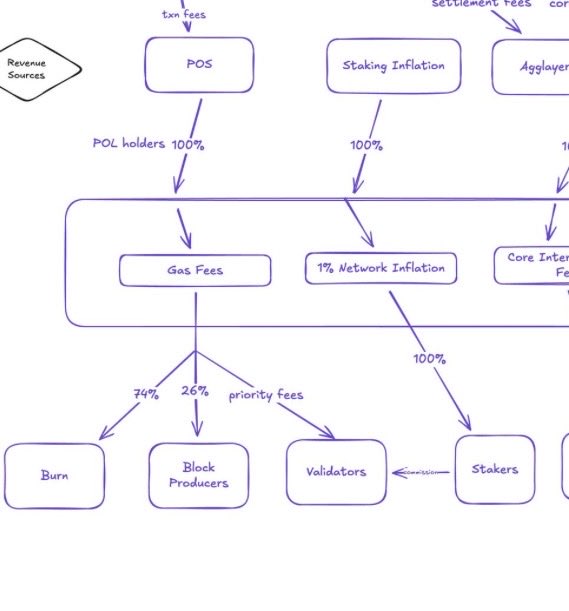
Over a third of all staked $POL sits with exchanges. Upbit (400M), Coinbase (340M), Binance (255M).
Most of them tap “stake” in an app. They don’t choose a validator. They don’t compare commission. They don’t move. The exchange decides everything.
Why this is hard to solve at the protocol level:
The protocol only sees addresses. It doesn’t know if an address belongs to an exchange or a person with a Ledger. Any rule you create, an exchange can work around with capital or structure.
The levers @0xPolygon does have:
1. Create a yield gap. If non-custodial staking pays significantly more than exchange staking, power users migrate. The bigger the gap, the faster they move.
2. Encourage liquid staking. stPOL, MaticX — if exchanges offer liquid staking tokens instead of running their own validator, rewards flow through the protocol. The exchange earns from trading, not from staking extraction.
3. Push transparency. Publish how much each validator passes through to delegators. When Upbit’s 100% commission becomes visible to their own users, pressure builds.
4. Minimum self-stake ratio. Require validators to back their delegation with real capital. Upbit self-stakes 1 POL on 400M delegation. A minimum ratio raises the cost — but doesn’t eliminate the problem.
5. Education and UX. Show stakers what they’re missing. “You earn 2% on your exchange. Non-custodial earns 5.8%.”
What doesn’t work:
Discriminating validators by identity — breaks decentralization.
Eliminating commission — punishes the 40% who actively choose.
Banning exchanges — not detectable on-chain.
The honest conclusion: Polygon can shrink this problem but not solve it. No PIP, no formula, no smart contract forces a user to move their POL off an exchange. The only real solution is user behavior. And that changes slowly.
This is the biggest structural challenge for POL tokenomics — bigger than any fee formula. Curious how the Polygon team plans to approach it.
We all want to see $POL succeed.
@sandeepnailwal@0xPolygonFdn@0xPolygonEco@davidesilverman@Smokey_
$Pol is the "most undervalued" for good reason:
Polygon is now sustaining 10m txs per day, which is 4x the daily transactions on Ethereum, which is really impressive.
⚠️However, most of that growth is not captured by retail token holders anymore, but is now funneled to a small group of 105 validators who do not share the revenue with their $pol delegators.
2026-05-05:
371k $pol burned
790k $pol to validators, which then proceed to dump these tokens on exchanges as @HopmansJust points out.
Fun Fact: According to Polygon Labs the estimated cost of running a validator node is only $929/month!
$Pol could become one of the best performers if this conflict of interest is resolved, but I doubt it as the validators have an enormous financial incentive not to allow that.
Why do I have to play with Russians when they clearly don’t speak English? It’s a big country. Let them play together. Europeans always speak English. Game is literally unplayable for solos in northern Europe 🤮🤮@CounterStrike#cs2#counterstrike2