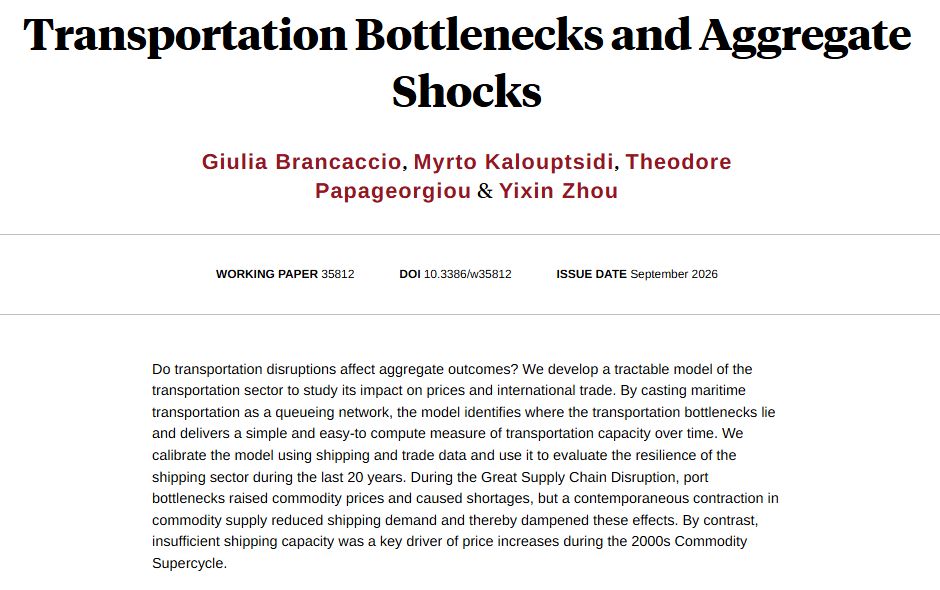
Maritime chokepoints are not just local logistics risks, they are a channel through which geopolitical, climate, and infrastructure disruptions become shocks for entire transport capacity, from Giulia Brancaccio, @myrto_kaloup, Theodore Papageorgiou, and Yixin https://t.co/3HdbfLzRSr
I put together a short practical guide for economists who want to use Claude Code, but who haven't gotten around to trying yet.
The goal is to reduce the start-up costs by using Claude Code within VS Code.
I've taught all the 50+ economists I've trained on agentic coding to use @every's Compound Engineering (CE) plugin.
Recently, @danshipper, CEO of Every, has integrated a new update to CE which is particular useful to economists - his tool "Proof".
Whenever Claude Code via CE makes a plan or a brainstorm document, an option will come up to "Share to Proof".
This will generate in your browser an interface in which you can interact with that plan or brainstorm document and give very specific feedback to Claude Code.
A big problem for economists is that they have a much greater need for certain kinds of correctness than software engineers do.
A big part of getting the most correct or best results downstream is getting your plan right from the beginning.
I think Proof - especially with its tight integration with Claude Code - is pushing practically in a very intelligent direction for human/AI collaboration, and I'd recommend any Claude Code using economists to try out this feature in Compound Engineering.
@every is rapidly iterating on the Compound Engineering plugin, but I did a video a couple months ago on Compound Engineering which I think is still worth watching: https://t.co/mODp2jdHCJ
Don't have Stata run Claude.
Have Claude run Stata.
I made a Claude Code skill just for this: https://t.co/zqL96gZBA5
Instructions for Claude on how to run and write Stata code + compressed Stata documentation in the form of md files.
As AI lowers the cost of producing papers, asking the right question matters more.
I built Frontier Graph: an open-source tool to explore open questions in economics, drawing on 240K papers across 300 journals.
I made a skill for PDF reading optimized for academic articles, including tables.
As a test case, I ran it on Acemoglu Johnson Robinson (2001).
You can see the benchmark results here: https://t.co/Dn6A4Y1C6a
Under the hood - it uses IBM's docling with various optimizations/tweaks for tables (you can see all the tables here): https://t.co/0ZoroP17tk
> thx @EconTraina for docling recommendation
You can install it from my skills repository - https://t.co/sbYtaO6hBa - which also includes a Python Learning Skill (https://t.co/VfW7r230ru) and has various install instructions
Or just point CC/Codex at https://t.co/bNypV3rWXv and ask it "install this skill"
I've got several ideas of how to improve the skill, but feel free to submit a Github issue and/or PRs with improvements.
There is a baguette blind taste test in Paris every year, and the winner supplies the French president's residence for a year.
2 different Sri Lankan immigrants won the competition in the last 3 years
good read on the competition:
https://t.co/neMsunL5TD
I’m not a lawyer so I won't interpret contracts for you. But I am an economist, so here's my take on the economics of what happened yesterday (TL;DR: Jesse is right).
One of the main drivers of economic activity in developed countries is a favorable regulatory environment and *certainty* about that environment. Any investment is risky, and regulatory/institutional uncertainty keeps companies from investing, growing, and building in these types of environments. Companies don't want to build a new plant if they think the govt will seize it or put extra regs on its products.
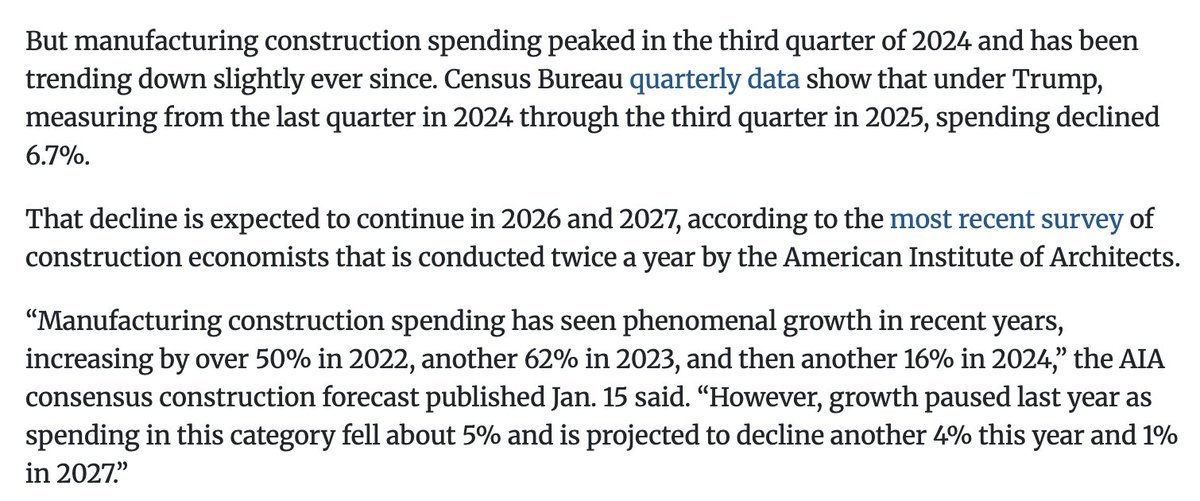
As an example, take the tariff bonanza of the past year +. It's one thing to enact a 15% across the board tariff and stick with it, and entirely another to draw up completely random numbers, change them constantly (e.g., because you don't like a commercial), all under the spectre of them being illegal in the first place (they were). The outcome was exactly as predicted: consumers paid most of the cost, manufacturing is shedding workers and pulling back on construction (after 4 years of increases). The economy does not like uncertainty.
The one bright shining star of the economy was AI. The US had two of the frontier labs and the most of the major tech companies. AI had the most favorable regulatory environment and was booming; investment was going through the roof.
And then the secretary of defense decided to nuke the business model of one of those companies because of too many stupid reasons to list here. It would be perfectly fine to cancel their contract, but designating Anthropic a *supply chain risk* --which has so far been reserved for foreign adversaries -- cuts off much of their business.
But so what? Anthropic is important, but it's just one company. The problem is that this overturns the regulatory certainty that has made the US such a beacon for AI. AI companies, which have a lot of options, will now think twice unless a capricious member of the admin wants to designate an important part of their supply chain risk.
Maybe this will all blow over, maybe there will be a walk back. But trust is hard to build, but very easy to break---especially when it comes to economics and risk. I hope I'm wrong.
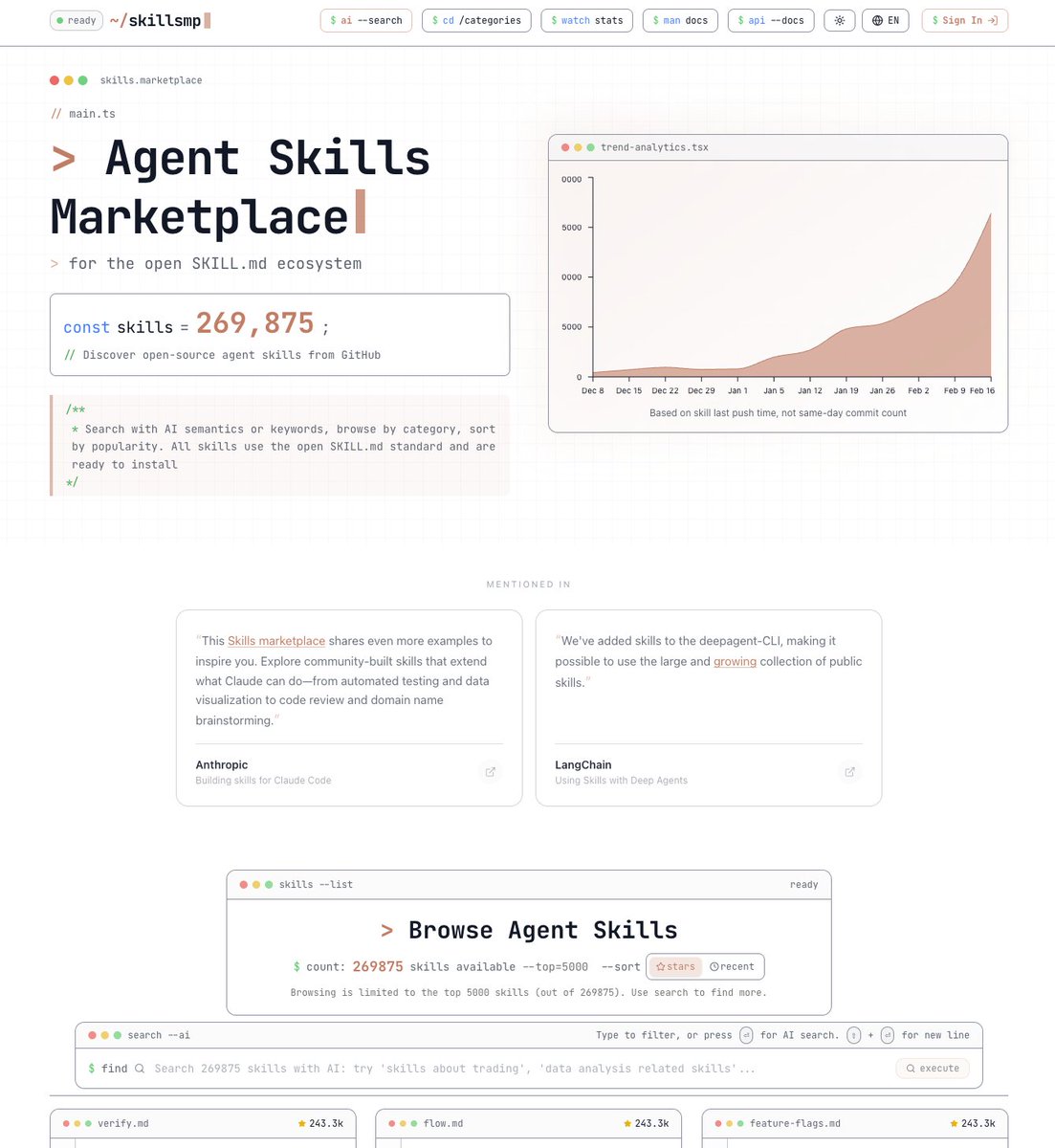
Holy shit... someone just built an App Store for Claude Code.
It's called SkillsMP and there are 200,000+ agent skills that teach your AI exactly how to write PPTX files, review PRs, deploy to cloud, analyze data, and more.
No complex prompting. No building from scratch. No wasted tokens.
100% Opensource.
I've used Claude Code to build 20+ projects in the last 6 months. Thousands of new users across them. And I've never written a single line of code.
I just dropped a 24-min video with my top 10 tips for non-developers — the exact playbook I use every day to run multiple AI agents that handle work that used to take me a full week.
This is the best beginner guide to learning and building with Claude Code out right now. Every tutorial I found assumes you're a developer. This one doesn't.
I cover everything from first install to running multi-agent workflows — with live demos and real examples for every single tip. How I set up new projects, how I got Claude to match my writing style, how I automate repeatable workflows with one command, and how I run multiple agents working on different tasks at the same time.
I also built a full resource repo to go alongside the video — curated video tutorials, the best skill libraries, plugin directories, MCP server guides, written docs, community links, and a starter https://t.co/00cPLRz1gJ template you can copy-paste into your first project today.
Comment "GUIDE" and I'll send you the full guide with everything you need to learn Claude Code!
(make sure we're connected so I can DM you)
Short title, interesting content!
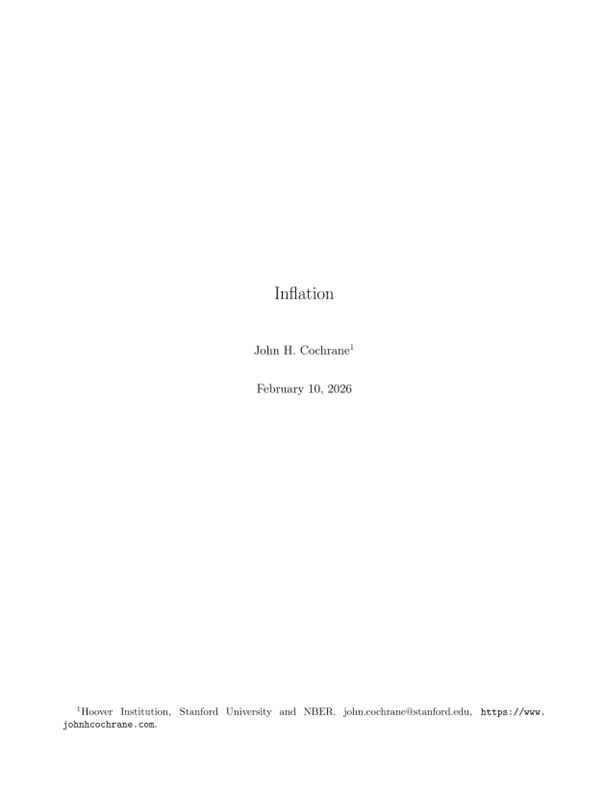
"Inflation" by John H. Cochrane.
"I focus on analyzing historical episodes. Why did inflation surge and then largely go away in 2021-2022? Why was inflation so quiet when interest rates were stuck at zero? Why did quantitative easing have no effect on inflation, but the same policy in 2021-2022 seemingly produce huge inflat? And so forth. Academic economics is usually devoted to formal testing. But as I have thought about these issues over the years, I find that exploring episodes is more illuminating, at least as a first step. Episodes also make it easier to understand a theory, and make for a far better lecture than slides full of equations."
https://t.co/3SP34F1QgI
This book stems from the Ninth Karl Brunner Distinguished Lecture, delivered at the SNB in Zurich in October 2025. You can watch it here: https://t.co/AEa2mqW7qi
How Tariffs Affect Trade Deficits...
... a new paper with amazing trade economist Arnaud Costinot.
Many politicians and the general public expect tariffs to reduce imports lower imports and thus work to close a trade deficit.
Economists typically say "not so fast"...
🧵1/n
While the USTR tariff calculator cites the findings from Cavallo, Gopinath, Neiman & Tang (2021) it is not entirely clear how they use our findings. Based on our research, the elasticity of import prices with respect to tariffs is closer to 1. If that figure were used instead of 0.25, the implied reciprocal tariffs would come out about four times smaller.
Okay, let's talk about Trump end game. To do that, let's read Stephen Miran's "A User's Guide to Restructuring the Global Trading System" together.
Note that there's a disclaimer that this is not a policy advocacy but catalog of tools available for them to "reshape the global trading system."
https://t.co/4i07pKDkzT
From 1264 to 1827, anyone who received a Master of Arts degree from Oxford had to swear that they would never forgive Henry Symeonis. By 1608, no one knew who he was or what he had done.
Chinese investors’ demand for better returns overseas is so strong that even an expanded purchase quota for some funds is selling out fast https://t.co/kQvNlLkY1S
🧵Now that the book is completed, I want to tell you in this thread why America, between 1870 and 1910, actually was enjoying fast growth in living standards for the bottom 90% -- as fast the improvements for the top 1% & faster than the improvements for the top 10% #econtwitter