Stablecoin payments to emerging-market B2B and remittance corridors are the most important blockchain product category of 2026.
Trade finance is the largest underbuilt sub-segment, a $9T trust problem disguised as a logistics one.
New piece walks through the stablecoin-enabled trade finance stack, and previews where we @1kxnetwork are looking to deploy next
https://t.co/kS5D4r1p1J
looking forward to discussing what we're excited about going into 2027 at @SingaporeBWeek
will also be at @sgfintechfest - keen to chat if you're building in onchain FX, cross-border credit, and trade finance
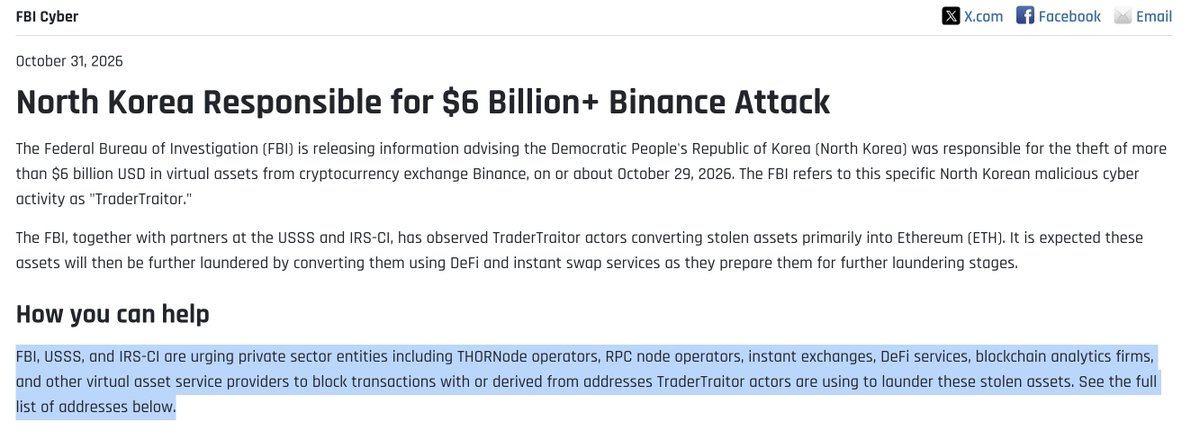
The FBI just released a set of digital asset addresses and requested the industry to help block them.
Let me know if you need help figuring out how to navigate all of this. Happy to hop on a call at all hours.
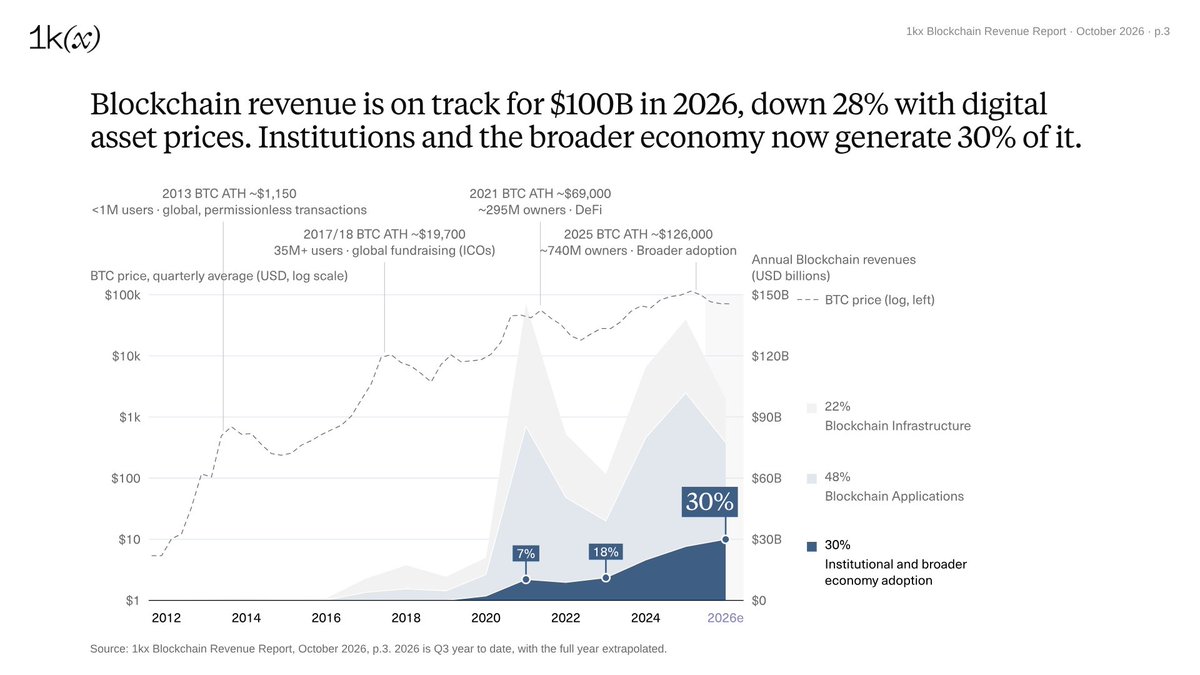
Today we @1kxnetwork publish our Blockchain Revenue Report.
Three things stand out for me:
1. Revenue is decoupling from price. Institutional and broader economy usage grew to 30% of the total, while everything else shrank. Payments, stablecoin settlement, and RWA trading now set the floor for this industry, not where tokens trade.
2. Value is moving up the stack. Broader economy revenue overtook infrastructure revenue in Q3 for the first time. Infra fees halved in H1 while transaction counts rose 18%. Blockspace is becoming a utility. Margins now accrue to whoever owns the customer.
3. The competition changed. Public companies earn 16% of blockchain revenue, up from 7% in 2022, and the top six hold ~60% of that. The incumbents aren’t adjacent anymore... they’re in the arena.
Full report from the team below.
The annual 1kx Blockchain Revenue Report is out today.
Blockchain revenue is on track for $100B in 2026, down 28% with prices. Institutions and the broader economy now generate 30% of it. In Q3, broader-economy revenue passed blockchain infrastructure for the first time. Public companies earn 16%, up from 7% in 2022. A record 283 protocols paid token holders in Q3 through buybacks, burns or fee sharing.
The report covers 2,600+ protocols and 100+ public companies through Q3 2026.
Read it here: https://t.co/CdSvQGKcon
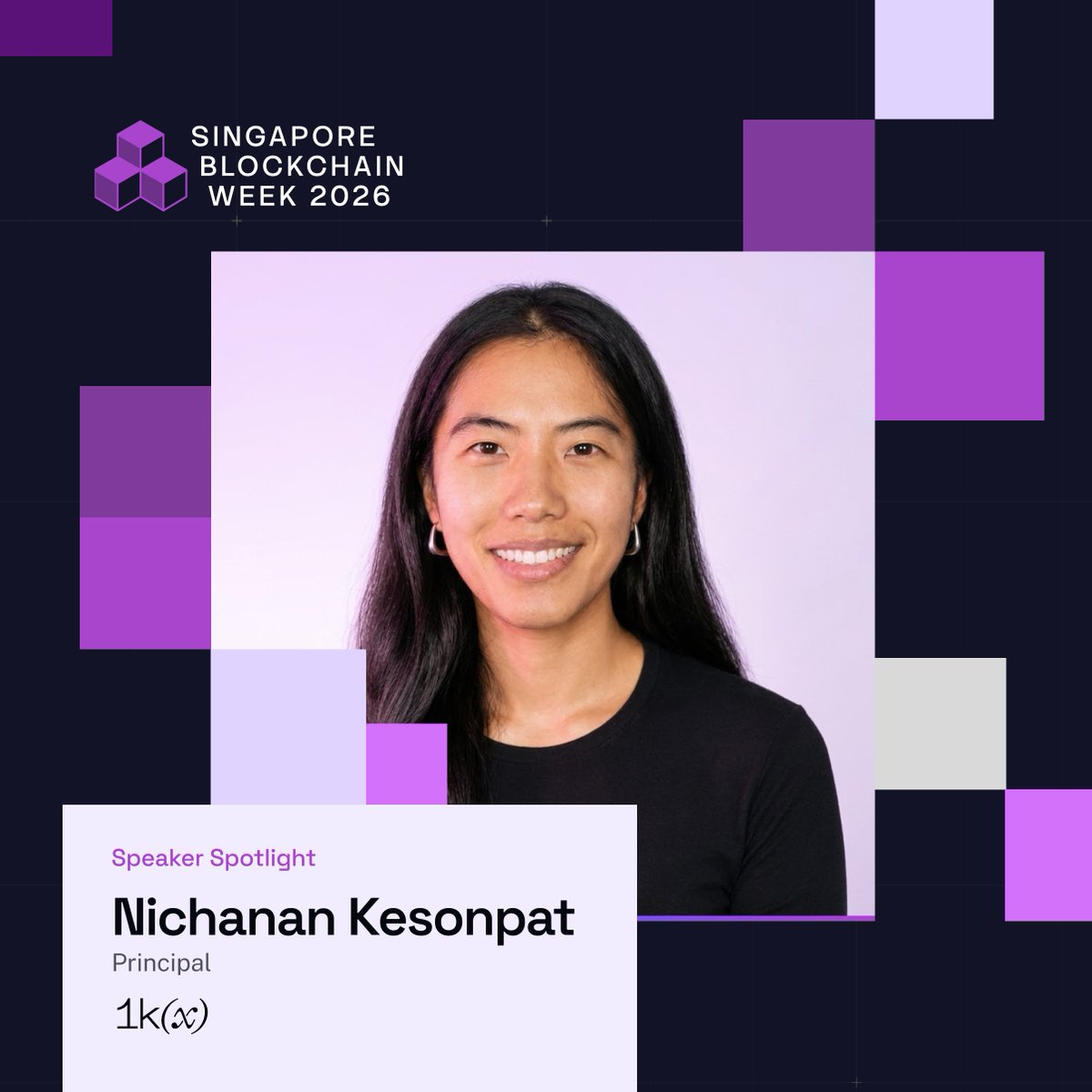
Nichanan Kesonpat (@nichanank), Principal at 1kx (@1kxnetwork), is confirmed for Singapore Blockchain Week.
Invests in wallets, identity, payments and trade finance. Built smart contracts before that.
Panel: Smart Money 2027. Judging Startup Pitch.
17 Nov, Furama Riverfront.
The @0xPredicate team has been at the forefront of onchain compliance since the days when crypto felt like the Wild West.
@pumpernikhil@Jessesawa were two of the very few founders who thought deeply about what it took for regulated markets to participate onchain.
Today, Predicate is ready to enable financial institutions and fintechs to scale regulated digital assets. Incredibly proud to have @1kxnetwork back the team at seed and seeing how far they have come.
We are thrilled to announce our $8M Series A to connect regulated markets to onchain finance.
Predicate enables digital assets to reach every market compliantly. We do this by embedding compliance controls directly into digital assets to block high-risk and sanctioned activity at every transaction.
To date, Predicate has:
- Screened $1B+ in transaction volume
- Evaluated 6M+ transactions against custom compliance policies
- Blocked 100K+ non-compliant transactions
The round was led by @bcap with participation from @Paxos, @1kxnetwork and @tribecap.
Deployment of agentic AI is no longer bottlenecked by capability, but rather on security & trust.
New piece in the @1kxnetwork cost of trust series: 20+ security incidents, 50+ products, and 100+ academic papers condensed and mapped onto a four-layer architecture.
Great weekend read by @nichanank at @1kxnetwork on how blockchains and stablecoins can enable a better infrastructure for trade finance.
Also thanks for the @0xPredicate shout out!
Cost of Trust 2.0, the full conversation.
Where the frame holds in financial infrastructure. Where it gets repriced at the AI edge. Where the next category gets built.
Plus, where the thesis has evolved since the 2018 paper.
https://t.co/ZAy2ib39k8
The Cost of Trust 2.0 framework, applied to a $9 trillion category.
@nichanank on the rewiring of trade finance: stablecoin rails compressing correspondent banking rent (340bps on lower-value flows) and opening dollar access where banks structurally cannot reach.
The seven-layer trade stack, the MLETR regulatory gating analysis, and where we are investing.
https://t.co/mtZ3wVab9m
35% of US employment is spent creating trust.
Auditors, notaries, attorneys, courts, custodians, compliance officers. Trust-establishing work is the single largest category in the modern economy.
It is also being repriced.
The repricing started in financial infrastructure. Custody costs heading to zero. Cross-border settlement collapsing from days to seconds. Aave hit $44B in custody at peak (late 2025) at zero fixed cost.
It hit AI a second time. The Hong Kong CFO who got on a Zoom call with deepfakes of his CEO and the board, and wired $20M. AWS outages caused by AI agents managing production clusters without human oversight.
AI is the most powerful trust-eroding technology we have built. Trust intermediaries built on human schedules cannot keep up with fraud produced on machine schedules. The cost of creating fakes goes to zero. The value of verified trust goes up exponentially.
And it is opening categories that were not possible before. Permissionless conversion-based advertising. Hallucination-proof knowledge graphs. Programmable insurance.
Eight years of investing. One argument.
Cost of Trust 2.0, our 2026 thesis. Read it: https://t.co/Y0qgmqHN9u
35% stat: "The Cost of Trust: A Pilot Study," SSRN.
Aave peak TVL: DefiLlama.
AWS outages: The Guardian, February 2026.
Stablecoin payments is becoming a crowded space. Margins are shrinking fast, especially after the GENIUS Act opened the door to more players.
@nichanank, Principal at @1kxnetwork, says the companies that survive will be the ones offering more than just payments.
"As businesses move their money on chain, that payment history becomes useful for things like lending, because the flows are auditable and they have regular volumes going through."
The next wave of stablecoin companies will look more like banks than payment processors.
.@nichanank, Principal at @1kxnetwork, shared three observations from her market deep dives on Stabledash Live today:
1/ Where the stack was a few years ago:
"A few years ago we were talking about things like key management and account abstraction. Nowadays, dapps can pick from a handful of default providers. The UX and the onboarding is pretty much solved."
2/ Where investment is moving now:
"Instead we're seeing things like on and off-ramps, stablecoin orchestration, tackling the next step of the problem, which is not onboarding. How do we make crypto useful in the real world?"
3/ Who the end user actually is:
"The next wave of crypto users aren't crypto-natives. They're using a product that happens to use blockchain under the hood to pay their vendors or send money back to their families."
Stablecoin payments are no longer theoretical infrastructure — they’re already reshaping cross-border finance across Southeast Asia.
At SEABW 2026, Bugeon “Mac” Lee (@moonpay), Ruam Siratanapanta (@mrbenokc), Vijak Sethaput (@vsethaput), and Jane Pukasemvarangkoon (@Ripple) discussed the real challenges behind scaling global stablecoin payments — from compliance and banking access to FX settlement and consumer trust.
Moderated by Nichanan Kesonpat (@nichanank).
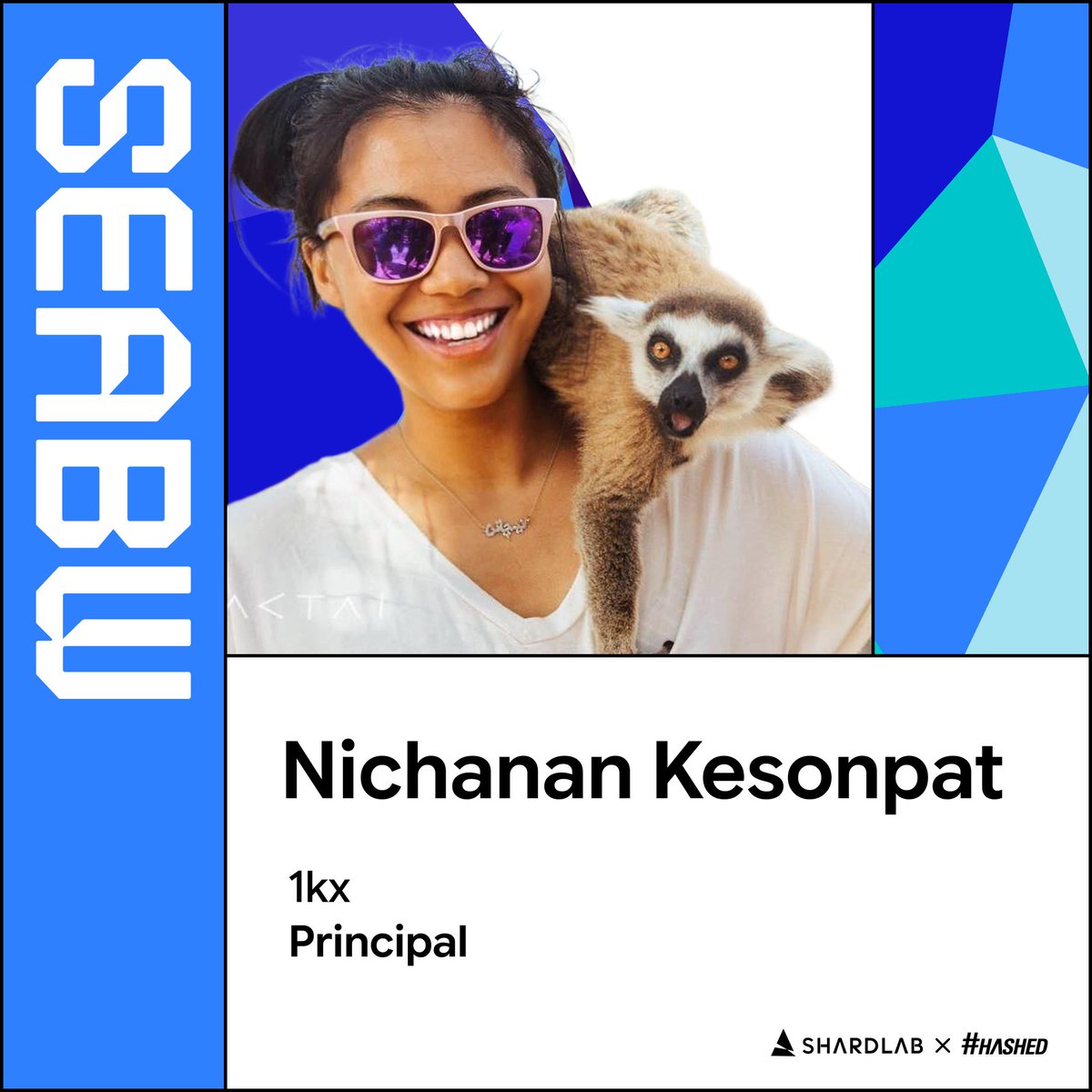
🎙️ Proud to welcome Nichanan Kesonpat (@nichanank), Principal at @1kxnetwork to SEABW 2026!
Smart contract developer turned investor, Nichanan researches and backs projects across wallet infrastructure, payments, and decentralized identity at 1kx. A UC Berkeley neuroscience graduate with roots in Bangkok's early blockchain scene, she'll be speaking on what it actually takes to move money faster, cheaper, and at scale through stablecoins and global payment rails.
🎟️ Join the conversation: https://t.co/R8NPqdO4Aa
#SEABW2026 #Stablecoins #Web3
Introducing Predicate Asset Compliance: Automated compliance controls for stablecoins and RWAs.
Issuers define policies for who can and can’t access their assets. Predicate enforces them in real time, directly onchain.
Here's how it works and why we built it.
A highlight of @1kxnetwork investments within our thesis on threat-resistant & compliant onchain privacy.
- @0xMiden: chain designed from the ground up for programmable privacy (ZK)
- @zksync: private & customizable prividiums (ZK)
- @inconetwork: user-friendly privacy layer for existing chains (TEEs)
- @SeismicSys: privacy-enabled EVM-based fintech L1 (TEEs)
- @ligero_inc: private account layer for all chains, custom-built for businesses (ZK)
- @0xPredicate: programmable policy infra, for privacy protocols, defi, & beyond
- @fiber_evm: private EVM wallet infra w/ a slick mobile app (ZK)
Here's the exciting bit: (at least) five of the above projects are about to go live this year!
2026 is the year for onchain privacy.
-----
At 1kx, we put our money where our mouth is.
We develop theses and partner with the best founders to realize the shared vision.
Onchain finance needs threat-resistant privacy
→ Real-world & institutional finance cannot move onchain without privacy
→ To prevent misuse (e.g. laundering of hacked funds), the only viable solution is to build threat-resistant privacy
More in my op-ed in Forbes 👇
We’re excited to share that 1kx led the pre-seed in @giggles_app - a new kind of social network where users can buy into videos early and participate in the upside as they spread.
We think Giggles opens up a compelling new design space at the intersection of social behavior, market design, and crypto-native coordination.
Congrats to @justinmujin, @itsedwinwang, and the whole team.
Big thanks to @TechCrunch and @asilbwrites for the exclusive: https://t.co/EtfJ0AAaDi