Excited to share the @NNDC_official Ketamine Task Force’s position statement in support of broader insurance coverage for intravenous ketamine infusions in treatment-resistant major depressive disorder https://t.co/AfOKSF1kE8
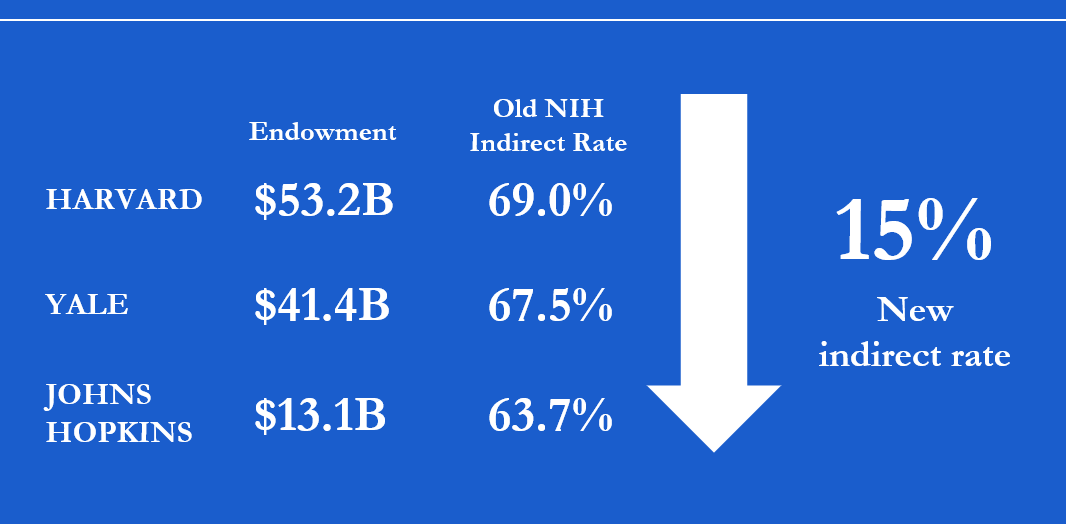
“50% indirect” means adding $0.50 for facilities and administrative costs to each $1.00 of directly budgeted costs = $1.50 total = *33%* of total grant budget. Similarly, “65% indirect” = 39% of total. Debate, but if you want anyone to take you seriously, please learn the facts (and do the arithmetic).
Last year, $9B of the $35B that the National Institutes of Health (NIH) granted for research was used for administrative overhead, what is known as “indirect costs.” Today, NIH lowered the maximum indirect cost rate research institutions can charge the government to 15%, above what many major foundations allow and much lower than the 60%+ that some institutions charge the government today. This change will save more than $4B a year effective immediately.
I'd be much more interested in a To Catch a Predator type series, but with successful labs. Chris Hansen going around and trying to reproduce flashy findings from raw data, hugging distraught visa-hostages, calling the ombudsperson on the PI, that kind of thing
I have Asthma, allergies, dyslexia, ADD, anxiety, and Depression.
But I will tell you that what you have does not define what you can become.
Why Not You!
We're excited to announce the 2024 Department of Psychiatry graduates! 🎉 Click the link to learn more about their incredible achievements and future plans: https://t.co/qQi7eDu9dd
Nicholas Trapp, MD, was featured in today's Noon News for innovations in interventional psychiatry! Check out the article below. https://t.co/xg2uudywWK
Department of Psychiatry Chair Peg Nopoulos, MD, was featured on KCRG this past Saturday to talk about Huntington's disease and the importance of community.
Looking forward to participating in this landmark @NIDDKgov workshop on gastrointestinal #interoception tomorrow. With this incredible group of speakers there are some surely amazing insights ahead! https://t.co/rbAQOAAYyS
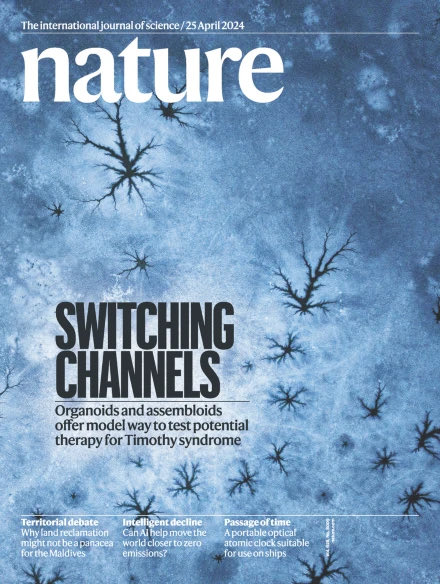
Today, I’m thrilled have our lab’s work featured on the cover of @Nature
In this article, we have developed a therapeutic approach for a severe condition called Timothy syndrome. This has been a long journey. It started with making hiPS cell-derived neurons in 2D cultures 15 years ago when I was a postdoc and continued with later creating in the lab #organoid and then #assembloid models of this disease caused by a mutation in a calcium channel.
Over time, these human cellular models and the biological insights we gained enable us to design a therapeutic strategy, which we validated in vivo following circuit integration of patient-derived organoids into the rat brain.
Grateful for the incredible work led by @XiaoyuChenxy and @fikribirey in the lab! And the many close collaborators who participated to this line of research over the years.
Today, my colleagues and I in @UIowaPsychiatry will potentially administer psilocybin legally for the first time in the state of Iowa as part of our psilocybin-assisted vs. ketamine-assisted psychotherapy trial for alcohol use disorder! #psilocybin#ketamine#alcoholusedisorder
Banu Gumusoglu, PhD, studies how illness and environmental factors during pregnancy influence a baby’s brain development and lifelong health, illuminating new approaches to screening and treatment for neurodevelopmental disorders. #DiscoverUI https://t.co/7qM0mKQvVb