Forward deployed engineers are what happens when the polymath becomes a hiring profile AI made it possible for one person to hold design, product, engineering, sales, and customer context at once. These people were always rare. They've never had this much leverage Anori is hiring
@balajis the Western Roman Empire never fully collapsed, it retreated to a collection of islands in the venetian lagoon. Venice was founded in 421, and had a continuous line of Dukes from the 700s up until 1797
Venice even controlled many parts of Greece and Croatia up until the 1500s
there's no catch; SAM3 is open source and really good
one of the things it does really well is object tracking, even in crazy complex scenes like basketball
probably my favorite computer vision model ever
Introducing Gemini Omni 🔮........ Omni is our new model that can create anything from any input — starting with video (think Nano Banana but for video). Available in the Gemini App, Flow, and YouTube, with API support coming soon!
Open source is the best part of working in tech. @huggingface keeps proving why — shipping the tools, hosting the models, and making serious AI accessible to anyone who wants to build.
I tested @huggingface ml-intern, given the prompt
"Fine-tune a Segment Anything Model (SAM) on a useful medical dataset. Train the model, and provide a comprehensive tutorial in a Jupyter Notebook file. Additionally, create a Hugging Face article/blog post documenting everything you have done."
It did it all autonomously:
- Researched via hf_papers & searched GitHub/HF Hub
- Found an HF dataset & wrote the finetuning script
- Trained it using HF compute (took ~1 hour)
- Pushed the weights & wrote the article
Here are the model weights, code, and the blog it generated:
hf article
https://t.co/cHHlkVWwzh
model weights
https://t.co/C07fFm4kZe
Awesome stuff @akseljoonas , looking forward to use this. 🔥
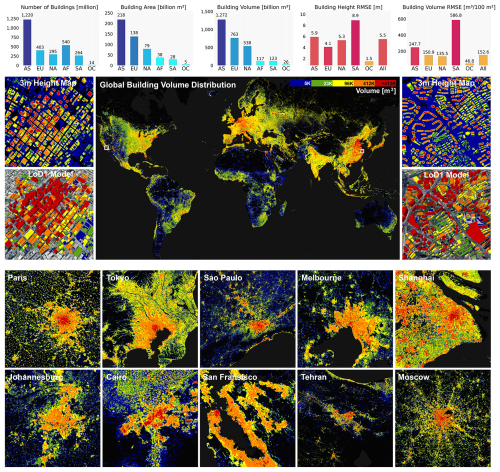
The UN estimates there are roughly 4 billion buildings on Earth.
Researchers have just released the first open dataset providing 3D models for 2.75 billion of them at 3m resolution:
Trails predict where land will reprice. Years before the cranes show up.
New York saw it. Chicago saw it. Atlanta saw it.
Dallas is next. And it's running the largest version of this experiment any American city has ever attempted.
Here's the pattern:
Every major American city is fighting the same battle. The suburbs keep growing. The urban core fights to hold its tax base. People say they want walkability and community. Then they leave for places that feel safer and easier to navigate.
Cities have big ambitions. Dallas. Chicago. Atlanta. They want to attract people, businesses, and jobs. That takes money. Aging infrastructure needs replacing. New amenities need building.
The tax base isn't shrinking. But it's not growing fast enough to fund those ambitions without raising rates. And raising rates pushes more people out.
There's another approach.
Build infrastructure that makes land more valuable. Not highways. Not stadiums.
Trails.
It sounds too simple.
When you build a connected trail network, you create the walkability people crave. Neighborhoods that were cut off become accessible. Land values rise. Tax revenue grows without raising anyone's rate.
The evidence is hard to argue with.
New York built the High Line. Property values jumped 35%. Chicago built The 606. Home prices spiked 48%. Atlanta built the BeltLine. Developers have poured more than $9 billion into land along it.
The pattern holds whether the city runs red, blue, or purple. Build the connection. Land reprices.
Dallas is now running this experiment at the largest scale any American city has attempted.
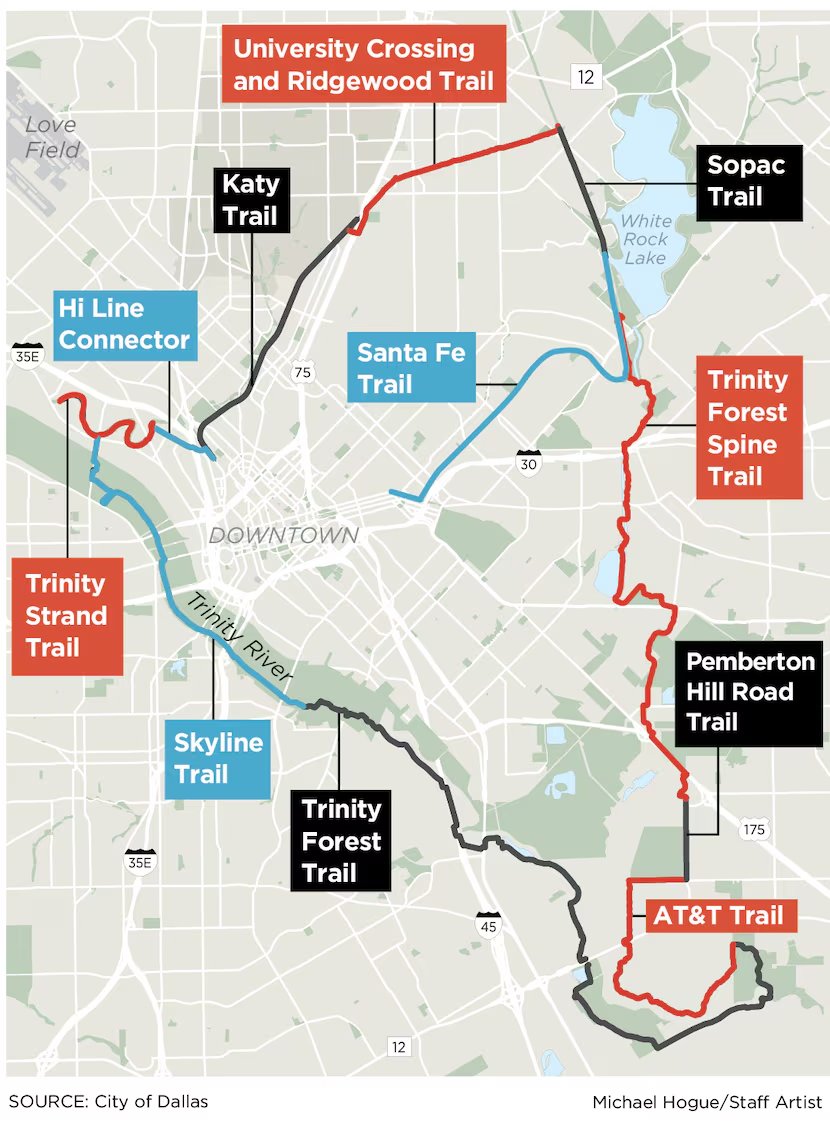
The Loop Dallas is a 50-mile trail circuit. It connects the Katy Trail, White Rock Lake, the Trinity Forest, Fair Park, the Design District, and Pleasant Grove. Every quadrant of the city.
The Design District already proves the thesis.
The city built a short connector to plug the area into the Uptown trail network. Before, it was an isolated pocket of warehouses. After, it became part of the Uptown ecosystem. Taxable value climbed 383%. Developers flipped their blueprints. Buildings now face the trail, not the street.
South Dallas is next.
A 1,200-foot bridge is opening the Trinity Forest Spine Trail. Neighborhoods cut off for decades by the river, the railroad, and the highways are about to become connected.
Every city that built a loop trail system saw the same result. Remove the barriers. Capital follows.
Trails aren't expenses.
They're leading indicators. They tell you where land is about to reprice, years before the cranes arrive.
If you want to understand where Dallas is heading, don't watch the skyline.
Follow the trail.
Lots of ink has been spilled on the subject but I've been noodling on another angle. I believe the best way to describe 2026 is the beginning of the Software Industrial Revolution.
https://t.co/P6Auy279NF