I’ll be presenting our work on on-policy expert corrections (OEC) at ICML next week!
grateful for the team led by @NiklasLauffer, with Xiang Deng, @Bckenstler and @_jeffda
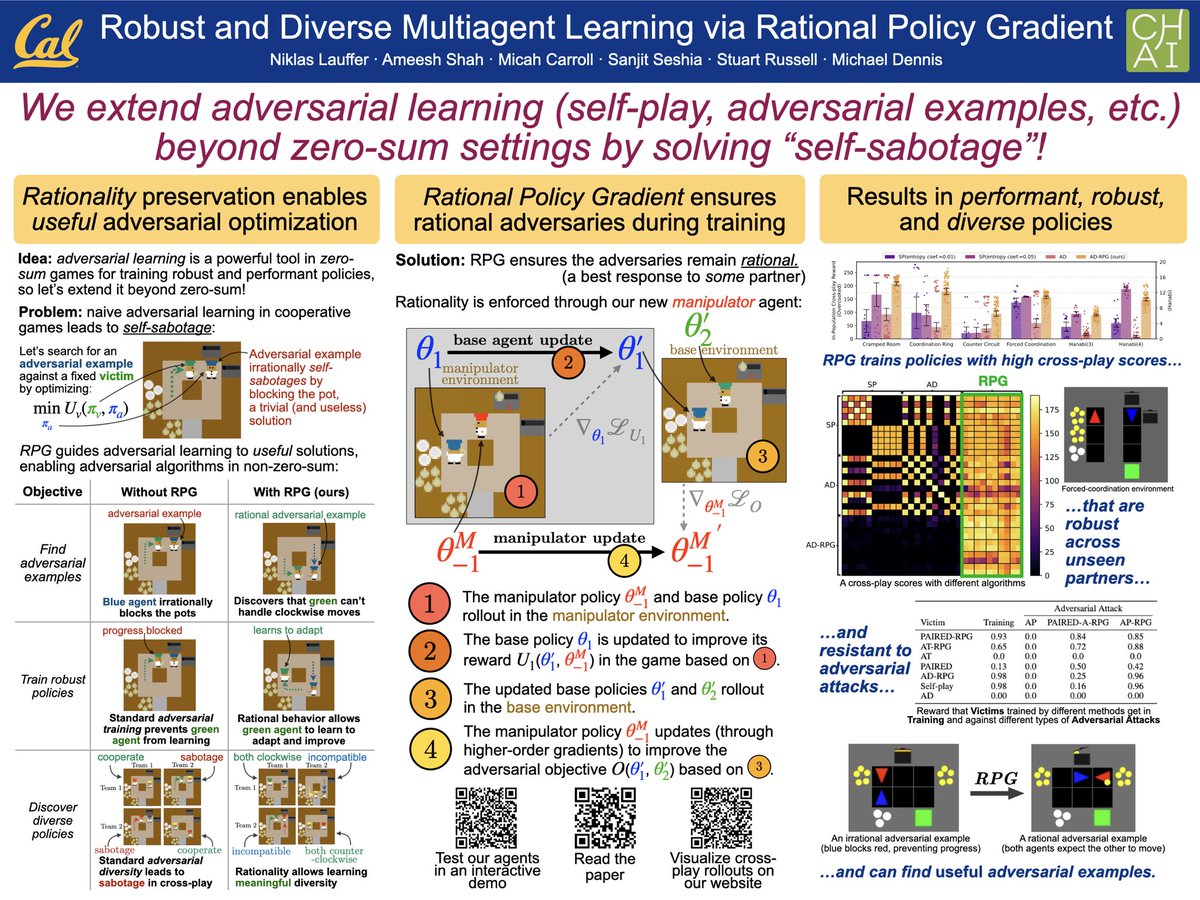
Our recent 'Fellows' Spotlight' seminar is now available on YouTube. Watch 'Robust and Diverse Multi-Agent Learning via Rational Policy Gradient' led by our PhD Fellow @NiklasLauffer (@UCBerkeley). Link below.
7 / N But what is to stop a novel task generator from going haywire? For this, I chanced upon a cool NeurIPS poster by @NiklasLauffer and @MichaelD1729 (and I am embarrassed not to have been aware of their work before despite all of us working at DeepMind :)
This work builds on a long line of work by Michael et al on adding antagonists to multi-agent systems as a means of providing guardrails for generating “rationality” or reasonable solutions. The present work extends further by asking how to prevent such systems from turning to self sabotage (which is an edge case of such multi-agent systems)
Not a whole lot of mainstream work on good theory-inspired multi-agent systems and exploiting nontrivial equilibria that may result from excellent design choices, but it seems increasingly people are thinking about it.
I had a lot of fun working with @BhatiRupali and Mariana on this project!
Turns out model’s coordination capabilities quickly breakdown if you don’t carefully define how they should coordinate as a part of their scaffold.
Come find us to chat!
Excited to present my @CHAI_Berkeley internship work “The Influence of Scaffolds on Coordination Scaling Laws in LLM Agents” tomorrow from 3:45pm-4:45pm at the @mti_neurips workshop and on Sunday 7th Dec from 12:10pm-1:10pm at the Scaling Envs for Agents workshop. Come say hi! 👋🏻
I’m at #NeurIPS2025 until Sunday!
Reach out to chat about multi-agent learning, AI safety, human-AI interaction, or LM agents.
Excited to present our work on rational policy gradient in hall C,D,E, #5511, 11-2pm on Wed with @MichaelD1729@MicahCarroll@ameeshsh
‘Robust and Diverse Multi-Agent Learning via Rational Policy Gradient’ by @NiklasLauffer et al.
To enable successful adversarial optimisation in cooperative multi-agent settings, which traditionally fails due to agents being irrationally incentivised to self-sabotage, this paper introduces Rationality-preserving Policy Optimisation (RPO) and a solution method called Rational Policy Gradient (RPG) that ensures agents remain rational whilst optimising adversarial objectives to find robust, adaptable, and diverse policies.
Full paper: https://t.co/vLRPpudlWg
Many open-ended algorithms are driven by an adversarial dynamic. But in cooperative or mixed-motive games this can result in self-sabotage
Rational Policy Gradient avoids sabotage, opening up a world of possibilities for multi-agent open-ended systems!
Had a lot of fun working on this project with @NiklasLauffer et. al. 🤠 We're able to improve multi-agent policies by having agents play with *meaningfully challenging* partners! But finding those partners is not an easy task - check out the thread for more!
Huge thanks to my fantastic collaborators @ameeshsh, @MicahCarroll, Sanjit Seshia, Stuart Russell, and @MichaelD1729.
arxiv: https://t.co/lEC9QWkR5g
website: https://t.co/v5q4myKIIW
code: https://t.co/cxNuDtP6Dm
RPG can be used to make any adversarial learning algorithm work in non-zero-sum settings. We used RPG to design algorithms to detect vulnerabilities in policies, train more robust agents, and discover diverse populations but we’re excited to see what you do with it!