Paul Tudor Jones shorted the 1987 crash and made 200% the same week the market lost a quarter of its value
now he's pointing at a date on the calendar
"it feels like October 1999"
back then the NASDAQ doubled in five months - then the whole thing blew off the top
he says the setup is here again: easy financial conditions, rate cuts instead of hikes, retail piling in, speculative mania building
the difference this time is the deficit, not a surplus
so he's not sitting it out - he wants gold, crypto, and the NASDAQ, all at once
Amos Tversky, Stanford professor:
"One bad decision can make $1 million. One good decision can lose $1 million. Wall Street pays for knowing the difference"
This free Yale lecture explains the psychology behind that skill.
Yale teaches the psychology behind that skill for free.
The lecture explains why people overweight recent events, ignore base rates, and judge decisions by results. The article below turns those failures into five practical filters:
Expected value measures the decision across repetition.
Base rates establish what was probable before new evidence.
Ergodicity asks whether one real bankroll survives the path.
Bayesian updating changes the odds as evidence arrives.
Signal discipline prevents noise from becoming a new theory.
These models work together. Expected value without survival can recommend eventual ruin. Accuracy without base rates can make a useless model look brilliant. Updating without discipline turns every headline into evidence.
A bad decision can win once. A good decision can lose once.
The mathematics is public. The Yale lecture and Jane Street’s guide are free.
The expensive skill is applying them while real money and incomplete information are pushing you toward instinct.
Read the article below.
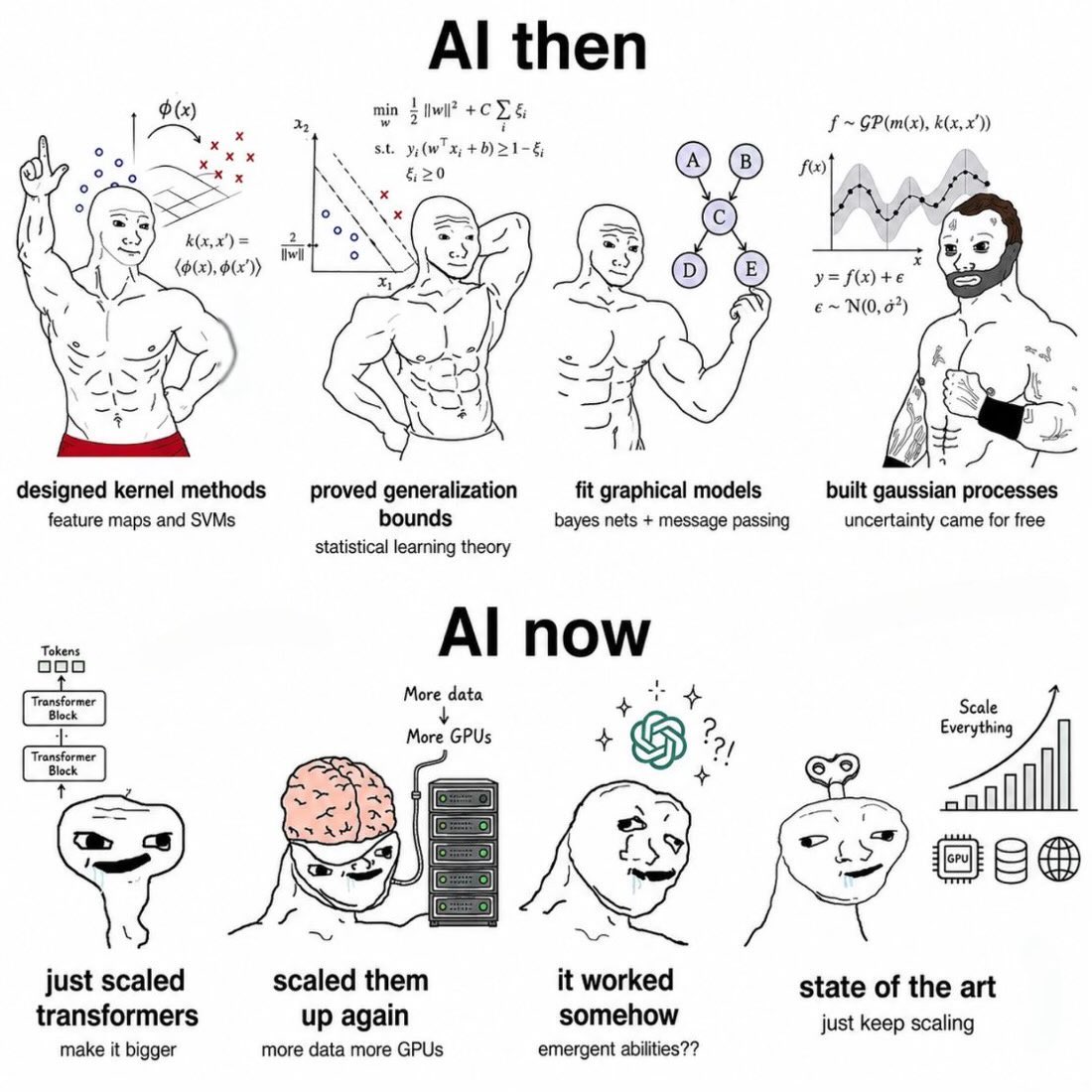
"Modern AI was built on one simple idea: machines can learn."
Ilya Sutskever says that in the early 2000s, computers couldn't truly learn, and many weren't even sure artificial learning was possible.
"He believed neural networks offered the best long-term path because they could learn from data, improve automatically, and scale with increasingly powerful parallel computers."
"Back then, models had only dozens or hundreds of neurons, a million parameters was considered huge, and researchers trained them on CPUs using MATLAB."
10 million people watched an MIT professor accidentally destroy the executive coaching industry.
He recorded one lecture in 2018.
It has taught more people to communicate than courses costing thousands of dollars.
Patrick Winston, former director of MIT's AI Lab, spent decades refining a simple framework for speaking that still outperforms most modern coaching.
Watch the lecture. Then read the article below to learn how to apply it. 👇
"I did a lot of math, I made a lot of money, and I gave almost all of it away." That's how Jim Simons summed up his entire life, in one sentence, at the end of a talk.
Buried inside that sentence is a quiet disaster nobody would guess.
Simons once published a theorem, only to watch two mathematicians, one named Bombieri, prove years later that his own supposed counterexample was real, killing the result.
He built the Chern-Simons invariant the same way, purely for its own beauty, with zero interest in physics. "You never know where something will go," he said, "you think you're doing math, and you're actually doing physics." Today, four physics papers a day still cite it.
This is oddly the same discipline underneath every casino floor and trading desk on earth. Nobody wins by predicting one outcome correctly. The house wins with a small edge repeated so many times that the Law of Large Numbers turns a whisper into certainty nobody can escape.
Simons found that same structure decades later in the market, an edge barely half a percent per trade, right only 50.75 percent of the time.
Barely better than a coin flip, applied with the same disciplined repetition that once let a failed proof quietly wait years to become something else entirely.
The real thread through his whole life is patience with not knowing. He never chased the payoff directly. He built the structure and let repetition do what a single brilliant guess never could.
STEVE JOBS GOT FIRED FROM APPLE.
Then he walked straight into MIT and dropped the most raw, unfiltered 60-minute business masterclass ever recorded.
Zero PR bullshit. Zero image to protect.
Just pure, brutal honesty from the man who built Apple once and was about to rebuild it even bigger.
Stop scrolling.
Watch this tonight instead of Netflix.
Bookmark it. Come back to it.
MIT Professor just revealed the exact mathematical framework behind quant trading and zero-sum edge.
80-minutes. free. By Ian Bell.
here's what they cover:
• how von Neumann proved moving first isn't a disadvantage in zero-sum games
• Nash equilibrium vs. security strategies (minimax & maximin algebra)
• why chess has an exact objective outcome (1, -1, or 0)
• von Neumann poker model - proving bluffing as pure math
Bookmark & watch today. Then read the article below.
Do not forget your weekend's mandatory read.
What happened last week explained.
Foundations: Market Structure, Volatility Targeting, Pod Shops & Other Gremlins
https://t.co/XlG8ScsCe4
The Type of Read that Grants the Reader not only Understanding but Air Superiority
Ken Griffin: "great companies are always on the edge - running a world-class firm feels like driving a Formula 1 car at 225 mph with squealing brakes on every turn"
Key moments from his iconic speech at the Economic Club of Chicago:
00:00 - Starting Citadel from a Harvard dorm room 08:00 - Hiring elite talent during market panics
15:30 - Surviving the 2008 financial crisis: Citadel's toughest test
33:35 - Why "too big to fail" banks should be broken up
43:55 - How Ken Griffin manages Citadel's research and trading
47:50 - The dangers of Federal Reserve QE policies
bookmark and watch the full conversation
🚨 Rosa María Palacios: “Mientras los 74 diputados de (Ahora Nación, Buen Gobierno, Juntos por el Perú y Obras) SE MANTENGAN UNIDOS y controlen la Mesa Directiva, NO HAY ninguna posibilidad de que disuelvan la Cámara de Diputados”.
“Que no vengan a decir que harán confianza para que les den facultades, porque la confianza ya no existe gracias a ellos. Las reglas fueron modificadas por el pacto que nos gobernó y el TC lo ratificó”.
Tags: Keiko Fujimori #Fujimorismo
Este discurso de elon vale oro.
En 2003, con 32 años, Elon Musk entró a una sala cerrada en Stanford y en 45 minutos destrozó todo lo que creías saber sobre startups.
Vale más que 10 libros juntos.
Desglosó, capa por capa, cómo llevó de cero a sobrevivir las 3 empresas que tenía en ese momento:
Zip2
PayPal
y SpaceX (que acababa de fundar un año antes)
Cómo encontrar dirección cuando nadie cree en ti.
Cómo controlar costos hasta el último centavo.
Cómo mantenerte vivo cuando el dinero se está acabando.
Cómo resolver cualquier problema con primeros principios.
20 años después y sigue siendo oro puro.
Guárdalo. Vas a necesitarlo.
🚨Jensen Huang acaba de enterrar el prompt engineering.
El CEO de NVIDIA (uno de los 7 hombres más ricos del mundo) habló 67 minutos en Stanford sin guion, sin filtros y soltó esto:
«Si todavía estás escribiendo prompts… para. Empieza a construir loops.»
Esto es gratis.
Y vale más que el 90 % de los cursos de 300 dólares que ves por ahí.
No lo leas.
Ve y construye tu primer loop ahora.
INSTEAD OF WATCHING AN HOUR OF NETFLIX TONIGHT.
This 60-minute Cambridge lecture by Demis Hassabis will teach you more about the future of AI than most people will learn in the next 5 years.
Bookmark it and give it an hour, no matter what.
Denis Auroux - Harvard professor of mathematics, teaching at MIT:
"Wall Street wants to read the future, but every model it runs was built to fit the past. The line remembers. It doesn't know the next point. The edge was never certainty - it's knowing the odds."
he sets up the whole game in one line: find the "best fit" line "that somehow approximates very well this data." past prices in, a rule out.
then he defines "best" - you "minimize some function of a and b that measures the total errors that we are making." you don't find truth, you find the line that's least wrong.
and the honesty most courses skip: "before you lose all the money that you don't have yet, you cannot use that to predict the stock market."
so the exact tool every quant desk runs on comes with a warning from the person who teaches it: it fits the past, it doesn't own the future.
an MIT lecture on the math under every trading model - free, and almost nobody's watching. bookmark. the line remembers the past; it was never promised the next point.
In 2008, Malcolm Gladwell explained why some people succeed while others don't in a single 1-hour talk.
It will forever change the way you think about talent, hard work, and success.
Bookmark & watch today.
P.S. If you're curious about Claude + Obsidian and want to build your own AI Second Brain, the article below is a must-read. 👇
We're starting to leave the territory where you'd test an LLM by e.g. "create an svg of pelican on a bicycle". As one idea to generalize it, I was interested what Opus 5 would do if I gave it the first paragraph of the Lord of the Rings, a 1M token budget (~$10) and asked for three js render of it. Opus went off for ~2 hours and wrote 5500 lines of code that (procedurally) rendered the story. It's kind of janky but fun. But it's a bit mindboggling that the LLM has to place and orchestrate various polygon assets in (x,y,z) coordinates and write code that animates it all, and that it even does anything at all.
I also like this kind of examples because no one in their right mind would ever spend the time to write something this custom but LLMs have all the stamina and patience in the world, so it's an example where we go from "no one would ever do this" to "sure, why not, it's ~free". There might be a lot more. But I'm excited about creating hyper custom worlds that you can imagine dropping players into, e.g. here to participate in the LoTR story as a spectator NPC, or one of the characters, or etc. Something like an ephemeral GTA of X on demand.
Last thought is that the domain of worlds/games exposes a weakness in LLMs: they can't easily audit their work because they aren't able to efficiently and natively perceive videos or play games within them. Here, Opus 5 had to very slowly and painstakingly take screenshots at different points, and it messed up a few times and created a bunch of jank. An example of raw capability (multimodal, gameplay) that I think is still quite lacking.