12 Keys to Becoming One Great Trader Cheat Sheet:
1. Love the Game: If you don't genuinely love trading, you will never become a Market Wizard. On our desk, guys talk trading on the way to the gym, over breakfast, and all day long. It isn't a 9-to-5; it’s an authentic obsession.
2. Learn How to Make One Good Trade: You must learn how to think through and construct a good risk-to-reward trade before touching the keys. One Good Trade. And then One Good Trade. And then One Good Trade.
3. Study & Build Real Edge: Study the setups profitable traders take. Make them your own. Innovate and add strategies that make sense to your unique cognitive strengths.
4. Execute Daily Best Practices: Complete your PlayBook, run your Daily Report Card (DRC), crunch your execution stats, backtest setups, and work on yourself.
5. Immerse Yourself in Professional Culture: Trading in isolation takes years longer and costs a fortune in "tuition"—otherwise known as painful trading losses. Get around serious traders with the highest standards.
6. Collaborate Relentlessly: Our top desk pulled in ~$50M in 2025 because they trade as a team. They gameplan A+ trades, hold each other accountable, and check each other's blind spots. Collaboration expands your PnL exponentially.
7. Build & Leverage Technology: You cannot see everything manually. Be bionic: build custom scanners, scripts, alerts, and leverage automated tools to make more.
8. Bring Your Best "You" to the Screens: Sleep, nutrition, exercise, and mindfulness all precede elite performance.
9. Embrace Supreme Patience: Traders want the 8-figure year on Day 30. Early in your career, focus on becoming consistently profitable, no matter how small the PnL.
10. Master Your Trading Psychology: Mindset isn't about avoiding losses; it’s how you handle market feedback. When you stop taking losses personally and treat them as the cost of doing business, the emotional friction disappears.
11. Talent: You can't play running back in the NFL without elite speed and strength. You can't become an elite active bionic discretionary Market Wizard without the ability to process information quickly.
12. Resources: Capital, technology, dedicated mentoring and coaching, seasoned senior traders, tools and research are essential to give you the best chance at greatness.
#DayTrading #PropTrading #SMBCapital #TradingPsychology #OneGoodTrade
This paragraph by Kobe Bryant hits hard:
“Everyone wants to be a beast. Everyone wants to be the best. But very few people are willing to do what it actually takes. Because what it takes is boring. It is waking up at 4:00 AM. It is shooting the same shot a thousand times. It is watching the film when you are tired. People fall in love with the result, but they hate the process. You have to fall in love with the boredom. You have to fall in love with the repetition. If you can find joy in the mundane work that no one else sees, the lights will eventually shine on you.”
This might be the funniest chart in tech right now.
Apple's capex strategy has to be the luckiest accident in history:
Amazon, Microsoft, Meta, Google, are in a spending arms race plowing over $100B PER QUARTER into data centers - While Apple spending is down 19%
Meanwhile:
- Mac Minis sold out bc everyone's buying them to run OpenClaw
- Mac Studios have a 6-week backlog
- Someone ran Qwen 3.5 on an iPhone yesterday
- The M5 Max just shipped with 128GB of unified memory and runs Llama 70B from anywhere
The company spending the least on AI infrastructure accidentally became the AI infrastructure
this is shocking:
> US collects $2.4T in income tax, but spends $1.5T on fraud
> if we didn't have to pay for fraud, only $900b would need to be collected
> this means anyone with less 500k in income could pay *literally $0* in income tax
we don't need to raise taxes. we need to cut fraud
SHOULD FUNDAMENTALS MATTER TO TRADERS!?
Let’s close this thread after some fantastic responses, my favorite of which was by @ConnorJBates_.
IMO, fundamentals ABSOLUTELY SHOULD matter to traders.
Why? Because the fundamentals affect the expected value of the trade in multiple ways.
1. As Connor noted in his reply - the absolute best trades have both. I’ve stated many times how in the best trades you want every single style of trader and timeframe of trader on your side.
In the best trades, we have hedge funds and institutions and smart money buying with us. We have long term traders and short term traders with us.
What that does is increases our win rate and our reward, while decreasing our risk.
Buying many of these quantum names, you’re never really going to have the smart or big money on your side because many of these valuations are unjustifiable.
2. The other part I didn’t see ANYONE mention but is also huge: when fundamentals are on your side, the news flow is also probabilistically on your side.
If fundamentals don’t matter, then why do so many traders use @DilutionTracker? Why are traders looking at cash burn to gauge offering risk?
If you are buying a garbage company, the odds of a headline or overnight risk wrecking you drastically increase. Vice versa if you are buying a great company.
3. TIMEFRAME MATTERS! The longer you are holding a garbage company, the more at risk you are to that discrepancy. Scalping means the fundamentals are less important versus day traders versus swing traders versus portfolio managers.
4. Price action still reigns king! My point here isn’t to say that you need to become or should become an analyst. Or that fundamentals should get a 50% weighting for us, or even a 25% weighting.
I am a technical trader and I will ALWAYS listen to the chart.
But my point though is that fundamentals should absolutely have a non-zero weighting for many traders. Even if that simply means knowing likelihood of dilution or being mentally aware of how much of a turd the co you’re buying is.
All things held equal, would I rather buy the same chart setup on an undervalued company or a company that is built on air and ripe for an offering?
As always in trading, the best traders find ways to combine disciplines. There are reasons why traders like @TheShortBear are combining technicals, quantitative data, and fundamentals. The more lenses that align, the better the expected value.
So yes, we are traders. But that doesn’t mean we can or should totally ignore what we are buying and selling.
Consider fundamentals being like a degree of gravity. When fundamentals are with you, gravity is zero and small forces can make you take off.
When fundamentals (gravity) are against you, that doesn’t mean you can’t fly, but it is going to take more energy behind it in proportion to how much gravity there is.
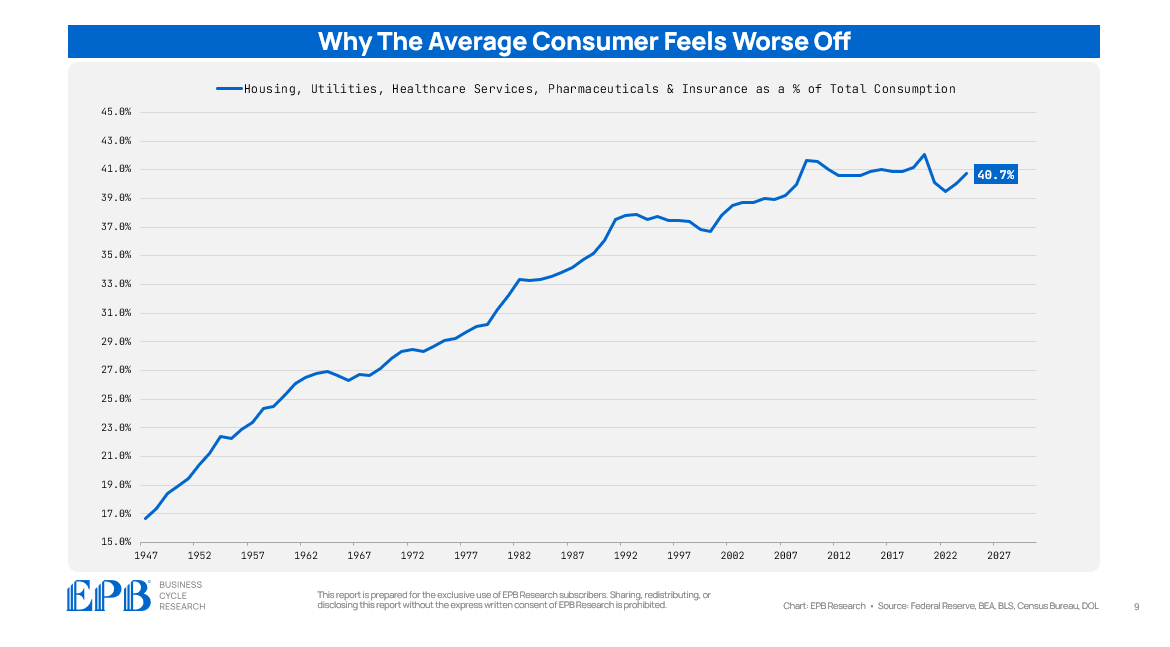
Why does the average consumer feel worse off?
Because 41% of consumer spending goes to: housing, utilities, healthcare, medications, and insurance.
This was 16% in 1947, 30% in 1980, and 35% in 1990.
Fewer consumer dollars are left for true discretionary spending.
Institutional investors are once again reducing their stock exposure:
Non-dealer net positioning in S&P 500 futures has fallen to its lowest level in 14 months, per CFTC data.
Since November 2024, asset managers, leveraged funds, and other investors' net positioning is down ~50%.
Additionally, the funding spread measuring institutional demand for long stock exposure through futures, options, and swaps resumed its decline after a brief jump in May.
This comes despite the market’s rapid recovery over the last 2 months.
The gap between retail and institutional sentiment is widening.
If you ask most people who makes the big money, they'll likely say athletes like @Cristiano or celebrities like @taylorswift13. Some might respond CEOs of giant companies like Apple's @tim_cook.
Hedge fund managers make more than both combined by an order of magnitude.
Klarna, a popular "Buy Now, Pay Later" service, just announced a +110% increase in their Q1 2025 loss of -$99 million.
On top of this, consumer credit losses surged to $136 million in Q1.
This is the same company that just announced "Buy Now, Pay Later" for DoorDash orders.
The worst part?
Klarna announced they now have over 100 MILLION users on "Buy Now, Pay Later."
Consumers are financing everything.