@seresanu, @genophoria, Matthew Wong, Shaopu Zhou, and team reveal that unspliced intronic RNA directly regulates HP1α condensates, the structures that package heterochromatin and keep genes transcriptionally silent.
Energized by the women's health session at #TERMISAM2026! At @Conception, engineering ovarian organoids is our prime directive, so it's exciting to see this cross section getting the airtime it deserves!
Interested in ovarian organoids? Let’s chat! (PS we're hiring) @termisam
FOS is the textbook immediate-early gene. 40 years on, there was still something buried just down the road 🦴
New preprint: FOSIL, a spliced lncRNA 16 kb downstream with no known function. We find it makes FOS fire on time and shut off cleanly.
https://t.co/tlbPX2gpjI
🧵 1/7
Excited to share that our MYC mutagenesis paper is now online at @CellCellPress! Free access link through Dec 24 https://t.co/tMPw5111M3. Special thanks to our handling editor Jude @JudeNicho and the reviewers for their support and feedback throughout the process!
Cool new work from @zhangf’s lab showing engineered fly Arc capsids can be used to deliver RNA/protein cargo into mammalian muscle cells! https://t.co/zRQVbXzrH4
Previously, our lab showed that lncRNA Firre can regulate genes in trans within 30 mins. Is Firre unique or is it general principle for many lncRNAs? we tested this with 17 lncRNAs to capture the primary targets during the first wave of transcription.
https://t.co/mZhyAASdVy
In this preprint we describe new ASOs targeting telomerase RNA hTR. They inhibit telomerase in vitro and induce telomere shortening with reduced proliferation in cancer cells.
A new tool for telomere biology and a promising chemistry for cancer therapies↓
https://t.co/mLNqn0omWd
Inspiring example of a scientist who faces daunting odds but perseveres and ultimately succeeds.
In an $80 Motel Room, a Discovery to Shed Light on the Origins of Life https://t.co/yQQlkYzrSD
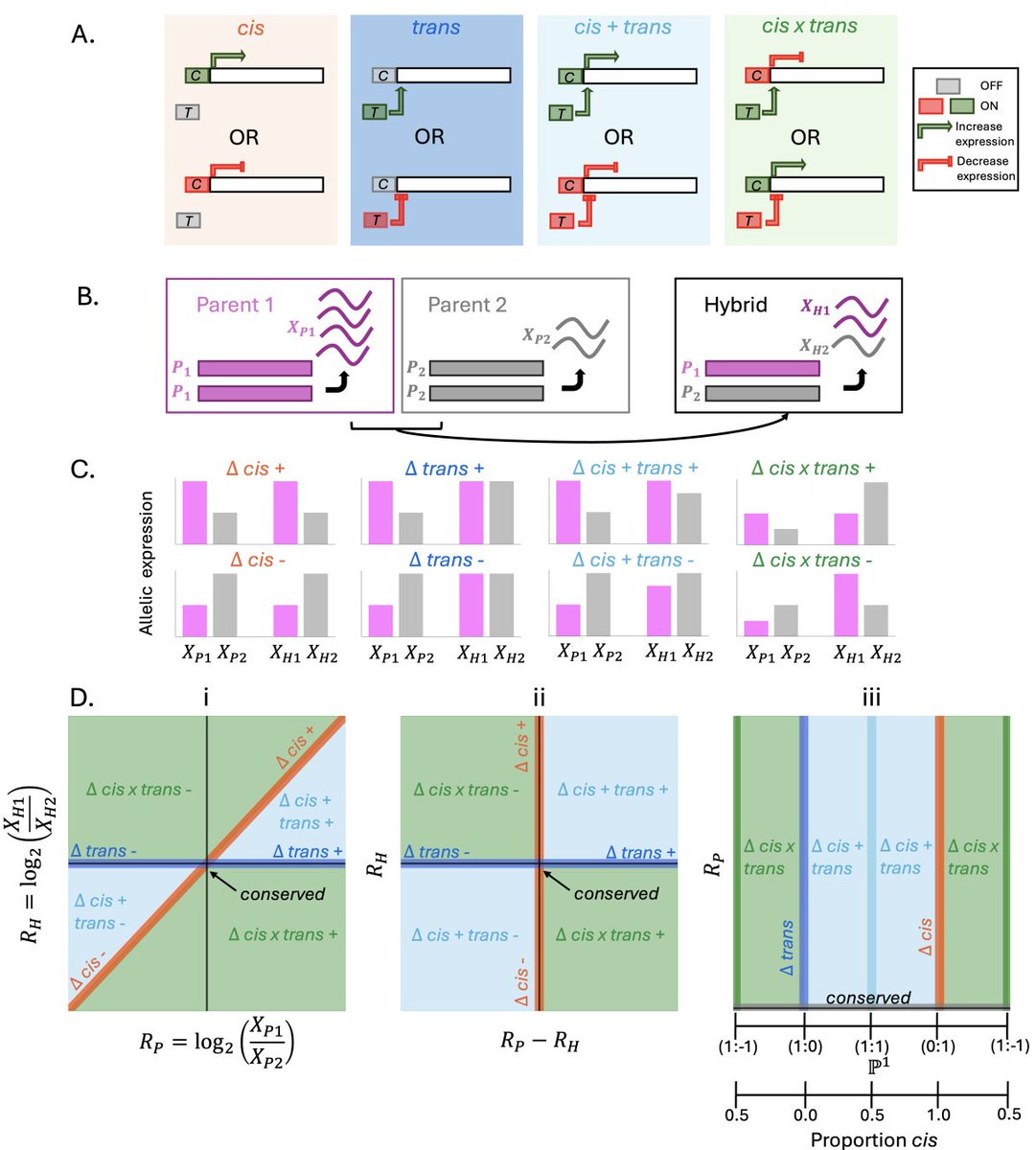
Beautiful paper on how to tease apart cis vs. trans contributions to differences in gene expression. Work of Ingileif Hallgrímsdóttir and Maria Carilli just out in Genetics https://t.co/onL106p57D
1/🧵
🧬🧪🔬Why are enhancers transcribed? How does it impact gene regulation? I’m excited to share our new paper in @ScienceMagazine showing that ncRNAs control the timing of gene activation in embryos. w/Mike Levine #ScienceResearch#RNA
A few highlights 🧵👇
https://t.co/ZHPXKBDLhh
Incredibly happy to share the first publication from our lab, now published in Nature Cell Biology! 🎉
How do cells coordinate RNA processing with nuclear organization and the cell cycle?
https://t.co/Ztg7IA2MWV
1/10
Discoveries can hide in plain sight. #HHMIInvestigator Steven Henikoff's lab found a surprise in old data: a region of ribosomal DNA producing microRNAs that can be associated with cancer, revealing a new role for part of the genome overlooked for decades: https://t.co/HCf46FYgBi.
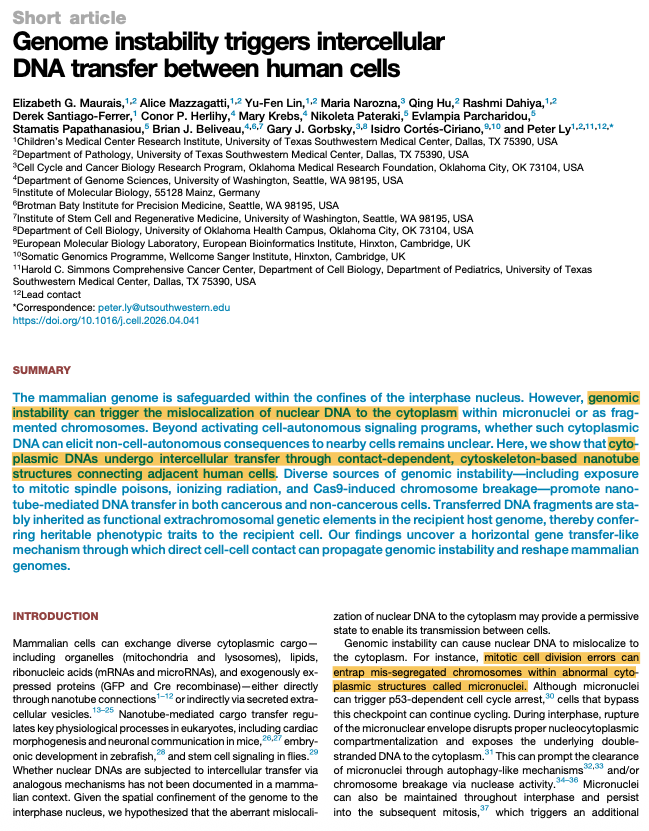
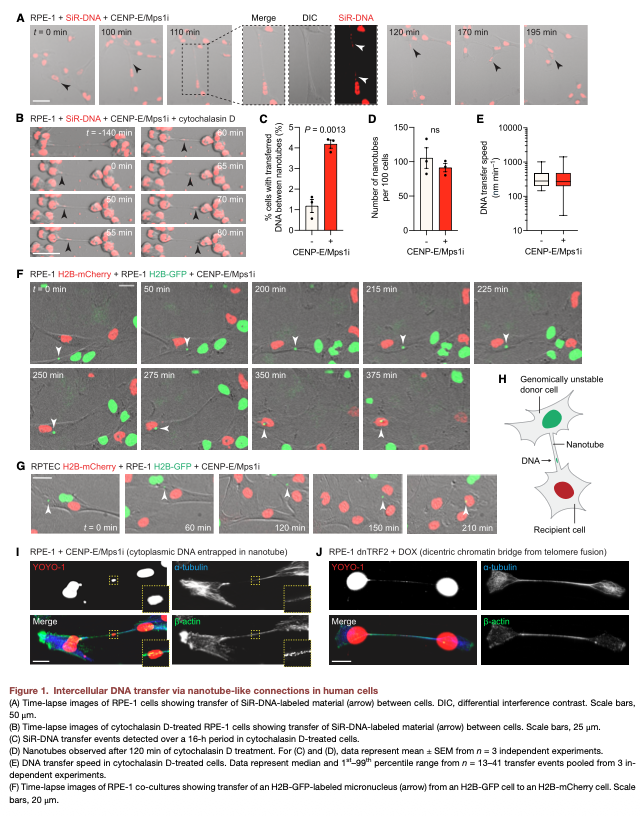
My favorite paper this week: Human cells with damaged genomes (from cancer, radiation, or even CRISPR editing) grow tube-like bridges to their neighbors and send them broken chromosomes. The transferred DNA sticks around in the receiving cell and remains functional.
This paper is really cool, and hints at *so many* interesting questions, but it’s important to caveat that it isn’t the first time people have seen DNA moving between human cells! There’s a 2013 paper (Jin Cai et al.) that shows extracellular vesicles (membrane-enclosed bubbles that bleb off cell membranes) can also carry DNA between cells. A similar thing happens with “apoptotic bodies.” Basically, when a cell dies, pieces of that cell will form into little spheres, some of which contain DNA. These “apoptotic bodies” are then engulfed by neighboring cells, which take up their DNA and (sometimes) incorporate the sequences into their own genomes. (See the Holmgren et al. paper from 1999.)
People had even shown that nanotubes can swap DNA between cells! They hadn’t seen this with nuclear DNA, though; mostly mitochondrial DNA and various RNAs. This paper, then, is extremely original and exciting, yet sits within a rich subfield of cell-cell DNA transfers.
The experiment was extremely simple. The researchers grew two types of human cells together in a dish. They tagged the histones in each cell type with a different fluorescent color; one green and the other red. Next, they exposed the cells to drugs that interfere with mitosis and recorded time-lapse videos. In one of these videos, they literally watched as DNA tagged with one color moved — through the thin nanotubes — into a cell with the other color. This happened not only with mitosis-blocking drugs, but also with CRISPR-induced chromosome breaks and radiation. The transferred DNA remained functional, too; they were transcribed into RNA and translated into protein.
(Sidebar: It seems like this whole discovery was an accident. The group behind this paper had previously studied what happens to nuclear DNA when chromosomes break using exactly the same techniques and drugs. But it seems like they never expected to see this transfer happen between cells. They write in the paper: “Surprisingly, using live-cell imaging to monitor cytoplasmic DNA labeled with a double-stranded DNA-specific fluorescent dye, we observed the apparent transfer of DNA from the cytoplasm of donor cells to neighboring recipient cells.”)
It’s not clear to me how important this might prove for, say, cancer. But the authors point at some intriguing ideas. Maybe the transfer of DNA between cells “mimics” some of the genome architectures we see in cancer cells, for example. Perhaps “DNA transfer could generate genomic alterations in recipient cells that resemble whole-chromosome gains or non-tandem duplications, challenging the assumption that these changes originate exclusively from cell-autonomous mitotic defects.”
The researchers also speculate that DNA transfers could “potentially enable genomically unstable cancer cells to disseminate oncogenic alleles, deleterious mutations, and/or regulatory elements to neighboring non-cancerous cells.” If this turns out to be true, nanotubes could be a useful target for cancer therapies.
Anyway, I love papers like this, where it feels like a whole swath of questions suddenly arises from beneath your feet. There is so much work to be done, and biology goes ever deeper.