In 1989, a small tech company sued a government-backed consortium for allegedly stealing their research.
Standard Silicon Valley IP dispute.
One problem: the founders were also running an illegal MDMA lab in Mexico producing 20kg a month.
This is a true story 🧵
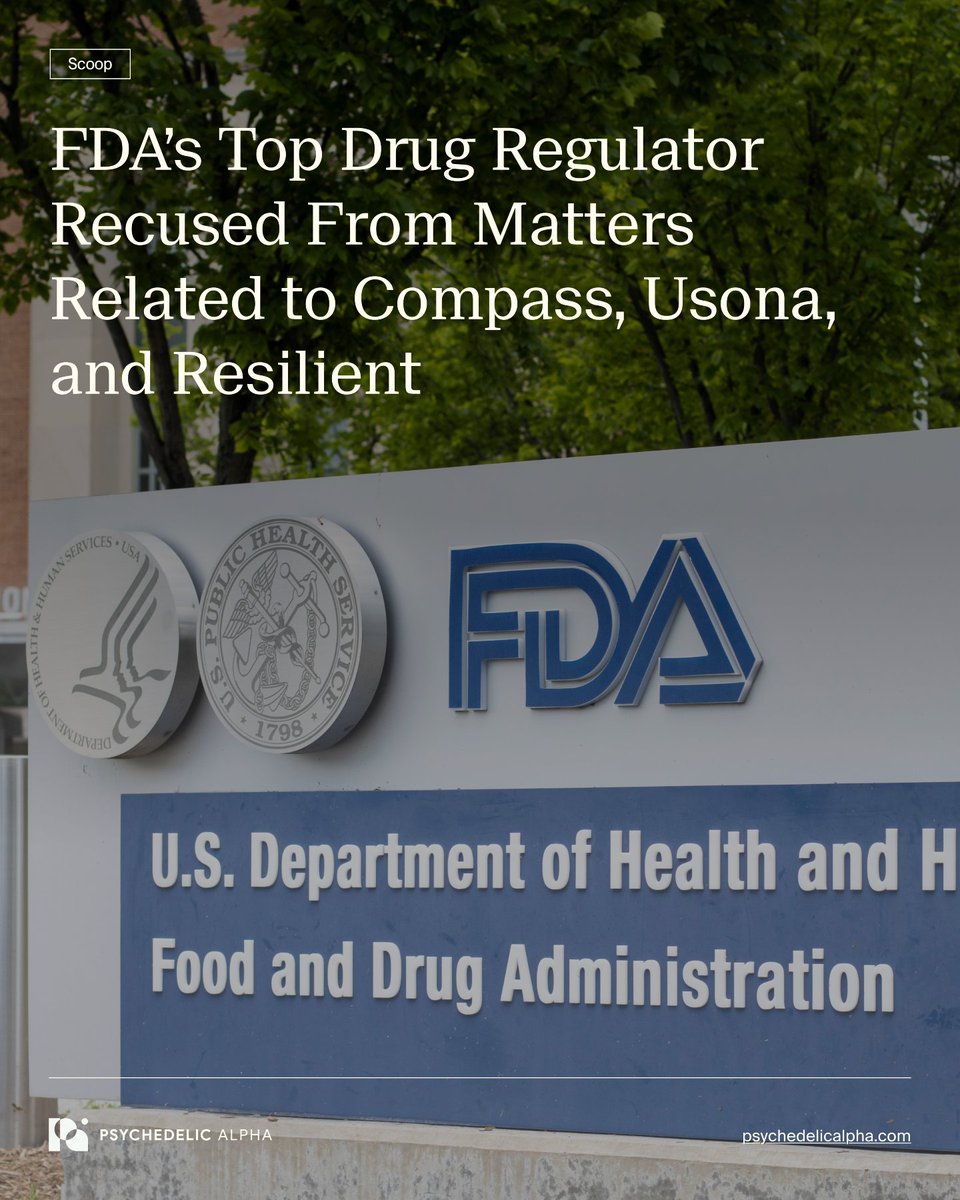
FDA's top drug regulator is formally recused from matters involving Usona Institute, Compass Pathways, and Resilient Pharmaceuticals, HHS has confirmed to Psychedelic Alpha.
Dr. Michael Davis, Director of FDA's Center for Drug Evaluation and Research (CDER), served as Usona's Chief Medical Officer from December 2022 to June 2025. Usona and Compass both hold Commissioner's National Priority Vouchers for psilocybin products that are now under FDA review.
In a statement, HHS said the recusals "extend beyond what is required by law."
The statement did not disclose when the recusals began. A separate request by Psychedelic Alpha to produce this information publicly is being processed.
this is one of the greatest, most profound monolgues ive ever witnessed in the middle of a casual conversation about psychedelics and hippies.
its so unbelievably good. I love Jesse so much, man.
@LitLeigh_@usglogisti12914 4-AcO-DMT is 😍🔥
One of my all time favorites.
My dose is about 30mg which is equivalent to about 3.5g of real shrooms.
Although if you're a complete newbie, better starting dose is half of that around 15mg.
@AQuarantesix@usglogisti12914 New for me too.
I thought the easy version of shrooms was 4-HO-MET which is metocin but it appears it's related to your compound.
It's basically a more colorful less intense headspace version of shrooms.
LSD is like the psychedelic equivalent of Tylenol in that the personality you'll experience is always predictable.
The contents of the trip may vary, but the personality is consistent, hence it's predictable.
Shrooms on the other hand can be very inconsistent and volatile, not necessarily because of what you believe because each batch/species/strain can vary in its constitution.
Thus, it makes perfect sense why psilocybin can be unpredictable.
Psilocybin is also excellent for emotional release + processing for the same reasons IMO.
@imu_pertrauka@usglogisti12914 Mescaline is cool but also very inaccessible relative to others.
Weird about your LSD experience... that's certainly not typical based on my experience + observations 🤔
@gHDA999@usglogisti12914 +1 for 2C-B 🔥
Here's why 2C-B is the best beginner psychedelic provided it actually works:
https://t.co/3XLzaZbn2P
Other than that, I would go with a low dose (50 - 100ųg) of LSD 😇
DMT Levels:
1. Threshold (1-4mg): Crisp and high-resolution experience without obvious hallucinations. Intensified colors and sharper edges.
2. Symmetry Hotel (3-6mg): A thin layer where you still see the "real" world around you but every surface is fully saturated with wallpaper symmetry groups. Empirically, at this level the surfaces one sees on DMT can be tessellated with any of the 17 wallpaper symmetry groups and their combinations. Essentially, if you increase the energy parameter any more, then you will start to see some hyperbolization of the 2D surfaces and unlock the Chrysanthemum.
3. Chrysanthemum (4-8mg): The wallpaper-saturated surfaces of the Symmetry Hotel overflow, leading to a hyperbolization of such surfaces. At this level, the mind will still try to embed these constructs in 3D Euclidean space, so in practice you will see kale-like surfaces, saddles, helixes, corners, twists, etc. This often manifests as what looks like the blossoming of a flower or unwrapping of a present in the center of your attention.
4. Magic Eye (8-12mg): The Chrysanthemum becomes so curved that it can be used to render arbitrary 3D scenes of all sorts (e.g. ice cream shops, apparel, play pens, kitchen counters, etc.). We can think of this as a dynamic and animated depth map, which we call the world-sheet. If you pay attention, you will realize that the texture of the world-sheet is in fact made out of a widely contorted Chrysanthemum, with similarities to autostereograms (aka. Magic Eye visual illusions).
5. Crystal Worlds (10-15mg): A thin layer analogous to the Symmetry Hotel but one spatial dimension higher. Namely, the curved world-sheet fills out the space around you, which becomes fully saturated with Euclidean space groups (the 3D counterparts of the wallpaper groups, of which there are 230). If the energy parameter is raised any higher, then you will start to see a hyperbolization of (3D) space itself and unlock Waiting Room phenomenology.
6. Waiting Room (12-25mg): Past the crystalline saturation of 3D space, qualia continues to build to the point that it simply does not fit 3D Euclidean space. Thus there is a forced hyperbolization of 3D phenomenal space, which also comes along a powerful multi-modal synchronization (cf. Kinesioöptic). This, in turn, makes the hallucinated world so engrossing that you lose contact with your surroundings. Often manifests as a hyper-realistic dome or series of interconnected rooms and exotic architectural structures with countless twists and turns.
7. Breakthrough (25mg+): The curvature and density of qualia is so extreme that the very topology of the worldsheet can change (e.g. via bifurcations and reconnections). One experiences radically exotic geometries of experience. There may be more than one geodesic between two given points, leading to markedly bizarre pseudo-acoustic properties. Sense of entering a sort of "interdimensional highway" that stitches together widely diverse and seemingly contradictory realities at once. (Today I would add that at this dose different regions of the experience may exhibit different pseudo-time arrows, and thus may have hybrid temporal qualities, as discussed here).
8. Amnesia (40mg+; depends): Not much to say here.
Note: high interpersonal and inter-trip variabilitu.
Techniques used: The photo has its depth map computed (Depth Anything V2) and object masks (Mask R-CNN), and from then on everything runs live in the browser (WebGL). A "beauty" filter softens flat areas and enhances the mid-scale detail. The scene is then parsed into surfaces with graph segmentation on color, depth and surface direction (Felzenszwalb–Huttenlocher), and each object and surface gets a fitted 3-D plane, with non-flat objects cut into planar facets. On each plane we overlay a lattice and one of the 17 wallpaper groups, thus every surface is tiled in perspective with copies of its own texture, and the parts move independently like layers of cel animation. Next, each part's pattern turns into a flat slice of a 7-dimensional cube lattice rotating in 12 dimensions (see https://t.co/Z8YE8yiP9G). The rotation of each part is treated as a set of Kuramoto oscillators coupled to the parts it touches and, more weakly, to all of them, and as the coupling rises toward the peak, neighbours synchronise first until everything converges on a single shared hyperobject. That object settles into its 7-fold shadow, and the picture becomes the {7,3} heptagonal tiling of the Poincaré disk, built entirely from mirror reflections (the hyperbolic orbifold *237), with a convex mirror jewel at every corner reflecting the whole net, as in Indra's net. On the way down, the same sequence runs in reverse.
See: https://t.co/zsMPeAkGhg
Original talk: https://t.co/GDaDi5kwrz
Source picture from: https://t.co/JTrkVbwKwR
@kevin__mak Long-term CMPS holder here with both shares and options.
I'm not worried at all, however, I do hope this stock price recovers and moons before January 2027!
Every day I think about my experience with 5-MeO-DMT, the world's most powerful psychedelic. It left me stunned beyond comprehension, unfurling a single omnipresent awareness of the inestimable preciousness of our existence and the warm invitation that it's ours if we say yes.
Serious question: Do you actually think people take LSD expecting instant enlightenment, or did you invent that straw man just to feel spiritually superior?
I know this might come as a shock, but LSD has low physiological toxicity, decades of therapeutic research, and promising results from modern clinical trials.
It's a potentially powerful therapeutic medicine, NOT a magic pill or shortcut to enlightenment.
Nobody serious ever claimed it magically eliminated the need for inner work... you still have to do the work... and if your description is based on personal experience, I'm genuinely wondering whether you got hoodwinked by your dealer or by your own expectations lol 😆
Either way, your inability to extract meaning from an experience isn't evidence that the experience itself is meaningless.
But the funniest part is watching someone lecture others about enlightenment while demonstrating the very spiritual narcissism that enlightenment is supposed to transcend... which is why the problem is most certainly you, not LSD 😉
@Azax_Railgun@evolvee33 Relax homie.
If it educates and informs at least 1 newbie it's worth it.
Besides telling ANY story about LSD most certainly does not demean nor cheapen the LSD experience at all.
That's just silly poppycock 🫠
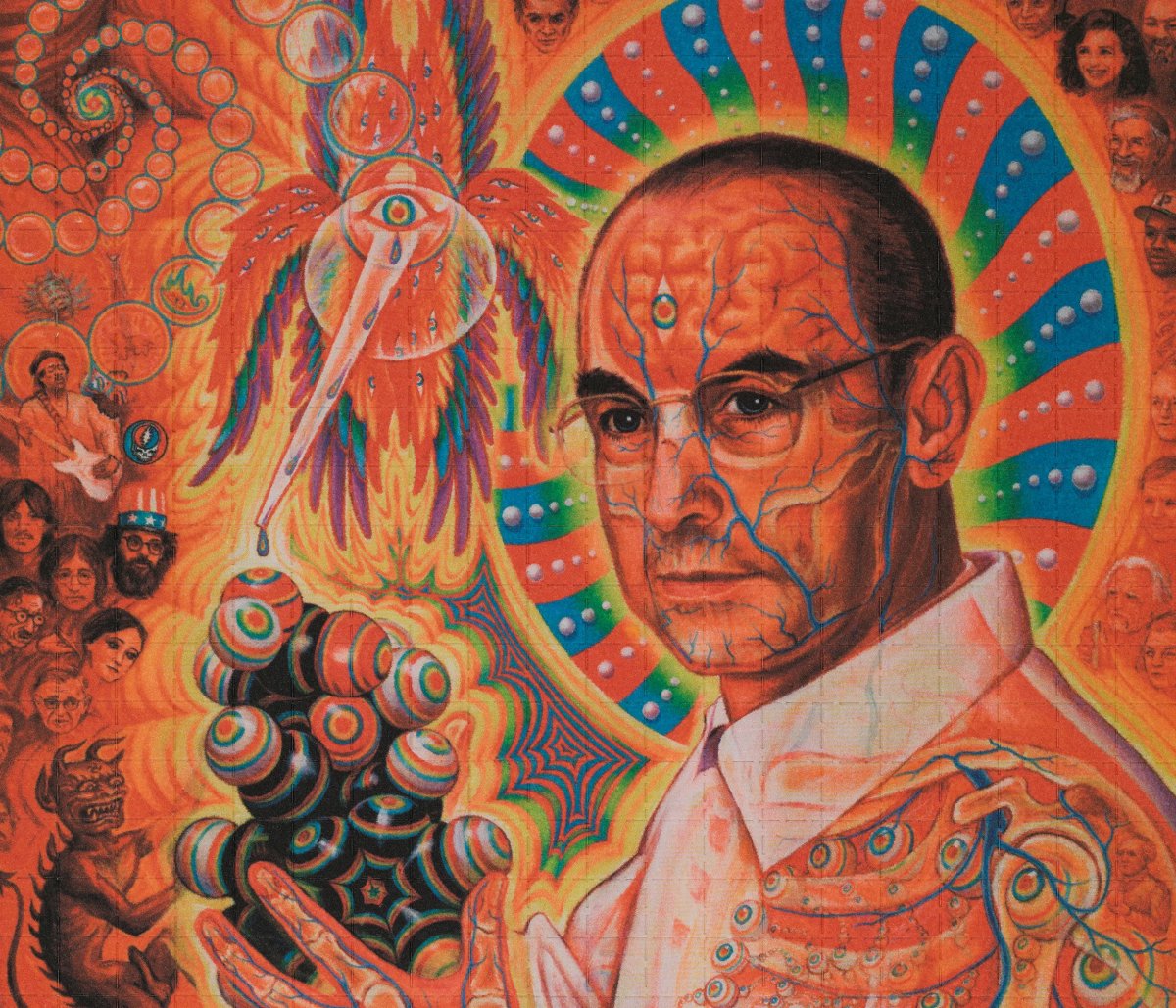
Albert Hofmann discovered the most powerful hallucinogen known to science, took it himself, and became convinced he was dying.
What happened next would change the way humanity understood the mind.
He was 37, a Swiss chemist working for Sandoz laboratories in Basel. In 1938 he had synthesized the twenty-fifth compound in a series derived from a fungus that grows on rye. It showed little promise. His colleagues lost interest. The substance was shelved.
Five years later, something made him return to it.
On April 16, 1943, while working in his laboratory, Hofmann began feeling strangely intoxicated. He went home, lay down, and closed his eyes. Extraordinary shapes appeared. Colors moved in patterns he had never seen. For two hours, his imagination seemed to have escaped the limits of his own mind.
He suspected the chemical.
Three days later he swallowed a measured dose of LSD-25. He believed he was being cautious. Within an hour he could barely write. His assistant helped him onto a bicycle. As they rode through Basel, the streets bent and twisted. Buildings seemed to move. He felt as though he were standing still, although they were cycling at considerable speed.
At home he became convinced he was dying. His neighbor appeared to him as a terrifying witch. The furniture took on monstrous forms. A doctor examined him and found no serious physical abnormality beyond dilated pupils.
Then the terror passed.
The same substance that had convinced him he was losing his mind now filled his vision with extraordinary beauty. He watched colors explode behind closed eyes. Every sound seemed to transform into an image. By the following morning he felt renewed, and the world appeared unusually alive.
Sandoz began distributing LSD to psychiatrists in 1947. Researchers investigated it for alcoholism, depression, and other conditions. Some believed it could reveal the workings of psychosis. Others believed it could help patients see beyond the psychological defenses that years of therapy had failed to penetrate.
Then LSD escaped the laboratory.
By the 1960s it had become a symbol of rebellion, spiritual awakening, and the collapse of conventional authority. Governments moved to prohibit it. Research largely stopped. A substance once distributed to psychiatrists became one of the most feared drugs in the Western world.
Hofmann watched the transformation with dismay. He had hoped his discovery would be used carefully to investigate consciousness. Instead, the world had turned what he considered a potentially valuable medicine into a cultural battlefield.
He lived to be 102.
The man who had briefly believed a chemical was going to kill him spent the rest of his life arguing that it might help humanity understand what it means to be alive.
And the substance that governments spent decades trying to keep out of human minds is now being studied again for what it might reveal about them.
Congratulations to @Helus_Pharma pharma for great #trial results! There is a normal placebo response of ~10 MADRS units even after the first dose (which is about the same as in most depression trials) and increases to ~15 after the second dose. Even better is that the between-arm difference is a very good ~5-7 MADRS units against this normal #placebo response. Given the headache of extremely low placebo responses in other psychedelic trials, there are two big picture questions that go beyond #psychedelics:
- Should not the magnitude of the placebo response be a part of how we evaluate treatments?! Most regulatory agencies / scientist focus almost exclusively on the between-arm difference, but a between-arm difference of (lets say) 4 MADRS units is very different against a placebo response of 3 or 10 MADRS units - they translate to a patient improvement after the treatment of ~7 and ~14 MADRS units, respectively. You would not notice patients are doing twice as well in the second case without knowing what happened in the placebo arm!
- Why was the placebo response here ~2x as large as in other psychedelic for major depression trials? I strongly suspect it is a combination of contextual factors (e.g. how the study was advertised), but we will never know as these factors are rarely documented. Half of medical research is placebo, yet we spend virtually nothing to understand what drives the giant variability in placebo responses.
@JensenHuang Hear me out.
Send Jensen to Peru for a few ayahuasca ceremonies, let him sort his shit out with the universe, and then get him back to building GPUs.
We need our boy back in the court.