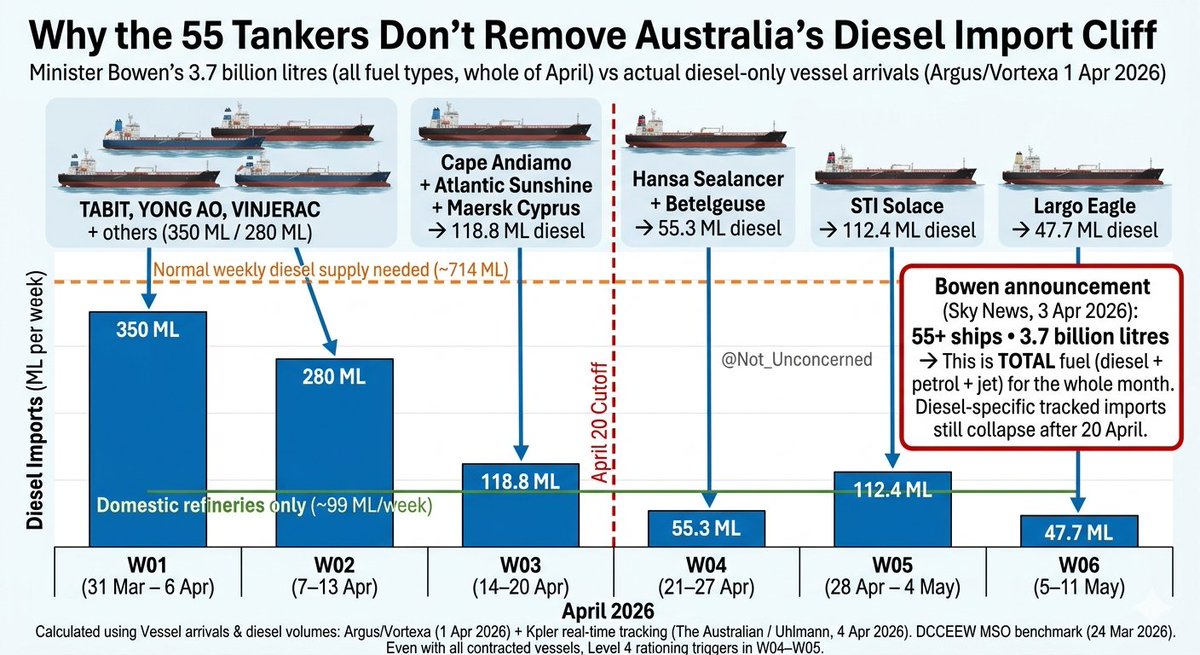
While finishing up research for my next piece, I stumbled on a new PM&C Fuel Supply Taskforce page that wasn't there a few days ago.
The standard MSO updates mostly give headline stockholding numbers (days of cover and reserve volumes) but this new page compiles together a broader summary. Current National Fuel Security Plan level, Petrol, diesel and jet fuel days of cover, Retail stock-outs by state and territory, Fuel price movements, Scheduled overseas arrivals over the next four weeks, Ships currently on water to Australia, including additional supply secured under the EFA underwriting powers.
But perhaps the most interesting addition is the ships-on-water section.
As at 24 April, PM&C reports:
• 10 crude oil tankers on water, 25 days of supply
• 48 clean-product tankers (diesel, jet, petrol & blends), 16 days
It's not revealing any new or raw government intelligence (they’re DCCEEW estimates using Kpler commodity tracking data). Whilst it gives us a slightly better view of the floating supply fuel chain, for anyone already tracking vessels approaching our EEZ, you'll know, much of this picture can be pieced together by watching the ships first enter New Zealand’s reporting system via MBIE.
The real improvement would be clearer splits between onshore stocks, near-EEZ arrivals and more distant on-water supplies, broken down by fuel type. Next update, let’s hope they adopt a similar level of granularity.
PM&C Fuel Supply Taskforce page: https://t.co/KTVKHLgLOe
#auspol #fuel
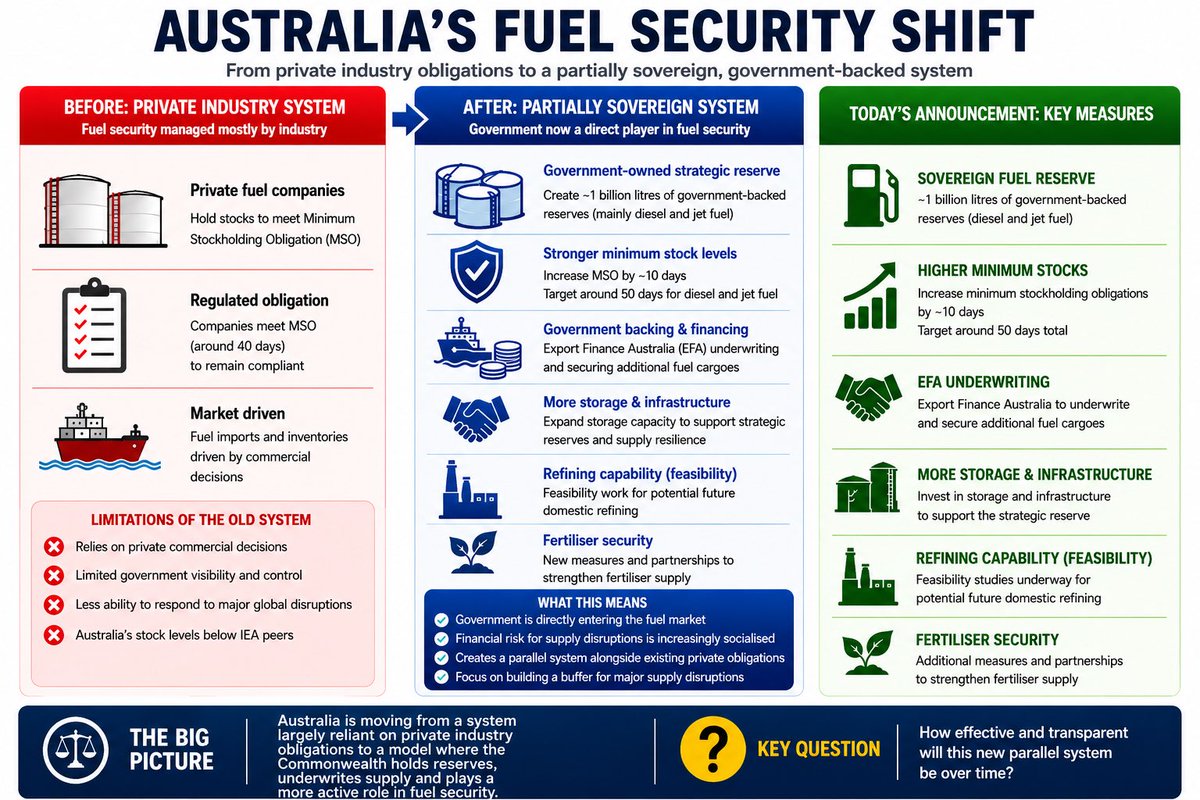
What the government announced today is effectively the formal transition from “fuel security managed mostly through private industry obligations” to a partially sovereign, government-backed fuel reserve system.
In other words, Australia is no longer relying mainly on private fuel companies holding enough stock. The Commonwealth is stepping directly into the market, with expanded capacity to underwrite cargoes, build strategic reserves and direct them, increase minimum stockholding requirements, and create a government-backed buffer against major supply disruptions.
It's a pretty significant shift, that quietly began on April 1 with the strategic reserve amendments. Today is just the day that announced increased funding. The ledger however isn't available to public,
An important detail is that fuel already secured through Export Finance Australia (EFA) arrangements does not appear to be counted in the public “MSO days” figures.
At least part of those stocks appear to be held separately as strategic reserves tied to level 4 of the National Plan (or when rationing may apply).
#auspol #energysecurity #australia #fuel
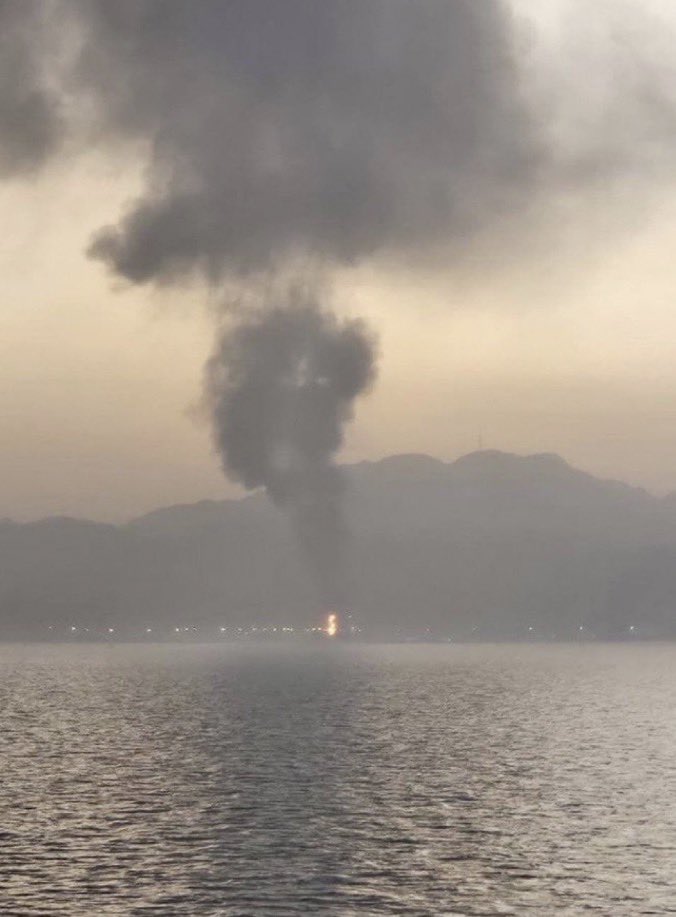
Iran has formally declared a “new control area” in the Strait of Hormuz, drawing a line from Mount Mobarak in Iran to south of Fujairah in the UAE, and from Qeshm Island to Umm Al Quwain. Together with the very recent Fujairah strike, appears to represent something of a unified strategy.
In other words, Iran seems to be drawing a much bigger box around the entire Gulf exit (including the workaround routes on the other side of the UAE) that the industry has been relying on for the past two months.
#IranWar #ausfuel #uaeattack
⭕️ Iranian Armed Forces announces new control area in the Strait of Hormuz, as follows:
- From the south, the line between Mount Mobarak in Iran and the south of Fujairah in the UAE
- From the west, the line between the end of Qeshm Island in Iran and Umm Al Quwain in the UAE
Empty supertankers have left Asia en route to the U.S. in one of the biggest queues of vessels ever seen as Asian buyers rush to load U.S. crude to replace the supply lost in the ME.
"Tankers are forming what looks like a fleet, an unbroken line heading to the U.S." - Matt Smith
So nothing has changed.
“Considering all these conditions together, passage through the strait will be limited, subject to toll payments, and managed by Iran—and this is precisely what Iran has been pursuing since the beginning of the war and is now imposing on America.”
Geelong refinery fire update (Viva Energy, Corio VIC): It was a hydrocarbon leak in the MOGAS petrol unit. Basically a pipe/valve issue. That stuff makes gasoline/petroleum + aviation fuel.
Diesel production largely unaffected. They were running at full capacity, so expect a temporary slowdown while they fix it. No injuries.
#GeelongRefinery #FuelSupply
https://t.co/eValt6Gmpv
@Aussie_Dad5 @ProgressivePuns@AshPolitik Agreed Mate. Diesel is what matters in the end anyway. Should have a full breakdown finished by end of day to help bring some clarity on this.
Yesterday, America effectively declared it is done with the Strait of Hormuz "Get your own oil."
Canberra has been treating this like a temporary disruption, a 3-month blip to "get through". But now, it's effectively become "our problem", and no longer something to get through, but a new reality.
What the Prime Minister is about to speak on to the nation (for the first time since a pandemic) is this new reality, to "stick togethor" and conserve fuel voluntarily, or "do your part" before they are forced to mandate it.
Yesterday, America effectively declared it is done with the Strait of Hormuz "Get your own oil."
Canberra has been treating this like a temporary disruption, a 3-month blip to "get through". But now, it's effectively become "our problem", and no longer something to get through, but a new reality.
What the Prime Minister is about to speak on to the nation (for the first time since a pandemic) is this new reality, to "stick togethor" and conserve fuel voluntarily, or "do your part" before they are forced to mandate it.
The problem is Singapore’s two biggest refineries are at somewhere between 50 to 60% capacity, aa obviously, their crude also comes through Hormuz.
That being said, Russian fuel oil is arriving to the region but reports say that's going to ship bunkering and not into Singapores refineries that make the diesel we would otherwise get.
Priority LNG for a promise to prioritise diesel to Australia sounds reassuring but it's Diesel that Singapore are increasingly unable to make. In any event let's not forget temp sanctions waiver was for 30 days (expires 12 April).
Handshake agreement or not, outlook from mid April is concerning.
Correct.
If anyone is seeking a clearer idea about what exactly the Government counts when it refers to "MSO Days" a breakdown can be found here:
https://t.co/pjZpYfodpv
Useful site. One thing to be aware of is that the AU view uses DCCEEW data (MSO Days includes unrefined crude as it's refined equivalent and both refined and crude on water) NZ measures what's already refined both in-country and on water. It would be nice to get the transparency NZ is getting.
Good dashboard! The NZ view is solid (MBIE refined only data). Key difference worth noting though is DCCEEW numbers include unrefined equivalent and crude on-water, not just refined product. That's why AU shows 20.8 days diesel in-country while a refined only equivalent would put it closer to 10/11 days (and that's without factoring in increased demand). That said NZ and AU legislation/importing companies are effectively identical. Working on a vessel spreadsheet with confirmed/cancelled ships, volume, fuel type, and origin country so that we can all get a clearer idea around this.
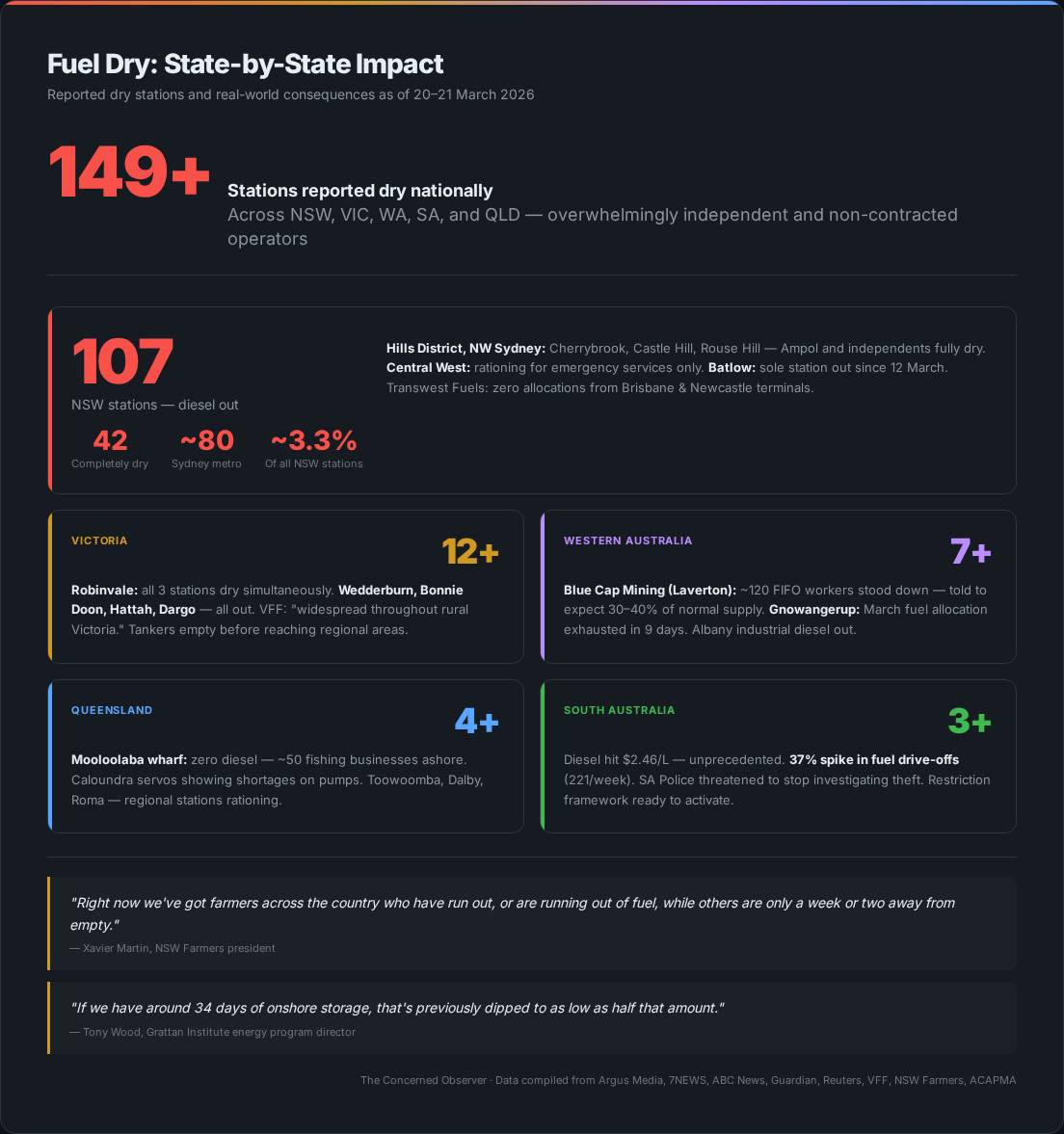
“Right now we’ve got farmers across the country who have run out, or are running out of fuel, while others are only a week or two away from empty.”
— NSW Farmers President
We’re already seeing it.