NovaIntegra SAS desarrollo sistemas que le permite detectar infracciones en las normas de seguridad industrial como puede ser la de no portar el... https://t.co/R480t1JVYH
What is Google’s TPU?
A TPU (Tensor Processing Unit) is Google’s custom AI chip, designed from scratch for the giant matrix multiplications that modern models live on. GPUs were built for graphics first.
TPUs were built for deep learning from day one.
At Cloud Next ’26, Google unveiled its 8th generation, and for the first time it ships in two flavors. TPU 8t is built for training, where raw throughput wins. TPU 8i is built for inference, where latency and chip-to-chip speed matter most.
Both still share the same Axion CPUs, liquid cooling, and software stack, so code written for one runs on the other.
The diagram below is a quick study guide to what’s the same, what’s different, and why, based on our understanding of published Google articles.
🚨 Most people talk about AI Agents.
Very few actually understand how they work.
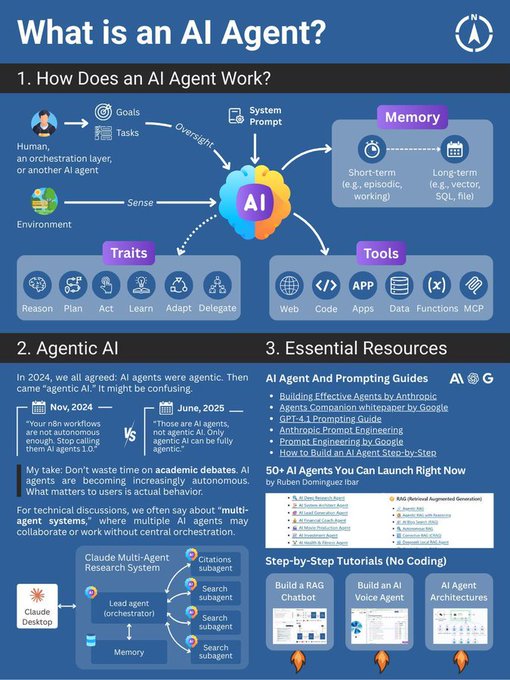
So I spent 100+ hours studying AI agents and condensed everything into one simple blueprint.
No fluff. No hype. Just the system.
Inside the sheet you’ll learn:
• How AI agents actually think and operate
• The role of memory, tools & system prompts
• How multi-agent systems collaborate
• 50+ real AI agents you can launch today
• Step-by-step paths to build RAG, Voice & Agent architectures
Think of it as the AI Agent cheat sheet for builders.
If you're serious about AI in 2026, this will save you months of research.
I’m giving it away FREE.
How to get it:
1️⃣ Follow me (so I can DM you)
2️⃣ Like + RT
3️⃣ Comment AI
I’ll send it to everyone who comments.
Drop “AI” below 👇
#NovedadesIA 🤖
⚠️ La Inteligencia Artificial también tiene riesgos… y debemos saber identificarlos.
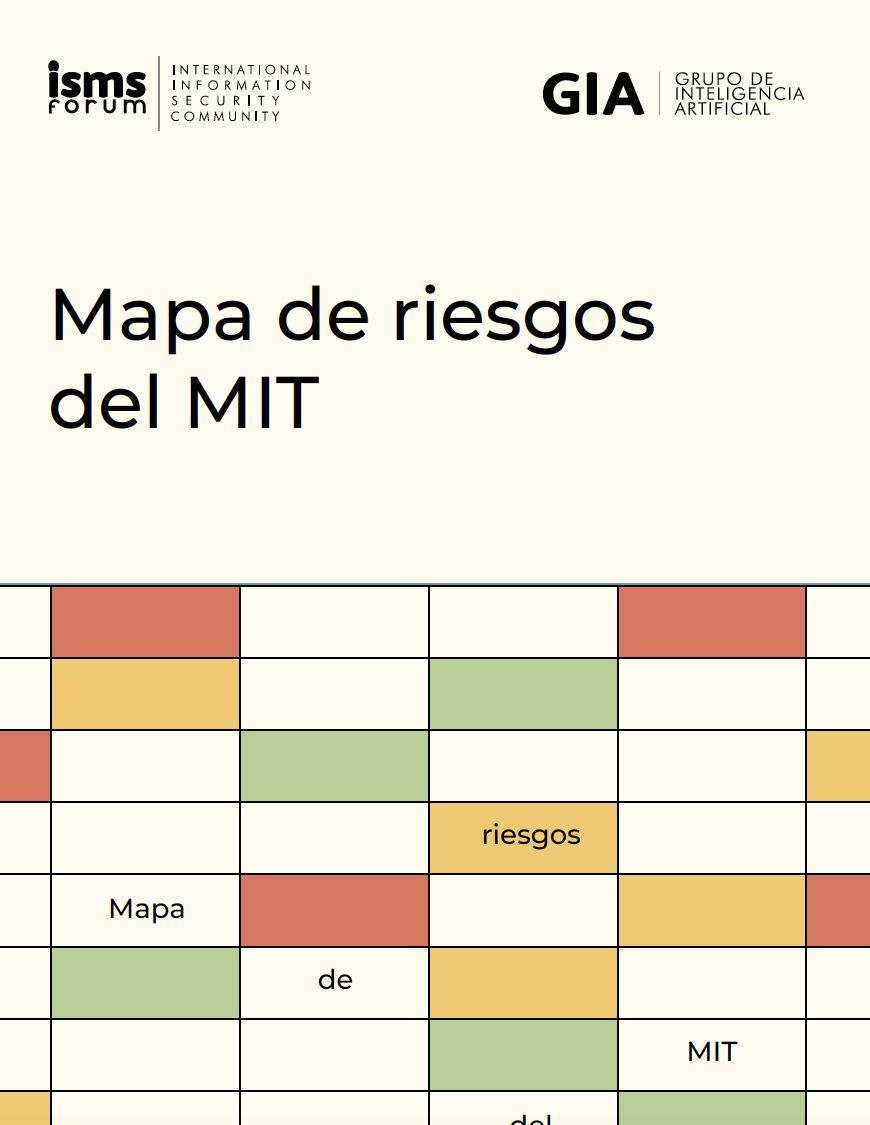
El Mapa de Riesgos de IA basado en el repositorio del MIT de @ISMSForum reúne más de 1,700 riesgos asociados a sistemas de inteligencia artificial, organizados para ayudar a las organizaciones a identificar, evaluar y mitigar impactos relacionados con sesgos, privacidad, ciberseguridad, desinformación y uso indebido.
📌 Un recurso muy útil para fortalecer la gobernanza de IA, la gestión de riesgos y el cumplimiento regulatorio en organizaciones públicas y privadas.
📄 Consulta el documento aquí:
https://t.co/bAZUOGpN93
#IAResponsable #GobernanzaDeIA #GestiónDeRiesgos #ProtecciónDeDatos #TodoPDP
𝗔𝗴𝗲𝗻𝘁𝗶𝗰 𝗥𝗔𝗚 and what you need to know about it as an AI Engineer?
Simple naive RAG systems are rarely used in real world applications. We are usually adding some agency to the RAG system - ideally a minimal amount.
There is 𝗻𝗼 𝘀𝗶𝗻𝗴𝗹𝗲 𝗯𝗹𝘂𝗲𝗽𝗿𝗶𝗻𝘁 on how the RAG system needs to be extended to solve your specific business use case, you will need to adapt.
For this you need to understand the potential moving pieces in Agentic RAG, let’s explore some of them:
𝟭. Analysis of the user query: we pass the original user query to a LLM based Agent for analysis. This is where:
➡️ The original query can be rewritten, sometimes multiple times to create either a single or multiple queries to be passed down the pipeline.
➡️ The agent decides if additional data sources are required to answer the query.
𝟮. If additional data is required, the Retrieval step is triggered. In Agentic RAG case, we could have a single or multiple agents responsible for figuring out what data sources should be tapped into, few examples:
➡️ Real time user data. This is a pretty cool concept as we might have some real time information like the current location of the user.
➡️ Internal documents that a user might be interested in.
➡️ Data available on the web.
➡️ …
𝟯. Retrieved data is consolidated and Reranked by a more powerful model compared to regular embedder. Data points are significantly narrowed down.
𝟰. If there is no need for additional data, we try to compose the answer (or multiple answers or a set of actions) straight via an LLM.
𝟱. The answer gets analysed, summarised and evaluated for correctness and relevance:
➡️ If the Agent decides that the answer is good enough, it gets returned to the user.
➡️ If the Agent decides that the answer needs improvement, we try to rewrite the user query and repeat the generation loop (this number of times the loop could run should be capped at a certain number).
Learn to build these kind of systems hands-on in my AI Engineering Bootcamp: https://t.co/gWBu8OLTzn
Apply code LastChance at the check-out for 10% off.
We kick off tomorrow!
𝗠𝘆 𝗛𝗼𝗻𝗲𝘀𝘁 𝗧𝗵𝗼𝘂𝗴𝗵𝘁𝘀:
✅ Simplify wherever possible, you don’t need most of the pipeline in most of the cases.
✅ Focus on proper preprocessing of the data and the Reranking step. It is enough for 90%+ use cases.
❗️ Agentic Systems go far beyond RAG in real enterprises. It becomes more interesting when you move beyond question answering machines to systems that can automate actions after routing the initial human intent appropriately. More on this in future posts, stay tuned!
What are your thoughts on Agentic RAG? Let me know in the comments! 👇
#LLM #AI #MachineLearning