6 parabolic reflectors turn circular waves into linear waves bouncing in a hexagonal cavity, focusing energy like a resonator—perfect to ignite fusion by concentrating shock waves at the center.
This is fascinating. It is a deep discovery that is nonetheless accessible for the public, making it a great story in the field of math research. Here is the original paper: https://t.co/64LoMgTBPU
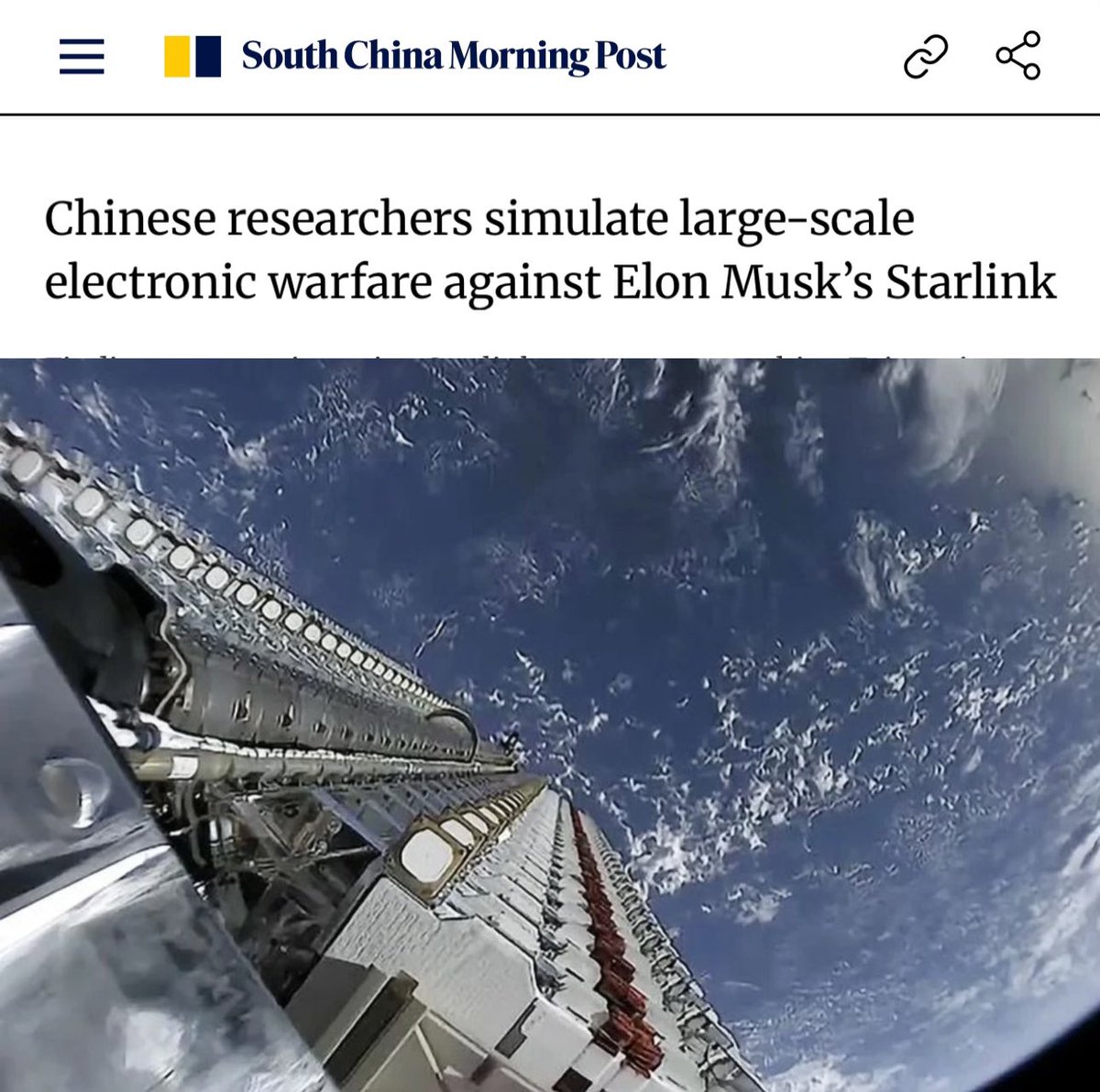
A simulation study by Chinese scientists shows how 🇨🇳 PLA could attempt to block Starlink across Taiwan.
Their findings — published on Nov 5 in the Chinese peer-reviewed journal Systems Engineering and Electronics — suggest that jamming Starlink across a region as large as Taiwan is technically feasible, but only at an immense scale that would require 1,000 to 2,000 electronic warfare drones.
The paper, titled “Simulation research of distributed jammers against mega-constellation downlink communication transmissions”, was written by a team from Zhejiang University and Beijing Institute of Technology (BIT) — the latter a top player in China’s defense research.
“The orbital planes of Starlink are not fixed, and the movement trajectories of the constellation are highly complex, with the number of satellites entering the visible area constantly changing.”
“This spatiotemporal uncertainty poses a significant challenge for any third party attempting to monitor or counter the Starlink constellation.”
Traditional satellite communication relies on a handful of large, geostationary satellites fixed above the equator. To block them, the Chinese military just needs to overpower their signal from the ground.
But Starlink is different. Its satellites are low, fast and numerous. A single user terminal does not connect to one satellite — it rapidly hops between multiple ones, creating a mesh network in the sky. Even if you manage to block one signal, the connection jumps to another within seconds.
Moreover, Starlink uses advanced phased-array antennas and frequency-hopping techniques that adapt in real time, much of which is controlled remotely by SpaceX engineers in the US.
Starlink could be countered by a distributed jamming strategy. Hundreds or thousands of small, synchronized jammers would need to be deployed across the sky — on drones, balloons or aircraft — forming an electromagnetic shield over the battlefield.
Using actual Starlink satellite data, the team simulated the dynamic positioning of satellites over a 12-hour period above eastern China. They modelled the downlink signal strength from Starlink satellites, reception pattern of user terminals, propagation of interference from ground to sky and sky to ground, and the cumulative effect of multiple jammers hitting the same terminal from different angles.
Then they introduced a grid of virtual jammers, flying at 20km altitude, spaced between 5 and 9km apart like a chessboard in the sky.

Each jammer emitted noise at various power levels, mimicking realistic electronic warfare payloads.
Two types of antennas were tested — one with a wide beam which covered more area but spread energy thinly, and a narrow-beam one that was focused and powerful, but required precision.
The simulation calculated, for every point on the ground, whether a Starlink terminal could maintain a usable signal.
Under optimal conditions — using a powerful but costly 26 decibel-watt (dBW) jamming power (400 watt) source, a narrow-beam antenna and 7km spacing — each jammer node suppressed Starlink reception across an average area of 38.5 sq km.
Taiwan covers around 36,000 sq km.
To blanket the island with reliable Starlink suppression would require at least 935 coordinated interference nodes, and this number does not include redundancy for failures, compensating for terrain such as mountains that block signals and countering Starlink’s future anti-jamming upgrades.
Using a weaker but more affordable 23 dBW power source with 5km spacing would double the drone deployment scale to around 2,000 units.
The results were preliminary because Starlink kept some key technology confidential.
“If it becomes possible in the future to obtain actual measurements of the radiation pattern data of Starlink user terminals, and to acquire empirically measured values of the suppression coefficients for these terminals, it would help achieve more accurate assessment results.”
https://t.co/F5vfHffdd4
Ethiopia is reporting what scientists say is its first confirmed volcanic eruption in thousands of years after the Hayli Gubbi volcano in the remote Afar region burst to life. Researchers say this marks the volcano’s first recorded activity and likely its first eruption in many centuries.
We've become obsessed with the idea that the brain is a "Prediction Machine."
The dominant theory in neuroscience says we're constantly simulating the future, calculating probabilities to guess what happens next.
A new paper argues this is a complete illusion. The reality is simpler, and strangely, much more powerful.
Here is the argument for Perceptual Control:
The "Prediction Illusion" starts with a mistake in observation.
When we see someone successfully handle a chaotic environment (like catching a flyball), it *looks* like they predicted the future trajectory of the ball.
But observing prediction isn't the same as implementing it.
The authors use the perfect analogy: The Watt’s Steam Governor.
In the 19th century, this device kept steam engines running at a constant speed. If pressure surged, it slowed the engine. If load increased, it sped up.
To an observer, it looked like the machine was "predicting" pressure surges and pre-empting them.
But the Governor has no brain. It has no model of the future.
It’s a mechanical negative feedback loop. [cite_start]It measures the *current* speed, compares it to the *desired* speed, and adjusts the valve immediately[cite: 80].
It doesn't predict; it controls.
This brings us to the "Hello" experiment, which broke my brain a little.
Researchers asked people to keep a computer cursor on a target. The computer applied a "disturbance" (forces pushing the cursor away) that the person had to fight against with their mouse.
Here's the twist:
The disturbance wasn't random. [cite_start]It was an invisible force field shaped like the word "hello" (written upside down and mirrored)[cite: 166].
The participants fought the force, keeping the cursor steady.
When researchers looked at the participants' hand movements, they had perfectly written the word "hello".
Crucially, the participants had NO idea they were writing words.
If the brain were a "prediction machine," it would have needed to model the force to predict the hand movement.
But the participants wrote a legible word purely by reacting to immediate error signals—instantaneously correcting the cursor's position.
This is **Perceptual Control Theory (PCT)**.
The theory suggests the nervous system isn't a linear pipeline (Input → Compute → Output).
It’s a closed loop. We act to keep our *perception* of the world matching our internal *reference value*.
[Image of Perceptual Control Theory negative feedback loop diagram]
Think about catching a baseball.
If you were a "prediction machine," you’d calculate the ball's trajectory, wind speed, and gravity, then run to where the ball *will* be.
But that’s computationally expensive and error-prone.
In reality, fielders just run in a way that keeps the "optical velocity" of the ball constant in their vision.
If the ball looks like it's rising too fast, they move back. Dropping? They move forward.
No physics calculus required. Just maintaining a visual constant.
This solves the "Noise" problem.
In predictive models, small jitters in your movement are considered "noise" or errors to be filtered out.
It’s the system "feeling out" the environment to maintain control.
This has huge implications for AI and robotics.
We are currently building robots with massive compute power to "predict" stability.
But robots built on PCT principles—like inverted pendulums that just react to maintain verticality—are often more robust and stable than the predictive ones.
Why does this matter for you?
It changes how we view "agency."
We often think we need to predict the outcome of our actions to be effective. [cite_start]But the most efficient systems don't predict the outcome—they specify the goal and let the feedback loop handle the rest[cite: 39].
The "Prediction Illusion" suggests we aren't prophets simulating the future.
We are controllers, surfing the present.
We don't need to know what the wave will do in 10 seconds. We just need to keep the board steady right now.
If you want to dig into the paper, it’s "The prediction illusion: perceptual control mechanisms that fool the observer" by Mansell, Gulrez, and Landman (2025).
It’s a dense read, but it completely reframes the "Bayesian Brain" debate.
One final thought:
Next time you're doing something skilled—driving, typing, sports—notice the difference.
Are you calculating what comes next? Or are you just managing the gap between *what you see* and *what you want*?
You might find you're doing a lot less "thinking" than you assumed.
The unbreakable bond between a mother and child as she rescues her infant from the mud hole.
This mother’s incredible determination to save her child is a testament to the power of family and the strength of this incredible bond! ❤️
Magnetically assisted gears work with no mechanical contact. The input shaft never touches the output shaft unless the gear box is overloaded
[📹 Neo-Dyne]
I told Claude to one-shot an integration test against a detailed spec I provided. It went silet for about 30 minutes. I asked how it was going twice and it reassured me it was doing work. Then I asked why it was taking so long:
A dogfight took place over the Pyramids between a U.S. Air Force F-16C Block 52 and an Egyptian Rafale DM during the Bright Star 2025 exercise.
Although the French Rafale is usually stronger on paper, its pilot was outmatched by the experienced U.S. pilot and lost the fight at the 18-second mark of the first video.
I am testing a 100% no internet needed—speech to text device for the https://t.co/E0WjzMW7Fy project.
All your thoughts are never on the internet and the device has spectacular, albeit slow, accurate speech to text.
We can then take these text files and train YOUR AI with them.
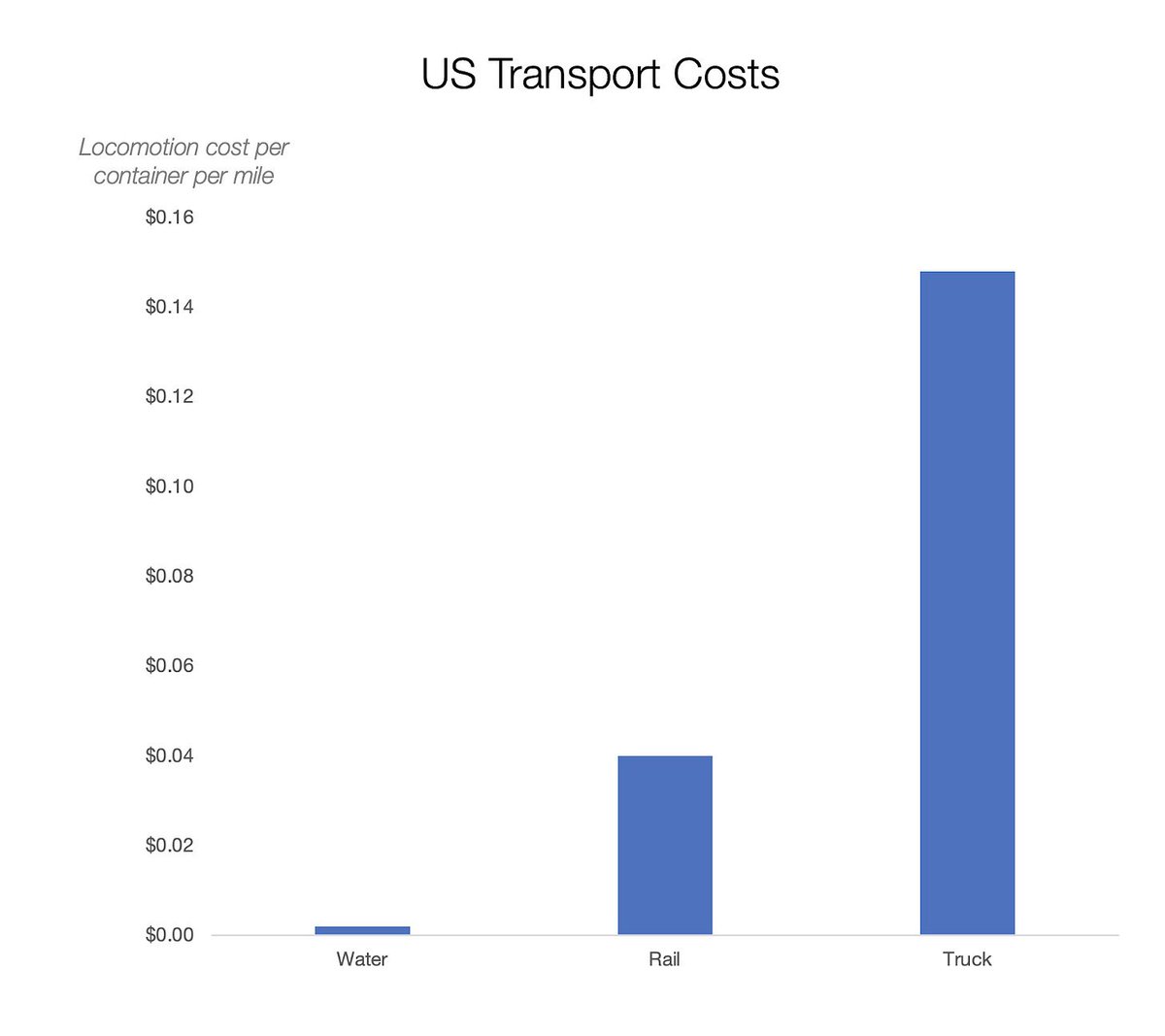
This chart is why we need to use the power of the atom to excavate a network of cargo-capable interstate canals, a maritime equivalent to the National System of Interstate and Defense Highways:
97% of cuneiform discovered has not been translated. I suspect we would find a lot more ancient insights if we did.
This clay tablet is ~3000 years old and calculated the orbit of Jupiter.
With my new DeepSeek-OCR AI system translate much of these, I just don’t have access.
All 1.7 million oil & gas wells in Texas.
Ownership instantly tabulated from a lasso on an interactive map.
Zero performance lag, no backend database required.
Incredible what we can do in geospatial these days.


![IntuitMachine's tweet photo. We've become obsessed with the idea that the brain is a "Prediction Machine."
The dominant theory in neuroscience says we're constantly simulating the future, calculating probabilities to guess what happens next.
A new paper argues this is a complete illusion. The reality is simpler, and strangely, much more powerful.
Here is the argument for Perceptual Control:
The "Prediction Illusion" starts with a mistake in observation.
When we see someone successfully handle a chaotic environment (like catching a flyball), it *looks* like they predicted the future trajectory of the ball.
But observing prediction isn't the same as implementing it.
The authors use the perfect analogy: The Watt’s Steam Governor.
In the 19th century, this device kept steam engines running at a constant speed. If pressure surged, it slowed the engine. If load increased, it sped up.
To an observer, it looked like the machine was "predicting" pressure surges and pre-empting them.
But the Governor has no brain. It has no model of the future.
It’s a mechanical negative feedback loop. [cite_start]It measures the *current* speed, compares it to the *desired* speed, and adjusts the valve immediately[cite: 80].
It doesn't predict; it controls.
This brings us to the "Hello" experiment, which broke my brain a little.
Researchers asked people to keep a computer cursor on a target. The computer applied a "disturbance" (forces pushing the cursor away) that the person had to fight against with their mouse.
Here's the twist:
The disturbance wasn't random. [cite_start]It was an invisible force field shaped like the word "hello" (written upside down and mirrored)[cite: 166].
The participants fought the force, keeping the cursor steady.
When researchers looked at the participants' hand movements, they had perfectly written the word "hello".
Crucially, the participants had NO idea they were writing words.
If the brain were a "prediction machine," it would have needed to model the force to predict the hand movement.
But the participants wrote a legible word purely by reacting to immediate error signals—instantaneously correcting the cursor's position.
This is **Perceptual Control Theory (PCT)**.
The theory suggests the nervous system isn't a linear pipeline (Input → Compute → Output).
It’s a closed loop. We act to keep our *perception* of the world matching our internal *reference value*.
[Image of Perceptual Control Theory negative feedback loop diagram]
Think about catching a baseball.
If you were a "prediction machine," you’d calculate the ball's trajectory, wind speed, and gravity, then run to where the ball *will* be.
But that’s computationally expensive and error-prone.
In reality, fielders just run in a way that keeps the "optical velocity" of the ball constant in their vision.
If the ball looks like it's rising too fast, they move back. Dropping? They move forward.
No physics calculus required. Just maintaining a visual constant.
This solves the "Noise" problem.
In predictive models, small jitters in your movement are considered "noise" or errors to be filtered out.
It’s the system "feeling out" the environment to maintain control.
This has huge implications for AI and robotics.
We are currently building robots with massive compute power to "predict" stability.
But robots built on PCT principles—like inverted pendulums that just react to maintain verticality—are often more robust and stable than the predictive ones.
Why does this matter for you?
It changes how we view "agency."
We often think we need to predict the outcome of our actions to be effective. [cite_start]But the most efficient systems don't predict the outcome—they specify the goal and let the feedback loop handle the rest[cite: 39].
The "Prediction Illusion" suggests we aren't prophets simulating the future.
We are controllers, surfing the present.
We don't need to know what the wave will do in 10 seconds. We just need to keep the board steady right now.
If you want to dig into the paper, it’s "The prediction illusion: perceptual control mechanisms that fool the observer" by Mansell, Gulrez, and Landman (2025).
It’s a dense read, but it completely reframes the "Bayesian Brain" debate.
One final thought:
Next time you're doing something skilled—driving, typing, sports—notice the difference.
Are you calculating what comes next? Or are you just managing the gap between *what you see* and *what you want*?
You might find you're doing a lot less "thinking" than you assumed.](https://pbs.twimg.com/media/G6Nb5h3WAAAUIFP.jpg)






![IntuitMachine's tweet photo. We've become obsessed with the idea that the brain is a "Prediction Machine."
The dominant theory in neuroscience says we're constantly simulating the future, calculating probabilities to guess what happens next.
A new paper argues this is a complete illusion. The reality is simpler, and strangely, much more powerful.
Here is the argument for Perceptual Control:
The "Prediction Illusion" starts with a mistake in observation.
When we see someone successfully handle a chaotic environment (like catching a flyball), it *looks* like they predicted the future trajectory of the ball.
But observing prediction isn't the same as implementing it.
The authors use the perfect analogy: The Watt’s Steam Governor.
In the 19th century, this device kept steam engines running at a constant speed. If pressure surged, it slowed the engine. If load increased, it sped up.
To an observer, it looked like the machine was "predicting" pressure surges and pre-empting them.
But the Governor has no brain. It has no model of the future.
It’s a mechanical negative feedback loop. [cite_start]It measures the *current* speed, compares it to the *desired* speed, and adjusts the valve immediately[cite: 80].
It doesn't predict; it controls.
This brings us to the "Hello" experiment, which broke my brain a little.
Researchers asked people to keep a computer cursor on a target. The computer applied a "disturbance" (forces pushing the cursor away) that the person had to fight against with their mouse.
Here's the twist:
The disturbance wasn't random. [cite_start]It was an invisible force field shaped like the word "hello" (written upside down and mirrored)[cite: 166].
The participants fought the force, keeping the cursor steady.
When researchers looked at the participants' hand movements, they had perfectly written the word "hello".
Crucially, the participants had NO idea they were writing words.
If the brain were a "prediction machine," it would have needed to model the force to predict the hand movement.
But the participants wrote a legible word purely by reacting to immediate error signals—instantaneously correcting the cursor's position.
This is **Perceptual Control Theory (PCT)**.
The theory suggests the nervous system isn't a linear pipeline (Input → Compute → Output).
It’s a closed loop. We act to keep our *perception* of the world matching our internal *reference value*.
[Image of Perceptual Control Theory negative feedback loop diagram]
Think about catching a baseball.
If you were a "prediction machine," you’d calculate the ball's trajectory, wind speed, and gravity, then run to where the ball *will* be.
But that’s computationally expensive and error-prone.
In reality, fielders just run in a way that keeps the "optical velocity" of the ball constant in their vision.
If the ball looks like it's rising too fast, they move back. Dropping? They move forward.
No physics calculus required. Just maintaining a visual constant.
This solves the "Noise" problem.
In predictive models, small jitters in your movement are considered "noise" or errors to be filtered out.
It’s the system "feeling out" the environment to maintain control.
This has huge implications for AI and robotics.
We are currently building robots with massive compute power to "predict" stability.
But robots built on PCT principles—like inverted pendulums that just react to maintain verticality—are often more robust and stable than the predictive ones.
Why does this matter for you?
It changes how we view "agency."
We often think we need to predict the outcome of our actions to be effective. [cite_start]But the most efficient systems don't predict the outcome—they specify the goal and let the feedback loop handle the rest[cite: 39].
The "Prediction Illusion" suggests we aren't prophets simulating the future.
We are controllers, surfing the present.
We don't need to know what the wave will do in 10 seconds. We just need to keep the board steady right now.
If you want to dig into the paper, it’s "The prediction illusion: perceptual control mechanisms that fool the observer" by Mansell, Gulrez, and Landman (2025).
It’s a dense read, but it completely reframes the "Bayesian Brain" debate.
One final thought:
Next time you're doing something skilled—driving, typing, sports—notice the difference.
Are you calculating what comes next? Or are you just managing the gap between *what you see* and *what you want*?
You might find you're doing a lot less "thinking" than you assumed.](https://pbs.twimg.com/media/G6Nb5h_W4AAGxbo.jpg)