Uniting HCPs to share the latest advances in #oncology. Making medical education accessible to all. Content on this channel is for informational purposes only.
As we wrap up the year on OncoViews, we’re grateful for our incredible OncoViewers and experts who make medical education accessible and impactful 🧑⚕️👩⚕️
Together, we’ve shared knowledge and advanced the conversation in oncology.
Here’s to continuing the journey in 2025!
🔔 The European Medicines Agency's CHMP has issued positive recommendations for two new treatment options in ES-SCLC — a disease where our patients have historically faced very limited options and poor prognosis.
⭕ Tarlatamab by @Amgen
A bispecific T-cell engager (BiTE) now recommended for relapsed ES-SCLC, addressing a clear unmet need for patients who have progressed after prior therapy.
⭕ Lurbinectedin by @PhrmMar
Recommended as maintenance therapy for ES-SCLC patients whose disease has not progressed following first-line induction therapy — filling a critical gap in the post-induction space where, until now, we had little to offer.
Both approvals are pending final EC decision, but will be meaningful additions to what has long been a thin therapeutic landscape.
https://t.co/DKy4yGTJtm
@peters_solange@LuisPaz_Ares@HosseinBorghaei@DrRoyHerbst@MartinReck2@g_mountzios@StephenVLiu@charlesrudin@JulienMazieres@teekayowo
ADC momentum in SCLC from @RManochakian at ILCS 2025. B7 H3 ADC ifinatamab deruxtecan and DLL3 ADC SHR4849 report response rates beyond 50% and OS near ten months in heavily pretreated patients. Toxicity and biomarkers now move center stage.
Full talk here ➡️ https://t.co/FgvH9EalYu
How should future trials refine treatment for unresectable stage III NSCLC?
At ILCS 2025, @AndrearicFili discussed ongoing efforts in the US and Europe comparing PACIFIC-like and induction chemo-immunotherapy strategies. He emphasized the need for biomarkers to predict response, since without them, both approaches risk losing patients who might otherwise benefit.
Watch the talk ⬇️
https://t.co/9cBkZBy5i1
The frontline NSCLC space is getting crowded.
As @NReguart explained, multiple phase 3 trials are now testing ADC combinations across PD-L1 subgroups, from TROP2 to HER2 and ITGB6 targets. Key questions remain: optimal duration, safety, and patient selection for escalation vs de-escalation strategies.
Watch the full talk here ⬇️
https://t.co/79wWEjZ4wZ
What lies beyond the current wave of bispecifics and ADCs in lung cancer?
At our Year in Review @charlesrudin and @peters_solange pointed to cell based therapies as the next major frontier.
Although efficacy in solid tumors remains a hurdle, innovations like CAR T cells might change the long term outlook.
Are our clinics ready for this shift?
Watch the full roundtable with @MartinReck2 ➡️ https://t.co/Xz3CofsSTS
T cell engagers are transforming small cell lung cancer but why is NSCLC lagging behind?
During our Year in Review roundtable @MartinReck2 and @peters_solange debated the future of this technology with @charlesrudin.
They explored whether the unique immune environment of SCLC is the key to their success and what this means for other immunotherapy strategies moving forward.
Watch the roundtable here ⬇️
https://t.co/Xz3CofsSTS
Can induction chemo-immunotherapy followed by cCRT and maintenance IO reshape outcomes in unresectable stage III NSCLC?
At ILCS 2025, @AndrearicFili highlighted phase II data from @MARIANOPROVENCI’s APOLO trial and Dr. William’s Latin American study, both showing ~70% 12-month PFS with induction CT-IO followed by cCRT and IO maintenance. The InTRist trial added toripalimab, reaching 85% 1-year PFS.
Watch the full talk ⬇️
https://t.co/9cBkZByD7z
ctDNA could redefine how we personalize IO in LS-SCLC.
In his ILCS2025 talk, @RManochakian highlighted how combining ctDNA with radiologic markers may identify who truly benefits from consolidation immunotherapy after chemoradiation, a key step toward precision in SCLC.
Watch the full talk here ⬇️
https://t.co/FgvH9EalYu
How can we overcome T-cell exhaustion to improve T-cell engager efficacy in SCLC?
During our Year in Review roundtable, @g_mountzios asked @charlesrudin about strategies to reinvigorate T-cells in pre-treated patients.
While early, @charlesrudin noted that combining tarlatamab with PD-(L)1 blockade shows promising activity, potentially bypassing primary resistance.
Watch the full roundtable with @peters_solange & @MartinReck2 here ⬇️
https://t.co/Xz3CofsSTS
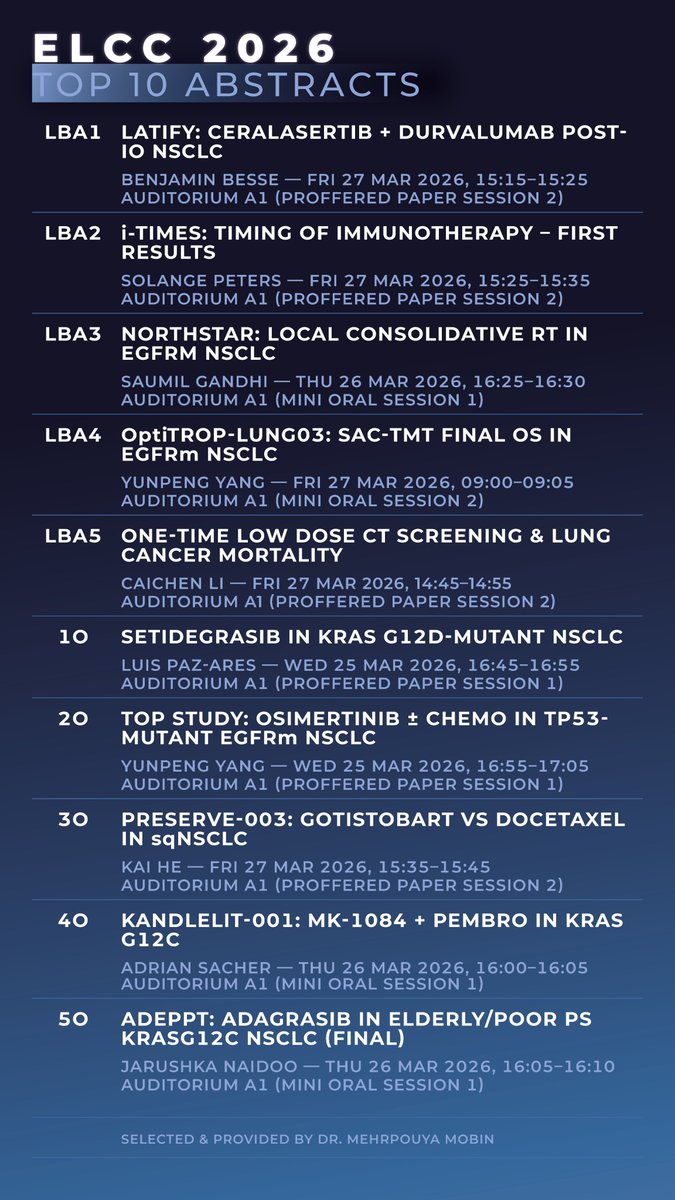
🚨 Check our Top 10 #LungCancer abstracts for ELCC 2026!
We've hand-picked the must-see sessions with times & presenters.
🗓️ Stay on track in Copenhagen and simply import these directly to your calendar by clicking this link:
https://t.co/ewiGwzCVah
Which lung abstracts are your favorites at ELCC26 #LCSM @IASLC@myESMO
Second line therapy after chemoimmunotherapy remains one of the biggest challenges in lung cancer.
As @MdCurioni highlighted using data from Russano et al., real world response rates stay around 20% and maybe only 60% of patients make it to second line.
We clearly need new strategies beyond taxanes.
Watch the full talk here 👇
🔗 https://t.co/9cBkZBy5i1
🚨New Immunobuddies Episode out now! 🎧
Episode 183: RS3PE — A WiFi password from the 90’s or an actual toxicity? (Part 3)
We’re back with the third instalment of our RS3PE mini-series — and this time we’re bringing it to life with a real clinical case.
In this episode we:
🔍 Walk through the patient presentation
🧪 Explore the investigations that were carried out
🖥️ Unpick the imaging and diagnostic clues
🧠 Show how it all led to an RS3PE diagnosis
Tune in to hear how the case unfolded and what it means for recognising RS3PE in practice.
🎧 Listen now wherever you get your podcasts.
https://t.co/HAOHIyYyzW
#ImmunoBuddies #RS3PE #Immunotherapy #irAEs #CaseStudy #Oncology #Rheumatology #Podcast
@RickyFrazer1@AOlssonBrown@IOClinicalNet@immunobuddies @UKAOSociety @UKONSmember@BOPACommittee@oncodaily@OncoDailyIO@onctrainees@ONCOassist@OncoViews@VelindreCS@OncEd@OncologyNT@myESMO@ASCO
In his ILCS2025 talk, @RManochakian discussed the DeLLphi-304 trial, a milestone in SCLC.
Tarlatamab outperformed chemotherapy in the 2L setting, delivering a 5-month OS benefit and a durable ORR of 35%. Rami also highlighted improvements in symptoms, including reduced dyspnea and cough. Patient monitoring remains the key for detecting and managing CRS or ICANS with this new drug class.
See his full talk 👇
https://t.co/FgvH9EaTO2
Can induction immunotherapy before chemoradiation improve outcomes in unresectable stage III NSCLC?
At ILCS 2025, @AndrearicFili reviewed results from the AFT-16 trial testing 4 cycles of atezolizumab before CRT in PD-L1+ patients. Despite some early progression, those completing CRT achieved encouraging PFS and OS rates.
Watch his full talk ⬇️
https://t.co/9cBkZBy5i1
SCLC treatment is seeing a major shift with latest data on T-Cell Engagers and ADCs. During our Year in Review with @MartinReck2 and @peters_solange, @charlesrudin showed how adding tarlatamab to first-line chemo-IO or as maintenance can improve survival.
While ADCs like I-DXd deliver high response rates, T-cell engagers seem to offer the durability patients need.
Watch the full roundtable here ⬇️
https://t.co/Xz3CofsSTS
68.4% versus 17.6%
At ILCS 2025 @stephanieplsaw highlighted a striking difference in response rates to T-DXd based on prior EGFR TKI exposure. While NSCLC was excluded from the DESTINY-PanTumor02 trial, exploratory cohorts suggest HER2 IHC 3+ is a highly relevant target in the post TKI setting. Is it time to routinely test for this marker?
See the full data breakdown https://t.co/qBfsppNuGi
Most patients with EGFR mutant NSCLC likely need escalation beyond osimertinib.
At ILCS 2025 @tnewsomdavis and @LeXiuning debated who truly benefits from intensification. They argued that younger patients and those with high risk features are clear candidates, while the decision is harder for older patients or those with borderline performance status. The key question remains which path to take MARIPOSA or FLAURA2.
Watch the debate here ➡️ https://t.co/qBfsppNuGi
How do we best handle progression in EGFR mutant NSCLC?
@MartinReck2 linked the frontline selection model from @ZosiaPiotrowska to resistance strategies defined by @RamalingamMD. With 4th generation targets remaining rare the focus shifts to MET alterations. Options for treatment include the use of amivantamab, which was done in the MARIPOSA-2 trial, or the combination of osimertinib and savolitinib as shown here with the SACHI trial.
Watch the full talk with @peters_solange and @charlesrudin ➡️ https://t.co/qBfsppNuGi
Targeting EGFR remains a complex challenge.
At ILCS 2025, @TommyJohn00 emphasized that EGFR-mutant NSCLC is a heterogeneous disease where co-mutations and ctDNA positivity could influence first-line choices. Next-generation inhibitors show promise for on-target resistance, yet better tools and sequencing strategies are essential for personalization.
Watch his full talk ⬇️
https://t.co/Y105J3YWV9
Approaches to liquid biopsy differ across regions.
At ILCS 2025, @md_mariusilie noted that while liquid biopsy is often preferred and requested by patients in the United States, in Europe it is mainly used when tissue samples are insufficient or rebiopsy is not feasible. The debate on standard practice continues.
Watch his full talk ⬇️
https://t.co/kWRWcrN7zN