Introducing M3 Code ✨
A T3 Code fork with ZERO telemetry.
NOTHING is being sent from this fork - no analytics, no product usage data, no error or crash reporting, no OpenTelemetry traces/metrics/logs, and no install, device, or account identifiers.
It will be updated DAILY to get latest commits from upstream T3 Code. It also includes some other unique features, specifically for local AI, but not just:
- Local providers marked, default for new threads
- Background writing prefers local models
- Settings → Inference: model server registry
- Supports llama.cpp, LM Studio, Ollama, TensorFold
- Gateway: per-server queues, TTFT, decode stats
- Queue position shown in waiting threads
- Pi gets managed provider + lean tool set
- OpenCode + Codex route through gateway
- Fallback servers, only while primary is down
- Cache health + probe freshness per server
- Vision: engine-reported + tested, images routed
- Watchdog stops loops, rants, and hangs
- Bounded retries; never retry cancellations
- "Use a local model" one-step setup
- "Find server" repairs a moved server
- Picker shows machine + server per model
- Warns when a thread's model is no longer served
- NoName provider via ACP bridge, auto-found
- Pi/OpenCode/NoName auto-enable when on PATH
- SSH machines get the fork's own server uploaded
- Fork version 0.1.x-mia.<time>.g<hash>
- Add project dialog: machine picker + folder browse
- Add servers from other connected machines
- Two-tone dark theme; true-black kept as OLED
- Sidebar cards title-first; Settled collapses
- Offline evals for local models
Get it here:
https://t.co/C2IPEjK799
If you own 2 DGX Sparks, skip M5U 256 GB
If you own 4 DGX Sparks, skip M5U 512 GB
Have money to spare?
- If you have 1 DGX Spark, add another
- If you have 3 DGX Sparks, add another
Want faster inference? Buy GPUs.
Hello everyone!
Qwopus Flash v2 is LIVE, all quants will be uploaded into the repo over the course of today!
Continued post-training on the Qwopus v1 recipe, plus fixing some Python indentation issues from a dataset in the first train!
This model is far more temperature stable than many prior finetunes; I recommend that it be run at .3 temp with x-high thinking for most coding work for stability and increased MTP acceptance!
If you want to get creative and have spare time, run it at medium, with thinking at a higher temp like temp 1; it produces some astounding results but takes longer. Surprisingly, the Qwen 3.8 thinking settings do not push any instruction for "medium," so it will let the model and teacher training decide what to do with full autonomy.
That said, .3 produces very stable code, and Xhigh thinking does a good job of choosing its battles with the finetune! The model is still very creative and capable at .3, so I would use that setting as a good baseline for the majority of work!
The biggest win here is we don't have to ride entropy at temp 1 to prevent looping like with the 3.6 fine-tunes; we can run it more greedy and still get astounding results! Plays nicer with harnesses that force temp changes, and increases MTP acceptance as well!
Looking forward to your results and feedback with Qwopus v2! Please comment anything awesome you build or any difficulties you may have, and I will take a look!
Happy Monday, and thank you all for your support!
https://t.co/gsULLVbZj7
🚨 codex users are cooked lmao!!
Of course!!!
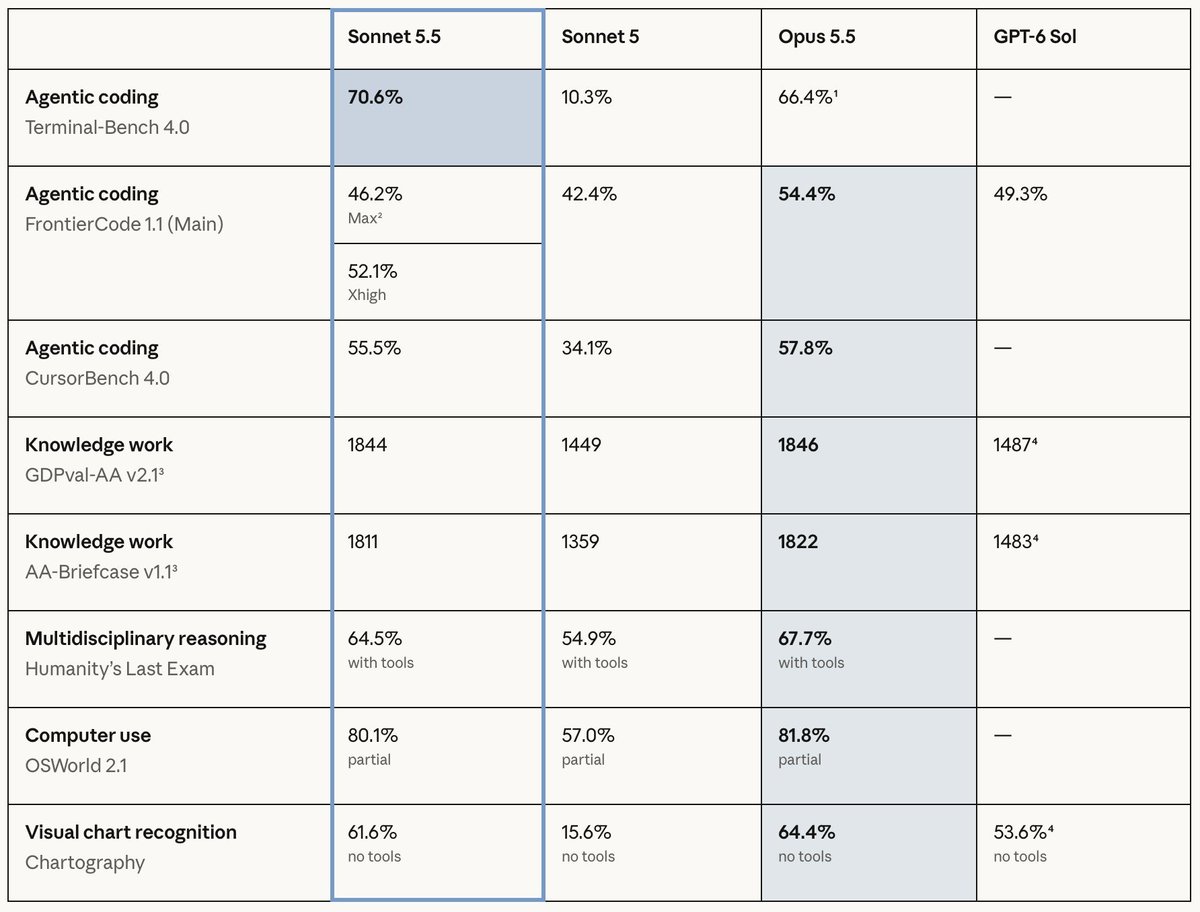
Sonnet 5.5 is BETTER than GPT-6 Sol
A 3rd tier model from Claude is BETTER than 2nd tier model from OpenAI
I really hope Tibo has a proper response to Claude 🫠
🚨 OpenAI's API may give you far more reasoning than Codex
- The same OpenAI models reportedly get a much bigger reasoning budget through the API than through Codex
- Even inside OpenAI's own Codex harness, you may be getting a more constrained version of the model
- GPT-6 Astra is said to hit roughly 832 "juice" on Max via the API
- The same model reportedly gets only 128 through Codex
- If true, OpenAI would be holding models back on its own plans while direct API users get the full-power version
- Early measurements reportedly support the claim
Are API users getting the real monster while Codex gets the leash?
Most notable thing
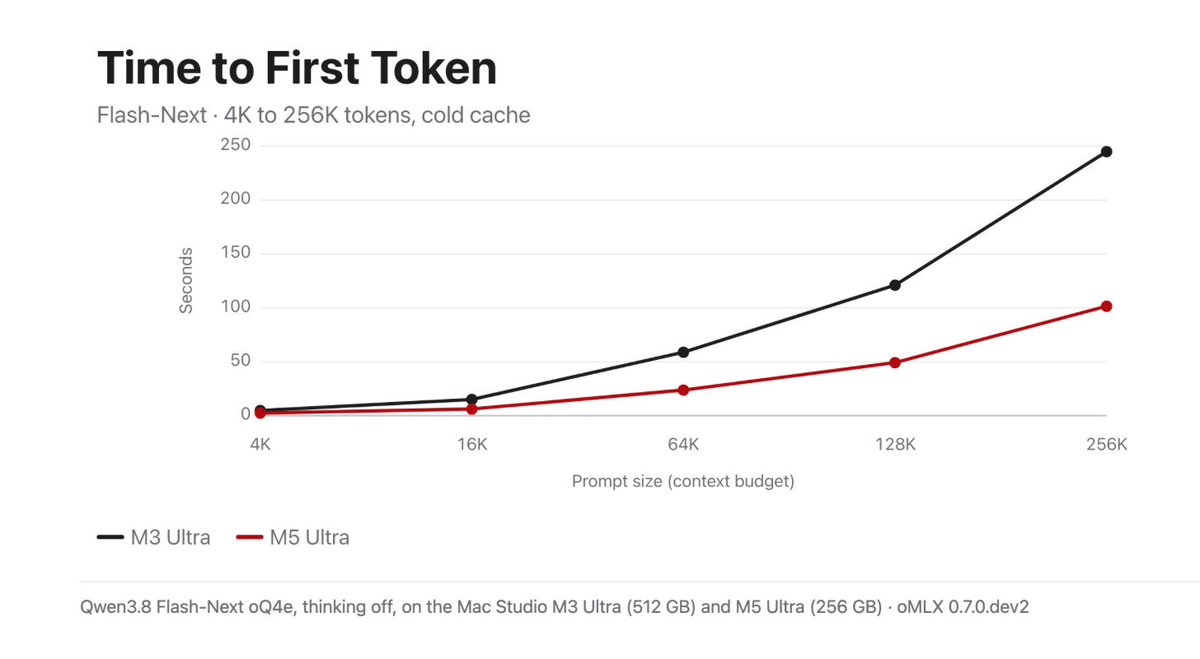
M5 Ultra with 1.2 TB/s bandwidth is only 6.4% faster in token generation than the DGX Spark (273 GB/s)
M5 Ultra has ~5x the Bandwidth of the DGX Spark
OpenAI and Anthropic are clearly running out of compute.
Because of this, they are quietly serving heavily quantized and nerfed models to regular users.
The full price API does not feel degraded like this.
This only happens on the paid monthly subscriptions.
Selling people a subscription while secretly downgrading the model is just a scam.
NVIDIA might just have solved the biggest tradeoff in LLMs.
Every LLM makes you pick between speed and quality. Autoregressive models like GPT give you quality, but they're slow because they generate one token at a time.
Diffusion models do the opposite. They generate whole blocks in parallel, so they're fast, but that speed has always come at the cost of quality.
Before we get to NVIDIA's solution, let's understand why diffusion isn't up to the mark in the first place.
A diffusion LLM starts with a block of masked tokens and unmasks them over a few passes. On every pass, it reads all the text written so far and predicts the masked tokens in that block together.
So the same network is doing two very different jobs at once. It has to understand the context that's already there while also guessing at tokens that don't exist yet.
That's one set of weights pulled in two directions, so it never gets good at either.
TwoTower fixes this by not forcing one network to do both. It clones a pretrained autoregressive model into two towers.
The first is a frozen context tower that reads everything written so far, exactly like the original did. It's never trained, so the model's intelligence stays perfectly intact.
The second is a trainable denoiser tower that fills in each new block of tokens in parallel. To stay on track, it constantly cross-attends back to the context tower.
The two connect layer by layer, so denoiser layer 5 talks to context layer 5, and so on.
That gives the denoiser the backbone's full multi-scale understanding, not just a final summary of it.
This results in:
↳ 2.42x higher generation throughput
↳ Keeps 98.7% of the original model's quality
↳ Built on a 30B hybrid Mamba-Transformer MoE backbone
↳ Trained on just ~2.1T tokens, a fraction of the 25T used to pretrain the original
Nothing here was trained from scratch.
It's an adaptation you build on top of an autoregressive model you already have, and it turns slow one-token-at-a-time decoding into fast parallel block generation, cheaply.
So if you're shipping anything latency-sensitive, check this blueprint. You no longer have to choose between the model you trust and the speed you need.
Weights and code are all open-source.
Link to the paper: https://t.co/uC85PoRKk1
That said, if you want to go deeper, I wrote a detailed article that explains LLM inference from first principles, step by step.
The article is quoted below.
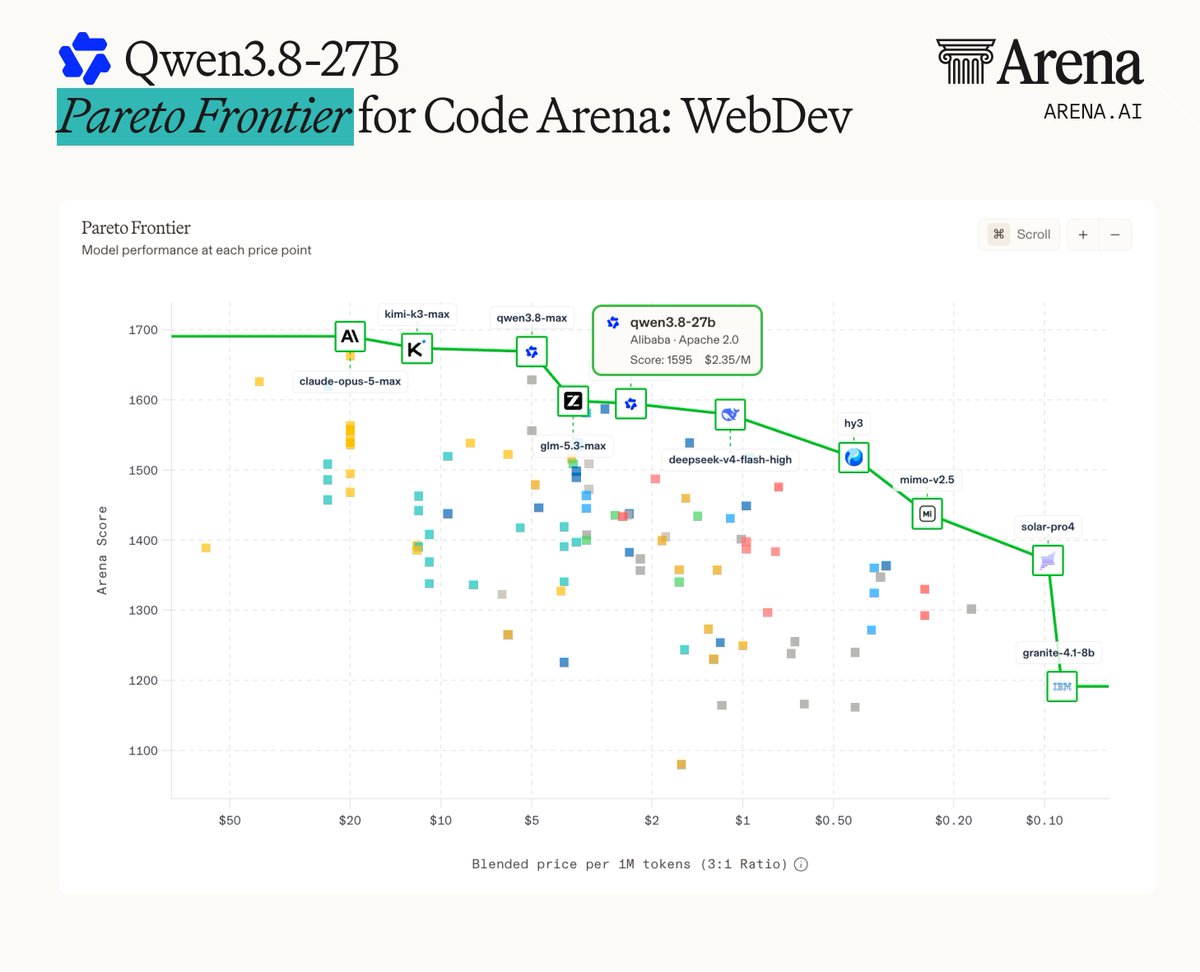
Exciting news: Qwen3.8-27B by @Alibaba_Qwen just landed in Code Arena: WebDev at #9 overall with 1595 pts. It is the only model in its size class in the top 10, and also reshapes the Pareto Frontier!
It is only 6 ranks behind the much larger Qwen3.8-Max. For scale: Gemma 4-31B which was released back in April sits at #80.
Congrats to @Alibaba_Qwen on the release!
See thread for more highlights on Qwen3.8-27B.