Christian Catalini on PostAGI. Verification is the only scarce resource.
Many people think it’s taste, agency or judgment. But these are just aesthetic descriptions of an underlying mathematical quantity: verifiability, the ability to verify whether an outcome meets a certain bar or improves on previous outcomes. Because what’s verifiable becomes optimizable by AGI.
In this 2nd episode of the PostAGI podcast, @soubhikdeb and I sit down with @ccatalini, founder of the @MIT Cryptoeconomics Lab, to discuss what happens to labor, capital and markets as AI scales.
We also get into:
02:41 The hollow economy, and why Amazon called an emergency meeting over AI slop
13:32 If it can be measured, it can be automated
16:55 Why AI hands you something that sounds right and is completely wrong
26:20 Why crypto built the infrastructure AI now needs
43:58 The missing junior problem, and why CS grads stopped getting jobs
59:12 The four zones that decide which jobs survive AI
Full episode below. @postagixyz is also on Spotify and YouTube.
Jared from subway just sandwiched @VitalikButerin: https://t.co/H9mP1CTa8y
this is the most Ethereum thing that has ever happened, MEV doesn't care who you are🥪
This is what happens when you stop paying people to use your chain
Yes, you heard me right
PAYING people to use a chain
The KaiChing (KaiKaiNow) contract ended with NEAR and they drove the majority of users and TPS
NEAR paid an undisclosed but likely 8-9 figure sum to KaiKaiNow just so they would integrate and use the chain
KaiKaiNow covered the gas fees for all user txs from the amount paid boosting users and TPS over 10x
Until the money ran out…
Then they peaced out and took over 90% of the numbers away
Just like when the Hedera subsidies ended and Atma stopped doing thousands of TPS
Remember when Hedera was doing 2k-4k consistent TPS?
Yeah, they paid for all that and then some and now their TPS is less than 5
TLDR: It’s all fake and we have to pay people to use this tech currently
This is not NEAR or Hedera FUD just a wake up call for many in the industry
Artificial intelligence (AI) can help track inflation risks in real time. A new ECB model based on machine learning informs experts how likely it is that inflation will be much higher or much lower than they expect https://t.co/FADBT6q5YS
These guys probably got a heads up from Anthropic about Mythos finding numerous 0-days in Ethereum smart contracts, which is why they're distracting people with Bitcoin quantum talk.
The extent in which they are talking about Bitcoin leads me to believe something very fundamental is broken in Ethereum and they're using quantum FUD to push out a "rewrite" narrative to cover it up.
How many billions $$$ are at stake secretly?
Is something critical broken like the staking contract?
Agentic Companies: The New Trillion Dollar Asset Class
AI converts execution into software. Crypto converts ownership and governance into software.
Creating a new kind of firm.
One that is pure software.
For the very first time.
Lowering the cost basis
Accelerating open innovation
Accessing global capital
Creating a new
Trillion Dollar
Digital Asset class
My talk from @blockworksDAS NYC on why this becomes a trillion-dollar asset class:
The internet also worked because of the 1A in America, with speech being unregulated and unregulatable in many forms.
Financial assets do not have this feature. An "open and permissionless" environment is not going to work the same way.
This is not to argue for private blockchains (a bridge to nowhere), but rather saying that thinking the only two extremes are public permissionless vs. private blockchain is actually a statement that we simply should not use blockchains at all.
Rather, we are going to need a middle state: a credibly neutral, open-access chain that is willing to enforce laws from issuer jurisdictions and controls that are essential to finance.
The important part of the blockchain is the immutability (e.g. no changing the history) and the open access by default assumption (e.g. we assume you can be here), but we will need the capability to change transactions later on (by reversing them, not changing the history, as having a send to b and later b send back to a is not a violation of immutability) and to kick people out who are bad actors (e.g. we assume you can be here but if you break the rules we will kick you out).
The winner will be the one who threads this needle to create the greatest access and neutrality while still enforcing the base level rules needed for everything to work.
Foundry mined 7 consecutive Bitcoin blocks and caused a 2-block reorg
Nobody outside of the Bitcoiners who follow the Bitmex research account are talking about it because the normie radar saw price bouncing back to $71K
Mining concentration is the story nobody wants to have
If my children were still young, I would teach them how to protect themselves by, among other things, defeating “age-verification” and other identification, tracking, and control systems.
The RWA space will produce two types of winners.
Platforms that built real infrastructure quietly, before the narrative made it fashionable, and are now simply continuing to execute.
And platforms that built during the hype, optimized for attention, and are now discovering what they skipped.
Those two groups are not competing on the same timeline.
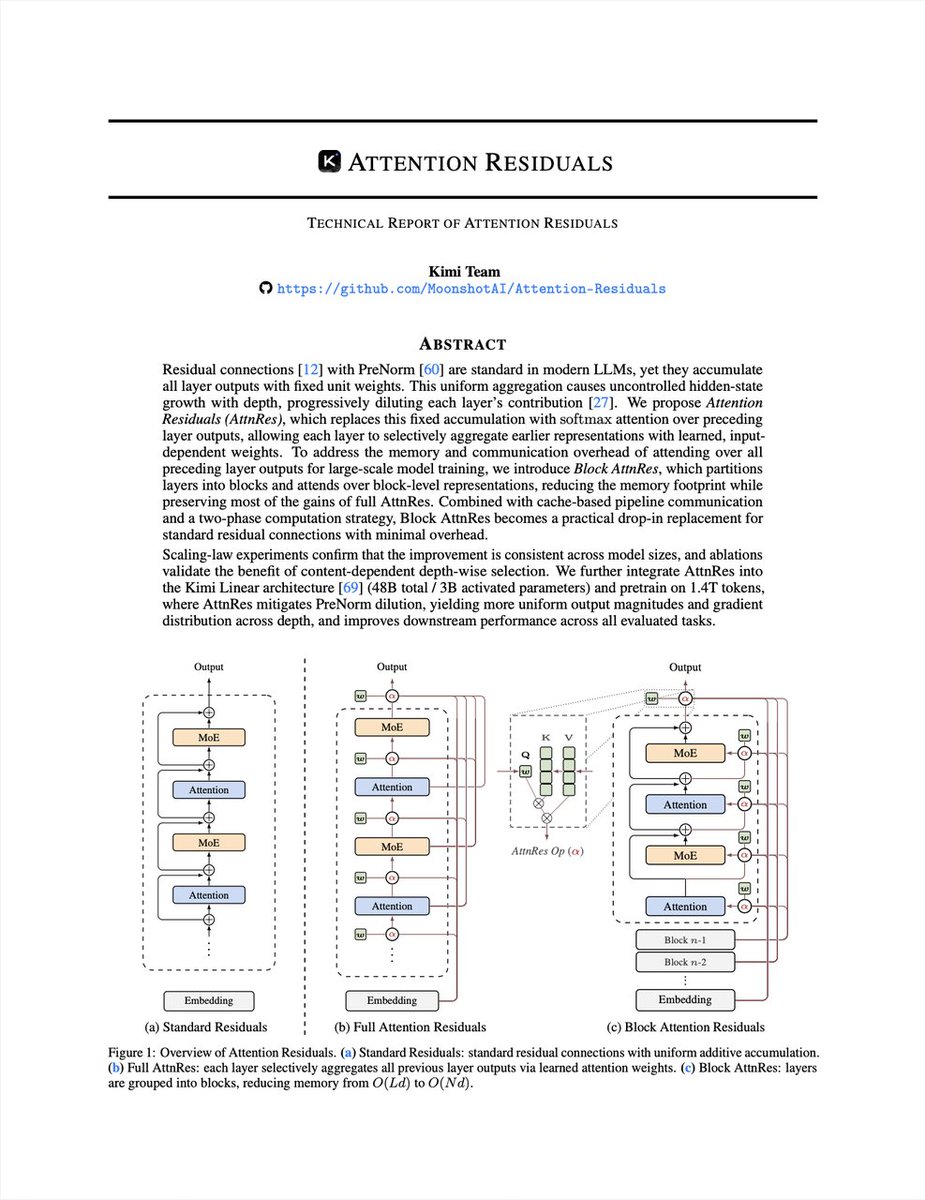
Introducing 𝑨𝒕𝒕𝒆𝒏𝒕𝒊𝒐𝒏 𝑹𝒆𝒔𝒊𝒅𝒖𝒂𝒍𝒔: Rethinking depth-wise aggregation.
Residual connections have long relied on fixed, uniform accumulation. Inspired by the duality of time and depth, we introduce Attention Residuals, replacing standard depth-wise recurrence with learned, input-dependent attention over preceding layers.
🔹 Enables networks to selectively retrieve past representations, naturally mitigating dilution and hidden-state growth.
🔹 Introduces Block AttnRes, partitioning layers into compressed blocks to make cross-layer attention practical at scale.
🔹 Serves as an efficient drop-in replacement, demonstrating a 1.25x compute advantage with negligible (<2%) inference latency overhead.
🔹 Validated on the Kimi Linear architecture (48B total, 3B activated parameters), delivering consistent downstream performance gains.
🔗Full report:
https://t.co/u3EHICG05h
👏🏼👏🏼👏🏼 “You have argued that intermediaries for tokenized securities should be regulated and that the trading of tokenized equity securities should be subject to protections that seek to ensure that all investors receive the best terms for their orders. What if there are no intermediaries to regulate? Or, if there are intermediaries, what if they do not clearly fit within the existing intermediary definitions in the Exchange Act (e.g., broker, dealer, exchange, clearing agency)? Does the SEC have statutory authority to impose the requirements that you recommend in such cases?”
Massive news for traditional finance today: the Fed, FDIC, and OCC just dropped a joint FAQ on the capital treatment of tokenized securities.
TL;DR🤣: Tokenizing a traditional security (like a Treasury bond) doesn't change its capital treatment for banks. It won't get hit with the massive capital charges normally reserved for crypto assets.
The biggest surprise? Regulators explicitly stated this rule is "technology-neutral"—meaning it applies even if the asset is recorded on a public, permissionless blockchain.
This is the exact regulatory air cover Wall Street and regional banks have been waiting for. The "capital penalty" fear is gone. Expect a major push toward 24/7 atomic settlement, better overnight yields for community banks, and an explosion in digital custody services.
The plumbing of Wall Street is officially getting an upgrade.
https://t.co/t2tEukI8c2
Roblox launched mandatory age verification in January. Facial scans. Government ID. Designed to protect children.
Within days, age-verified accounts appeared on eBay.
$2.99 to $19.99.
Buyers sign in without any ID or facial scan. The verification was already done. The account carries the trust.
A predator can buy a pre-verified "minor" account for less than the cost of coffee and access child-only chat spaces.
The system designed to protect children became the tool to bypass protections.
This isn't a Roblox bug. It's a structural flaw in account-based verification.
When verification attaches to the account, anyone who holds the account gets the verification. Transfer the account, transfer the trust.
Verify once, transfer forever.
The same problem exists everywhere:
Dating apps: verified profiles sold to catfishers
Social media: verified accounts traded on markets
Financial platforms: verified users enabling money laundering
Any system that says "this account is verified" faces the same flaw. The account is not the person.
The fix is verifying the person, not the account.
When verification ties to the individual through cryptography, selling the account doesn't transfer the verification. The buyer gets the account. But the proof of identity stays with the original owner.
You can sell an account. You can't sell a https://t.co/sPgIDeu7uD.
That's what person-based cryptographic verification means. The trust goes where you go and stays where you stay.
No amount of account trading changes who you are.
Read more: https://t.co/kla1J44MA6