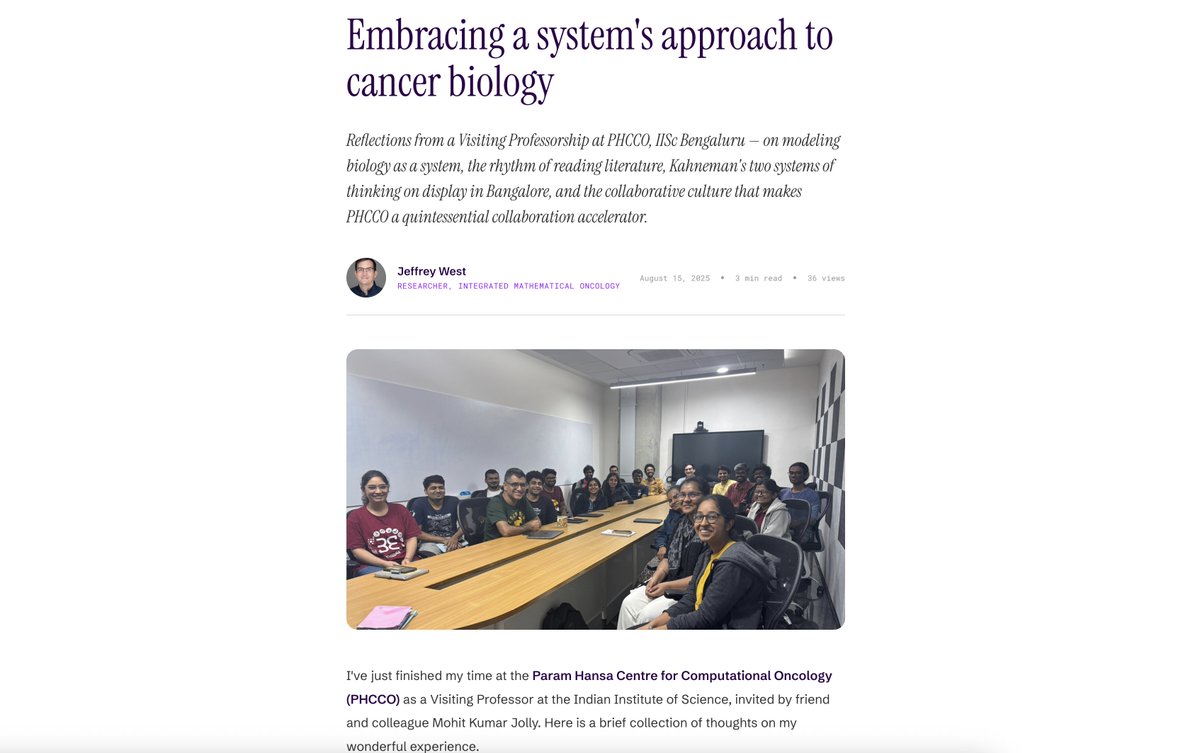
I'm quite pleased to see my post describing my Visiting Professorship at the Indian Institute of Science published on the Param Hansa blog:
"Embracing a system's approach to cancer biology"
https://t.co/9qMSD15xPC
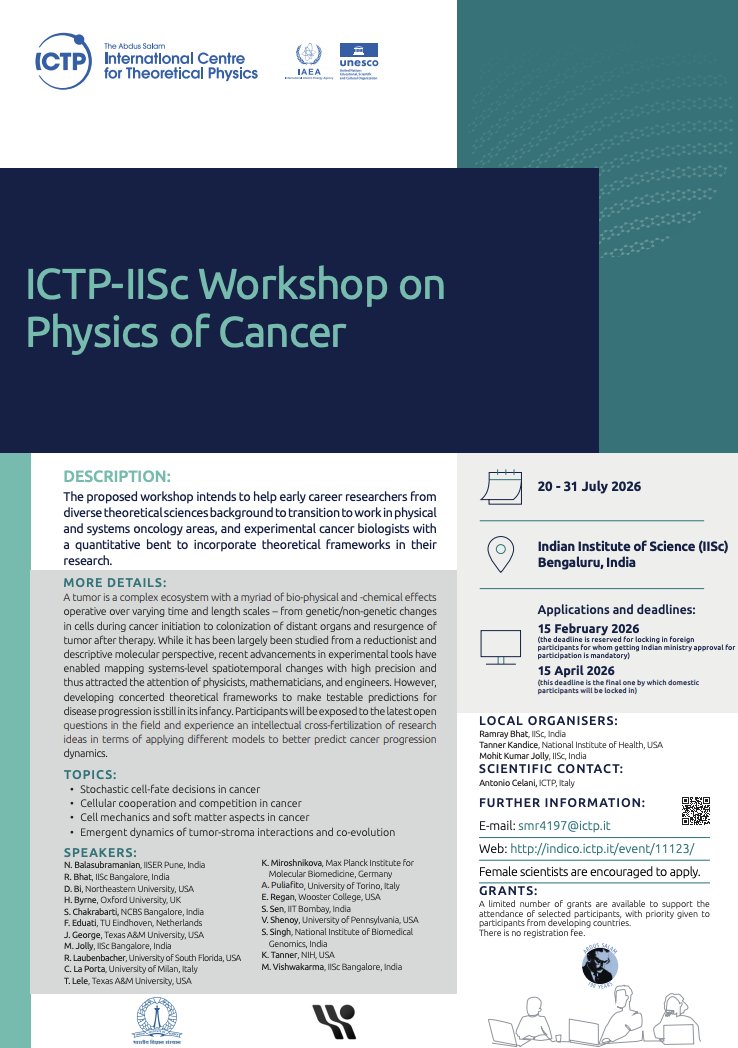
Applications open for ICTP-IISc workshop on Physics of Cancer (20 experimental and/or computational speakers in stochastic cellular decisions, cellular competition & cooperation, soft matter aspects and tumor-immune co-evolution dynamics).
Apply by Feb 15!
https://t.co/UuwZkt1uqC
Researchers at IISc have developed a maths model to understand how cancer cell plasticity – switching between drug-resistant and drug-sensitive states – affects adaptive therapy.
@mkjolly15@BE_IISc
Read: https://t.co/wjumnLNHug
#IIScresearch
Every year, India watches 1000s of its engineers pack their bags for Silicon Valley, London, or Toronto. We call it "brain drain" and shrug it off as inevitable.
China had the same problem. Their best minds were scattered across MIT, Stanford, Google. Then in 2008, they decided to do something about it
Enter the "Thousand Talents Plan" - China's audacious bet to reverse the tide. The pitch was simple: "Why struggle on a postdoc salary in Boston when you can lead your own lab in Beijing?"
The numbers were eye-watering. 1 million yuan signing bonus. Research funding of 3-5 million yuan. Free housing. Your kids' education sorted. And here's the kicker - they didn't just want Chinese scientists back.
The Young Thousand Talents program started actively recruiting brilliant minds from India, Korea, Japan - anywhere they could find them. While we were busy celebrating our diaspora's success abroad, China was quietly building its own Silicon Valley.
Fast forward to today: China has pulled back 7,000+ top scientists. They're not just catching up in AI and semiconductors - they're leading.
Meanwhile, Indian parents still dream of their kids getting that coveted H1-B visa.
The brutal truth? Brain drain isn't fate. It's a choice. China chose to fight for talent. What did we choose?
https://t.co/YZdgx8q8Gq
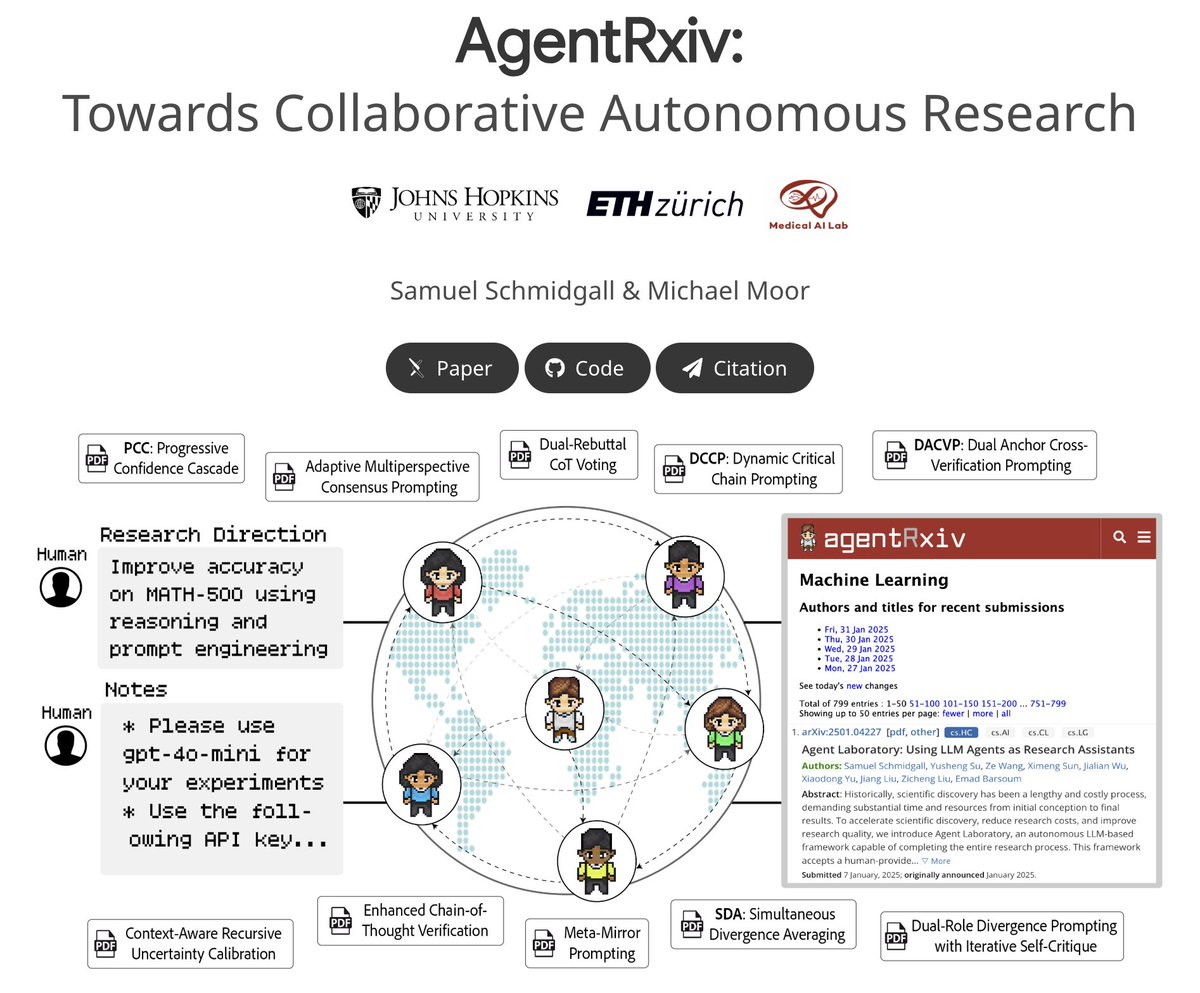
🚀🌐Introducing AgentRxiv: a framework where autonomous research agents can upload, retrieve, and build on each other’s research.
AgentRxiv takes your research direction and progressively outputs research, building on its previous work with each new paper!
🧵
✨it's PhD application season again!✨ i am re-sharing my popular guide on applying for PhD programs in STEM, that has now been viewed 60k+ times over the past 6 years😍 please RT and share with anyone that might find it useful! https://t.co/GZjrcU5kjg
🚀 Excited to announce our new mixed reality game: Wall Town Wonders! 🏡✨
It turns your living room into a lively miniature town full of colorful characters. Pre-order now on the Meta Quest Store to get a discount and exclusive skins! 🎮
The entire Indian space program came out of IISc. Looks like you totally missed out the entire Rocket Boys series. If you count successful deep tech startups from IIT alums the list will be just too long for this platform. But they are also positive additions to Indian society…
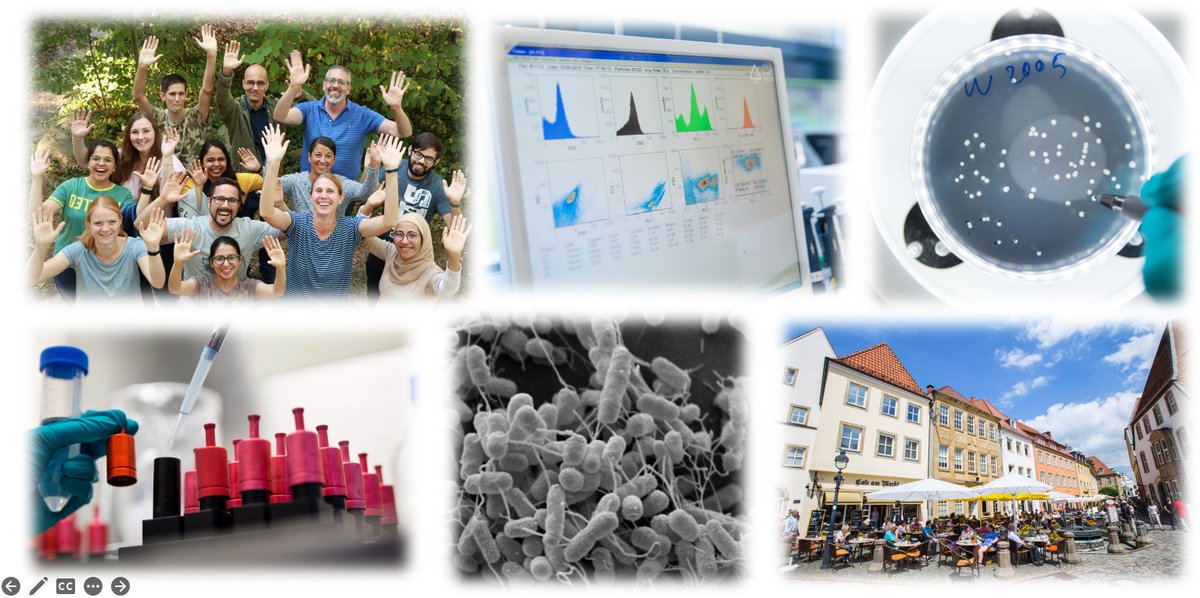
A fully funded (3 year) PhD position is available in my group. The project will focus on analysing how synergistically interacting bacteria coevolve.
Join my vibrant group at @UniOsnabrueck.
Please RT
Deadline: 28.07.2024
More information👇
https://t.co/gdMbN1ItJi
1. Honest title of every transcription talk:
“everything we previously told you about transcription was wrong, again”
Honest title of every cell division talk:
“here are 3 more proteins that are apparently absolutely essential for cell division but no one worked on previously”
What can Minecraft teach us about cells in developing embryos?
Find out how a new theoretical approach by EMBL researchers can help us understand the dynamics of biological processes, such as cell sorting in embryos.
https://t.co/k2i9iTBwcR
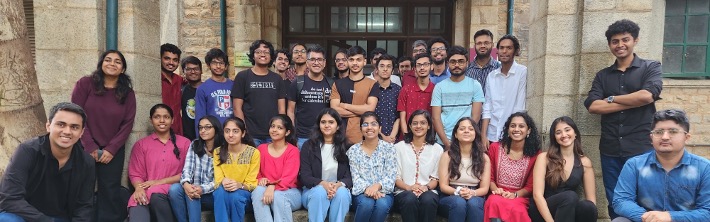
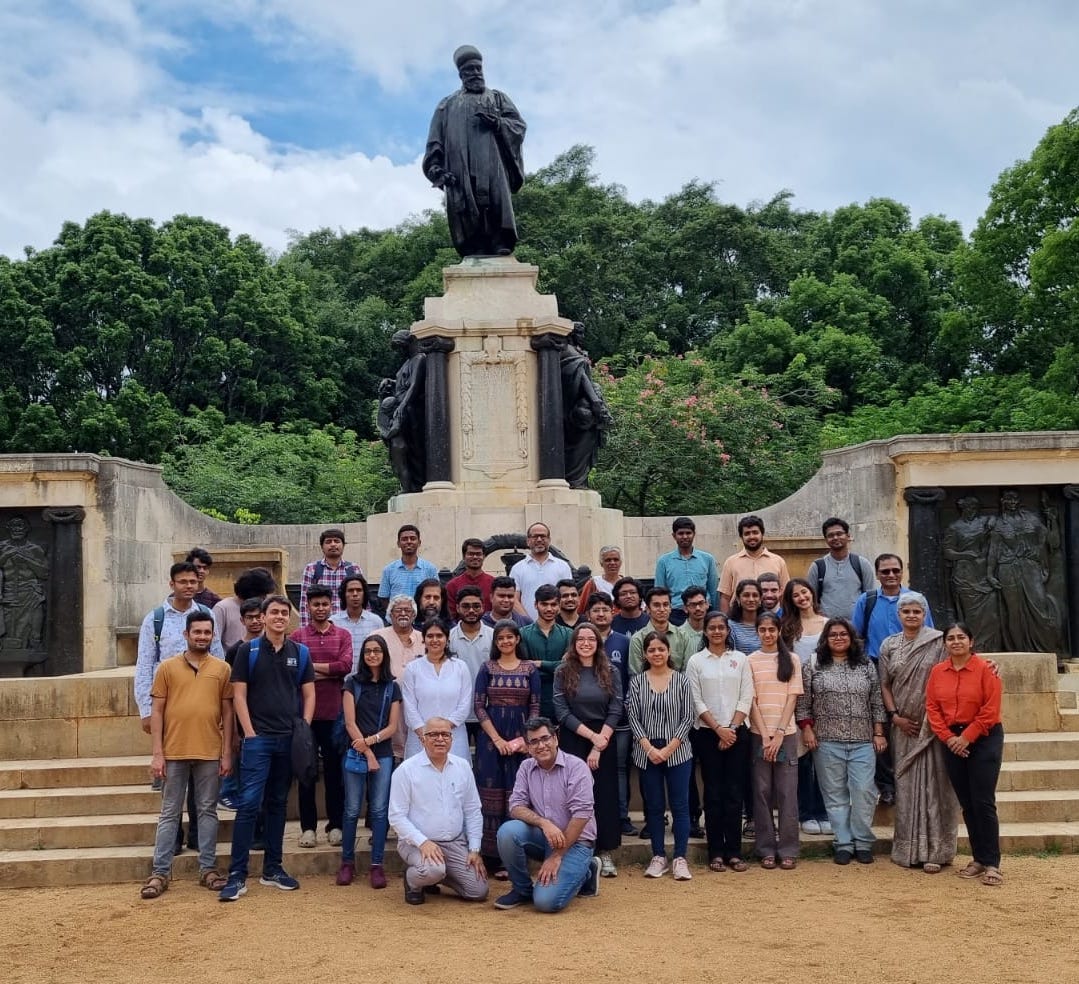
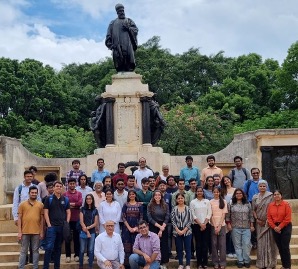
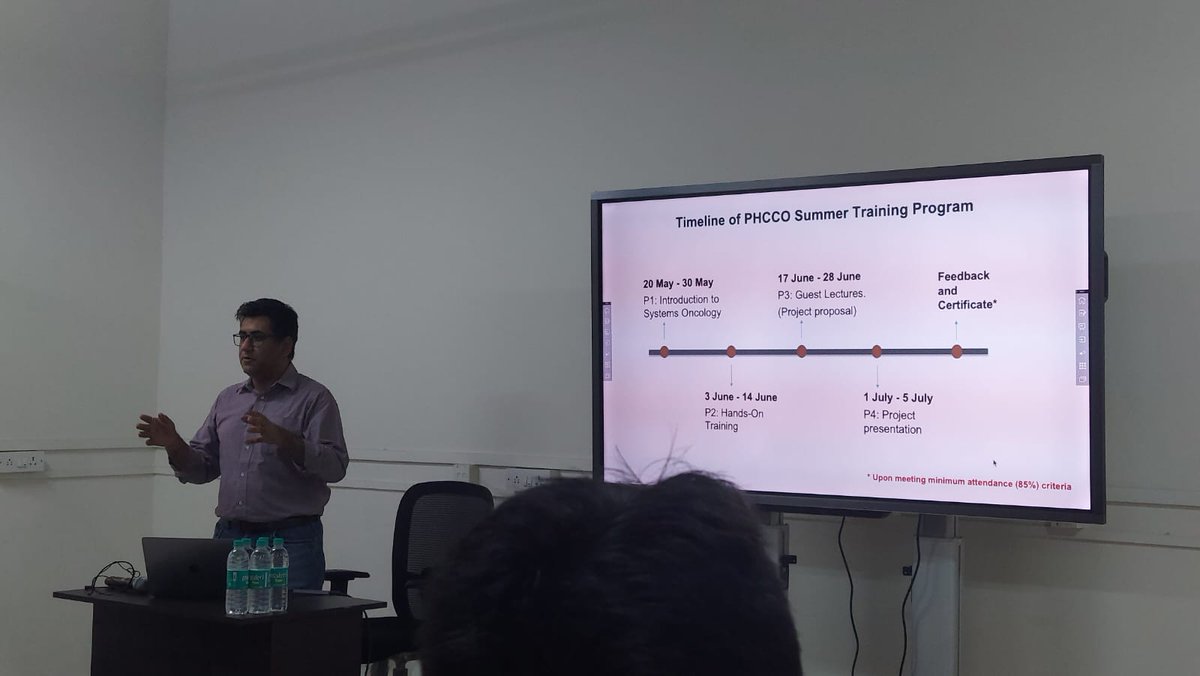
We launched today 7-week summer training program (including lectures, hands-on sessions, a short research project) in computational oncology for 24 undergrad students from all over India & across disciplines (Engineering, Medicine, Data Science, Biology etc.) at @iiscbangalore 🧵
🍊🧬 Citrus Defense Boosted! New study finds DMNT & TMTT volatiles from citrus leaves deter pests like Asian citrus psyllid. Discovering CsCYP82 genes enhances strategies against huanglongbing disease. #CitrusResearch 🌿🔬 @OxfordJournals
Details:https://t.co/P6LKnBOLWY