#Trading
Why do you often lose money buying altcoin spot?
The reason is simple: you usually buy during emotional peaks. Once the price makes a normal pullback, your position immediately goes into the red.
Then you may have what feels like a “smart” idea:
“If buying high makes me lose, then I should just short it instead.”
But trading doesn’t work with such simple reverse logic.
If you keep the same habits—
chasing moves, skipping stop-losses, and trading emotionally—
shorting will only make you lose faster.
When shorting, you’ll end up chasing the drop, and the moment the market rebounds you get hit: losses, holding a bad position, adding size, then finally panic-cutting or even getting liquidated.
The problem is never “long or short.”
The real problem is using the same flawed trading behavior in both directions.
#Trading
If you keep losing money on shitcoins,
the “smart move” might seem to short them.
But does shorting guarantee profits?
Or will you just lose money even faster?
🚨NEW: TOM LEE WARNS OF A BIGGER CORRECTION AHEAD
“The market had a parabolic lift in the last month and now there’s some sobering taking place”
“People are raising cash. I don’t think that this is the start of a broader correction yet.”
@chronocrator0x Looking at last year's candlestick chart, the signs of manipulation are quite obvious. The overall price has been hovering around the $2 level at the bottom for an extended period.
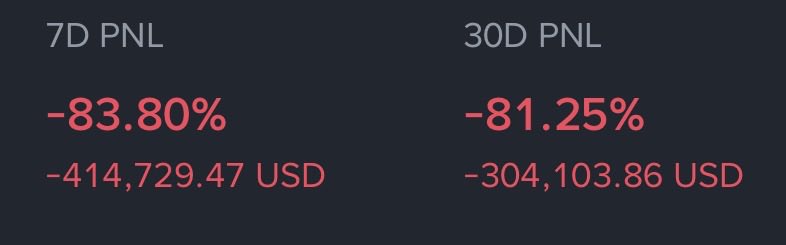
Orait, time to talk about losses. This has genuinely been the hardest month of my trading career. What hurts the most is that a lot of it was self-inflicted. I roundtripped heavy, gave back a lot to the market, and honestly things would’ve been very different if I just stopped around 97k. Instead I kept martingaling, forced a few trades, revenge traded, and paid for it with a solid chunk of my portfolio.
I can share a lot of insights from this, but I’m not here to pretend I win all the time. I’ve made close to 8 figures in my life and one thing that never changes is that the same strategies don’t always work. For now I’m flat and waiting for the next real opportunity to capitalize on. Not gonna lie, losing money never feels good, especially when you know most of it came from breaking your own rules.
This month I got chopped trying to trade too much, opening and closing positions nonstop, and fees + bad execution alone cost me more than some people realize. It’s part of the game, but it’s also a reminder that edge isn’t just about entries, it’s about discipline, patience, and knowing when to do nothing.
This post isn’t for pity. I just think it’s important to share the dark side of trading too. Everyone loves posting wins and green screenshots, but even the traders you see at the top of leaderboards take real losses and go through brutal periods. That’s the reality of this game.
Much love,
mattertrades❤️
#Trading
GM
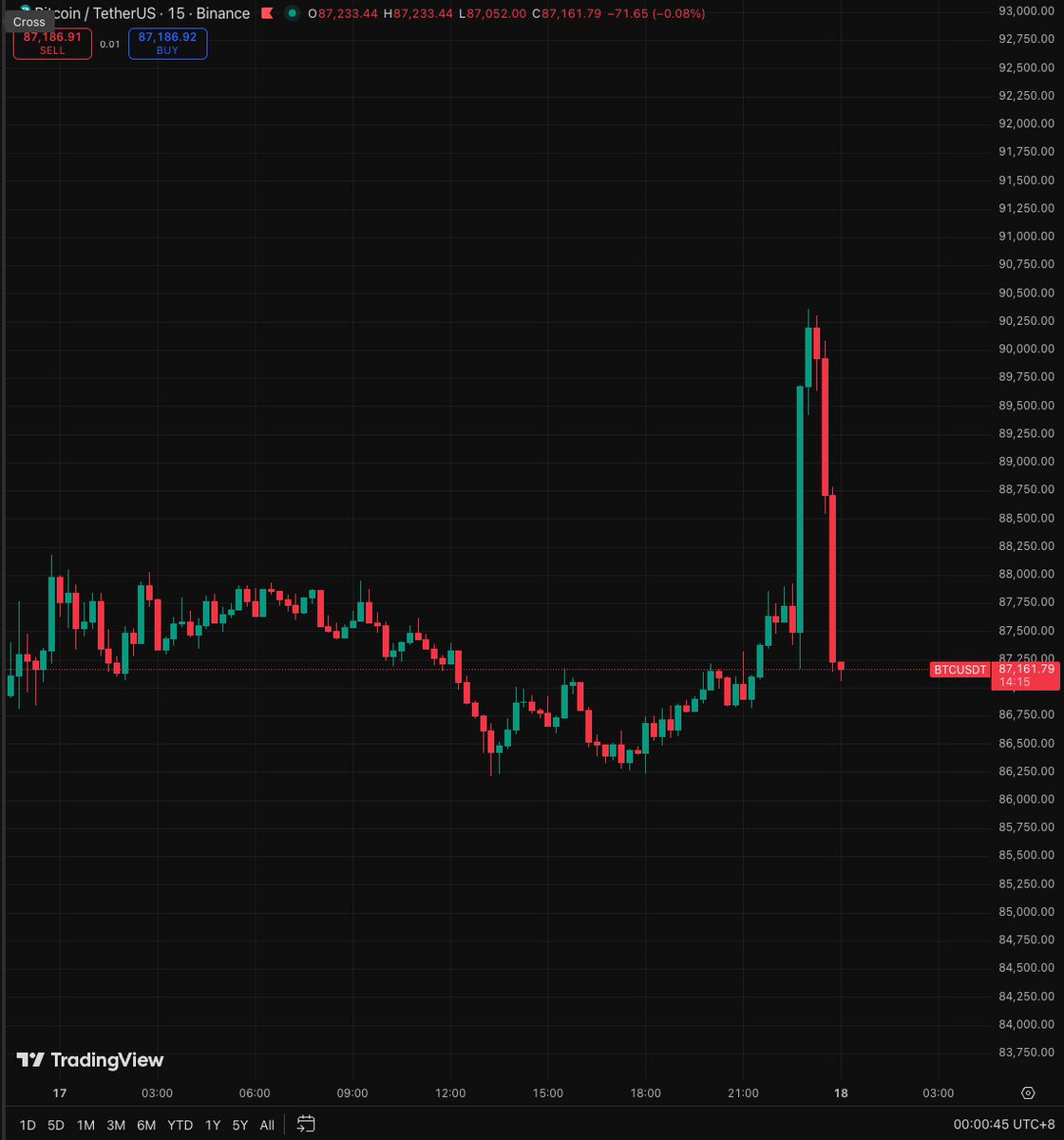
It feels like the market always tries to stage a big rebound
—giving everyone a “graceful exit” or a chance to clean out their positions.
But when the rally actually comes,
many people can’t bring themselves to sell,
and they end up getting taught a lesson by the next wave of volatility.
#Trading
Once you add time to profits and losses, trading shifts from judging an outcome to managing a process.
It becomes simpler because you can align strategy with timeframe and use time-based rules for risk control;
but it also becomes more complex because positions evolve over time, opportunity costs accumulate, and emotional pressure increases—adding more decision and evaluation dimensions.
Shorting is like skydiving:
Before you jump, you must plan your altitude (leverage/position size),
landing zone (targets/scale-out exits), and weather (trend/volatility/liquidity)—and pack both a main chute and a reserve: hard stop rules + a position-size cap.
If you’re new, you need repeated practice under a “coach” (a clear rulebook, review process, and risk framework).
Otherwise, one sudden patch of turbulence—a sharp squeeze, a black swan, or slippage/liquidity vacuum—can turn into uncontrolled drawdown at best, or a liquidation at worst.
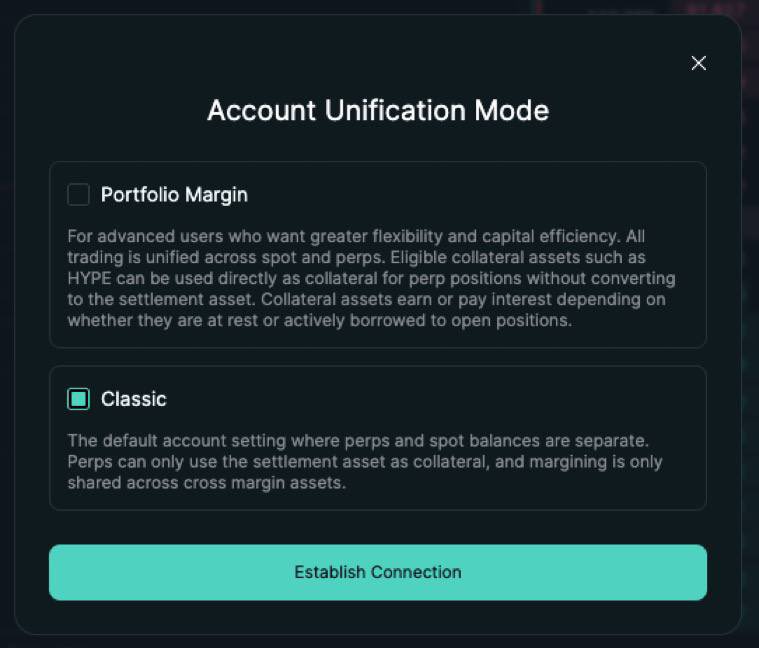
Hyperliquid’s Account Unification Mode is essentially closer to cross margin—risk is aggregated at the account level.
That also leaves a theoretical path to a full account wipe in extreme scenarios.
The probability may be low, but crypto is never short of black swans.
Make Money Behave
Money not listening? f(x) teaches it discipline—so you can earn real, sustainable on-chain yield and take up to 10x ETH exposure with minimal liquidation risk and no funding costs under normal market conditions.
With f(x) Protocol, your capital isn’t driven by emotion or luck—it’s managed through smart structured design. With a single deposit, you can split it into two “well-behaved” legs:
—— fxUSD: a decentralized stablecoin that captures leveraged real yield from perps trading fees + ETH staking yield + FXN emissions.
—— xPOSITION: up to 10x ETH leverage designed with minimal liquidation risk and no funding costs under normal market conditions, so you can stay in the trade with less stress.
More stability in returns, more control in risk—no more late nights glued to the chart. f(x) puts rules around your money, so you can trade with clarity and earn with confidence.
Some of the best slogans we had so far (random order):
@Ikebillion_ 👉 Leverage with control. Yield with confidence. f(x) it
@EthMydas 👉 Volatility under your control.
@siendo_x 👉 Save, spend, speculate.
@0xDrVV 👉 Master the cycle, not the moment.
@0Xnotlazy 👉 f(x) Protocol, where risk isn’t actually risk.
@MetaCvx 👉 You leverage. We protect.
@0xk1mi 👉 Here your trades stop dying, and your stables start living.
@annon2zero 👉 f(x) Protocol, where stable design powers smart leverage.
@TheTradfiDegen 👉 Yields without the yikes.
@Dobbias 👉 Yield for the calm. Leverage for the bold.
Have you come up with one? Which one is your favourite?