This heatwave has, predictably, resulted in little output from Ontario's 5,000MW wind fleet. You can see wind's anti-correlation with demand, producing well when demand is low, displacing a bit of gas, but as the heat rolls in and demand, and gas use, soars? it vanishes.
This AI just exposed the BIGGEST legal insider trading operation in America.
A platform called GovGreed built a seven-layer machine learning system that cross-references every stock trade disclosed by every sitting politician against the bills their committees control, the campaign donations they receive, and the companies their votes directly impact.
It scored all 540 politicians currently in Congress. And the numbers are crazy:
56% of every stock purchase made by Congress in the last 16 months was on a stock directly affected by a bill the buyer later voted on. That is 6,170 out of 11,016 total purchases.
More than HALF of all congressional stock buys are on companies whose fate that same politician is about to decide.
343 of 540 Congress members actively trade stocks while holding access to nonpublic legislative information.
That is 63.8% of the entire legislature making market bets with an informational edge that would put any hedge fund manager in prison.
The AI identified 752 active "Triple Signals" in the current Congress. A Triple Signal fires when three conditions line up at once:
The politician sits on the committee controlling a bill, they traded stock in a company affected by that bill, AND they received campaign contributions from that same industry.
Bills carrying these insider indicators pass at 5.4 TIMES the normal rate.
Now look at the individual leaderboard:
- Nancy Pelosi's estimated portfolio sits at $194 million with a Greediness score of 98.1 out of 100
- Ro Khanna made 13,231 trades across 800+ different tickers
- Michael McCaul made 32,302 trades and filed 6,670 of them late
- Thomas Suozzi filed 86.4% of his trades late with an average delay of 396 days, meaning his disclosures landed over a YEAR after he made the trade
And then there is Lisa McClain, the fourth-ranking Republican in the House. She has made 1,443 trades in three years, more than 98% of all politicians tracked.
She violated the STOCK Act twice in a single year, disclosing up to $900,000 in trades months after the legal deadline. Her husband bought up to $250,000 in Elon Musk's xAI, which quietly converted into SpaceX equity before last Friday's $2 trillion IPO.
The penalty for all of this? A $200 fine.
The number of Congress members ever prosecuted under the STOCK Act since it passed in 2012? Zero.
And the cruelest part is this:
A bill to ban congressional stock trading was introduced in January 2026. It has bipartisan support. Over 80% of American voters want it passed.
But Congress is sitting on it, because the people who would have to vote yes are the same people making millions from the system staying exactly the way it is.
They write the insider trading laws, they exempt themselves from enforcement, they trade on the information those laws generate, and when they get caught, they pay a fine that is basically nothing.
The AI didn't discover anything Congress was hiding. It just organized what was already public into a pattern so obvious that nobody can pretend it isn't there anymore.
This idea that uranium demand is going to be replaced by thorium on any reasonable near term timeframe is quite frankly ridiculous, as is the sheer amount of times this has been brought up in conversations I had with people on nuclear power
Time to debunk it, strap in. Thorium appears to be a fan favorite 'this clean energy source will quickly take over and eat nuclear power market share' comment I see come across more often than I'd like. The way I see it, this entire narrative reflects a fundamental misunderstanding of where thorium technology actually sits on the development curve, what the supply chain for any kind of commercial thorium fuel cycle would actually require and frankly also how the engineering and regulatory realities differ from a slick PowerPoint slide showing a pretty molten salt loop, because trust me there are a lot of those as well.
The Chinese thorium program everyone keeps pointing to is a real thing and I am not dismissing it, so I just wated to mention this out of the gate. The TMSR-LF1 facility out in Gansu province has achieved criticality and has been running experimental campaigns and the Chinese Academy of Sciences has laid out a multi-decade roadmap for scaling the technology. The trouble is that the TMSR-LF1 is a 2 MW thermal research reactor, which is to say it produces roughly enough heat to run a handful of apartment buildings if you wired it up to a turbine, which incidentally they are not doing to the surprise of nobody. The next step on the Chinese roadmap is a 10 MW demonstration unit targeted for around 2030, and after that, if everything goes well and no fundamental materials problems emerge (which remains a big if when it comes to this tech), a 100 MW commercial-scale demonstrator somewhere in the 2035 to 2040 window. To put that in perspective, China is currently building dozens of conventional uranium-fueled gigawatt-class reactors, with a fleet target in the hundreds of GWes by 2035 and even more come 2050, and every single one of those reactors is uranium-fueled. From what I can tell, even in the most optimistic Chinese scenarios, thorium accounts for a low single-digit share of their nuclear capacity by 2050, which is to say that even China itself is treating thorium as a hedge and a long-term R&D play rather than a near-term displacement strategy and I don't blame them.
Time to put my uranium analyst hat on for a second, but if China really believed thorium was about to displace uranium, why are they simultaneously locking up mass amounts of supply (see my Bannerman research piece from when that deal was signed), and roughly five Kazakh joint ventures pulling north of 10 million pounds annually? Why are they running a uranium storage facility on the Kazakh border? Why are the Chinese utilities out there contracting aggressively as if pounds are about to become genuinely difficult to find? Why are they building a strategic uranium reserve that, depending on what source material you run with, sits at ~750+ million pounds? Of course the answer is that they know what the actual timeline is and they are positioning accordingly.
Now let me get into the engineering side, because this is where things get even more interesting and where the casual thorium evangelism tends to fall apart and it's about time for that to happen. Thorium itself is not fissile, as many of you will know. I think this trips people up more than just about anything else in the discussion. Ready for some vague left-field pub quiz knowledge that you will probably never use anyway? Thorium-232 is fertile, meaning it absorbs a neutron, decays through protactinium-233, and eventually becomes uranium-233, which is the actually fissile material that does the work in the reactor. This means every thorium reactor needs a fissile starter charge, typically enriched uranium or plutonium, to get the breeding cycle going in the first place, and the protactinium intermediate has a 27-day half-life that creates its own headache because if it absorbs another neutron before decaying it becomes useless from a fuel standpoint, which is why the molten salt designs require continuous online reprocessing to skim the protactinium out. That reprocessing loop, I believe as I am not a nuclear engineer myself, is the single most underappreciated technical challenge in the entire thorium story, because you are essentially running a chemical reprocessing plant attached to the reactor in real time, with all of the materials science, corrosion, and radiation challenges that implies.
There is also the U-232 contamination problem, which I find rarely gets discussed in the popular pieces. When you breed U-233 in a thorium reactor, you inevitably produce some U-232 alongside it, and U-232 has decay daughters including thallium-208 which emits a 2.6 MeV gamma ray that is genuinely nasty from a shielding and handling perspective (more vague pub quiz knowledge, I warned you all). The implication is that any thorium fuel cycle facility has to be designed for remote handling at every stage of fuel fabrication, transport, and reprocessing, and the existing uranium fuel infrastructure simply cannot be adapted to this without a ground-up redesign. That represents a multi-billion-dollar industrial buildout that does not yet exist anywhere in the world at anything remotely resembling commercial scale.
The supply chain comparison, of course to the surprise of exactly 0 people, is where the gap becomes pretty stark. Uranium has a fully mature global supply chain including mining, conversion, enrichment, fuel fabrication, reactor operations, spent fuel management, and in some jurisdictions reprocessing, all of which represents roughly seventy (had to spell it out for dramatic effect) years of cumulative industrial investment and several $ billions of installed infrastructure. The thorium side has essentially none of this at commercial scale. There is no dedicated thorium mining industry to speak of, with most current thorium production occurring as a byproduct stream from monazite processing in rare earth operations (why do I know this? Because I also spent an unhealthy amount of time mapping out global REE markets... I really need a new hobby), and that material mostly gets stockpiled or treated as a low-level waste because there is simply no buyer for it. There are no commercial thorium conversion or fuel fabrication facilities outside of small experimental setups. There is no established regulatory framework for thorium fuel licensing in any major reactor market, which is to say no NRC pathway, no CNSC pathway, no IAEA safeguards regime built out for the U-233 cycle. There are no transport protocols, no waste classification standards, no operator training programs at scale. To build all of that from scratch, even with significant state backing, is realistically a 20 to 30 year endeavor at minimum, and that is assuming the underlying reactor technology actually works reliably at commercial scale, which has not yet been demonstrated anywhere and that pathway has never exactly been known for being 'on time and on budget'... a bit like uranium mining now that I think about it.
Meanwhile, every single reactor currently under construction worldwide, every SMR design with a credible deployment pathway into the 2030's window, and every hyperscaler nuclear deal I and many others have been tracking runs on uranium. The AP1000s in China, the Hualong Ones, the VVER-1200s in RSA and Egypt and elsewhere, the EPRs in France and the UK, the CANDU refurbishments, the proposed BWRX-300s, the proposed Kairos units, the proposed X-energy reactors going to the Texas Gulf Coast, every one of them needs uranium and the associated fuel cycle infrastructure and that demand is not getting displaced by a Chinese research reactor running at 2 MW thermal and if you believe that it will, I have an oceanfront property in the Swiss Alps to show you.
The way I see it, the thorium narrative has become a kind of energy meme that is mostly disconnected from the actual industrial trajectory. I have no problem with thorium R&D continuing (As we have seen in country's like India as well), and I think it is genuinely possible that by the 2050s and beyond thorium plays a somewhat meaningful role in the global nuclear mix, particularly in countries with abundant thorium resources and limited uranium access (again, with India being the obvious example, although their three-stage program has been crawling along for decades and is still essentially in the first stage of the proverbial trilogy). The idea, however, that any of this affects the uranium demand cycle that is unfolding right now, or the structural deficit through 2040 that I have walked through extensively in prior coverage on the Codex for the better part of 5 years, or the price discovery process happening in term contracts that just keeps moving higher and higher (more details on that in Friday's extensive report, which you can find on the Codex), is simply not realistic. Thank you for coming to my Ted talk, now please focus on nuclear power and stop it with the thorium energy memes chatter. Have a good and healthy day folks.
Time to bring this analysis back because this statement from Chamath is questionable at best. What he is stating here sounds nice enough on paper, but it requires a lot of nuance, so let me take a stab at it.
Yeah sure, solar energy does come from fusion in the sun (hence why he refers to solar as a form of nuclear, which in terms of reliability is like comparing a Rolls-Royce to a 2006 Fiat Punto. Both drive, but one is a bit more reliable than the other), yet a photovoltaic fleet behaves like an intermittent surface capture technology whose output is synchronized to daylight and weather, while nuclear plants are built to run as high capacity factor thermal machines with fuel stored on site.
Capacity factor is the first place where the comparison breaks in my view. US utility-scale solar PV averaged about 25% in EIA’s multi-year sample of operating plants, which is a reasonable anchor for real-world delivered output once you include night, winter angles, cloud variability, and operating constraints. Nuclear routinely sits in a different regime. Global reactor capacity factor was 81.5%, and US reactors have historically clustered higher than the global mean in many years with some coming in around the 92% mark, which is the practical reason nuclear is treated as firm capacity in grid planning. If I translate that into energy math (I know, nobody likes math, but bear with me) replacing 1 GW of nuclear annual generation usually takes roughly 3–4 GW of nameplate solar, and the multiple rises in higher-latitude grids where winter output is weaker.
The “combine it with a little storage and it’s always-on” claim is a duration claim, so I look at duration data. EIA calculated that utility-scale batteries built through 2020 could discharge at nameplate power for about 3.0 hours on average, and regional operators like CAISO still describe most large-scale systems in operation as having a maximum duration of 4 hours. That profile helps with peak shifting and ramping, yet “always-on” requires coverage through multi-day weather events and winter weeks, which pushes you into far more storage energy capacity, larger overbuild, and heavier transmission buildout.
Land use follows directly from energy density and this is so important to realize. Empirical benchmarks for utility-scale PV land requirements land around 2.8 acres per MWdc for fixed-tilt and 4.2 acres per MWdc for tracking at the median, and IPCC literature summaries commonly cite roughly 4–6 acres per 1 MW for solar electricity production depending on configuration. Nuclear’s operational footprint per unit of electricity is materially smaller, and land-use comparisons I have seen that were synthesized by Our World in Data show solar PV using vastly more land per unit energy than nuclear, with the ratio often presented on the order of tens of times, as in we are talking nuclear being about 18–27× more land-efficient than ground-mounted solar PV on a per-unit-electricity basis, so in other words the nuclear footprint is roughly 18–27× smaller for the same delivered energy.
Finally, asset life and system replacement cycles matter, because of course they do. US nuclear plants were licensed for up to 40 years, with renewals granted in 20-year increments, and 60-year operation is common while 80-year extensions are now being approved. Solar hardware has improved a lot, yet the system includes inverters, transformers, trackers, and degradation that create ongoing replacement capex, which becomes more visible once you try to make an intermittent resource behave like firm supply.
I personally end up viewing solar and nuclear as complementary tools, with solar excelling at low-marginal-cost daytime energy including on smaller scale and nuclear excelling at compact, fuel-secure, high-capacity-factor electricity that reduces the scale of storage and transmission the grid needs. To state we don't need nuclear because the sun provides fusion is far too simplistic of a take. We need both.
HST change + new fund buying unsold condos as rentals means a higher share of new condos will enter rental pool
This is a big trend to watch. If 75% of condos under construction become rentals, total rental stock across GTA will grow 12% at a time when population is declining
Unreal numbers 👀⚡️
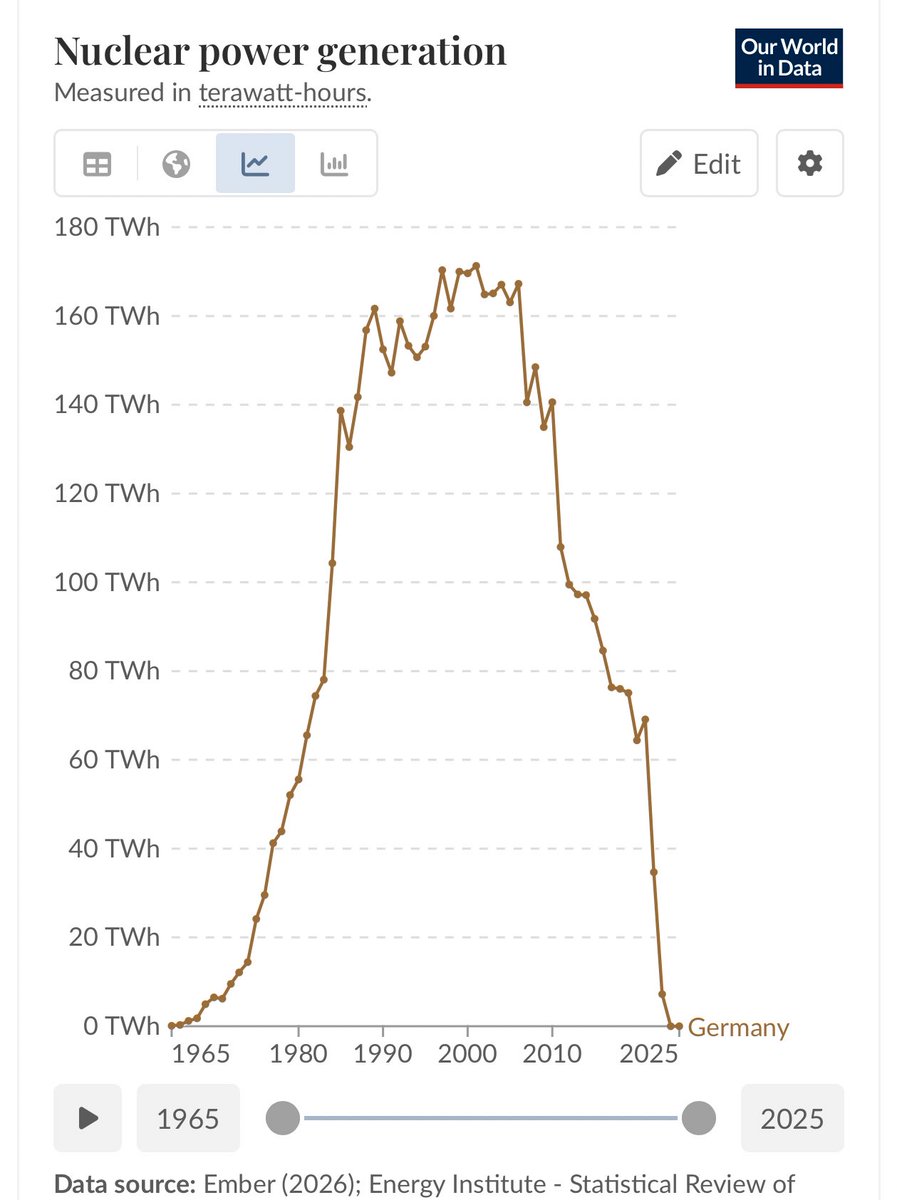
"JPMorgan estimates that, had Germany not phased out nuclear power, the country would have generated 50% less electricity from fossil fuels and 84% less electricity from natural gas in 2024. Electricity prices in Germany would have been around 25% lower, and the country would have imported half as much electricity.."
CNRL President Scott Stauth told an investor call Thursday morning that it was being deferred “due to lack of finalization of government regulatory policies around carbon pricing and methane, which creates uncertainty and economic burden for our long-term growth.”
I can’t even believe this is real
Canada Minister Marc Miller is questioned about their new bill under the Liberal government led by Prime Minister Mark Carney that would EXEMPT ALL MINISTERS FROM ALL LAWS
Yes, you heard that correctly
Hidden in the omnibus budget implementation bill, section 208 or clause 12 amends the Red Tape Reduction Act to grant federal cabinet ministers broad discretionary powers
Ministers would be able to temporarily exempt any individual, company, organization, or entity from the application of almost any provision of any federal law (or regulations made under those laws) that the minister is responsible for administering or enforcing, with the sole exception of the Criminal Code
They can themselves, and deem anyone they choose exempt from ALL laws. The only exception is the criminal code
He says you can trust them because “Canadians expect us to act reasonably”
(Holy cr*p)
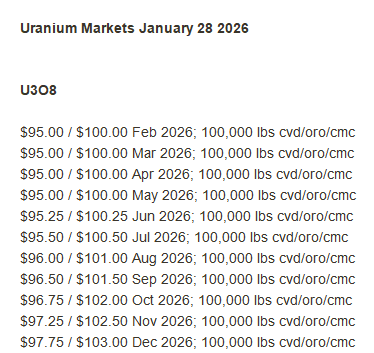
It appears that sellers are stepping back and requesting higher prices, which are now rising into triple digits as the spot price of uranium itself just spiked to over $97
Meanwhile term market negotiations are going on and the terms are moving up.
This year will be exciting
HOLY #$&@!🎇🎆🤯 #Nuclear fuel brokers @UraniumMarkets are reporting an over $6 spike in their opening Spot #Uranium price to $97.50/lb #U3O8 💲⏫⚛️⛏️🛒 with sellers now demanding $100!!🧀🐭 Buckle up, space travellers!💺🧑🚀🔥🚀🌜🪐✨🌟🤠🐂 #UraniumSqueeze 🗜️💥🌊🏄
#BREAKING: Premier @FordNation takes a stand on the federal gun grab. "I stand with hunters and legal gun owners," he said, calling out Mark Carney and the Liberals for doing nothing about violent repeat offenders with illegal guns, while wasting millions on gun confiscation. 🇨🇦
"We are going heavy into nuclear power" ~Trump
It's clear that nuclear power will be a key part of US energy policy going forward and a major buildout program of both conventional large reactors as well as small modular reactors feels like a matter of time
California started with the Gold Rush and might end with the Golden Exit.
it has been underreported how much wealth has left CA because of the asset seizure tax being proposed.
a private poll was conducted amongst affected individuals a few days ago and 80-90% surveyed said they have already left CA in 2025 or will leave in 2026 if the ballot measure looks likely to pass.
$2-2.5T of assets gone, representing about $20B of annual revenue for the state government. and likely hundreds of thousands of jobs now at risk.
less reported is the bigger exodus underway from folks who are NOT directly affected but worry (as they should) that this law will quickly transition from billionaires to everyone else...
the initiative actually gives CA legislators the right to take anyone's post-tax assets anytime in the future based on a majority vote. this isn't about billionaires. it's a new "tax system" that simply destroys private property rights in America.
all private property is now public property.
even after paying your taxes, it's not legally your property anymore. it's the government's, you're just borrowing it.
legislators will decide what you get to keep and temporarily use each year.
countless founders, CEOs, and other business leaders are actively looking to move their companies out of state. not just tech, not just AI, not just billionaires, but the core engine of California's prosperity since 1847 is unraveling.
and here is how this initiative risks unraveling America:
- ~10 states have explicit or implicit prohibitions against an asset seizure tax...
- individuals affected in CA (and other states trying to do the same) will move to these states that endow private property rights.
- CA already has a $20-30B annual budget deficit, an unfunded ~$1T pension liability for public employees/unions, and $500B of debt outstanding. the state can not afford to borrow much more and will launch more asset seizures to meet its obligations.
- asset seizures will first transition to "millionaires" and eventually to the entire middle class as more asset seizures drive more people to leave the state.
- the deficit, debt, and job loss will spiral. the Golden Exit.
- no US state has ever declared bankruptcy. in addition to CA, dozens of other states face similar fiscal crises - legislators promised future benefits that can't be paid or theft and waste have been allowed to run rampant and unabated for years.
- struggling states will eventually request federal government assistance, as they always have in times of fiscal crisis, effectively "federalizing state debt".
- states not in crisis will declare "enough is enough", individuals in those states will refuse to pay their federal taxes (why pay for other people's mistakes?), some states may try to secede from the Union, and a constitutional and civil crisis will erupt.
this may seem far-fetched but it is the obvious domino effect of selectively deleting private property rights for some people in some states.
i am not a billionaire and this CA bill does not affect me, but i care about the country and the state of CA. i want both to thrive. it's obvious that there are people in CA in desperate need of support and assistance, and inequities may exist that need to be rectified, but eliminating private property rights is the wrong path for everyone.
a few alternatives to consider first:
1) with a $350B annual budget, CA can cut programs that result in theft and little-to-no benefit for citizens. $50B per year is likely recoverable.
2) if more taxes are needed, tax loans against unrealized capital gains (very few objections will arise), eliminate tax-free rollover of certain appreciated assets (real estate industry will fight), create a step up in basis on inheritance (some will fight but most will support). likely $10Bs of incremental revenue can be realized.
3) restructure all public retirement programs from Defined Benefit to Defined Contribution. eliminating the unfunded retirement liabilities ($1T+) will be the release valve on the future the state so desperately needs.
we must address what ails us without dividing and destroying our state, our nation, our home.
ignore the rhetoric, these are the facts.