A psychologist recently explained something interesting why 90s kids developed different thinking patterns than Gen Z, largely because of games. Back then, no autosaves, no hints, just three lives. Games like Super Mario Bros. and Prince of Persia taught: fail, restart, keep going you had to earn progress. Games like Tetris and The Legend of Zelda trained maps and patterns, building memory, navigation, and patience. Finish a level turn off the console. No infinite dopamine. Play was social: one couch, one screen, real conflict and cooperation.
Today, games like Fortnite and Roblox are endless, with autosaves and reward systems that keep you playing. They hold attention but don’t train completion the same way. The difference is simple: 90s kids built focus and tolerance for failure, while today’s players are shaped by constant stimulation. What do you think about this?
Your brain basically stopped recording your life around age 25. Everything since then is a blur for a reason.
Neuroscientists measured this so many times they named it: the reminiscence bump. Ask anyone over 60 to recall their strongest memories and almost every answer clusters between ages 15 and 25. The decade where everything was new. First job, first apartment, first real relationship. Your brain encoded each day because nothing had a template yet.
After that window closes, most people enter a repetition loop. Same commute, same office, same weekend rhythm. The brain stops recording repeated experiences as distinct events. A year with 300 novel days leaves 300 memory anchors. A year with 10 leaves 10. Both took 365 days to live. Only one of them will exist when you look back.
This is why people at 50 say "where did the time go." The time went into routine that felt like living but left almost nothing behind.
Your remaining years are fixed. How many your brain bothers to remember is entirely up to you.
The WTA grass-court season has officially arrived! Kicking off the action is the highly anticipated WTA 500 HSBC Championship.
Find out who will dominate the turf and open this stage of the tour with much-needed momentum.
Catch the WTA 500 HSBC Championship LIVE on Premier Sports 2 from June 8–14.
📱 Don't miss a beat: Download the BlastTV app to watch the matches for FREE!
#WTA500 #AlexEala
🇮🇩🇵🇭 Tsunami came to Indonesia following the earthquake in the southern Philippines
Maritime agencies instructed boat owners to save their boats
Not sure how are they going to save them, though...
Foi, até agora.. um dos melhores produtos que já usei na minha pele, ever.
Única vez que senti que precisava usar foi aos 28 anos.
Tô com 32, com cara de 25 só por causa do retinol.
Passou dos 28 anos?? Use sem dó. Vai te economizar de fazer procedimentos.
- Eu - usei da SALLVE.
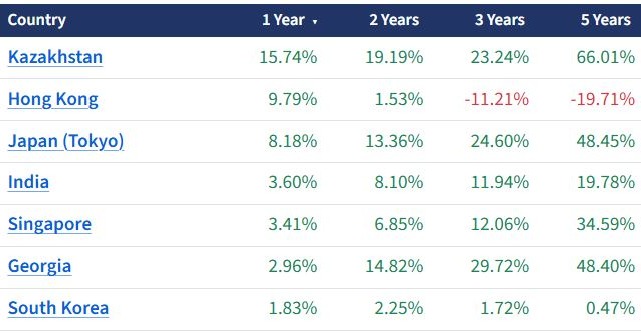
1-Year House Price Change in Asia (Nominal, Latest Data):
Vietnam: 24.3%
Hong Kong: 9.8%
Japan (Tokyo): 8.2%
India: 3.6%
Singapore: 3.4%
South Korea: 1.8%
Malaysia: 1.7%
Philippines: 1.6%
Thailand: 1.2%
Indonesia: 0.6%
Source: National statistics offices and central banks
Scientists in Denmark strapped heart monitors onto 110 people and sent them through a haunted house, the kind with a chainsaw-wielding maniac in a pig mask waiting in the dark. They were hunting for the exact line where being scared stops being fun and turns into too much.
They found it. Plot the whole group’s fear against their enjoyment and you get a clean arch: the fun rises with the fear, hits a peak, then drops the moment the fear tips past it. Too little, and the house bored people; too much, and they wanted out. The 110 guests ranged from 12 to 57, in a study published in the journal Psychological Science in 2020.
The peak is the whole trick. A University of Pennsylvania psychologist, Paul Rozin, named it in 2013: benign masochism. Big phrase, plain idea. You enjoy your body’s panic while a calm part of you stays sure you are safe. He saw it everywhere people choose a little suffering: the chili heat you love sits just below the heat that becomes pain. Same with a song that makes you cry, or a film that leaves you rattled. You want it strong, right up to the edge of what you can take.
A jump scare gets you before you can think. Your heart slams, muscles clench, adrenaline floods in, because an ancient alarm is shrieking that a predator just lunged. A half-second later, your thinking brain says the thing on screen cannot touch you. The alarm switches off, but the rush is still pouring through you, and now it reads as a thrill instead of a threat. What is left is the good chemistry: dopamine, endorphins, which are the body’s own painkillers, and oxytocin, the bonding chemical that floods a mother at birth. A clean high, and nothing laid a finger on you.
A team at the University of Pittsburgh measured what the scare leaves behind. They surveyed 262 people before and after an extreme haunted house and fitted 100 of them with brain sensors. About half came out happier, their brains calmer on stressful mental tasks. The ones who walked in tired or stressed felt the best. They compared it to a runner’s high and the stillness after meditation, in a 2019 paper in the journal Emotion.
The awful feeling earns its keep. In spring 2020, as the first lockdowns hit, researchers surveyed 310 people and found horror fans holding up better than everyone else, with less anxiety and stress. Fans of apocalypse and zombie movies felt readier for what was coming. A scary movie is a rehearsal. You practice being terrified somewhere nothing can reach you, and you walk out a little steadier for the kind of fear that can.
So the next time someone says they loved a movie for making them feel terrible, take them at their word. Their body ran the whole fear response, found nothing to hurt them, and paid out the chemicals it saves for surviving something that could.
Take an ibuprofen and your toes get just as much of it as your skull does. About 20 minutes after you swallow it, it's in every drop of blood you have, head to foot, all at once. It never homes in on the sore spot. It can't. Pain isn't a thing a pill can chase.
When you bang your knee, the bruise itself is only a small slice of the hurt. Your body rushes a chemical to the spot, and that chemical cranks your nerve endings up to full volume. Suddenly a sock, a breeze, the weight of a blanket, any of it can light those nerves up like you're being stabbed. The damage is small. The screaming is mostly chemical.
Ibuprofen jams the tiny machine in your cells that pumps that chemical out. Doctors call the machine COX and the chemical a prostaglandin, but the names barely matter. With the machine jammed, the chemical level drops, the nerves climb down off the ceiling, and the throbbing fades. The pill does this everywhere your blood goes, the sore knee and the bored elbow getting an identical dose.
That same all-over reach is why ibuprofen can wreck your stomach. The machine it jams to quiet your headache is the same machine that keeps a thin layer of slime coating your stomach wall. Jam it for the headache and you jam it for the slime too. The pill has no way to tell your aching head apart from the lining that keeps acid off your gut.
And it was never meant for headaches in the first place. A pharmacist named Stewart Adams spent about ten years at a company called Boots, starting in the 1950s, trying to build something gentler than aspirin for people wrecked by arthritis. He tried the first doses on himself. The famous one came the morning he woke up hungover before a speech, swallowed 600 milligrams, three normal tablets, and felt good enough to walk on stage. He paid the one pound fee to patent it out of his own pocket, never claimed the money back, and earned nothing from one of the most common painkillers on earth. A very particular kind of bad luck.
So picture the swordsman in that clip arriving in every part of your body at the same instant, with no enemy to find and nowhere to march. He just spends his few hours quietly turning the volume down on every nerve he drifts past, including the ones that were trying to keep your stomach in one piece.
🌍 𝗝𝘂𝗻𝗲 𝟭 𝗶𝘀 𝗜𝗻𝘁𝗲𝗿𝗻𝗮𝘁𝗶𝗼𝗻𝗮𝗹 𝗖𝗵𝗶𝗹𝗱𝗿𝗲𝗻’𝘀 𝗗𝗮𝘆 👧👦
Ngayong araw, ating ipinagdiriwang ang bawat bata, ang kanilang boses, mga pangarap, at karapatang maramdamang ligtas, nakikita, at sinusuportahan. 💛