Balancing positivity-creativity-productivity. Laureate Tagore: ‘Let your life lightly dance on the edges of time like dew on the tip of a leaf'. Only PV’s POV.
@chamath Am teaching s course at CBS in summer on exactly this topic for my MBA masters class…it’s the exact same thesis. Thx for articulating it really well. Market rewards capital allocators who underwrite risk differently in an era where capital used to buy labor, now it buys t/gpu
Glad to share that I’ll be speaking at the Operating Partners Forum Napa. Looking forward to connecting with other operating partners to compare what’s working across PE value creation.
If you’re attending, let’s connect. https://t.co/cy8eNVIuOs
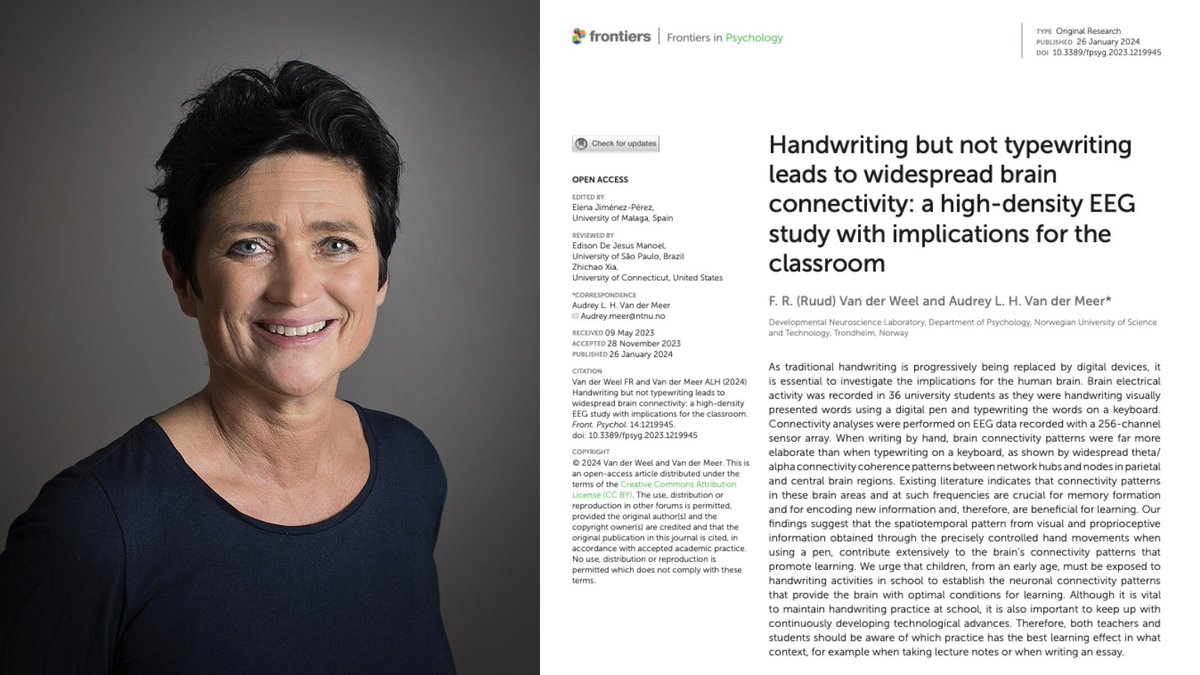
A Norwegian neuroscientist spent 20 years proving that the act of writing by hand changes the human brain in ways typing physically cannot, and almost nobody outside her field has read the paper.
Her name is Audrey van der Meer.
She runs a brain research lab in Trondheim, and the paper that closed the argument was published in 2024 in a journal called Frontiers in Psychology. The finding is brutal enough that it should have changed every classroom on Earth.
The experiment was simple. She recruited 36 university students and put each one in a cap with 256 sensors pressed against their scalp to record brain activity. Words flashed on a screen one at a time.
Sometimes the students wrote the word by hand on a touchscreen using a digital pen, and sometimes they typed the same word on a keyboard. Every neural response was recorded for the full five seconds the word stayed on screen.
Then her team looked at the part of the data most researchers had ignored for years, which is how different parts of the brain were communicating with each other during the task.
When the students wrote by hand, the brain lit up everywhere at once.
The regions responsible for memory, sensory integration, and the encoding of new information were all firing together in a coordinated pattern that spread across the entire cortex. The whole network was awake and connected.
When the same students typed the same word, that pattern collapsed almost completely.
Most of the brain went quiet, and the connections between regions that had been alive seconds earlier were nowhere to be found on the EEG.
Same word, same brain, same person, and two completely different neurological events.
The reason turned out to be something nobody had really paid attention to before her work. Writing by hand is not one motion but a sequence of thousands of tiny micro-movements coordinated with your eyes in real time, where each letter is a different shape that requires the brain to solve a slightly different spatial problem.
Your fingers, wrist, vision, and the parts of your brain that track position in space are all working together to produce one letter, then the next, then the next.
Typing throws all of that away. Every key on a keyboard requires the exact same finger motion regardless of which letter you are pressing, which means the brain has almost nothing to integrate and almost no problem to solve.
Van der Meer said it plainly in her interviews.
Pressing the same key with the same finger over and over does not stimulate the brain in any meaningful way, and she pointed out something that should scare every parent who handed their kid an iPad.
Children who learn to read and write on tablets often cannot tell letters like b and d apart, because they have never physically felt with their bodies what it takes to actually produce those letters on a page.
A decade before her, two researchers at Princeton ran the same fight using a completely different method and ended up at the same answer. Pam Mueller and Daniel Oppenheimer tested 327 students across three experiments, where half took notes on laptops with the internet disabled and half took notes by hand, before testing everyone on what they actually understood from the lectures they had watched.
The handwriting group won by a wide margin on every question that required real understanding rather than surface recall.
The reason was hiding in the transcripts of what the two groups had actually written down.
The laptop students typed almost word for word, capturing more total content but processing almost none of it as they went, while the handwriting students physically could not write fast enough to transcribe a lecture in real time, which forced them to listen carefully, decide what actually mattered, and put it in their own words on the page.
That single act of choosing what to keep was the learning itself, and the keyboard had quietly skipped the choosing and skipped the learning along with it.
Two studies. Two countries. Same answer.
Handwriting makes the brain work. Typing lets it coast.
Every note you have ever typed instead of written went into your brain through a thinner pipe. Every meeting, every book highlight, every idea you captured on your phone instead of on paper was processed at half depth.
You did not forget those things because your memory is bad. You forgot them because typing never woke the part of the brain that would have made them stick.
The fix is the thing your grandmother already knew.
Pick up a pen. Write the thing down. The slower road is the faster one.
Billionaire Michael Milken joked “if a US company replaces the US-born CEO with a CEO born in India, I buy the stock”
But he reveals he hasn’t backtested the idea.
So we did.
In the last 15yrs, that would’ve 50x’d your money: 7.5x more $$ and >2x IRR vs S&P500: 30% vs 14%!
@levie Operating systems always worked in a headless way…Windows at one point was an 16-bit App on 8-bit DOS! :)
One-agent doing many tasks or managing N-agents doing mini-tasks - both have to-exist - but 4 enterprises trying to budget for it or companies trying to price - is a TBD
Glad to share that I’ll be speaking at the Operating Partners Forum Napa. Looking forward to connecting with other operating partners to compare what’s working across PE value creation.
If you’re attending, let’s connect. https://t.co/BborGUUVjY
@veryrv75 We can start companies much more easily now. We can do it from a very low cost of living place too.
If you have talent, you can make it in India today. That was much harder in the socialist raj days.
Gary Woodland is the anti-Tiger Woods in every possible way.
Allow me to explain why.
Gary Woodland just won the Houston Open by five shots.
Two and a half years ago, doctors cut a baseball-sized hole in his skull to remove a brain lesion.
He spent two nights in the ICU.
There was a real chance he would wake up paralyzed.
This is the best comeback story in golf right now and it's not even close.
The full story behind today is insane.
In 2019, Gary Woodland won the U.S. Open at Pebble Beach.
He finished 13-under and beat Brooks Koepka by three strokes.
At that point, Woodland had four PGA Tour wins including a major, and was ranked 12th in the world.
Then everything slowly fell apart.
After the 2023 Masters, Woodland became consumed by fear.
Not regular nerves.
Actual, debilitating terror.
He was afraid he was going to die.
Afraid something was going to happen to his kids.
Afraid of falling to his death in his sleep.
At the Memorial Tournament in June 2023, he woke up in his hotel room and clung to the mattress for an hour.
He was convinced that if he let go, he would fall.
His hands were trembling.
He had no appetite.
Spasms would jolt him awake at night.
He was losing focus over putts.
Forgetting what club he was holding mid-swing.
An MRI finally revealed the cause.
A lesion was growing on his brain.
It was pressing directly on the part of his brain that controls fear and anxiety.
Think about that.
The thing responsible for every irrational terror he was experiencing had a physical, medical explanation.
His brain was literally being pressed into a constant state of fear.
In September 2023, Woodland had a craniotomy.
Surgeons removed as much of the lesion as they could, roughly half, because it was pressed against the optic tract of his left eye.
They cut off blood supply to the rest to try to stop it from growing.
He walked out of the hospital two days later.
Started putting again two days after that.
He came back to the PGA Tour in January 2024 at the Sony Open.
But he was nowhere near the same player.
In 26 starts during 2024, he had three top-25 finishes.
His best was a tie for ninth at the Shriners Children's Open.
For a former U.S. Open champion, those are survival numbers.
And nobody knew the full extent of what he was dealing with.
Because on top of the brain surgery and the recovery, Woodland had been diagnosed with PTSD.
He kept it hidden for over a year.
He described being hypervigilant on the course.
A walking scorer once got too close from behind and startled him so badly that his vision went blurry and he forgot where he was.
He would go into bathrooms between holes and cry.
He would break down in the scoring trailer after rounds.
He would sprint to his car in the parking lot just to hide it from everyone.
He said he felt like he was living a lie.
Spending so much energy pretending to be okay that he had nothing left for the actual golf.
On March 9, three weeks before this Houston Open, Woodland finally told the truth publicly.
He sat down with Golf Channel's Rex Hoggard and revealed everything.
The PTSD.
The crying.
The fear.
All of it.
He said after that interview it felt like a thousand pounds had been lifted off his back.
Then he showed up at Memorial Park.
He opened with a 64.
Then a 63.
Then a 65.
Then a 67 on Sunday to close it out.
259 total.
A tournament record.
21-under par.
Five strokes clear of Nicolai Højgaard.
Wire to wire.
Led every single round.
His first win since the 2019 U.S. Open.
Nearly seven years between victories.
Brain surgery, PTSD, two years of hiding in bathrooms between holes, and a thousand pounds of weight he was carrying that nobody could see.
This is a guy who was a basketball player first.
He grew up in Topeka, Kansas, won state basketball titles at Shawnee Heights High School, and played a year of college basketball at Washburn before he realized golf was his future.
He won the Courage Award from the PGA Tour in 2025.
The seventh player to ever receive it.
And now, at 41 years old, with titanium plates holding his skull together, he walked into Memorial Park three weeks after telling the world the truth about what he had been going through and played the best golf of the entire field for four straight days.
The full breakdown of Woodland's career, the surgery, the PTSD, and how he got to this point is here:
https://t.co/5ngVyMCs78
There is a reason this one hits different.
Comeback stories in sports usually involve torn ACLs or shoulder surgeries.
Things you can see.
Things that heal on a timeline.
Woodland's comeback was from something that rewired his brain.
Something that turned his own mind against him.
And the hardest part of his recovery wasn't physical.
It was admitting to the people around him that he wasn't okay.
Three weeks ago he said the words out loud.
Today he won a golf tournament by five shots.