Any US state that wants to license its own stablecoin issuers now has to prove one thing: its rules are "substantially similar" to Washington's.
Treasury set out how on Sept 30, in an interim final rule (RIN 1505-AC97) for the Stablecoin Certification Review Committee: the Treasury Secretary plus the Fed and FDIC chairs.
What a state regulator must send:
→ a signed attestation
→ a detailed narrative, criterion by criterion
→ citations to its statutes, rules and binding guidance
→ the same again every year, or approval is suspended
The prize: a state path for issuers with up to $10B in coins outstanding.
The hard part is not the signature. It is the comparison. Many state rulebooks, one federal benchmark, re-checked every year.
That is a data problem. @Auditchain has spent 2026 mapping one disclosure taxonomy the FDIC, OCC and NCUA could share, the kind of common map that lets a state-licensed issuer and a bank-owned one report the same facts the same way.
@Pacioli_ai then checks those facts against the rules before they are filed, whoever issued the license.
Comments: Oct 30 on the forms, Nov 30 on the rule.
#GENIUS
$AUDT
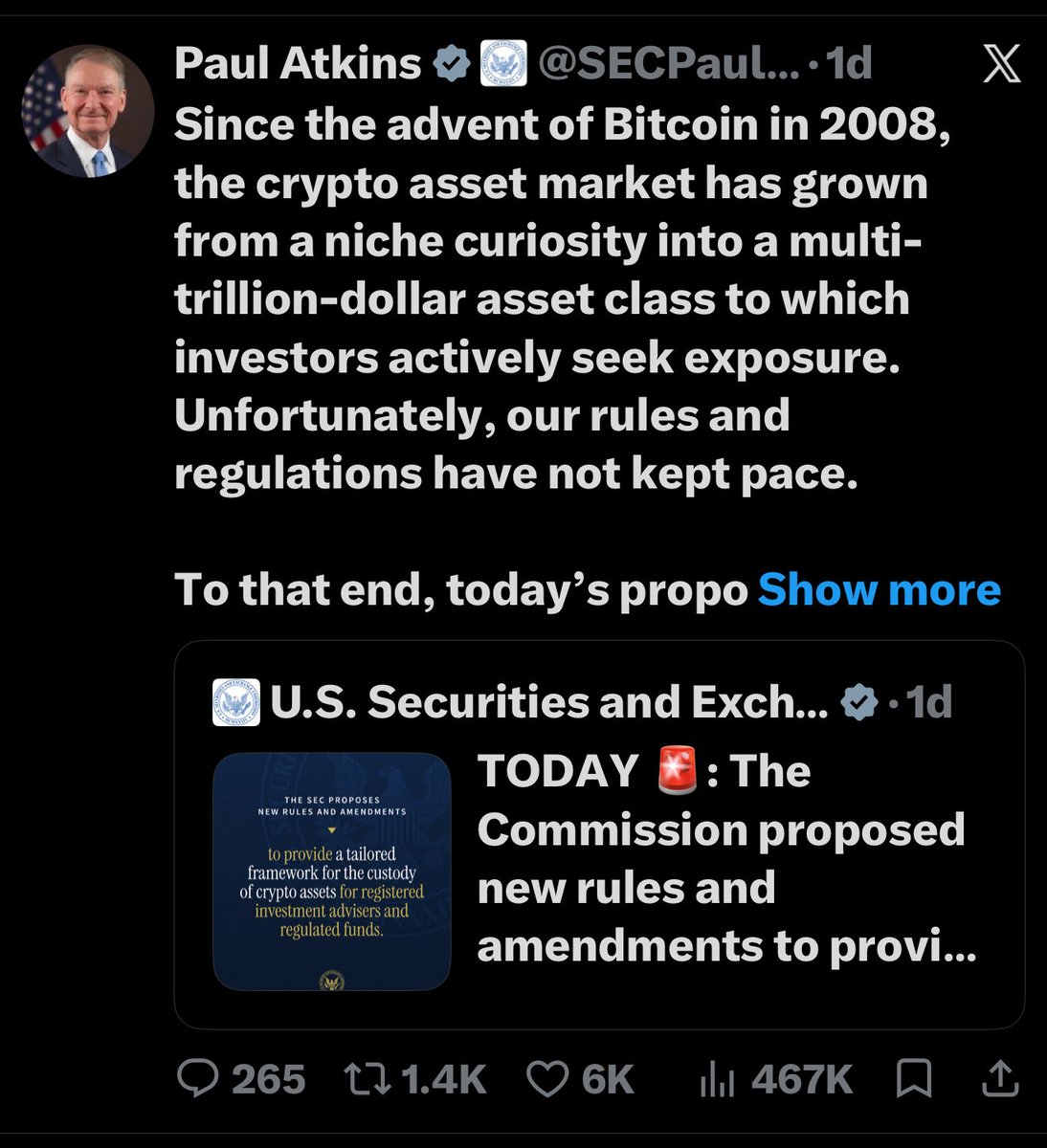
Risk factors are the part of a company report almost nobody can compare.
Today, Item 105 (Risk Factors) and Item 106 (Cybersecurity) under SEC Regulation S-K are prose. Ten companies can name the same blockchain network risk in ten different ways, and an investor has to read every page to notice.
@Auditchain's letter to SEC Chairman Atkins asks for a fix: extend Inline XBRL from the financial statements to key S-K items, and add disclosures for companies materially dependent on public blockchain networks, using the same categories the FDIC and OCC frameworks already use.
That turns "we may be exposed to network outages" into a fact that can be searched, compared and checked.
This is the work @Pacioli_ai is built for: tag the disclosure, validate it, and make it readable by people and machines alike.
#SEC
$AUDT
Sources:
1. How Pacioli Works, Step 02: Author in LucaSuite™, plus AUDT settlement and staking (Pacioli): https://t.co/a885aSYEhE
2. Overview of Luca Suite, "the basis for, and is the first implementation of" SBRM (Pacioli): https://t.co/IgQN9YixkE
3. Luca Suite, Getting Started guide and workflow (Auditchain documentation): https://t.co/1ffsvxyc19
4. Luca Suite, Collaboration, multi-contributor teams (Auditchain documentation): https://t.co/RNqGWo1kbl
5. SBRM specification catalog, Version 1.0 beta (Object Management Group): https://t.co/iQYd4G1jFD
6. OMG Insights, "How SBRM Enables Digital Asset White Paper Compliance Under the EU's MiCA Regulations", by Jason Meyers of Auditchain Labs AG: https://t.co/ZsYZth9iR4
7. Series hub, How Pacioli Works (part 1): https://t.co/SKiivf3f5Z
A regulatory disclosure is not free-written in LucaSuite™. It is assembled, element by element, inside rules the model sets first.
Pacioli (@pacioli_ai) series, part 2: the authoring layer. This is Step 02, where disclosures get created.
1. The Model Loads First
There is no blank page. You load a taxonomy model from the scheme library first, setting structure, elements, and validation rules up front. The model constrains the disclosure: structured entry governed by taxonomy logic, not freeform authoring.
2. Compose, Element by Element
Then you build piece by piece. The walkthrough loads the MiCA (Markets in Crypto-Assets) prototype and picks Annex I elements for a utility token. Fill each in and save as you go: legal, accounting, engineering and ESG (environmental, social and governance) teams can work the same disclosure at once, every element tagged, typed, and structured.
3. Validate Before It Ever Leaves
The draft is validated locally first, an internal check for internal audit functions. Then you generate the output: iXBRL (Inline eXtensible Business Reporting Language), one file human-readable and machine-readable at once. That file goes to the validation network. The hub maps the rest: https://t.co/SKiivf3f5Z
4. The Spec Underneath
LucaSuite™ is where the SBRM (Standard Business Report Model) becomes software. SBRM is a specification from Object Management Group® (@ObjectMgmtGroup), or OMG, for representing business and regulatory reporting; it sits at 1.0 beta, and Pacioli describes LucaSuite™ as "the basis for, and is the first implementation of" it.
5. The Front Door of the AUDT Economy
Creating a disclosure is a paid step. AUDT is the base settlement currency, other payment methods pay standard rates, and staking AUDT cuts creation and validation costs.
The Fine Print
• "First implementation" is Pacioli's own description, repeated in an OMG Insights piece by Jason Meyers (@JasonMeyersNYC) of Auditchain (@Auditchain): not a separate OMG standards vote declaring exclusivity.
In Plain English
• In LucaSuite™ you build a disclosure from a rulebook template, not a blank document: pick the elements, fill them in, check them, hand off to the network.
• What comes out is iXBRL: readable by a person and by a machine.
Why This Is Bullish
• Disclosure prep becomes guided software: the model sets the rules up front, and every element comes out tagged, typed, and structured.
• Every disclosure built here is work for the validation network, and AUDT stakers pay less to create it.
My Take:
A standard without software is a PDF nobody files. Software without a standard is another proprietary form. Pacioli bets on both: SBRM 1.0 beta as the model, LucaSuite™ as the software, then a network that checks what comes out.
If software constrained a filing from the first element, would you trust the filer more, or ask who wrote the rules?
$AUDT
You Ask, I Research. Questions welcome.
Follow @BullsCryptolife for free sourced crypto breakdowns.
Sources in the first comment ↓
Pacioli (@pacioli_ai) lists 4 live rulebooks for its taxonomy models — MiCAR as regulation, and IFRS, US GAAP and EFRAG/ESRS each backed by a published machine-readable taxonomy.
Scheme coverage, widened: step 1 of Thursday's series map, the rulebooks themselves — and who writes each one.
1. What "coverage" means here
A taxonomy model is the rulebook a disclosure is built against: it defines structure, elements, and validation rules before anyone writes a number. Pick the model first, and the step 4 checks (structural completeness, data types, calculation consistency, regulatory compliance) run against that model's rules, not a generic checklist.
2. The 4 live schemes, and who stands behind each
• MiCAR (Markets in Crypto-Assets Regulation) — the EU crypto-asset rulebook (Regulation 2023/1114). ESMA (@ESMAComms) lists it as applying from 30 December 2024.
• IFRS (International Financial Reporting Standards) — the IFRS Foundation (@IFRSFoundation) publishes the IFRS Accounting Taxonomy — tagging that makes statements "computer-readable."
• US GAAP (Generally Accepted Accounting Principles) — FASB maintains the GAAP Financial Reporting Taxonomy; the SEC (@SECGov) accepted the 2026 version on March 17, 2026.
• EFRAG (European Financial Reporting Advisory Group) / ESRS (European Sustainability Reporting Standards) — EFRAG builds the ESRS XBRL taxonomy; its page says digital tagging "will not be mandatory" until the European Commission (@EU_Commission) adopts it.
3. The 2 marked "coming soon"
The page also marks the GENIUS Act and SEC Regulation Crypto Assets (Reg-CA) as "coming soon." That is the project's own roadmap marking, from a single source — not a launch date or anyone else's commitment.
Monday and Tuesday covered taxonomy models and SBRM. Friday covered LucaSuite™.
The Fine Print
• The scheme list is Pacioli's (@pacioli_ai) own. Regulators and standard-setters here are cited for their rulebooks, not for Pacioli or Auditchain (@Auditchain).
• Coverage means a taxonomy model is listed for the scheme, as Pacioli describes its design; whether filings are validated under each scheme today is a separate question.
In Plain English
• Four rulebooks are on the shelf today: MiCAR, IFRS, US GAAP, and EFRAG/ESRS.
• Two more are labelled "coming soon" by the project itself: the GENIUS Act and Reg-CA.
Why This Is Bullish
• Pacioli is not inventing the rules: it builds on taxonomies the IFRS Foundation, FASB and EFRAG publish. Four live schemes span crypto, global accounting, US accounting, and EU sustainability — where regulated reporting actually happens.
My Take:
Most "compliance" crypto projects name one regulation and stop. A shelf of four rulebooks, each tied to who writes the rules, with the next two labelled "coming soon" instead of live, is a claim anyone can check. The shelf is the product surface; the race to validate against it is Monday's post.
Which rulebook would you want checked first if your own disclosure had to pass: the crypto one, or the accounting one your auditor already lives by?
$AUDT
You Ask, I Research. Questions welcome.
Follow @BullsCryptolife for free sourced crypto breakdowns.
Sources in the first comment ↓
Pacioli (@pacioli_ai) maps its compliance pipeline in 6 steps. This is the hub for our 7-part "How It Works" series. Bookmark it.
The 6-step map, from Pacioli's own "How it works" page:
1. Select a taxonomy model
The model defines the structure, elements and validation rules for the disclosure. (Taxonomy was Monday's post.)
2. Author in LucaSuite™
Guided authoring that outputs iXBRL (inline eXtensible Business Reporting Language), human-readable and machine-readable simultaneously. Pacioli calls it the "first implementation of the SBRM specification by Object Management Group®" (@ObjectMgmtGroup). OMG lists SBRM (Standard Business Report Model) as 1.0 beta.
3. Submit for validation
Two paths: Open Protocol, where any qualified licensee can operate a PVN (Pacioli Validating Node) and compete, or Cohort ("private professional group"). The validation request is recorded on-chain from the moment of submission.
4. Nodes validate
PVNs run taxonomy-based checks, checking structural completeness, data type conformance, calculation consistency, and regulatory compliance. PVN operators stake AUDT, with staking amounts subject to community governance.
5. Consensus reached
The consensus algorithm determines the winning validator and identifies corroborating PVNs that independently reached the same result.
6. Published to Explorer
The journey ends at the Pacioli Explorer, which the page describes as a public destination for viewing, analyzing, and comparing compliant projects.
Schemes the project lists: MiCAR (Markets in Crypto-Assets Regulation), IFRS (International Financial Reporting Standards), US GAAP (Generally Accepted Accounting Principles), EFRAG (European Financial Reporting Advisory Group) and ESRS (European Sustainability Reporting Standards). GENIUS Act and SEC Regulation Crypto Assets (Reg-CA) are marked "coming soon."
Next up: one deep dive every morning, 6:45 AM PT, through Oct 21.
The Fine Print
• This map is Pacioli's own description of the design. It's not a third-party audit, and it doesn't confirm every step is running today.
• The scheme list is project-listed, not a regulator endorsement.
• SBRM is still 1.0 beta at OMG, not a final standard.
In Plain English
Pick a rulebook, write the report to it, submit it, let independent nodes race to check it, and the result lands in the Pacioli Explorer for viewing, analyzing, and comparing.
Why This Is Bullish
Steps 3 to 5 run through the node network, and PVN operators stake AUDT to take part. The token sits inside the workflow, not beside it.
My Take:
Six steps is a lot of paperwork. That's the point. Compliance is boring until it's machine-checkable. If the map holds up step by step, this is infrastructure, not a vibe.
If a disclosure had to earn trust step by step, which step would you audit first: who sets the rules, who runs the race, or the record it leaves behind?
$AUDT
You Ask, I Research. Questions welcome.
Follow @BullsCryptolife for free sourced crypto breakdowns.
Sources in the first comment ↓
Ive been building in the space for 13 years. This is all still very surreal. Feels like a fuzzy somewhat bad dream that most of us actually wished for. Can anyone else relate? Miss you @HesterPeirce
Dear @HesterPeirce I am writing this from the other side of October 2, from someone who spent 10 years building into the void not knowing that the kind of market you insisted was possible, would ever become a reality.
You were an army of one. You wrote the dissents the rest of us quoted when the Commission preferred enforcement to a rule.
You served us with a token safe harbor in GitHub - when the Commission served us subpoenas on stage at conferences. https://t.co/tKMsOGvg6Y
Your Safe Harbor and life's work, now #RegCA transformed tokens from thorns into roses. This bouquet is from me to you.
You said, plainly and repeatedly, that using enforcement actions to tell people what the law is in an emerging industry is neither efficient nor fair. That sentence aged better than the complaints it answered.
You preferred cooperation and clarity over enforcement.
In the home stretch of your reign, you inspired and reinvigorated millions as you toured America.
Regulation by ambiguity punishes those of us fighting a revolutionary war, and leaves the public with confusion instead of standards.
You argued that case when it was lonely. The Commission’s own colleagues have now said what the record already showed: long before regulatory clarity was a priority, there was you.
You counseled faith, patience and clarity, not FUD. You fed us ice cream. You were our Martha Washington.
Your resignation letter named the task correctly -- "Maximizing people’s freedom to choose what is best for themselves and their families, inside sensible parameters designed to give them confidence to transact, is delicate and vital work".
That is not a slogan. That is the standard against which this chapter of US and global regulation will be judged.
The Crypto Task Force carried your name on it for a reason. The course the Commission is on now bears the mark of arguments you made when you were alone.
You called your service the honor of your professional lifetime. Personally, the honor was all mine.
We don't get a commissioner who will fight with us in public and in writing and then stay long enough to turn seemingly certain defeat into victory. You did both.
The nickname our industry gave you was affectionate and accurate. Behind every Commission of men, there is a great woman.
Because of you, the world's children will know what dissent costs, what the rule of law means, why a regulator’s first duty is not to punish, but to explore, and to collaborate.
America is better because of you.
Those of us who remain in your absence will deeply miss your beacon of light during the darkest hours at 100 F Street.
We will forever be your Seventh Son of a Seventh Son. 🤘 ♥️
🌹🌹
🌹 🌹 🌹
🌹🌹
🌹
@0xAndrewKeller What does "good" mean? Just a story thats likely to be manipulated? Or a project that solves a real problem whose token price rises based on real utility and demand, NOT ephemeral pump marketing. $AUDT Asking for the world.
https://t.co/OjISQv8mMP
The reporting-entities page names two outside standards. It does not say either one was written by the company.
Auditchain Labs AG's page says ISAE 3402 is set by the IAASB. It says the standard covers controls that affect financial reporting at a service organization.
The same page says the Committee of European Auditing Oversight Bodies, the CEAOB, adopted guidance in November 2021 on the auditor's involvement with financial statements in the European Single Electronic Format. It says that guidance requires auditors in the 27 member states of the European Union to include the machine-readable financial-statement instance, in the ESEF format, within the scope of the audit engagement.
https://t.co/deKw3bpPSf
https://t.co/p62PbrppDQ
@Auditchain@pacioli_ai
$AUDT
A stablecoin report should do math, not make claims.
The FDIC's proposed GENIUS Act forms (PS-01, PS-01a, PS-02) set hard numbers: reserves must match tokens one-to-one, and concentration has a 40% limit. Some issuers may also qualify for a lighter short form.
Today, "we meet the limit" is something a firm writes down and a supervisor checks later by hand.
@Auditchain's 79-page comment (Sept 16) flips that: file in XBRL, the format the FDIC has run for Call Reports since 2005, and publish the form's own checks as machine-executable rules. Then the one-to-one test and the 40% cap run the moment the report lands, and short-form eligibility is computed, not asserted.
That is exactly the work @Pacioli_ai is built for: running those rules before a filing ships, so a broken number gets caught by the issuer, not discovered by the examiner.
#GENIUS
$AUDT
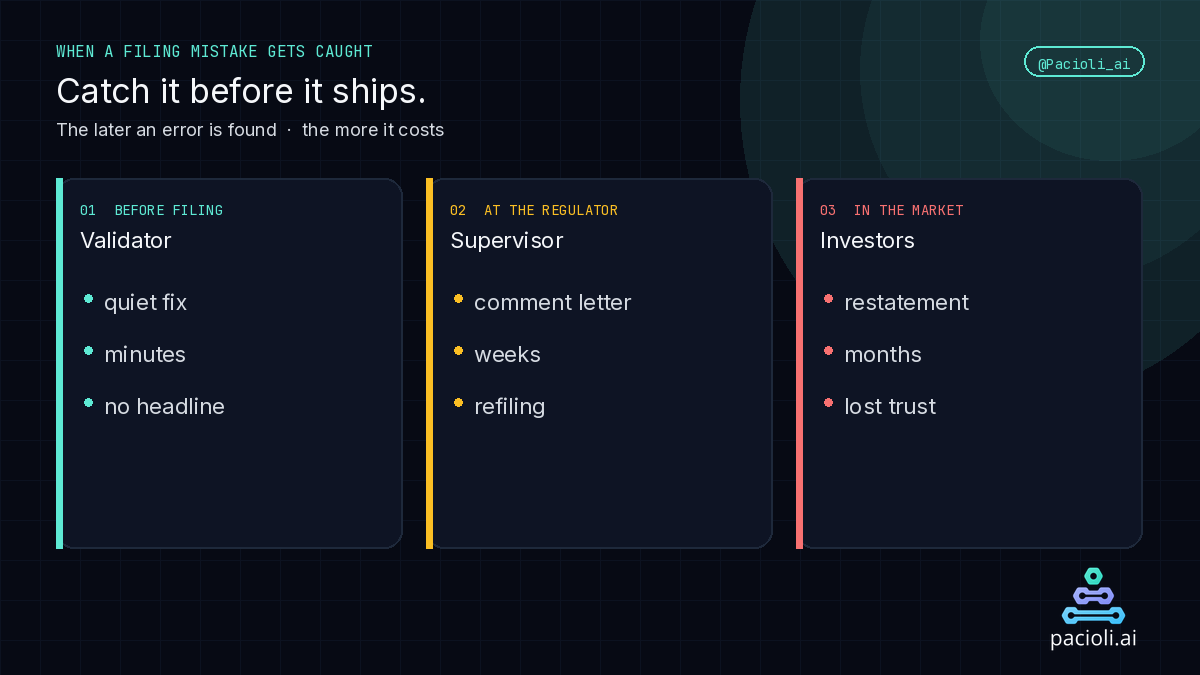
A filing mistake costs almost nothing if you catch it before you file, and a lot once investors find it.
@Pacioli_ai's Validating Node checks a disclosure before it ships, and @Auditchain's taxonomies give it the rules to check against.
#RegTech
$AUDT
Credit unions are about to get a stablecoin door.
The NCUA's GENIUS Act proposal (RIN 3133-AF69) sets how a federally insured credit union can invest in, and license, a subsidiary that issues payment stablecoins.
One detail most people miss: unlike the FDIC, OCC and Fed, the NCUA does not run XBRL reporting today. This rule is its first real chance to start machine-readable instead of bolting it on later.
@Auditchain filed on exactly that: disclose the subsidiary's blockchain network participation in the application, file it as structured data in step with the banking agencies, and recognise licenses across agencies so credit unions are not stuck at the back of the line.
That is the gap @Pacioli_ai is built for: structured, validated disclosure a small institution can produce without a data team.
#GENIUS #NCUA
$AUDT
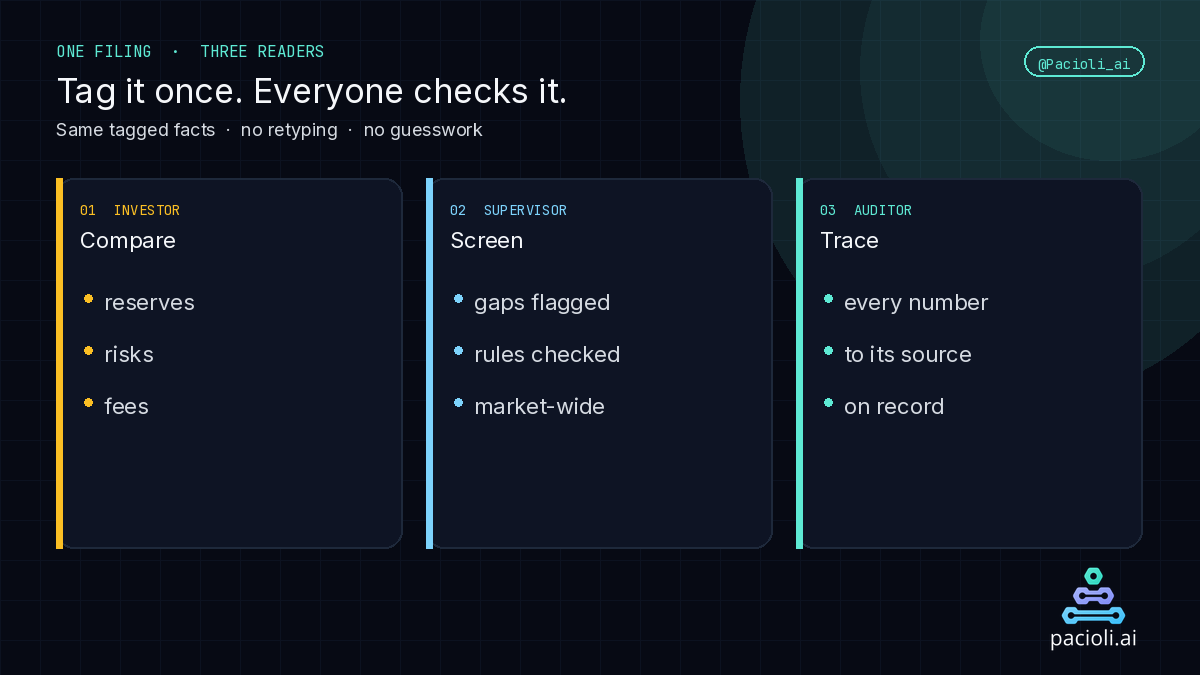
One filing. Three readers.
An investor compares it. A supervisor screens it. An auditor traces it.
When the facts are tagged once by @Auditchain taxonomies and checked by @Pacioli_ai before filing, all three read the same numbers — no retyping, no guesswork.
#RegTech
$AUDT
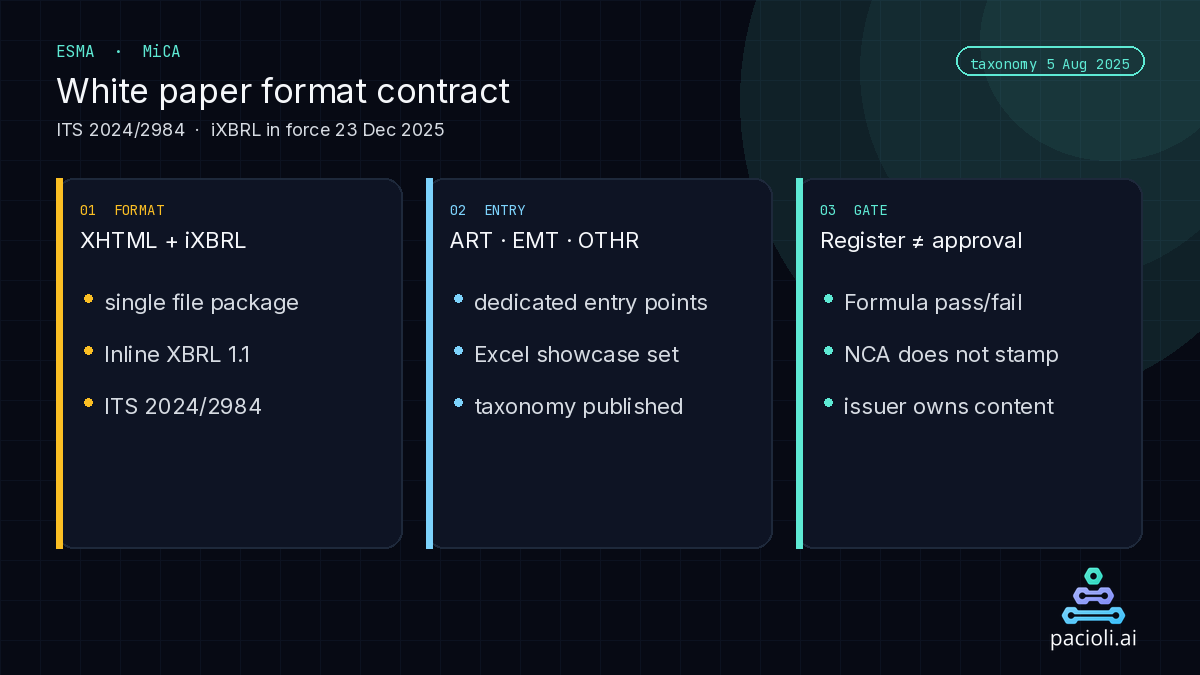
Getting a MiCAR white paper accepted is a three-step job, not a one-step upload.
Step 1: create it. The white paper is the document a crypto issuer must publish in the EU, and it now has to carry machine-readable tags, not just words.
Step 2: validate it. Before anyone files, every tagged fact gets checked against the rules, so mistakes are caught by software instead of by a regulator months later.
Step 3: make it findable. Once filed, investors should be able to look it up and compare it with others.
@Pacioli_ai covers all three in one path: draft in iXBRL, check on the Pacioli AI Validating Node, then list on Pacioli Explorer. Built in Switzerland with @Auditchain, whose taxonomies define what each tag means.
#MiCAR
$AUDT
The 18 May 2026 note is a comment to the PCAOB. It is not a new auditing standard.
The page says Auditchain Labs AG commented on PCAOB Release No. 2026-001, the Board's priorities for 2026 through 2030. Three asks are written there. Amend AS 4101 so an auditor's responsibility for an Inline XBRL filing covers the machine-readable layer, in line with the European guidance the page names. Update the standards for a trail from the internal control to the public disclosure. And prepare for the reserve examinations the page says the GENIUS Act already gives to PCAOB-registered firms, including on-chain attestations.
The page points that work at Pacioli. A letter to the Board is not an adopted standard.
https://t.co/Xxdz7bTeyo
https://t.co/jIMBjstTSh
@Auditchain@pacioli_ai
$AUDT
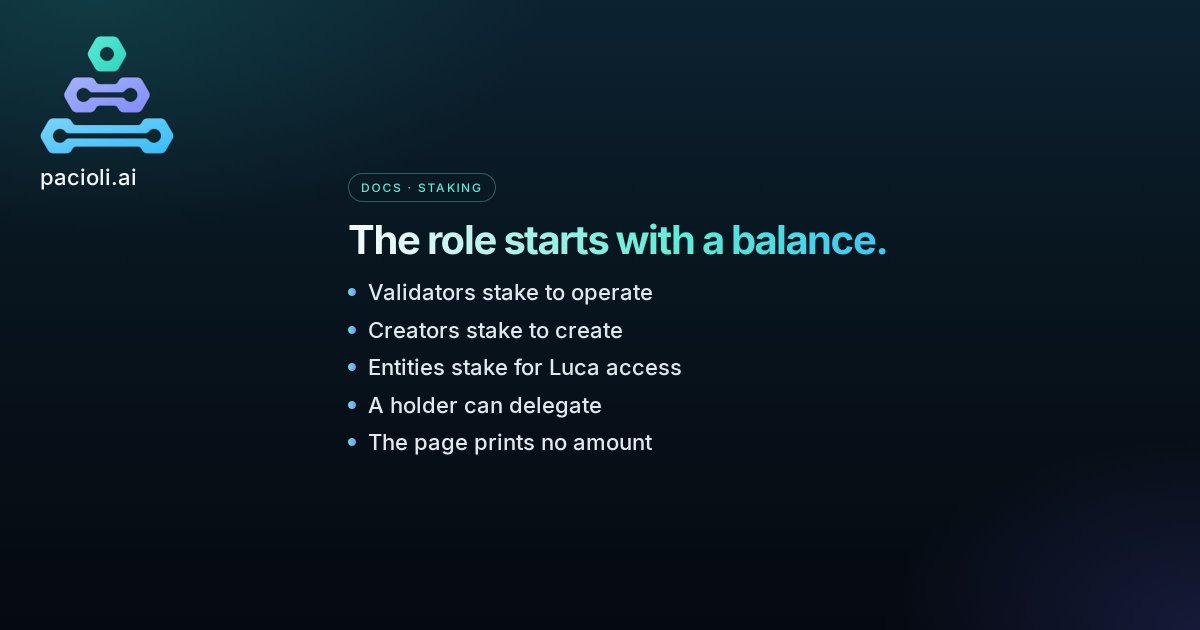
Three roles on the staking page start with a balance of AUDT.
The page says a validator stakes in order to operate, a creator of process controls stakes in order to create, and a reporting entity stakes for access to the Luca Suite. A holder who is not running the work can delegate that balance.
The page also describes being paid when controls are used. That is a reward sentence. It is not repeated here. This note stays on the requirement. The page says the balance comes first, and it does not print the amount.
https://t.co/MRSqm8qTtz
https://t.co/p62PbrppDQ
@Auditchain@pacioli_ai
$AUDT