https://t.co/8etWSJq3J4
If I had to link to a “one-stop-shop” of information — with study abstracts and links — this’d be it.
Very handy resource-rundown for those who have tried hard to ignore and forget the emergence of a new, major wrinkle in our reality in 2020. 🦠
“COVID-19 and Immune Dysregulation, a Summary and Resource”
Sure, some women are stronger than some men. But if you compare the same age groups, the median male outdoes 98% of females in long jump, 98% in height, 99.5% in chest press, 99.6% in aerobic fitness, and 99.9% in grip and medicine ball throw.
“When I talk to people who work for Anthropic after they’ve had a couple drinks, the conversation often turns to overthrowing the US government and taking over the world.”—@tegmark
His is one of the deities of the Effective Altruist cult Anthropic so loves.
Now the IPO gets them rich—MASKS OFF.
I think I've missed a really important piece of context in this story because I have no idea why the reaction to Huang's reinstatement seems to be aligning to a left-vs-right position
Epstein-Barr virus infects 90% of the world's population, so what accounts for the very small fraction of individuals who develop multiple sclerosis? A new experimental model study pointing to immune system genetic susceptibility @PNASNews
https://t.co/Ga9hRdKLQz
This guy does a perfect impression of Gen Z! 😂😂😂 I seriously can’t stop laughing! It reminds me so much of the experience I had with a customer service rep at AT&T last week 🤣
—> Michael Pavano TT
> Anthropic model proves Reimann hypothesis. Anthropic stock down 10%
> Google releases new cheap model beloved by everyone. Google stock down 5%
lol
A Brown University psychiatrist says anxiety can become a HABIT.
The disturbing part?
The very things you believe are PROTECTING you may actually be IMPRISONING you.
6 ways you TRAP yourself in anxiety: ▼▼▼
Two pieces of good news this week.
1 — The G3 air quality monitor can be pre-ordered.
It's in transit to our global warehouse right now, about 10 days out, and presale is open in the store today. Presale orders ship first the moment stock lands.
It measures four things:
• PM1.0 / PM2.5 / PM10 — particulates at all three sizes • VOC — total volatile organic compounds
• HCHO — formaldehyde
• CO₂ — carbon dioxide
Four readings, four independent sensors. Each channel has its own dedicated sensor. And every sensor is a proven part from an established manufacturer, mature technology with a long field record.
2 — Black Friday is live.
8% off the whole store, G3 presale included. 👇
https://t.co/XqdzEk2AZV
https://t.co/XqdzEk2AZV
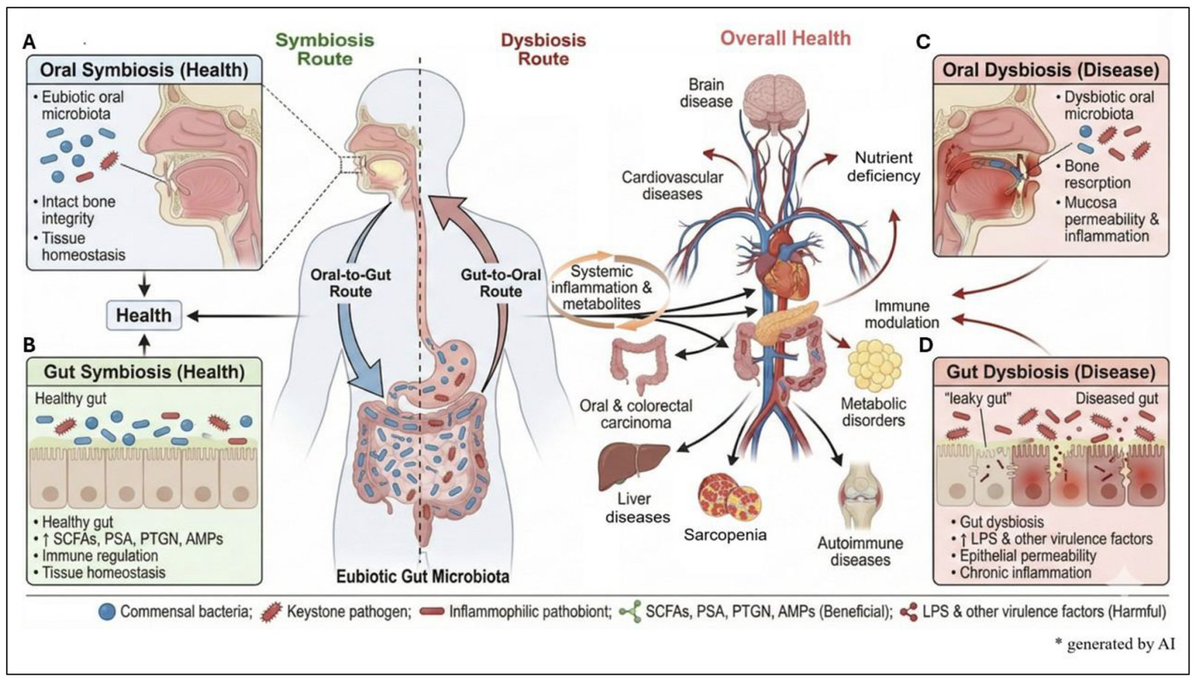
Cavities and poor dental health - a sign your gut is begging for help.
➥ Bad breath
➥ Coated tongue
➥ Gingivitis
➥ Tooth decay
These are all conditions that can result from gut dysbiosis and impaired motility,
directly leading to imbalances in oral bacteria + inflammation.
I've seen this with tons of people, improving gut health will do more for dental health than avoiding sugar, coffee or any toothpaste.
If you presented this graph to me in 2023 as one of several options for how the future would unfold, I feel pretty confident that I would've said it failed to account for how defenders would respond and get sped up by AI, despite my having relatively short timelines to AGI.
Quote of the day from @Invivyd: “COVID is an enormous problem *TODAY*. Too many people seem unwilling to face these facts, and sometimes at Invivyd, we suspect that is because there’s been no particularly attractive way to further lower the burden of disease. VYD2311 may be able to change all of that.”
🎯
The lived-experience for this one is overwhelming. Criminal to pretend otherwise and move to drugs. We need intermittent intensity and then recovery to tamp down any baseline of neuroticism, no matter the person.
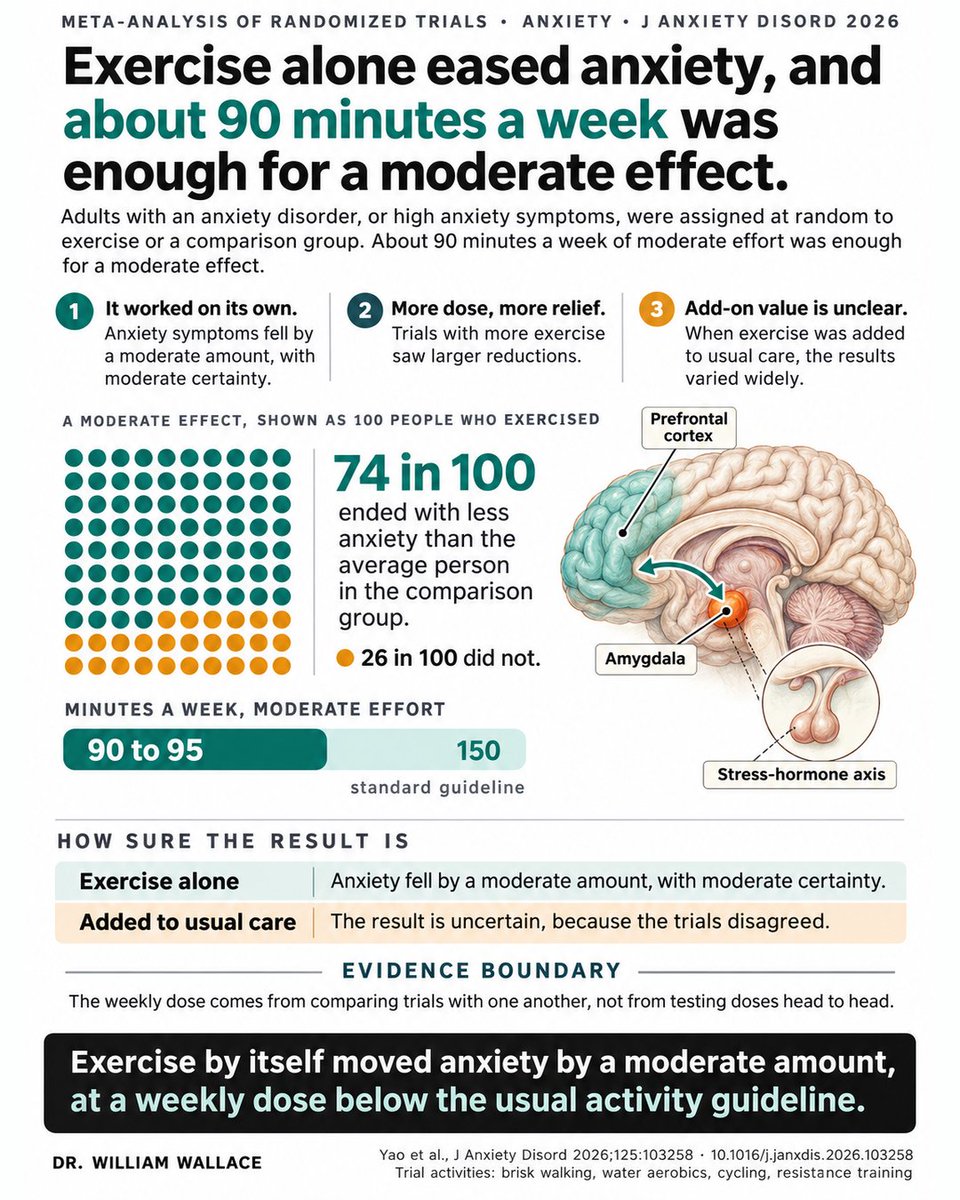
Exercise alone eased anxiety, and about 90 minutes a week was enough for a moderate effect.
A new review pooled randomized trials in adults with an anxiety disorder or high anxiety symptoms. Exercise on its own lowered anxiety by a moderate amount, with moderate certainty. In practical terms, 74 in 100 people who exercised ended up less anxious than the average person in the comparison group. About 90 to 95 minutes a week of moderate effort, such as brisk walking, water aerobics, cycling, or resistance training, was enough for that effect, which is below the usual 150-minute weekly activity guideline, and trials that prescribed more exercise saw larger reductions.
This fits a broader body of evidence. In a Swedish trial of 286 primary care patients with anxiety, 12 weeks of group cardio and strength training three times a week gave about 3.6 times the odds of a meaningful improvement at lower intensity, and nearly 5 times the odds at higher intensity, compared with patients given standard advice on physical activity. Exercise may also help prevent anxiety. Across 13 studies that followed 75,831 people over time, the most active had 26% lower odds of developing anxiety than the least active.
One likely reason is that exercise brings on sensations many anxious people dread, such as a racing heart. In a trial of 60 adults who were highly fearful of those sensations, two weeks of exercise eased that fear far more than waiting did, and that change helped explain the improvement in anxious mood.
When exercise was added on top of usual care, the results varied widely and the extra benefit is uncertain. The weekly dose comes from comparing trials with one another, not from testing doses head to head, and the prevention studies relied on self-reported activity. Even so, about 30 minutes of brisk walking, cycling, or strength work three times a week is a realistic, well-supported way to take some of the edge off anxiety.
References
1. Yao Y, et al. J Anxiety Disord. 2026;125:103258.
2. Henriksson M, et al. J Affect Disord. 2022;297:26-34.
3. Schuch FB, et al. Depress Anxiety. 2019;36(9):846-858.
4. Smits JA, et al. Depress Anxiety. 2008;25(8):689-699.