@jonasgeiping Amazing work.
Interesting how this lines up with the OpenAI Hugging Face 'incident - in the black hat talk they show small snippets of raw reasoning that look like this.
@emollick Isn't it more likely a misaligned prediction of what we want to see?
In the OpenAI black hat talk the reasoning traces (presumably of the new model) have a terse caveman-esque style that looks super efficient
Quite liking @n8n_io as an experimental canvas for AI flows. e.g. a simple candidate screening workflow:
Watch a drive folder -> get doc contents -> call LLM -> write results to a sheet.
Lets me focus on the LLM steps using familiar langchain components. Nice.
@yoheinakajima Yes! Been working on this idea for a while now in @ask_archer . Docs/articles go in -> embeddings + KG updated -> outputs based on LLM + graph, e.g. a thematic summary thats influenced by connections between concepts in the graph (and this only scratching the surface).
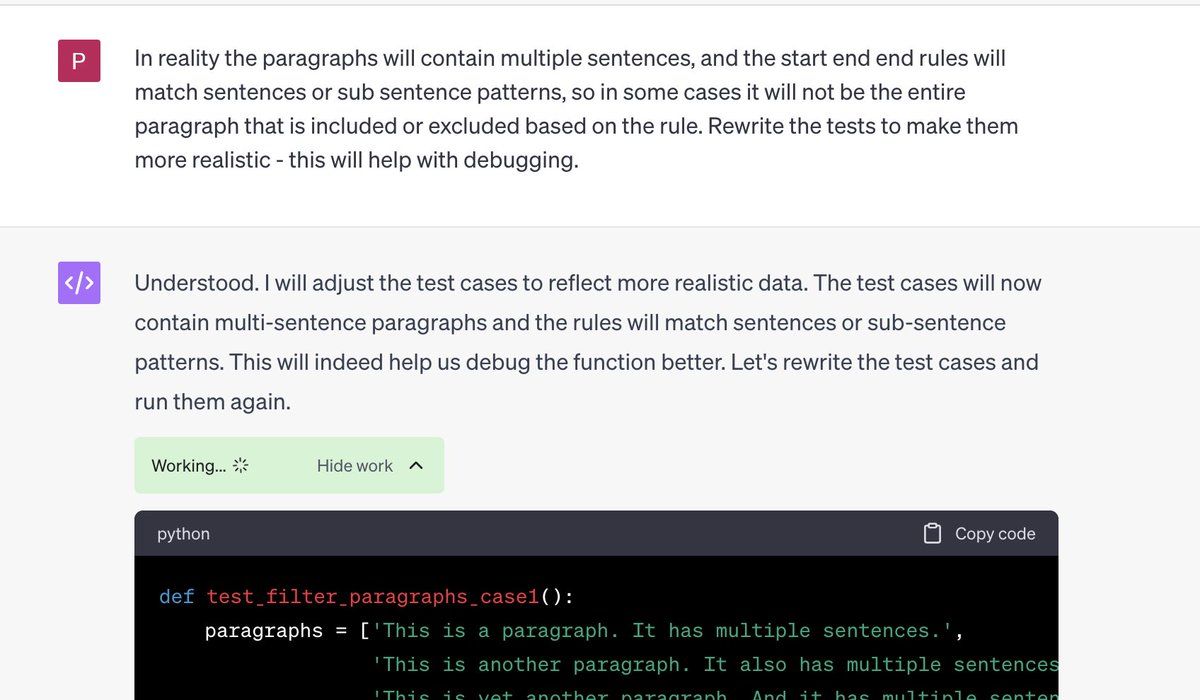
I'm programming with Code Interpreter and its 🔥🔥🤯
Much like working with a junior dev, I'm guiding, making suggestions, reviewing. Its writing and running tests faster than I can. Even though its not quite getting it right yet, feels worthwhile persisting.
@waseemhnyc@langchain Start by enabling debug mode and have a look at the timings in console output. No point in worrying about vector store retrieval performance if most of the time is in the 2 LLM calls (which it most likely is).
@Scobleizer All very fascinating! Theres an interesting question at the end of this video - could the LLM figure out your identity from the anonymised transcript? Maybe this could be investigated with some follow up prompts asking the model to predict an identity.