POR ESTO LAS AEROLÍNEAS ODIAN CLAUDE.
Vuelo por 479€.
Yo pagué 159€.
- Sin VPN.
- Sin puntos.
- Sin afiliaciones.
Estos son los 8 prompts que usé para viajar como un pro ↓ ↓
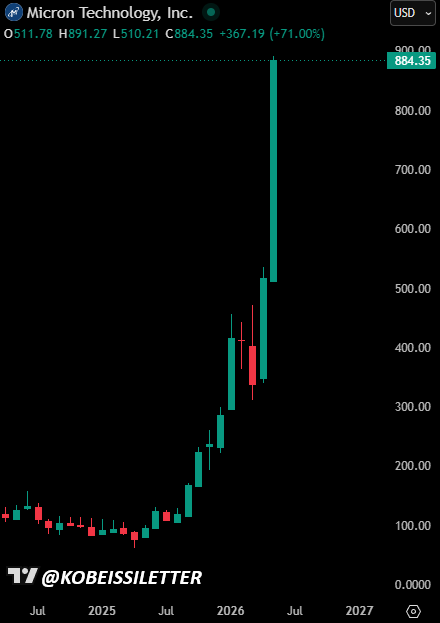
BREAKING: Micron stock, $MU, officially hits $1 trillion in market cap for the first time in history.
12 months ago, this stock was worth just $70 billion.
🚨 DON'T BECOME EXIT LIQUIDITY
SpaceX and OpenAI IPOs are being hyped as the next Amazon in 1997.
But almost nobody sees the massive problem.
Amazon went public at just $438M with huge upside ahead.
SpaceX and OpenAI are already multi-billion mega‑cap monsters.
They've been traded privately for years.
Insiders are sitting on massive paper gains.
But paper gains don't buy yachts.
They need your money to cash out.
Remember Rivian in 2021.
Hyped as the "Next Tesla."
Went public at $150B+ valuation.
Insiders dumped and retail lost over 90%.
The same playbook is repeating right now:
Pump public AI (Nvidia, Microsoft) to historic highs to create maximum FOMO.
Then flood the market with the biggest private tech IPOs in history.
Use retail euphoria as an exit door for new IPOs, while bleeding the current AI giants for cash.
This won't be the start of a new bull run.
This is the grand finale of the AI cash-out.
Retail will buy the top.
Insiders lock in 100x gains and step aside.
Don’t be their exit liquidity.
Remember, I've called every major turn for the last 10 years, including the exact $16K bottom three years ago and the $111K top in October.
Turn on notifications. When the data shows the dumping is over, I'll call the real bottom here.
🚨 URGENT: Claude can now run your social media on autopilot — like a $600/hour community manager.
For free.
Here are 7 powerful Claude prompts to try 👇
Bugün Claude öğrenmek, 2017’de Bitcoin almak gibi.
Çoğu insan bunun ne demek olduğunu çok geç anlayacak.
Sıfırdan her ay 5.000$ para kazanmak.. aslında sandığından kadar zor değil.
ve 2026’da seni %99’un önüne geçirecek 7 prompt var:
INSTEAD OF WATCHING NETFLIX TONIGHT.
Spend 1 hour with this.
Claude AI FULL COURSE that teaches you how to BUILD and AUTOMATE anything.
The people who watch this tonight will wake up tomorrow with a new skill.
Watch it and Bookmark it now.
🚨 ÚLTIMA HORA: La IA ya puede montarte un negocio en 24 horas.
Sí, leíste bien.
Aquí tienes 8 prompts brutales para usar con Claude y convertir cualquier idea en ingresos en 2026 👇
(Guárdalo antes de que tu competencia lo vea)
One AI Supercycle -
10 Layers. 10 Tickers.
Layer 1 — Power | $BE
A single AI data center can consume 100–500MW. The US grid wasn’t built for this. Bloom Energy sits at the intersection of distributed power generation and the insatiable energy appetite of hyperscalers. Power is the foundational constraint — before chips, before cooling, before anything else.
Layer 2 — Substrates | $AXTI
InP (Indium Phosphide) and GaAs (Gallium Arsenide) wafers are the raw material for photonic components — lasers, modulators, detectors. AXT Inc supplies these specialty substrates to the photonics supply chain. Demand is structurally rising as Co-Packaged Optics (CPO) and 1.6T transceivers scale. Tight supply, long qualification cycles, few alternatives.
Layer 3 — Chips | $NVDA
H100. H200. Blackwell. Each generation widens the moat rather than narrowing it. CUDA lock-in is one of the deepest competitive advantages in tech history. $NVDA isn’t just a chipmaker — it’s the operating system of the AI era.
Layer 4 — Memory | $MU
HBM3E (High Bandwidth Memory) is the bandwidth interface between the GPU and data. Without it, the most powerful chips in the world are throttled. Micron is one of only three companies globally that can produce HBM at scale — alongside SK Hynix and Samsung. Supply is tight. ASPs are rising. The AI upgrade cycle is a multi-year HBM demand wave.
Layer 5 — Photonics | $AAOI
As data centers scale from 400G to 800G to 1.6T optical speeds, the components inside transceivers — lasers, modulators, detectors — face an exponential demand surge. Applied Optoelectronics is a pure-play photonics manufacturer benefiting directly from this cycle. Margin expansion + volume ramp = a powerful setup.
Layer 6 — Optics | $LITE
If photonics makes the components, optics assembles them into the interconnect.
Lumentum is a leader in optical networking — coherent transceivers, 3D sensing, EML lasers. The 800G → 1.6T transition is a hardware replacement cycle that touches every hyperscaler and co-lo data center globally. This isn’t incremental demand. It’s a full network overhaul.
Layer 7 — Cooling | $VRT
Vertiv designs and manufactures liquid cooling, immersion systems, and thermal management infrastructure for high-density AI racks. As GPU power density climbs past 1kW per chip, traditional air cooling fails. Vertiv is already embedded with the largest hyperscalers. Backlog is growing. Lead times are extending.
Layer 8 — Networking | $ANET
Arista Networks builds the high-speed Ethernet switching fabric that connects thousands of GPUs inside AI training clusters. Their software-defined architecture and 400G/800G switching platforms are designed for exactly the traffic patterns AI workloads generate. AI networking is a separate, incremental growth vector on top of their already dominant enterprise business.
Layer 9 — Data Centers | $NBIS
Nebius Group is building AI-native data centers — purpose-built for GPU density, liquid cooling, and low-latency networking. Unlike legacy co-los retrofitting old facilities, Nebius is starting from scratch for the AI era. Backed by Yandex’s original infrastructure DNA, they’re scaling fast in a market where capacity is chronically constrained.
Layer 10 — Hyperscalers | $GOOG
Google has committed $75B in capex for 2025 alone. Their TPU buildout, data center expansion, and AI product integration (Gemini, Search, Cloud) make them both a consumer and a builder across the stack. Every dollar they spend flows down through layers 1–9.
The AI supercycle isn’t a software story — it’s a physical infrastructure buildout that rivals the railroad era. Every layer of this stack is capacity-constrained, capital-intensive, and structurally undersupplied relative to where demand is heading. Most investors own one or two names at the top of the stack. The opportunity is in understanding all 10 layers — and sizing accordingly.
Not financial advice .
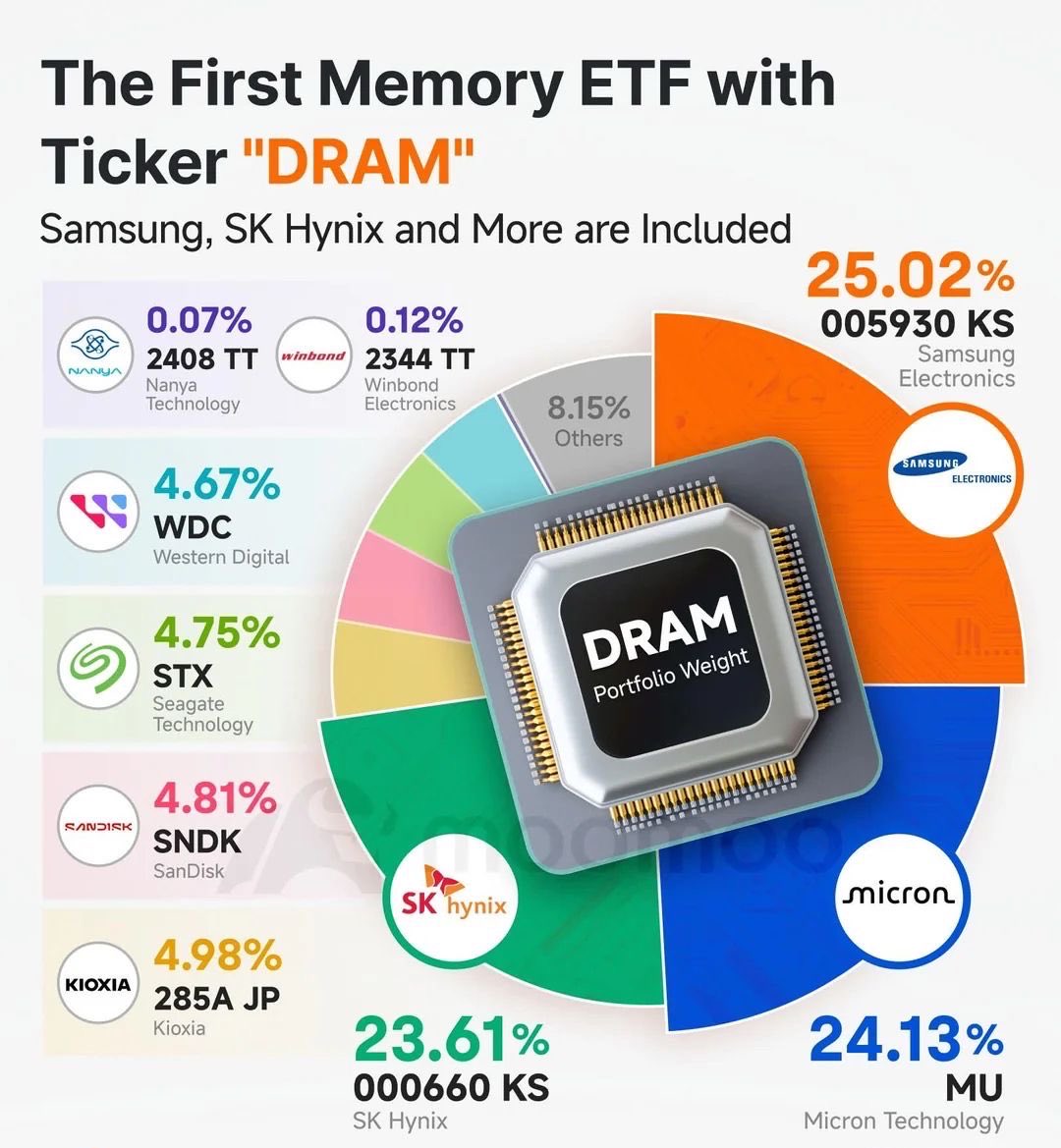
The first Memory ETF just dropped — $DRAM
Top holdings:
→ Samsung Electronics — 25.02%
→ $MU Micron Technology — 24.13%
→ SK Hynix — 23.61%
→ Kioxia — 4.98%
→ $SNDK SanDisk — 4.81%
→ $STX Seagate — 4.75%
→ $WDC Western Digital — 4.67%
The AI memory arms race now has its own ETF
HBM demand isn’t slowing down. Memory is the bottleneck. $DRAM gives you a basket of every major player in the space.
This is absolutely CRAZY.
Leopold Aschenbrenner turned $250 Million into $1.48 Billion on SanDisk in 8 months.
The same Leopold who worked at SBF's FTX Future Fund before its collapse, and was later fired by OpenAI in 2024 after raising internal security concerns.
His hedge fund Situational Awareness LP first bought SanDisk in September 2025 at around $112 per share. By Q4 he had over $250 Million in the stock.
Today SanDisk trades around $1,406, up more than 700% in 8 months.
His next positions will be disclosed in 7 days.
ADIÓS, ANALISTAS. ADIÓS, WALL STREET.
Se acabaron las suscripciones de 99 $/mes.
ChatGPT acaba de convertir mi portátil en un escáner bursátil en tiempo real.
Aquí tienes 10 prompts para hacerlo tú mismo ↓
Meet the 22 year old guy with no investing experience who got fired from OpenAI, wrote 165 pages predicting the future, and used it to build a $5.5 BILLION portfolio. His previous employer was Sam Bankman-Fried.
Leopold Aschenbrenner was born in Germany around 2001. Both parents were doctors. He enrolled at Columbia University at 15 and graduated as valedictorian at 19. Economist Tyler Cowen called him a prodigy.
He co-founded Columbia’s Effective Altruism chapter. That network led him to the FTX Future Fund, a philanthropic initiative funded by Sam Bankman-Fried’s cryptocurrency exchange. He resigned before FTX collapsed. There is no evidence he knew the money was stolen.
In 2023, he joined OpenAI’s Superalignment team, working under Ilya Sutskever on the problem of controlling AI systems smarter than humans. After a hacker breached OpenAI’s internal messaging system, Aschenbrenner wrote a memo to the board arguing the company’s security was insufficient to prevent theft of model weights by China.
He received a warning from human resources. In April 2024, OpenAI fired him. He said he was told explicitly that the security memo was the real reason.
One month later, the Superalignment team was dissolved. Sutskever left.
Two months after being fired, Aschenbrenner published “Situational Awareness: The Decade Ahead.” 165 pages. It predicted AGI by 2027. Ivanka Trump praised it publicly. The University of Rochester made it required reading.
“Everyone is now talking about AI,” he wrote, “but few have the faintest glimmer of what is about to hit them.”
In September 2024, he launched a hedge fund named after the essay. He reportedly put in nearly all of his personal net worth. Patrick and John Collison of Stripe backed it. So did former GitHub CEO Nat Friedman. Investors agreed to lock up their capital for years.
The thesis was one sentence. AI labs need power, compute, storage, and bandwidth. Nobody was buying the companies that supplied them.
He bought Bloom Energy. Fuel cells for data centres. Lumentum. Optical components that move data between chips. Call options on CoreWeave, a GPU cloud company most investors had never heard of. Core Scientific, a Bitcoin miner pivoting to AI hosting. IREN. Riot Platforms. Hut 8. 20.2 MILLION call options on Intel, a chipmaker Wall Street had written off.
Top 10 positions accounted for 86% of the portfolio. No venture capital. All public markets.
In the first half of 2025, the fund returned 47% after fees. The S&P 500 returned 6%.
By December 2025, the fund’s 13F filing disclosed $5.52 BILLION in U.S. equity and options positions across 29 holdings. Actual assets under management were estimated at $1.5 BILLION. The rest was leverage. Options-heavy, concentrated, thesis-dependent leverage on a single prediction.
He is engaged to Avital Balwit, the chief of staff to the CEO of Anthropic, OpenAI’s largest competitor. In 2024 she wrote that the next five years might be the last years she works. Her fiance built a fund on the same belief.
The career so far: valedictorian at 19, a job at a charity funded with stolen money, a safety team that no longer exists, a firing, a 165-page prediction, and $5.5 BILLION in leveraged bets that it all comes true by 2027. He has been right about everything so far except the places he chose to work.
A 25 year old just turned $225 million into $5.5 billion in 12 months.
Here’s exactly what he bought.
Leopold Aschenbrenner got fired from OpenAI in April 2024.
He spent the next few months writing a 165-page thesis predicting AGI by 2027.
Then he launched a fund and put his money where his thesis was.
He bought zero Nvidia. Zero Microsoft. Zero Google. Zero Amazon.
He bought what AI actually runs on.
Bloom Energy (BE), power infrastructure for data centers. Up 1,422% in one year.
Lumentum (LITE), optical components that move data between chips. Up 1,331%.
Sandisk (SNDK), storage. Up 3,130%.
CoreWeave (CRWV), GPU cloud infrastructure. Up 166%.
Iris Energy (IREN), AI computing and data centers. Up 583%.
The thesis was simple: every AI company needs energy, bandwidth, storage, and compute.
Nobody was buying those. Everyone was buying the AI companies themselves.
He was right.
His fund now manages $6 billion. Backed by Patrick and John Collison of Stripe and former GitHub CEO Nat Friedman.
I’m adding this to my watchlist.
Every time he files a new 13F, we will break it down here.
Turn on notifications so you don’t miss the alert, this is VERY important.
Many people will wish they followed us sooner.