Most developer experiences begin with friction:
Install this. Configure that. Read the docs.
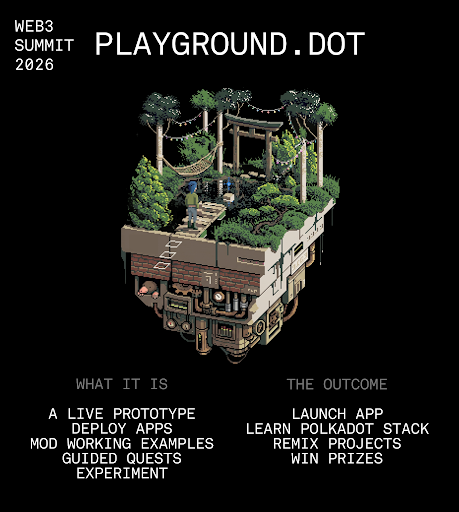
At Web3 Summit 2026, Playground . dot starts differently.
Start with a working app. Modify it. Experiment. Deploy your own version in ~30 mins.
Decentralized hosting. Data. Domains. Private accounts by default.
Parity engineers will be on hand to guide and help, but the idea is that even a total novice could deploy a fully decentralized app.
Build. Deploy. Vote. Climb the leaderboard.
Bulletin Chain is a specialized storage chain in the Polkadot ecosystem.
Data is submitted via authorized extrinsics, indexed with Blake2b-256 hashes, and retrievable by content hash from IPFS or directly from the node.
Storage expires after the retention period. Renew it if you need it. Let it go if you don't.
Store static sites, media assets, and application data with built-in availability and censorship resistance.
Not everything needs to live on-chain forever.
Full nodes verify every state transition and store the entire chain history. That's significant overhead for most applications.
Polkadot's light clients verify state using only cryptographic proofs and block headers.
A mobile wallet built with PAPI and smoldot verifies account state through Merkle proofs against block headers. Verification happens inside the app itself. No third-party node. No infrastructure to run or trust.
• Works across multiple chains simultaneously.
• Runs inside the application itself.
• Minimizes trust by default.
Secure blockchain access without the overhead.
There are rooms where the conversation moves faster than anywhere else. The Louvre salon at @ProofofTalk is one of them.
Tomorrow, Parity's VP of Engineering @pierreaubert sits down with @ChiZhangData, @provenauthority, and @StuartHaber to ask the hard questions:
How do we prove who is actually behind every interaction when AI agents start acting, transacting, and communicating on behalf of people?
Personhood, Provenance, and Verification in the Agentic Age.
PANEL ANNOUNCEMENT: When AI agents start acting, transacting, and communicating on behalf of people and institutions, how do we prove who is actually behind every interaction?
Chi Zhang @ChiZhangData (Co-founder & CEO, @GoKiteAI), Evin McMullen @provenauthority (Co-Founder & CEO, @billions_ntwk), Pierre Aubert @pierreaubert (VP of Engineering, @paritytech), and Stuart Haber @StuartHaber (Chief Cryptographic Officer, @SuremarkDigital) sit down for a talk with Mohamed Ezeldin @Mo_Ezz14 (VP & Head of Animoca Labs, @animocabrands) discussing:
Personhood, Provenance, and Verification in the Agentic Age.
Drawing from their experience, they will discuss how decentralised identity systems can prove someone is human, eligible, or trustworthy without exposing their full identity or relying on Web2 gatekeepers.
Challenge! They will have to name 1 under-discussed threat from agentic AI, from synthetic users and bot networks to agent impersonation, credential fraud, and the collapse of trust online.
Be in the room.
https://t.co/ol4EWRsimW
In 2014, Gavin Wood wrote the blueprint for a web where people own their digital lives. Not platforms. Not governments. People.
Parts of the space lost sight of that.
This June, Parity CEO @gavofyork returns to Web3 Summit to share his vision for the next decade of a free internet.
See you in Berlin.
https://t.co/ukFpLffWVD
Pierre Aubert, our VP of Engineering (@pierreaubert), is speaking at @proofoftalk this June.
Taking place at the magical Louvre, Paris, where 2,500 leaders will convene. There are no ‘pay to speak’ ops at Proof of Talk; every voice in that room earned its place.
Pierre has spent his career building systems that actually work at CERN, Google, and now Parity. The focus now is on turning blockchain infra into something people can use without complexity.
If you're lucky enough to have secured your ticket, make sure not to miss this one.
https://t.co/sTeq8ZgLYW
PANEL ANNOUNCEMENT: When AI agents start acting, transacting, and communicating on behalf of people and institutions, how do we prove who is actually behind every interaction?
Chi Zhang @ChiZhangData (Co-founder & CEO, @GoKiteAI), Evin McMullen @provenauthority (Co-Founder & CEO, @billions_ntwk), Pierre Aubert @pierreaubert (VP of Engineering, @paritytech), and Stuart Haber @StuartHaber (Chief Cryptographic Officer, @SuremarkDigital) sit down for a talk with Mohamed Ezeldin @Mo_Ezz14 (VP & Head of Animoca Labs, @animocabrands) discussing:
Personhood, Provenance, and Verification in the Agentic Age.
Drawing from their experience, they will discuss how decentralised identity systems can prove someone is human, eligible, or trustworthy without exposing their full identity or relying on Web2 gatekeepers.
Challenge! They will have to name 1 under-discussed threat from agentic AI, from synthetic users and bot networks to agent impersonation, credential fraud, and the collapse of trust online.
Be in the room.
https://t.co/ol4EWRsimW
Most blockchains ask validators to see everything.
ELVES changes that.
The research team at @Web3foundation built ELVES so that a random subset of validators can verify each block, rather than the full set, unless needed. Each validator does less work, but the network as a whole does more.
Smaller validation surface.
More throughput per set.
Same security. Higher throughput.
The result is a system that scales without asking every validator to carry the full load.
Probabilistic systems never quite finalize a block, and that gap is exploitable.
Actors monitor chains for reorgs. They replay states speculatively and extract information from the space between "probably final" and "actually final."
GRANDPA closes that space.
@Polkadot finalizes blocks in seconds, reducing ambiguity and exposure.
You’ve heard it for years:
“If you’re not paying, you’re the product.”
But what if the true cost of the internet was far higher than anyone realized?
New research from Web3 Foundation suggests Big Tech and AI companies may extract up to $162,492 in lifetime value from each internet user. 🧵
Everyone says decentralization matters. Few explain why.
Our research team's latest blog dives into the trade-offs, challenges, opportunities, and more, so you can learn what decentralization is beyond the buzzwords and what it does from the people working on it every day.
🔗 https://t.co/mL2KsbR4bF
Full nodes download everything, which comes at a cost.
Polkadot's light clients verify state using cryptographic proofs and block headers alone. They don't replicate global state or process data outside their scope.
☑️ Query only what you need.
☑️ Verify responses against block headers, not the full chain state.
☑️ Download less. Process less.
Participation doesn't require downloading the entire chain, which opens the door for resource-constrained environments, mobile applications, and other use cases that need secure blockchain access without running a full node.
12 hours of fuzzing. ~740k blocks tested.
Most of the errors in the logs are intentional. The fuzzer is checking whether the client correctly rejects invalid blocks.
Stage 2 of 5 for @jam_brains, the voluntary JAM implementer team at Parity, working through the hard parts in public.
👏 @bkchr
Fuzzing our client since 12 hours now for about 740k blocks 💪
There are many errors in the logs, which indicates that the fuzzer is testing whether our client is correctly rejecting invalid blocks.
But this is just the second of five stages, and we need to pass all of them 🤞
JAM Implementer Teams - the automated fuzzer to test JAM implementations is now accessible here: https://t.co/FtwdMKPzsc
Please note that you will need to register and be approved, and need ~ 0.5 DOT to use it. Also please note that this is only for JAM implementer teams.
If all is successful, you can attest on-chain and then set up an interview with the Polkadot Technical Fellowship.
See the "Let's JAM" channel on Matrix ( #jam:https://t.co/5wtOqhdkd9 ) for more details.
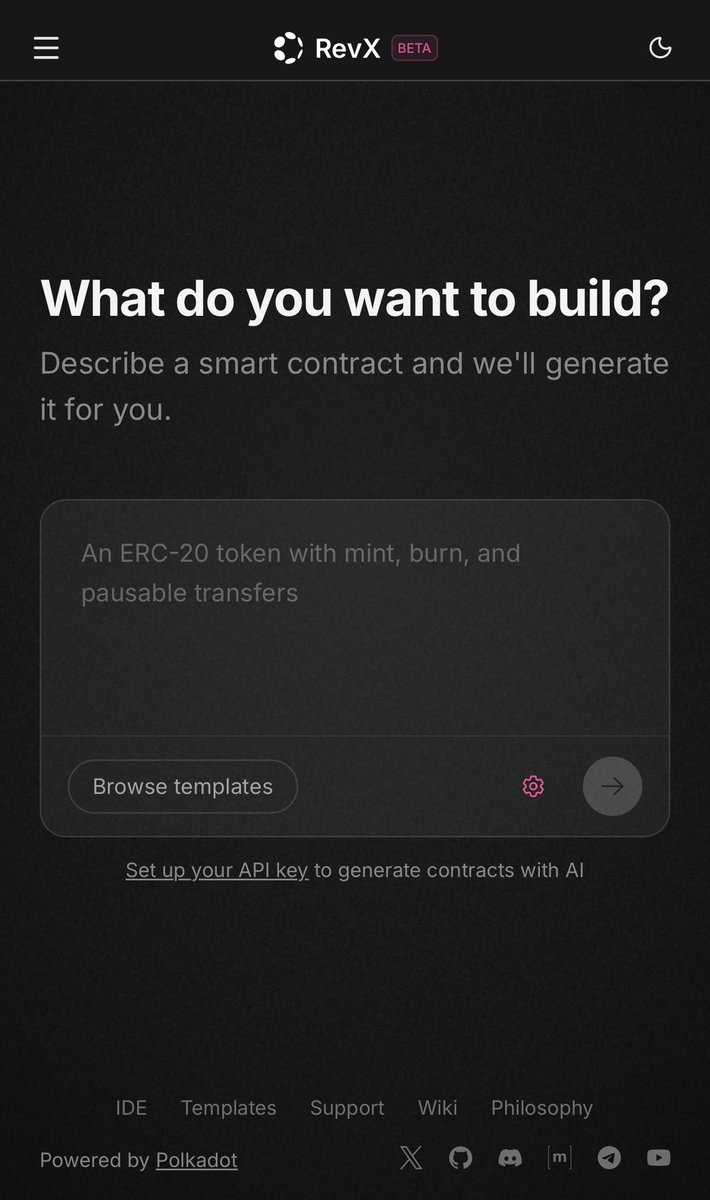
1- One of the biggest lessons from building RevX has been this: Don’t wait for perfect. Ship the smallest thing that works, get it into real users’ hands, and learn fast.
Cargo is live on Mainnet!
Full Linux containers, running on Android core smartphones globally. The biggest upgrade to Acurast since the TGE launch in January.
As a developer you now get:
-Language freedom
-A VPS-like developer experience
-Instant access to the Linux ecosystem
Anything you'd run on a traditional cloud, you can now deploy on Acurast.
Same workflow. Very different trust model.
Example App Deployment:
https://t.co/g3MX6twYtj
Full environment Documentation
https://t.co/8GsJSzQO7c
One way to measure decentralization and why you should care.
A Nakamoto coefficient of 178 means it would take 178 independent validators to collude to disrupt consensus. For comparison, many chains sit in low or single digits.
Decentralization isn't something a network can just claim. It's something you can measure and demand proof of.