🚨Publication🚨 I am thrilled this paper found a home at the Journal of Population Econ. I find banning female genital cutting decreases women's education and increases the prob of early marriage. The edu decrease dissipates following the free primary edu https://t.co/71KBKSCISC
This podcast covers Lakshmi and my recent article in the Journal of Development Economics. This paper examines the long-run economic effects of colonial rule in India. We conclude that targeted public policy can counteract the negative effects of colonialism.
New @ecb Working Paper by R. A. De Santis & D. Cardamone “Understanding the inflation–output relationship across business cycle phases” https://t.co/bkSu8U2wG8
New @nberpubs working paper from our colleague Robert Johnson and graduate student Mitchell Boice (plus Emily Blanchard), "Effective Protection with Global Value Chains." Check it out: https://t.co/GQYdjxIdAB
Hier erklärt eine Psychotherapeutin, die ME/CFS Patienten behandelt, dass es keine psychische Erkrankung ist. Es trotzdem so darzustellen ist eine Demütigung. In Anbetracht ihres Leids sind die meisten Opfer resilienter als viele von uns. Lesenswert. https://t.co/ME6ZIfVqs3
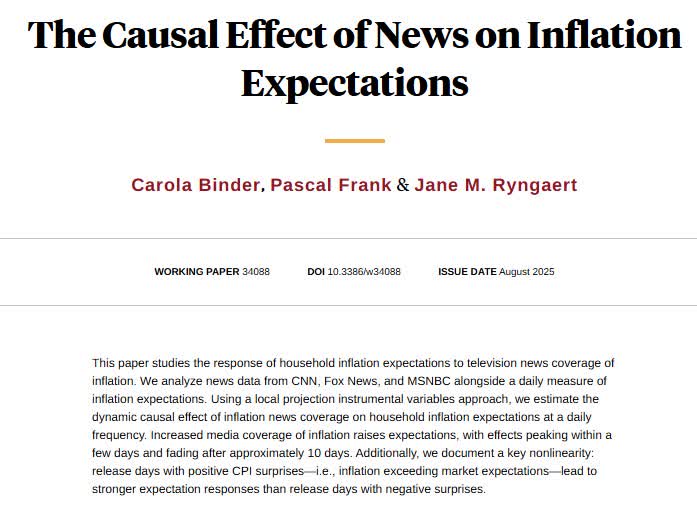
Media coverage of inflation has a significant and asymmetric effect on consumer inflation expectations, from @cconces, @PascalFrank12, and Jane M. Ryngaert https://t.co/ji6ltWWjfX
🚨 New working paper 🚨
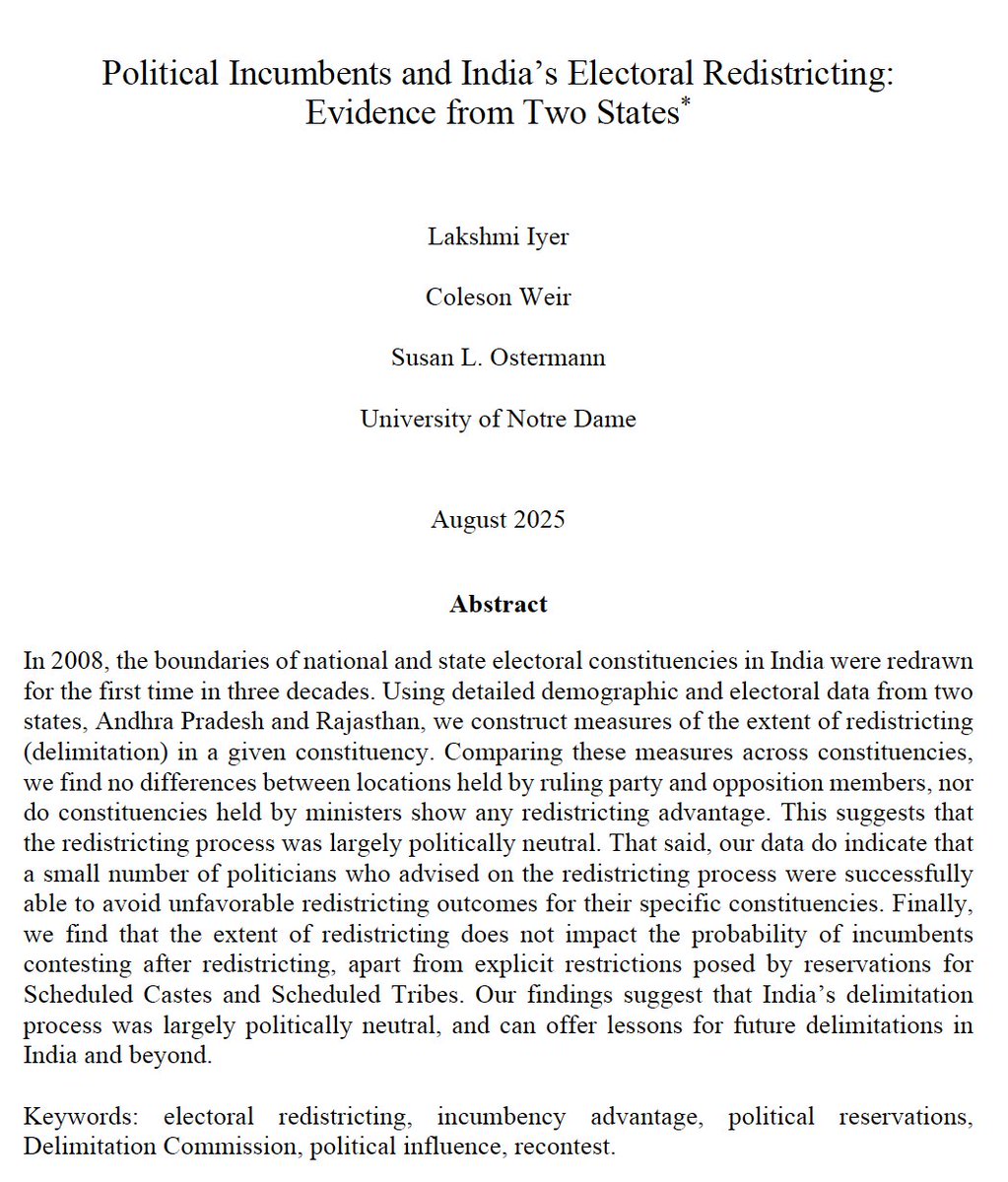
With Lakshmi Iyer (@nd_econ) and Susan Ostermann (@KeoughGlobalND). We examine whether there was political influence in India's redistricting process, and how this affects the probability politicians recontest their seat 1/4
Link: https://t.co/0gXoMUTRAj
Our colleague Jane Ryngaert has a new working paper, "The Causal Effect of News on Inflation Expectations," joint with our graduate student Pascal Frank (@PascalFrank12) and Carola Binder (@cconces). Check it out: https://t.co/sEBl3uG9lj
Thrilled our paper "The Colonial Legacy in India: How Persistent are the Effects of Historical Institutions?" is forthcoming at the JDE. We examine how historical institutions continue to shape development today. Colonial legacies can dissipate through targeted public policy. 1/6
New research by Lakshmi Iyer & Coleson Weir explores the persistence of colonial-era disparities in India, finding that some have faded while others remain, highlighting the impact of targeted policies. Journal of Development Economics: https://t.co/00bcDNrsJ3
A thread on the state of macroeconomics, based on https://t.co/WBc3ctD2Dy
Macroeconomics is the subject of many criticisms. From the journalists, that macroeconomists are not good at predicting the future, or that macroeconomists too often disagree. From other economists, that modern macroeconomic models are heavy on techniques, unwieldy and ugly.
My own view is more positive.
To get some of the criticisms out of the way: Not being able to predict the future is due to the nature of the beast. To take the usual example: Movements in the stock market are and should be mostly unpredictable. That macroeconomists disagree: This is largely due to the complexity of the world, and to free entry in the macroeconomic pontification business. That the models are heavy on techniques: There is nothing wrong with techniques, so long as they help understand complex phenomena.
I would argue that, in fact, over the last 50 years, macroeconomics has made much progress, and can at last be considered a mature field. The definition of a mature field is a field in which most researchers agree on a core view of the economy, explore various extensions, but do so within a common intellectual framework. I believe that, after five decades of fights and tensions, convergence has largely taken place, we are close to being there.
I see the core as based on two principles. In terms of methods. That, to the extent possible, behavior should be derived from micro foundations. Being understood not as strict adherence to neoclassical postulates, but allowing for example for behavioral deviations from it, be it for the formation of expectations, or the motives for saving. Then, in terms of content. That there is a number of distortions essential to understanding macroeconomic fluctuations, one of them being nominal rigidities and the implied effect on the role of demand in those fluctuations.
This general view has come to be known as the New Keynesian approach. The analytical core is a set of three equations, known as the New Keynesian model, characterizing the behavior of demand, the behavior of inflation, and the role of monetary policy. This core has played a central role in redefining monetary policy. The extensions are nearly infinite, from the implications of heterogeneity in incomplete markets, to the relevance of liquidity constraints, to the importance of myopia, to search and matching models of the labor market. These models have been used to analyse the global financial crisis, the pandemic inflation, the Greek debt crisis, etc. They are sometimes heavy, sometimes too much of a black box, but they have proven useful in thinking about the nature and the effects of the shocks, and the role of policy.
Not everything is perfect, and the linked paper lists my reservations. But, on net, I believe the field is in good shape.
Libertäre die sagen Deutschland sei ein unfreier Unterdrückerstaat, sind wie 200 Kg schwere Fans die zum Fernseher brüllen, dass Joshua Kimmich kein Fußball könne.
Keine #Wahlunterlagen bei mir in London angekommen!
Bei der #Bundestagswahl können viele Deutsche im Ausland ihr Wahlrecht nicht ausüben. Fristen wurden zu knapp kalkuliert, die Verfahren sind zu bürokratisch. Eine Reform ist dringend notwendig.
@Wahlleitung_de
In my speech “R(ising) star?” at the #ECBwatchers’ conference, I ask whether the recent measurable rise in real interest rates is a sign that rates will remain higher, or whether they are likely to return to the lows seen in the pre-pandemic era. 1/20
Germany isn't facing a debt crisis, but a crazy budget crisis triggered by the ruling of our constitutional court. Here's a🧵what this is all about.
In the media you read about 60 bn unused "Corona debts" shifted to a climate fund. But actually, the issue runs much deeper. /1
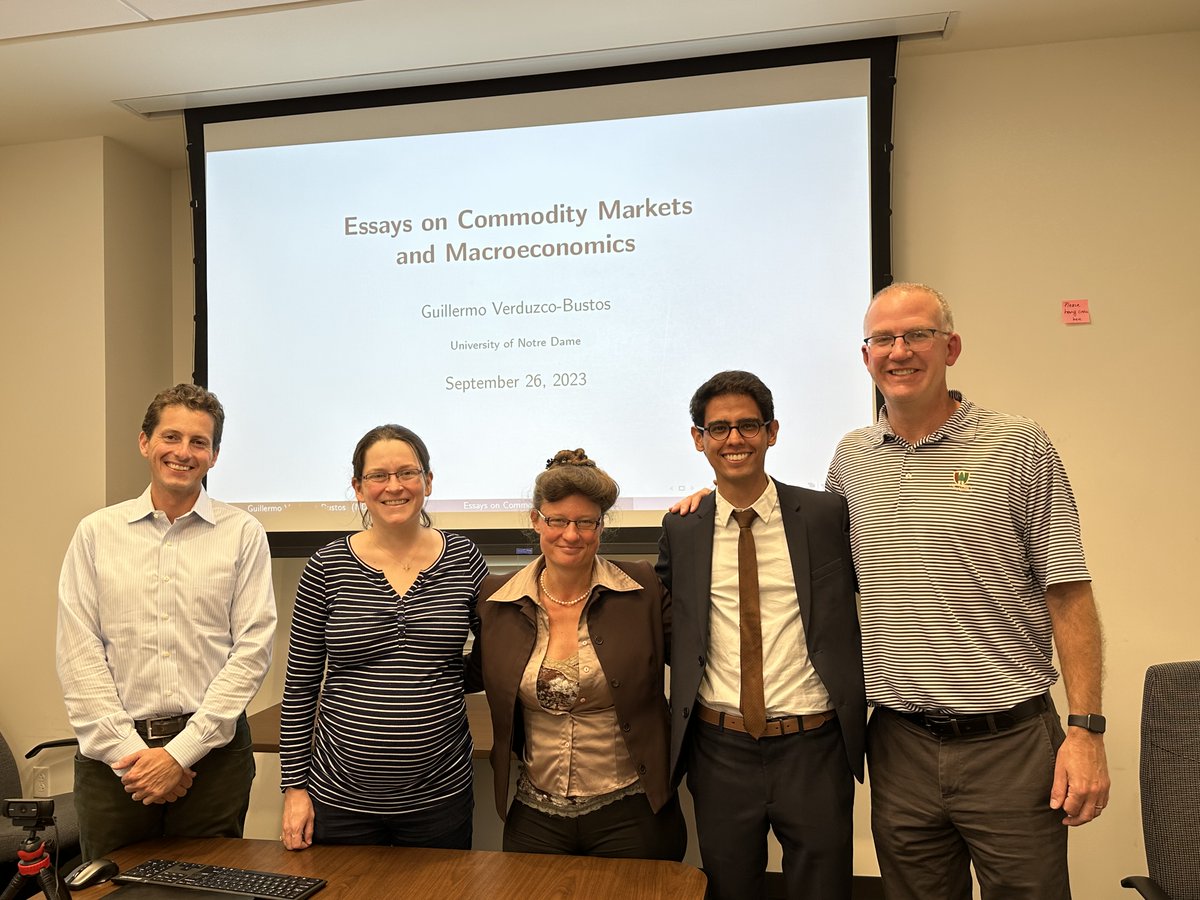
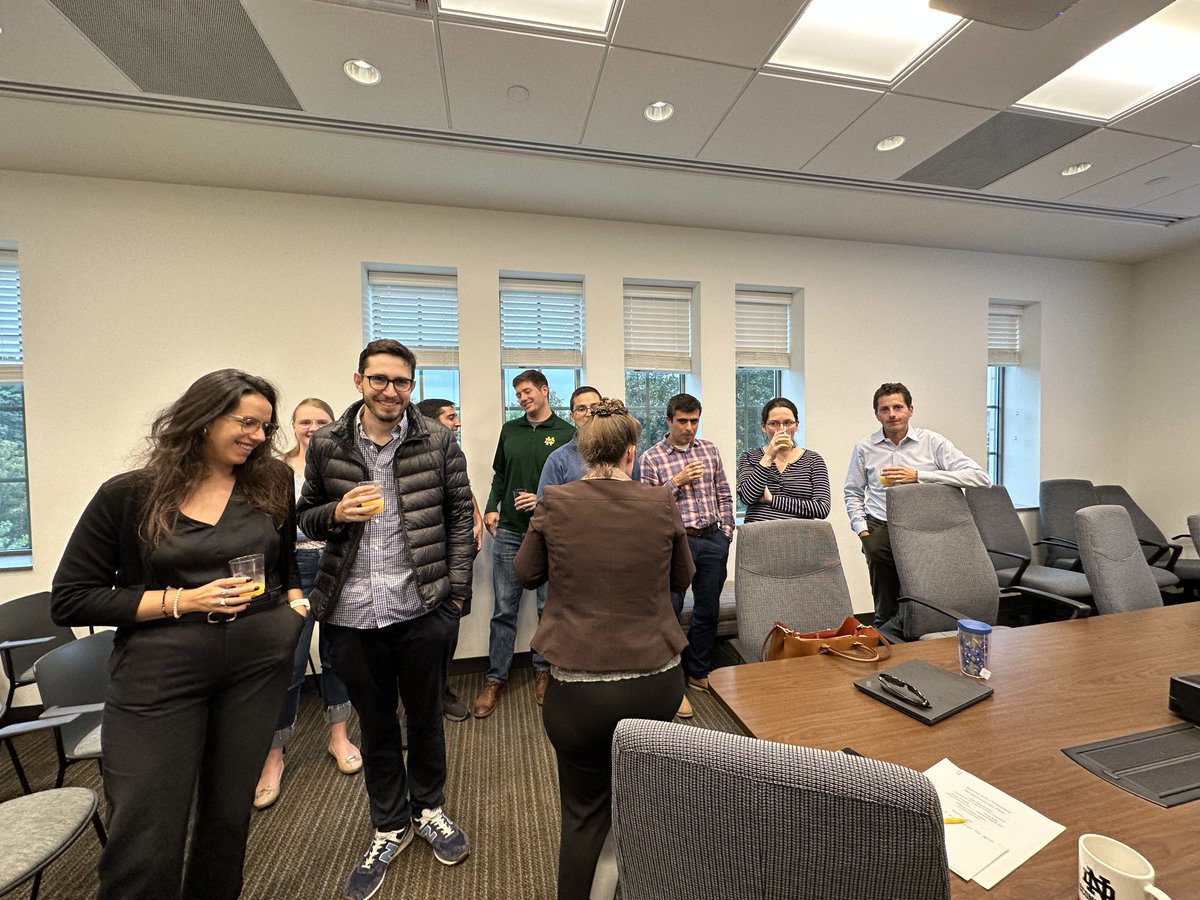
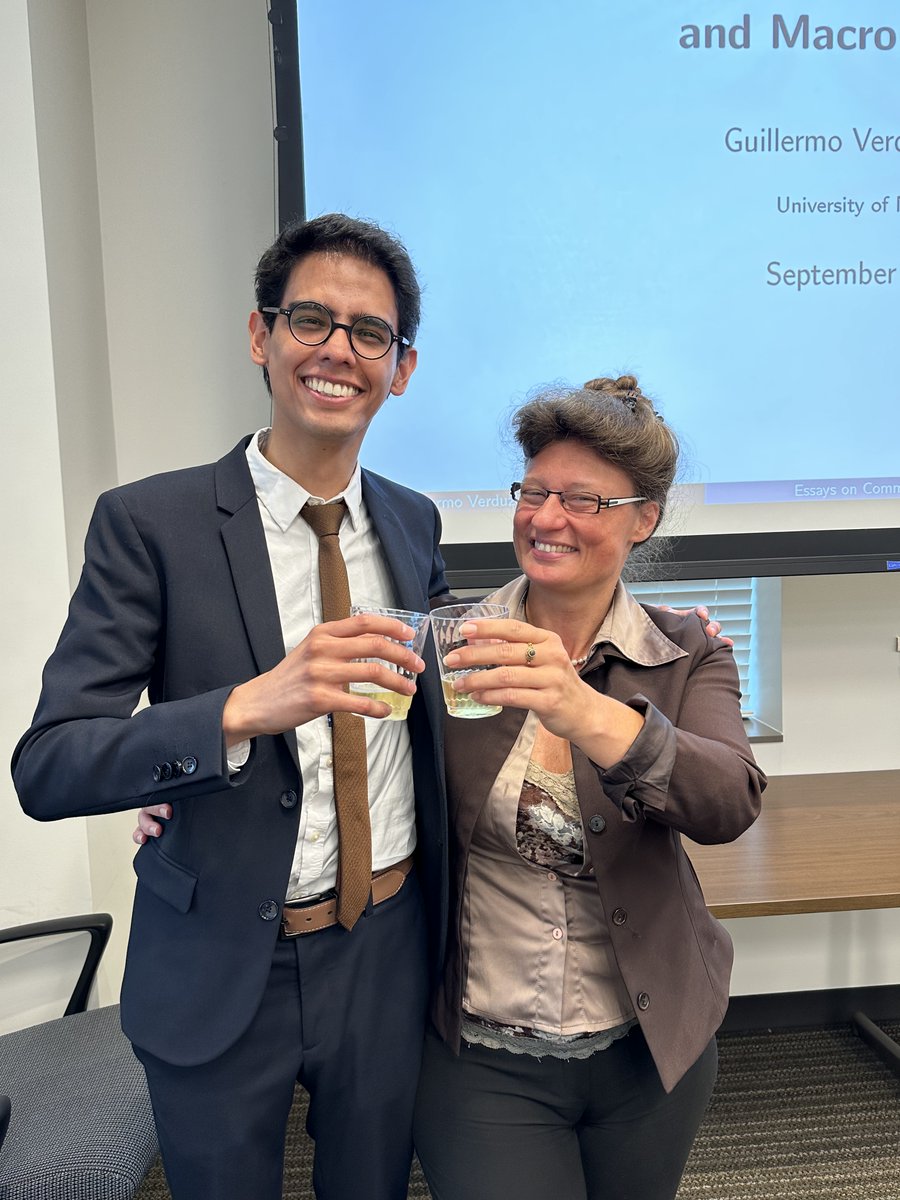
Congratulations to fifth-year student Guillermo Verduzco-Bustos, who successfully defended his dissertation yesterday. He will be starting a job at the World Bank (@WorldBank) next week. Some pictures from his dissertation celebration: